

Last Updated on 19 January 2026 by Cycloscope
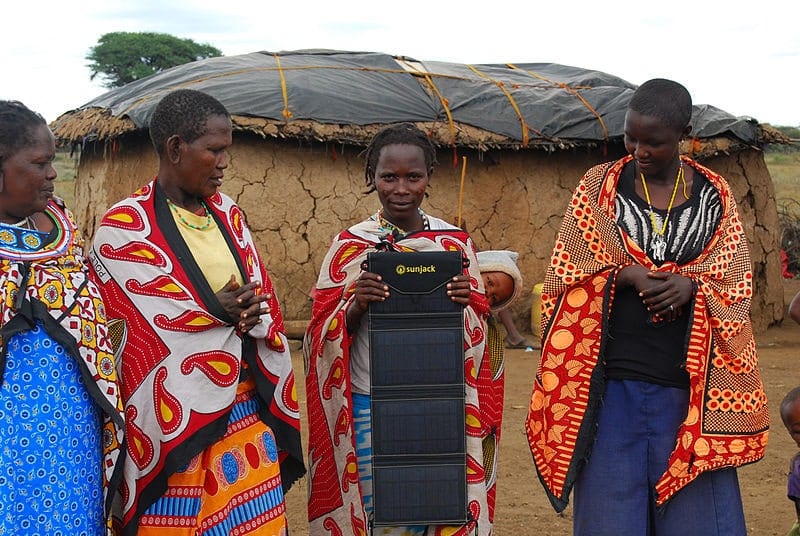
8 Best Bikepacking Solar Panels – Ultralight camping solar chargers for bike touring and cycling adventures + solar power banks for phones, tablets, laptops, cams, and more!
Keeping your phone, laptop, and electronics charged while bikepacking or bike touring in remote areas can be a challenge.
Disclosure: Some of our articles contain affiliate links. This comes at no additional cost for you and helps us keep this website up and running. (as Amazon Associates we earn commission from qualifying purchases)
How we compile our gear guides: during the almost 10 years of cycloscope.net our team personally tested dozens of similar pieces of gear. For what we can't test personally, we involve other people in the cycling community to give their feedback and opinion about gear they have used. Our decade-long experience in bicycle touring enables us to find the key cons and pros of every product we mention.

The best solar chargers for bikepacking or cycling are the same panels and battery sets as those for backpacking; the needs of hikers and cycle tourers are alike, but choosing the best camping solar panel and power bank for your needs requires a fair bit of research.
We did it for you, comparing the specs of cheap, budget, and more expensive solar panels and batteries to help you choose what to buy.
Let’s try to understand a bit about how solar chargers work, but first of all, for those in a hurry, a quick list of the best solar panel chargers for bike touring.
Best bikepacking solar panels in a nutshell
- Goal Zero Nomad 10
- Anker Solix PS30
- Editor’s choice for the best cycle touring solar charger
- Biolite Solar Panel 10+ 2.0
- Nekteck 28W Solar Charger
- X-DRAGON 40W
- Best Budget Bikepacking Solar Charger for Laptops
- LuminAID PackLite Titan
- SunJack 15W Solar Charger + 10,000mAh Power Bank
- Hiluckey Outdoor 15W
- best compact solar panel + power bank
- Voltaic Systems Arc 20W + 19,000mA Power Bank
- Best Heavy-Duty Bike Touring Solar Charger for Laptops
8 Best Solar Panel Chargers for Bikepacking, Cycle-Touring, Backpacking – Compared!
1. Goal Zero Nomad 10

Probably the most famous bikepacking solar charger brand, GoalZero panels are a little pricey but very efficient.
The new Nomad comes in three versions: the ultralight (350g) and compact Nomad 5 (5 Watts), the efficient Nomad 10, and the larger Nomad 20 (20 Watts).
The NOMAD 10 has recently been enhanced for an optimal user experience. The redesigned product now features a built-in Flip Power Bank dock, a power-flow indicator, and an adjustable kickstand to keep the panel at the perfect angle, ensuring effortless charging and added stability. Moreover, the integrated USB port enables charging small devices even in sunlight.
The new auto-restart feature tracks power flow history and distinguishes between a device that is fully charged and one that disconnects due to environmental factors such as a lack of sunlight.
If a device is disconnected before it is fully charged, the NOMAD 10 will reconnect and begin charging once the sunlight returns. Ideal for phones, GPS, headlamps, wireless headphones, and all those little tech gadgets for bikepacking.
You can choose between different packages: the solar charger only, with Venture 35 or Venture 75 power banks, or even with the Guide 12 battery pack if you wish to charge AA batteries.
Charges an iPhone 6 from 0 to 100% in 2/3 hours in perfect sunny conditions, and works well even with an overcast sky.
- Dimensions (unfolded): 9.5 x 14.5 x 0.75 in (24.1 x 36.8 x 1.9 cm)
- Dimensions (folded): 9.5 x 7.2 x 1.25 in (24.1 x 18.4 x 3.2 cm)
- Weight: 1.12 lb
- Power: 1.5A 10W 6-7V
2. Anker Solix PS30
Editor’s choice for the best cycle touring solar charger

The Anker Solis PS30 is the new solar charger by the popular brand. The weird decision by Anker to discontinue their best-selling Power Port Lite 15w has left many fans stranded – that was our panel of choice for those on a budget and one of the most popular solar chargers for bicycle touring, bikepacking, camping, and hiking.
This Solis PS30, though, is a fabulous heir, very well suited for those adventurers who like to get as far away in the wilderness as they can. 30W of charging power and a 3A output ensure this little beast can juice up even the neediest of smartphones or tablets.
At half the price of a Goal Zero 20W, Anker maintains its price advantage over competitors while improving the overall quality and durability of its product. All this while still staying slightly under 1kg is quite impressive for a 30W solar charger.
The compact size (10.7 × 8.8 when folded) and elastic loops at each corner make it easy to attach to backpacks, trees, or tents.
The panel is very light, but remember the weight doesn’t include the battery, which you can purchase separately (if you want it).
Charges a 10000mAh power bank in 4 hours (ideal conditions) and, similar to the Goal Zero, resumes charging automatically when sunlight conditions change.
- Dimensions (Folded): 10.7 × 8.8 × 1.7 in
- Dimension (Unfolded): 35.6 × 10.7 × 0.7 in
- Weight: 2.2 lb
- Power: 3A 30W
3. Biolite Solar Panel 10+ 2.0
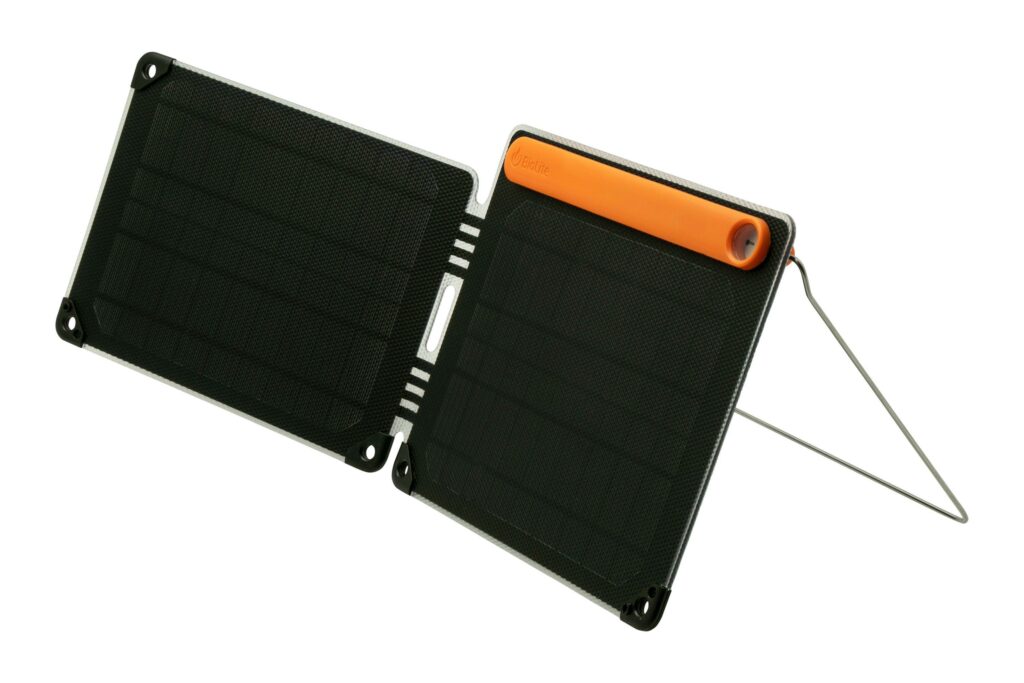
This High-efficiency monocrystalline solar panel comes in two versions: the 10+ (10-watt USB output) and the Biolite 5+ (5 watts). Both are great for charging phones, cameras, and other gear in 1/2 to 3 hours, though a little pricey for the performance.
It comes with a somewhat low-capacity 3,200 mAh integrated rechargeable battery, so your power is available even when the sun goes down, and micro USB Charge Input lets you get a head start on your power by charging the battery at home.
The ultra-slim weather-resistant design and increased efficiency through heat dissipation make it a good all-in-one choice for bicycle tourers and bikepackers.
It also features a charge strength indicator, so you can see the sun’s strength to measure your panel capacity and how much juice you have. The integrated kickstand helps to catch the best sunlight.
The onboard 3,200 mAh rechargeable battery fully charges in 2 hrs in direct sunlight and has been made much lighter in the new 2.0 version.
- Dimensions: 10.1 x 8.2 x 1″
- Weight: 1.8 lb
- Power: 1A 10W
- Battery: 3,200mA
4. Nekteck 28W Solar Charger
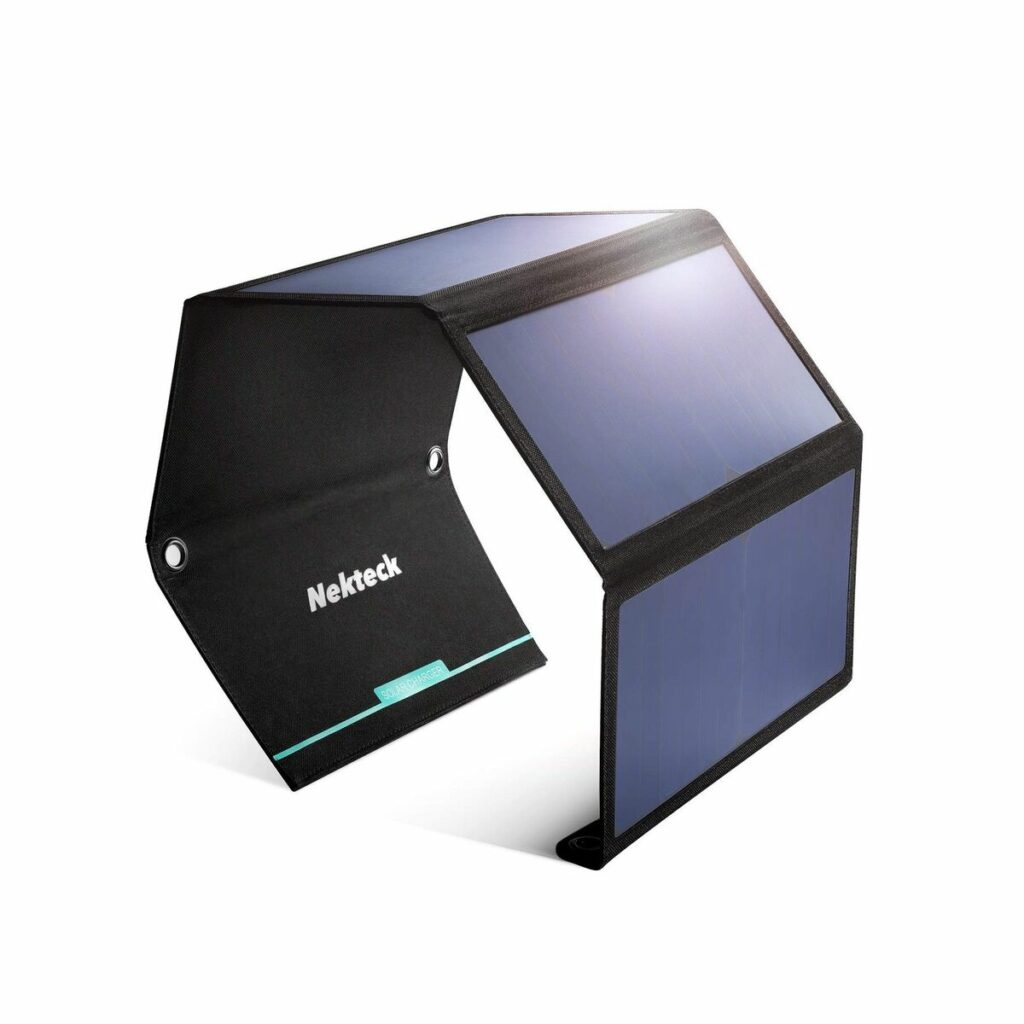
The recently upgraded Nekteck 28W is a cheap but sturdy camping solar charger with a few downsides.
The biggest issue is that the Nekteck has trouble recharging after being shaded intermittently. Some devices might need to be unplugged and then replugged for the charging to resume. This can also damage more sensitive devices, so it’s a good idea to use the Neckteck to charge a power bank, which in turn charges your precious electronics.
Still, this panel is a pretty good choice for those on a budget, it’s ultralight for 28W and its bungee loops help attach it to your bikepacking bags, dual USB charging ports allow up to two devices to recharge at once at a maximum output current of 3 Amps total.
It outputs up to 3A (one USB port is used) and 3A when two USB ports are used simultaneously. In ideal conditions, it can charge an iPhone in about 3 hours.
Dimensions: 6.3x 11.1x 1.06″ folded, 26.3x 11.1″ opened
Weight: 1.1 lb
Power: 2/3A 28W
5. LuminAID PakLite Titan
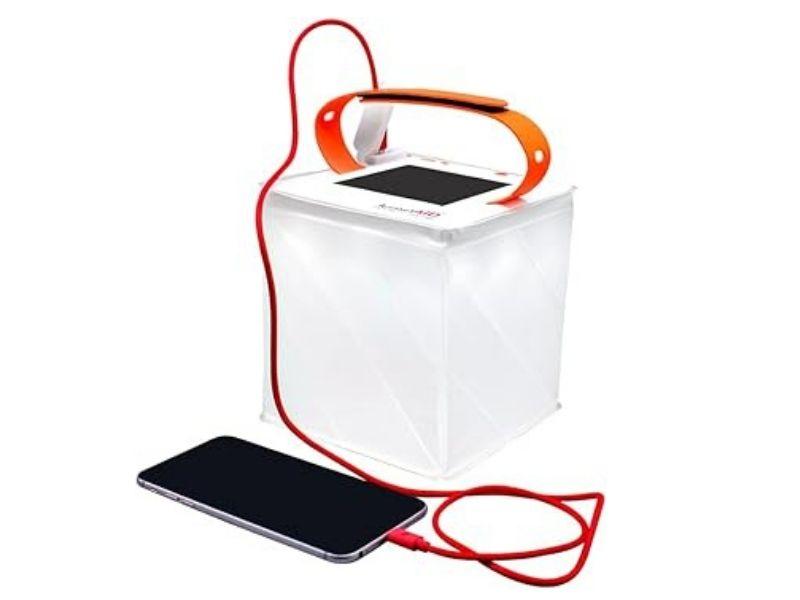
A very compact and lightweight solution, the LuminAID PackLite Titan is a multipurpose device: a camping lamp, solar panel, and power bank.
The relatively low-capacity 4,000 mAh battery fully charges in 16–20 hours of sunlight (or in 4 hours via micro-USB) for 100 hours of total runtime.
This powerful lantern features a 5V USB output, ensuring you stay connected by recharging your phone or tablet up to 1-2 times, taking about 2-4 hours for a full charge.
Not just a charger, this lantern also illuminates your path with its versatile light settings. With a brilliant 300-lumen mode, you’ll have ample brightness to light up your surroundings. Additionally, a new red light mode is thoughtfully integrated, providing enhanced visibility for night activities, making it a great camping companion.
The lantern’s thoughtful design includes a hook-and-loop strap, allowing easy hanging at your campsite and the option to attach it to your pack for on-the-go charging convenience. When it’s time to move, its collapsible design collapses down to a mere 6 x 6 and 1.3 inches tall, making it highly portable and easy to carry and pack.
Built to withstand any outdoor condition, the LuminAID PackLite Titan is made of heavy-duty TPU (thermoplastic polyurethane), waterproof, and shatterproof.
6. SunJack 15W Solar Charger + 10,000mAh Power Bank

SunJack is a Kickstarter-funded company manufacturing two different solar chargers: the 15W listed here and a 25W version.
The SunJack 15W Solar Charger comes with a large-capacity 10,000 mAh battery pack (charges iPhones and most smartphones up to 5 times).
The four solar panels deliver up to 2.8 Amps of USB power, with a built-in smart IC chip that intelligently identifies your device, maximizes charging speed, and protects it from overcharging.
This solar charger is one of the most efficient on this list, capable of charging a 10,000 mAh battery in about 4 hours of direct sunlight. It also performs very well in overcast weather.
SunJack also manufactures a cheap USB AA battery charger, and the 10,000 mAh power bank can be purchased separately. Backed by a 12-month hassle-free warranty.
- Folded: 9×6.5×1.75″ (23×16.5×4.5cm)
- Unfolded: 9x31x1″ (23x79x2.5cm)
- Weight: 2.2 lb
- Power: 10,000mAh 15W 2.8A
7. Hiluckey Outdoor 15W – best compact solar panel + power bank
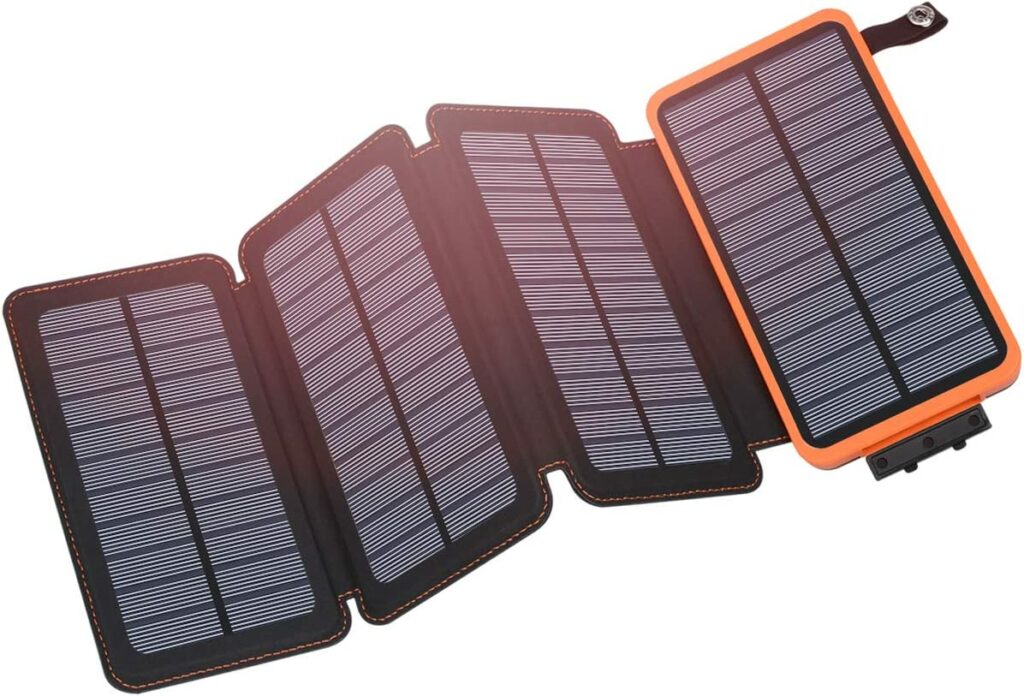
Lightweight and compact, this solar charger with a huge integrated 24,000 mAh power bank isn’t the highest quality, but it definitely gets the job done multiple times.
Equipped with four large solar panels that reach 6W in direct sunlight, it claims uninterrupted phone charging. It can juice up an iPhone up to 6 times, a Samsung S23 up to 4 times, and an average tablet up to 2.5 times.
Thanks to the upgraded 15W output, this portable solar charger by Hilukey can charge an iPhone up to 50% in just 30 minutes. With one USB-C port and dual USB-A ports, it enables simultaneous charging for three devices.
While it lacks a built-in hook for backpack hanging, the snap on the loop lets you use it with a compatible hook. Just be aware that the loop is not centered, which may cause the power bank to hang at an angle.
The USB-C port supports both input and output, providing 2.5X faster recharging when used with a PD fast charger (not included). Additionally, an internal security system safeguards your devices from potential damage.
Bulkier than a power bank but much more compact than the average solar panel charger, the Hilukey is a good bet if you want to stay compact and on a budget.
Lastly, be mindful of its fragility as it is not made of high-impact plastic; a single drop could render the device inoperable.

- Dimensions: 6.18 x 3.54 x 1.38 inches
- Weight: 1.36 lb
- Battery: 24,000mAh
- Output: 600mAh/3W
8. Voltaic Systems Arc 49W Laptop charger
Best Heavy-Duty Bike Touring Solar Charger for Laptops
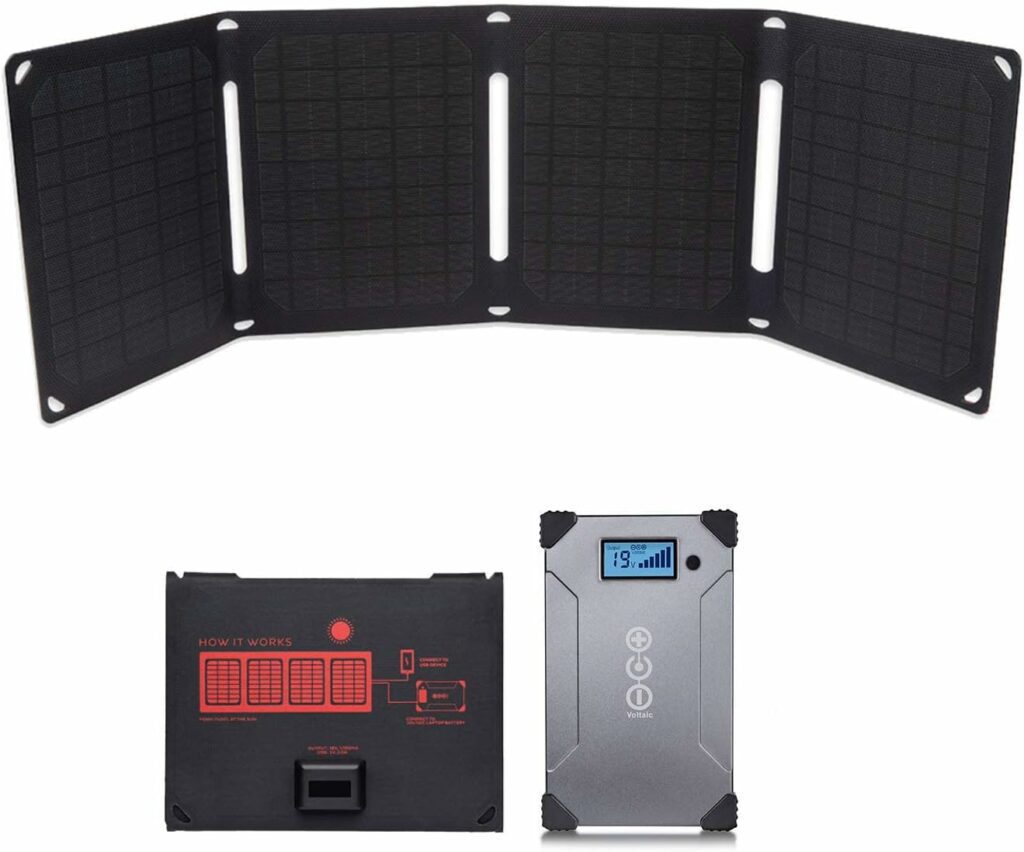
Last but not least, here comes the beast! For all digital nomads who need their laptops even when roaming the remote emptiness of the outback, here comes this monster.
With a 19,000 mAh/73 Wh battery pack that can fully charge the average laptop once and a standard smartphone up to 6 times, this combination is one of the most powerful bicycle touring solar chargers available.
The Voltaic Arc 20W takes 7-8 hours to fully charge a MacBook Pro in good sunlight, and it can also charge DSLR and drone batteries.
Of course, don’t expect this kit to be lightweight; with 3.5 lb (total), it is the heaviest in this list. It comes with a variety of laptop adapters.
- Open: 33.9 x 10.0 x 0.1 inches
- Folded: 7.5 x 10.0 x 0.8″>
- Battery: 0.63 x 7.28 x 4.92″
- Weight: 3.5 lb
- Power: 20W 19,000mAh/73Wh
- Check Also
Solar Panel output power
The electrical power is measured in Watts, a unit used to quantify the rate of energy transfer. The power is the product of Voltage and the magnitude of the electric current (measured in Ampere “A”), W=V*A.
Given that the output voltage of a USB port is always 5V, the more amperes the Solar Panel generates, the more power (Watts) it delivers, and the faster your device will charge (assuming it can take higher Amperage, which most devices can do).
More solar cells generate more current, but that usually means larger and heavier solar panels. The efficiency of solar cells also plays a huge role, but most of the solar chargers listed here share similar solar cell specifications.
Power Banks and Battery Packs Capacity
The capacity of a battery is measured in Amperes per hour (Ah), although the mAh unit is more commonly used. A battery with a capacity rating of 3500 mAh could deliver 3500 mA for 1 hour. Higher mAh ratings for the same battery type will generally mean longer run times.
check our
> Stay Powered On The Go: 9 Best Power Banks For Bikepacking, Backpacking, And Cycle Touring
The purpose of solar chargers
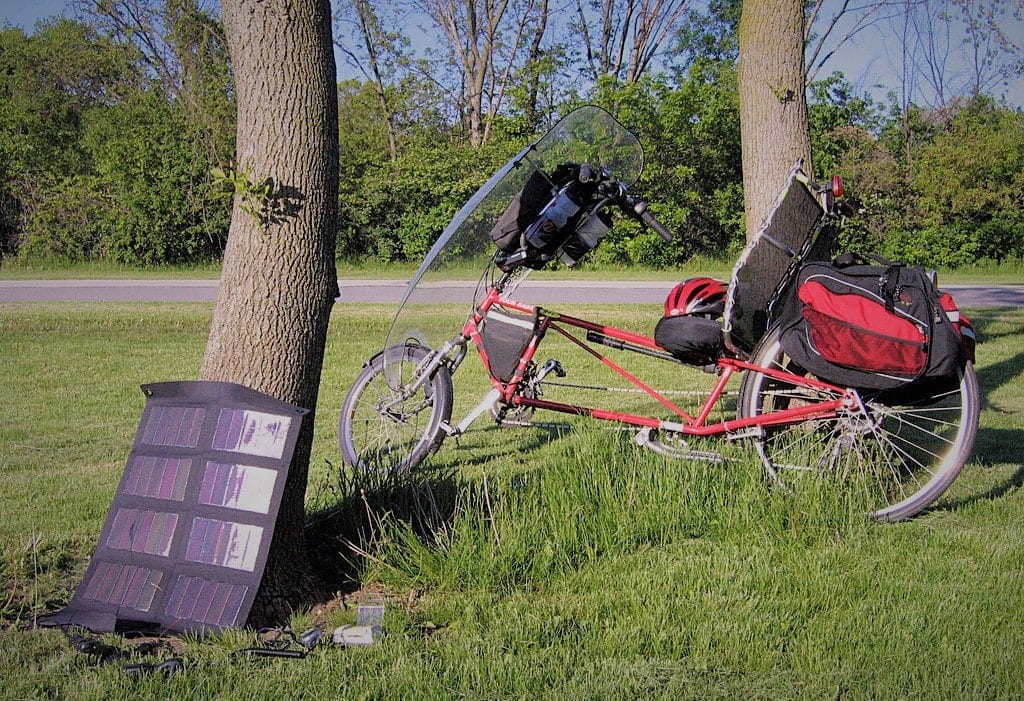
To choose the best camping solar panel charger for your needs, you must first assess what those needs are.
Do you plan on spending days and days in a row hiking or cycle touring in remote areas without any chance to find a power outlet? Will you use your phone and other electronic devices constantly for hiking or bikepacking navigation, taking pictures and videos with your action cam, listening to music, or whatever? Will you rely on the solar panel as your only source of electricity to keep those devices juiced?
If the answer to these questions is “yes”, then you need a more powerful solar charger, and possibly a high-capacity power bank.
If, instead, you plan to use solar power only in emergencies to keep your phone alive, you can go for a smaller, lighter solar charger.
Solar Chargers interruption issues
Most of these solar panels may stop charging if there’s not enough sunlight (in the shade, for example), and the interruption recovery speed is the panel’s ability to resume charging when the sun hits it again.
Some of the cheapest panels might fail to resume charging, so it may be necessary to unplug and replug the device. This is quite annoying, especially when you’re not looking at the charger.
Some solar chargers perform very well in overcast weather, while some don’t.
Ok, now that we have an idea of how they work, let’s dive into product comparison. Don’t forget that solar chargers also make great gifts for hikers, cycle tourers, and outdoor lovers in general.
Wrap-Up: Can you really rely on a lightweight solar panel charger to keep your device charged while bikepacking?
While lightweight solar panel chargers can provide a convenient and eco-friendly way to charge devices during bikepacking, their reliability depends on several factors. In areas with ample sunlight, a well-designed and efficient solar charger can keep your device charged. However, their performance may be impacted by weather conditions, limited sunlight, and the charger’s capacity.
For optimal results, choose a high-quality solar charger with efficient panels and sufficient capacity. It’s best to view lightweight solar chargers as a supplementary charging solution rather than the sole source of power during extended bikepacking trips.
Combining them with traditional power banks ensures a reliable backup for continuous device charging, providing peace of mind during outdoor adventures.
Frequently Asked Questions about Solar Panel Chargers
Are solar chargers worth it for camping?
If you plan to stay out in the wild for consecutive days, a camping solar charger is definitely worth the expense and extra luggage. If you’re planning to go back to civilization every other day, then you can just carry a power bank.
How do I choose a solar charger?
You should have your needs in mind when choosing the best solar chargers for you. How long are you staying in the wild? What do you need to keep charged? What’s the Wattage of your gear? You should keep these questions in mind when choosing a solar panel and charger.
What does mAh mean on solar chargers?
mAh is the unit used to measure a battery’s capacity. Battery capacity is measured in Ampere-hours (Ah), although Milliampere-hours (mAh) are more commonly used for solar chargers. I.e., a battery with a capacity rating of 5000 mAh could deliver a current of 5000 mA for 1 hour. Higher mAh ratings for the same battery type generally indicate longer runtime.