

Last Updated on 30 November 2025 by Cycloscope
6 of the best ultralight budget sleeping bags for backpacking, cycle touring, & bikepacking
Cheap, affordable, lightweight sleeping bags on a budget [2026]
Looking for a cheap but reliable camping companion? Welcome to our comprehensive comparison of the best ultralight budget sleeping bags for backpacking, cycle touring, and bikepacking.
Disclosure: Some of our articles contain affiliate links. This comes at no additional cost for you and helps us keep this website up and running. (as Amazon Associates we earn commission from qualifying purchases)
How we compile our gear guides: during the almost 10 years of cycloscope.net our team personally tested dozens of similar pieces of gear. For what we can't test personally, we involve other people in the cycling community to give their feedback and opinion about gear they have used. Our decade-long experience in bicycle touring enables us to find the key cons and pros of every product we mention.
We’ve meticulously reviewed a range of options, from snug insulation to efficient packability, that won’t weigh you down – both on your bike and in your wallet.
A quick note about how we selected the best budget sleeping bags
The lightweight sleeping bags listed here are certainly not the best on the market for backpacking, hiking, and bicycle touring/bikepacking, but do you really need the best?
The sleeping bag is probably the most critical piece of equipment when facing cold climates, but for most of us, who do not really travel in extreme environments, a budget lightweight sleeping bag would do the job.
We selected 10 relatively cheap sleeping bags trying to feature different models for different travel conditions and traveler’s tastes – several of them we have personally tested, others we have seen in action and collected personal opinions from fellow adventurers, a few we’ve researched online.
Most of these ultralight backpacking sleeping bags will keep you warm down to 5°C, some even lower, while others are designed for more tropical climates.
You’ll find all the info you need to make the right purchase in the buying guide section below our list of the best budget sleeping bags.
Best budget lightweight sleeping bags for bikepacking & backpacking in a nutshell
- Kelty Tuck 40F – Best Ultralight for Tall People
- Naturehike CWM – Best Ultralight Quilt Sleeping Bag
- Hyke & Byke Shavano 32F – Best Quality Budget Sleeping bag
- Snugpak Jungle 36F – Best Ultralight for Tropical Climate
- Marmot Trestles 30F – Best Budget Ultralight Sleeping Bag
- East Hills Outdoors Jungle Explorer – Best Ultralight Hammock
Best Cheap Ultralight Sleeping Bags for Bikepacking & Backpacking
1. Kelty Tuck 40 Degree Thermapro [+/- 90$]
Best Ultralight Sleeping Bag for Tall People
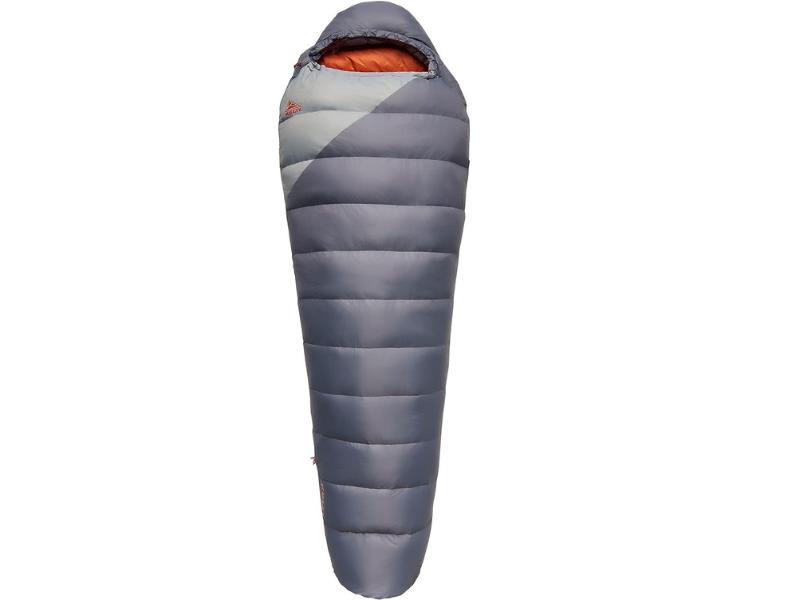
This is an interesting 3-season sleeping bag, wide enough to sleep in more comfortable positions it has an additional cool feature.
Should you feel too warm you can just un-zip the Comfort-Tuck Zipper system stick your feet out and give your toes a breath of fresh air. Plus, a media storage pocket keeps your devices close to you all night.
This oversized mummy bag is filled with ThermaPro synthetic insulation giving a pretty good ratio of warmth and compressibility.
A great budget choice for summer/spring camping adventures or for those so fortunate to never get night temperatures below 40F (4C).
Light enough to be carried with you when bike touring and compact enough to meet the needs of ultralight backpackers.
Fits up to a 6’6 ft tall fella. Kelty is based in Boulder, Colorado.
- Material: Synthetic
- Long Size Weight: 2lb 10oz. / 1.2 kg
- Regular Size Weight: 1 lb 7 oz, 0,70 kg
- Stuffed size: 7.9 x 14 in / 20 x 35 cm
- Temp rate: 40F/4.4C
2. Naturehike Goose [+/- 70$]
Best Ultralight Quilt Sleeping Bag
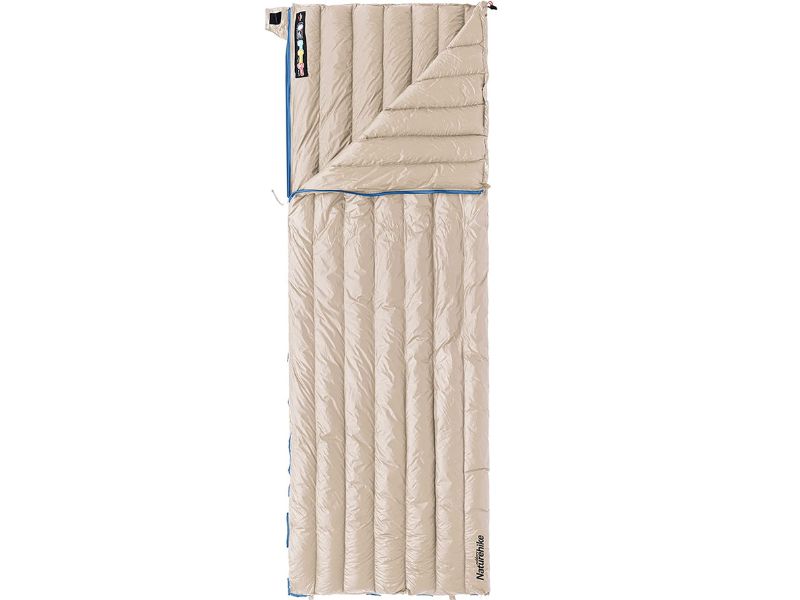
The sleeping bag we brought with us on our bikepacking trip through Africa – super light and compact, this Naturehike sleeping bag is an excellent product despite its limitations.
The CWM280 is one of the lightest sleeping bags you can get your hands on. Naturehike, though, has revised its excessively optimistic temperature ratings, so now the comfort temp for this quilt is 11C with a limit around 6C (52/42F), much more realistic than the 36F stated some years ago.
Anyway, they also manufacture a CWM400 version (that you can purchase at the same link), which is slightly heavier but boosts a comfort rating of 6C (42F) and a limit of 0C (32F).
To maximize warmth-to-weight ratio, Naturehike utilizes twice as much insulation on the top of the bag as on the bottom.
Weighing only 1.25lb, it packs tiny with the included 4-point compression sack, down to just 10 x 5 inches. It can be stuffed into a bike saddlebag, leaving room for a jacket and some food.
The Naturehike CWM ultralight sleeping bag uses light and tough materials. The 15D ripstop fabric lets you shave weight from the sleeping bag, making this budget sleeping bag one of the best available if you’re looking for the comfort of a rectangular shape.
The downsides are the lack of a hood and somehow weak zippers; we had to replace one after a couple of years of use.
- Materials: Goose Down 15D/400T nylon
- Weight: 1.26 lbs / 570g
- Size: 74.8x 28.3″
- Packed: 4.7×10.2″
3. Hyke & Byke Shavano 32F [+/- 140$]
Best Quality Budget Sleeping bag
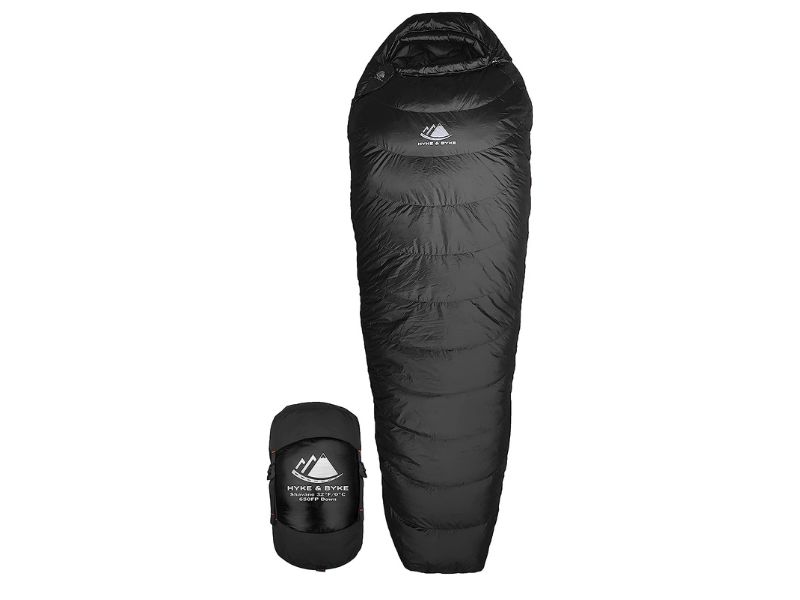
Another Hyke & Byke budget lightweight sleeping bag, the Shavano 32 is one of the lightest mummy sleeping bags available with a 0°C rating, weighing barely over 2 lbs. Again great quality for the price.
The small packed size 6.5×9″ makes it ideal for cycle touring, bikepacking and backpacking.
While zipper baffles as well as hood and shoulder drawcords to tighten up the bag, help to hold the heat, however, this should still be considered a warm-weather sleeping bag.
Hyke & Byke LLC claims to be committed to improving animal welfare in the duck/goose down and feather supply chain.
The fill used in our Shavano bags is 90/10 premium quality duck down that is responsibly sourced by being a byproduct of the meat and egg industry.
They state to work hard to ensure that down does not come from animals that have been subjected to any unnecessary harm, such as force-feeding or live-plucking.
- Materials: Duck Down Water repellent 400T 20 D Ripstop nylon fabric
- Weight: 2.15 lbs / 980 g
- Packed Size: 6.5″ X 10″
- Temp: comfort 60ºF / 15ºC | limit 45ºF / 7ºC
4. Snugpak Jungle Bag [+/-60$]
Best Ultralight for Tropical Climate
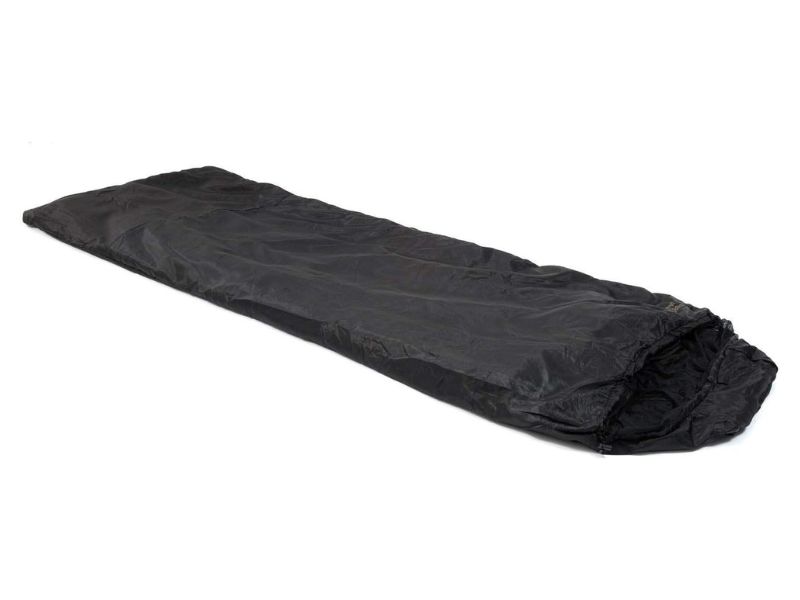
Snugpak is a well-known brand from England. The Snugpak Jungle Bag is the perfect choice for backpackers or bicycle travelers who are heading to warmer climates.
The Jungle Bag was specially designed for humid, hot environments, the Travelsoft insulation was chosen for its exceptional performance in tropical and sub-tropical environments.
The design of the Snugpak Jungle Bag allows it to pack down very small, and with its square bottom, the Jungle Bag can unzip into a blanket or ground cloth.
Additionally, the Jungle Bag features a roll-away mosquito net that can be zipped over the face and fully seal the bag to any ground-borne critters.
Downsides? A little heavy for a summer sleeping bag at almost 900g for a regular size.
- Materials: Nylon Travelsoft insulation
- Weight: 1.9 lbs / 900 g
- Size: 30×86″
- Packed: 7×6″
5. Marmot Trestles 30 [+/- $70]
Best Budget Ultralight Sleeping Bag
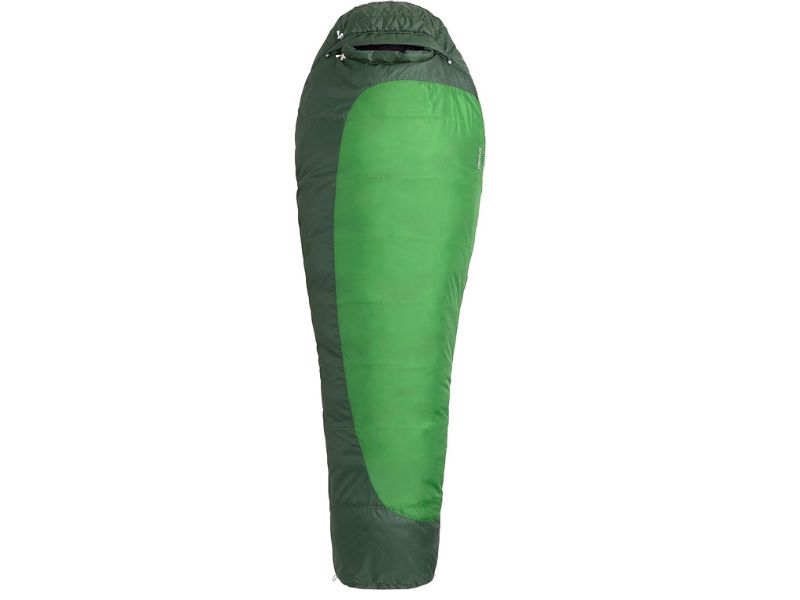
Here’s another Marmot sleeping bag. Marmot is certainly one of the most famous brands in the outdoor industry, with a reputation for quality and product testing so they deserve another spot in our list of the best budget sleeping bags for bikepacking and backpacking.
Featuring SpiraFil high-loft insulation, the Trestles mummy-style sleeping bag retains the warmth, softness, and compressibility of a natural down bag, with the added moisture resistance that comes with synthetic insulation.
It is EN rated as comfortable for men to the lower limit of approximately 30°F. The Trestles’ combination wave construction offers warmth and maximum loft on its top side and a plush, blanket-like feel on the bottom. Just a little heavy at 3 pounds and, most importantly for the minimalist bikepackers out there, very very bulky.
- Materials: SpiraFil high-loft insulation
- Weight: 3 lbs / 1.3 kg
- Temp: 30°F
- Packed Size: 18.1 x 8.7 in, 46 x 22 cm
6. Easthills Outdoors Jungle Explorer [+/- 70$]
Best Ultralight Hammock
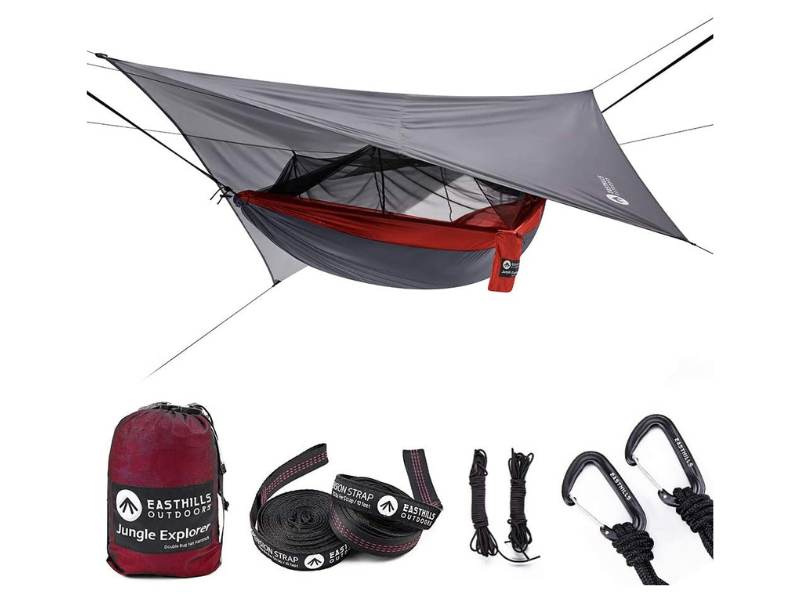
Crafted from high-strength, breathable 210T Taffeta parachute with triple-stitch edge seams. The No-See-Um mesh on top provides excellent insect protection and ventilation. The mesh contains 2500 holes per square inch.
Measuring 300 x 200cm (118 x 79 inches), it can fit two adults, so you can relax with a buddy or just hog the whole thing for yourself. The hammock supports a maximum capacity of 700 lb. yet weighs only 36 oz. and takes up little space in your pack.
If you like hammock camping, you should definitely get also a hammock sleeping pad.
- Material: 210T Taffeta
- Weight: 3.96 pounds
- Packed Size: 14.4 x 10.5 x 6 inches
Understanding Sleeping Bags temperature rates
The EN 13537 Standard that is now used by many sleeping bag manufacturers, is the official European criterion for the classification of sleeping bags.
The EN13537 applies to all sleeping bags with the exemption of sleeping bags for military use and sleeping bags for extreme temperatures (below -25°C).
To be labeled for the EN temperature rate, sleeping bags need to undergo a standardized lab procedure which determines 4 different factors, from Wikipedia:
- Upper Limit — the temperature at which a standard male can sleep without excessive perspiration. It is established with the hood and zippers open and with the arms outside of the bag.
- Comfort — the temperature at which a standard female can expect to sleep comfortably in a relaxed position.
- Lower Limit — the temperature at which a standard male can sleep for eight hours in a curled position without waking.
- Extreme — the minimum temperature at which a standard female can remain for six hours without risk of death from hypothermia (though frostbite is still possible).
These ratings are taken assuming that the subject is using a sleeping pad, tent and is wearing one base layer of thermal underwear. If you want to better understand this rating we recommend this article.
Unfortunately, brands are often not transparent about whether or not they refer to the EN standard, and which factor they consider when they state their sleeping bag’s temperature rating. Apparently, most refer to the lower limit, while others to the more relevant Comfort zone.
Moreover, it is important to be aware that standards like this cannot be taken as universal truths. Plenty of factors are involved in the temperature real feel, which varies widely from person to person. Hydration, nutrition, altitude, and quality of the other gear (sleeping pad, tent, clothes) are also very important factors.
Mummy VS Rectangular Sleeping Bags
The narrower the space inside your sleeping bag, the easier it will be for your body to warm up the air inside, thus giving you a feeling of warmth. That’s why real winter sleeping bags are always mummy-shaped.
The movement though, inside a mummy sleeping bag is very constrained, forcing you to sleep in only a few positions, this can be hell for some (like me for example) and cause intense sweating when the temperatures get warmer.
There is nothing such as a 4-season sleeping bag, 4-seasons means winter. If you’re going to hike, backpack, or bikepack across different climate zones there’s no way you’ll always be comfortable with the same sleeping bag.
check also
> 3-Season Tents VS 4-Season Tents – What Should You Bring With You?
Down VS Synthetic insulation
There are two types of materials used to fill a sleeping bag, bird downs (generally duck or goose) and synthetic materials. The cheapest sleeping bags are usually filled with synthetic materials, less efficient in retaining warmth compared to downs.
The lightweight sleeping bags listed here though, are not the cheapest on the market, but a decent compromise between price and quality. Indeed some of the best budget sleeping bags feature down insulation.
Other advantages of down are that they compress more (reducing the packed size), and are usually lighter.
Few more things to know about sleeping bags
Some sleeping bags feature waterproof coating, do not be fooled though, sleeping inside a wet bag will never be comfortable, so I won’t consider this as a decisive factor, although it will help a lot if condensation is an issue.
Another thing to consider is that not all down are the same: the filling power ratio is a value that measures the insulating power of the down filling.
A down-filling power of 800 is considered high-quality, unfortunately, you’ll hardly find a budget sleeping bag with these characteristics.
What Is Down Fill Power?
Down fill power is a crucial specification that indicates the quality and insulating capability of down feathers used in sleeping bags, jackets, and other insulated outdoor gear.
It’s a measure of how well the down clusters can loft or expand to trap air, which in turn creates warmth. The higher the fill power, the better the insulation-to-weight ratio, resulting in a warmer and more lightweight product.
Fill power is measured in cubic inches per ounce (in³/oz) or in liters per gram (L/g) in the metric system.
For example, if you have down with a fill power of 800, it means one ounce of that down can expand to fill 800 cubic inches of space. This expansion creates more air pockets, which increases the insulating power of the down.
Here’s what different fill power ratings generally indicate:
- Low Fill Power (300-500): Down with lower fill power provides decent insulation but may require more volume to achieve the same warmth as higher fill power down. It’s often used in more budget-friendly products.
- Medium Fill Power (550-700): This range offers good insulation and is commonly found in mid-range outdoor gear. It provides a good balance between performance and cost.
- High Fill Power (750-900+): Down with higher fill power offers exceptional insulation, allowing for warmer gear that’s also lightweight and packable. It’s often used in premium and high-performance products.
Keep in mind though that while higher fill power down is generally more efficient in terms of warmth-to-weight ratio, the actual warmth of a sleeping bag also depends on other factors like the total amount of down used, the design of the baffles, and the quality of the shell fabric.
When choosing gear with down insulation, considering the fill power along with other factors such as the overall design, temperature rating, and your specific outdoor activities will help you find the right balance between warmth, weight, and comfort.
Would you recommend something different? Feel free to contribute to the comment section below!
FAQs about the best budget sleeping bags
Are mummy sleeping bags better than rectangular ones?
Mummy sleeping bags are definitely better at keeping the warmth inside. They are thus the best type of sleeping bag for winter and general chill weather camping. Regular sleeping bags give you more freedom of movement and are better suited for warm weather.
What is the best filling for a sleeping bag?
Down sleeping bags have the highest warmth-to-weight ratio, but they are a pain to wash. Synthetic fillings are not as efficient as down but they dry much faster. One could also consider the animal exploitation involved in making goose-down fillings.
Check also
- 17 best lightweight tents under 200$
- Camping Gear Essentials Checklist
- How much does it cost to cycle around the world
- Top 10 Best Instant Pop Up Tent for Couple or Families
- Beginner’s guide to bike touring
- Bikepacking Bags! The Best For Each Category from CHEAP to TOP