

Last Updated on 14 January 2026 by Cycloscope
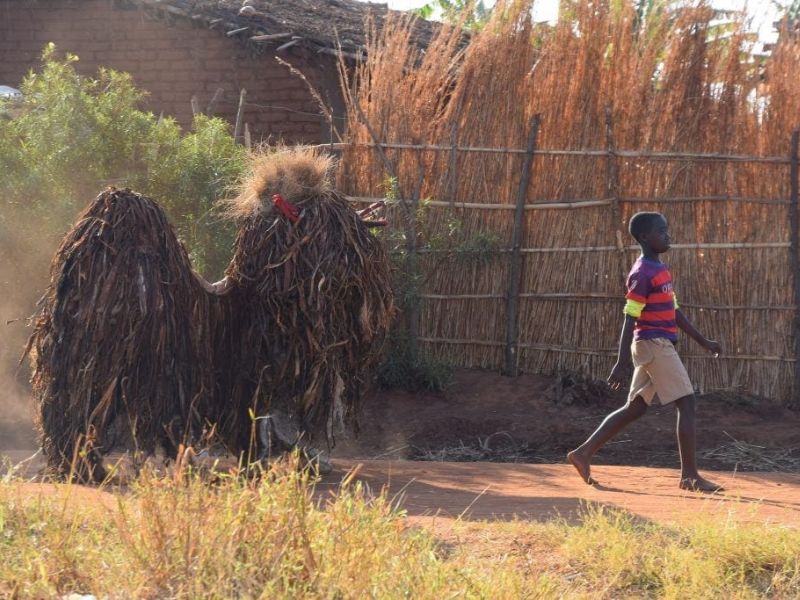
Culture, traditions, initiation ceremonies, dance, and costumes in Malawi – Gule Wamkulu and Nyau secret society
The sacred dance of the Chewa People and our meeting with one of the oldest religions in Africa
We knew that among the Southern African nations, Malawi is probably the most densely populated, with traditions, cultural peculiarities, masks, dances, music… We had heard about the complicated initiation ceremonies in Malawi, but nothing we knew about its secret society, the Nyau.
Disclosure: Some of our articles contain affiliate links. This comes at no additional cost for you and helps us keep this website up and running. (as Amazon Associates we earn commission from qualifying purchases)
During our bicycle trip through Africa, we left Cape Town (South Africa) and rode through Lesotho, Eswatini, Mozambique, Zimbabwe, and Zambia, ending up in Malawi.
Before arriving here, we tried to learn more about Malawi’s culture and how to see a traditional ceremony or dance in its real context (not as a show for tourists).
That’s how we discovered about the Gule Wamkulu… but where and how to see it was a totally different matter.
The internet didn’t have an answer, so we joined Malawian groups on social networks and asked locals and expats living in Malawi—still no honest answer. And just when we had lost our hopes, the incredible happened: we literally bumped into a Gule Wamkulu!
From the capital, Lilongwe, we headed to Cape Maclear, one of the most famous locations on the beautiful, enormous Lake Malawi.
Instead of riding on the main road, which was paved but rather dull, we trusted our GPS navigator, which led us through small country roads and single tracks, inaccessible by car, through numerous small villages and cultivated fields.
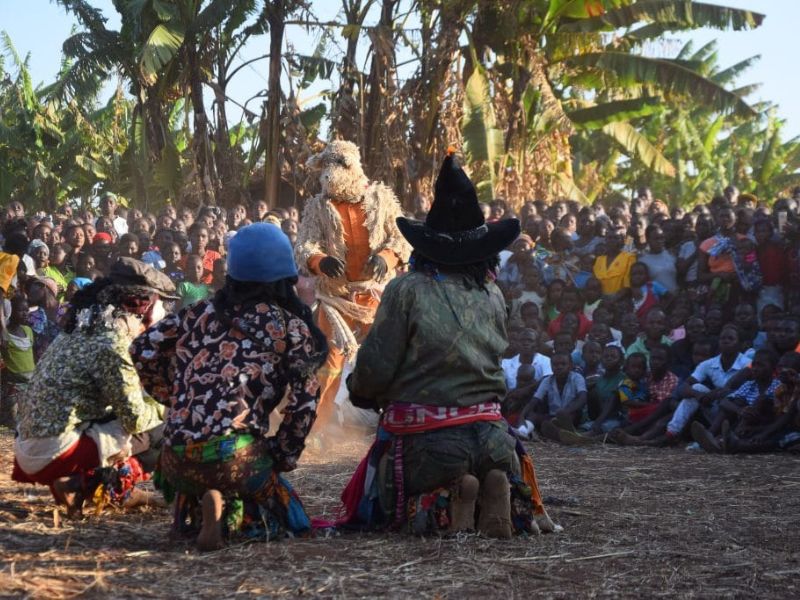
A beautiful road that also gave us a fantastic surprise, we came across a ceremony for the arrival of the new chief of a small village near Tete, where we witnessed the traditional sacred dance Gule Wamkulo.
This dance is part of the culture and traditions of the Cheawa People, who live in Southern and Central Malawi. In this article, we will discuss this fascinating religion, its masks, and our experience at a Malawian ceremony.
If you are planning to visit Malawi, absolutely check out our Backpacking Malawi – The best travel guide about Malawi on the web.
Where, when, and how to see traditional dances and ceremonies in Malawi
If you want to see these sacred dances for yourself while visiting Malawi, the best time to attend is during the dry season, after the July harvest, for the whole month of August.
However, knowing for certain when and where to attend a Gule Wamkulu or similar traditional ceremonies is almost impossible.
The best option is to visit the Kugoni Project at Mua Mission, which has the world’s most extensive collection of Malawian ritual art. Here is their site (or rather “sites” since they have three). If you do not have the opportunity to stop by, you can try contacting them for information.
Kugoni and Mua Mission also organize a large festival every year in the second half of August. Although it is not a traditional festival, the Kugoni Festival is an excellent opportunity to observe various traditional dances.
Another possibility is to ask in one of the various Facebook groups dedicated to Malawi. Expats Malawi is in English, and you should be able to get some indication.
If you are particularly interested in Gule Wamkulu and the Chewa people, obviously, you will have to find yourself in the area of Malawi inhabited by these people. Take a look at this map to get an idea of the distribution of ethnic groups in Malawi.
We recommend watching the movie “The Boy Who Harnessed the Wind“. You can find it on Netflix, where you can guess the role of Gule Wamkulo and how it was also used, and still is, for political purposes.
It seems that President Banda, who remained in power for 30 years, used masks to intimidate people and dissuade them from protesting.
When you really want something the universe conspires for you to get it. We took some narrow village roads on the way from Lilongwe to Dezda that are not on Google, amazing themselves. We were trying to reach Dezda but it was too late, so we asked around if there was a rest house in Lobi and a random guy pointed us to Tete so we changed our route. (read more…)
Culture in Malawi: Origins, life, and society of the Chewa people
The Chewa people are one of the many ethnic groups descended from the so-called Bantu Civilization, which began to migrate from central and southern Africa thousands of years ago, reaching Malawi around 1500 BC.
The Chewa (Chichewa) are one of the predominant groups in Malawi, with a population of 1.5 million. Among the many diverse cultures of Malawi, Chewa traditions are distinctive.
Their society is matrilineal; the land is inherited through the maternal line, and the profits from the sale of the harvest belong to the woman.
Since a man can have many wives (we met some who have ten or more), the children of the same mother (lubele la achite) form a family of dependents or Mbumba.
The elder brothers of the mothers are called Nkhoswe; they are the guardians of the lineage and mentor their sisters’ children.
The village is led by a chief (Mfumu), a position to which every resident of good character can aspire. The village leaders and women were subordinate to the regional leaders (Mwini Dziko), who were themselves subordinate to the paramount chiefs.
Subordination means the regular payment of taxes and the willingness to provide for men in times of war.
At least this is the traditional cultural model of the Chewa people; how the Chichewa traditions are adapting to modern Malawian culture and society is a poorly studied and debatable matter.
Despite being a matrilineal society, what we have seen in everyday life is that women work all day, often doing very strenuous tasks like collecting firewood or water, they always carry heavy baskets on their heads and at least one child on their backs, cook meals for the whole family, and take care of the many children.
Drinking beer, dancing at bars, and playing billiards seem to be man-only activities; moreover, women speak much less English than men, which means they have had, on average, less access to school.
The literacy rate among young people aged 15 to 24 is 71% for females and 82% for males.
Near the Tete junction we saw a monster, and then a faceless spirit, then a crowded circle of people… We approached, a bit intimidated… They let us in, with all the bikes, everyone staring at us, even the spirits. It is a Gule Wamkulu, spirits fight each other and compete in symbolic dances… (read more…)
The Secret Society of the Chewa People: Nyau
The religion of the Chewa people, Nyau, apparently originated in today’s Democratic Republic of the Congo, where a rock painting depicting Kasiya Maliro, dating back to 992 AD, has been found.
Kasiya Maliro is the costume representing the mother. In Malawi, it is called Kasiyamaliro and is the Great Mother of Gule Wamkulu and probably the most essential Nyau figure.
It is said to be the principle of the Nyau, the symbol of the mother of everything. Serving as a comforter of souls in transition, she is almost omnipresent at every ritual performance or traditional dance of the Chewa culture in Malawi.
The Kasiyamaliro is an ancestral spirit, an antelope of pure and ancient origins. It seems to have been born from the white and serene waters of the earthly depths, from which all the Chewa spirits come, the depths of the world. Under its belly lies the abyss of the world, the womb of the Great Ancestral Mother, and the tomb.
The Chewa people, therefore, believe in the existence of the Nyau (or Nyao), a secret society whose name means “mask” or “initiation”.
The Nyau society comprises initiated members of the Chewa and Nyanja peoples. The initiation ceremonies are separate for men and women, with different knowledge learned and with different ritual roles in society based on gender and seniority. Only initiates are considered mature and members of the Nyau.
There is a Nyau society in each village. Still, they are part of a vast Nyau network extending through the central area and parts of the southern regions of Malawi, eastern Zambia, western Mozambique, and parts of Zimbabwe from which the Chewa emigrated.
The Nyau religion survived the colonial period, when missionaries forbade the population of Malawi from engaging in any traditional practices, dances, music, initiation rites, etc.
The Chewa adapted aspects of Christianity, which, to this day, is the most practiced religion in Malawi, with Chewa members belonging to both a Christian church and the Nyau society.
To protect themselves from the British colonial authorities, the members of the Nyau began to impose punishments on anyone who revealed the society’s secrets to uninitiated people or, worse still, to those who were not part of the religion.
Revealing the real names of the people wearing masks could also result in their deaths. This is one of the main reasons why not much is known about the origins of the Nyau.
Although other ethnic groups in Malawi have developed elaborate traditional dances, including the Ngoni, the Yao, and the Mang’anja, the Cheya Nyau can be considered the most ornate of the secret societies and dances in the areas around Lake Malawi.
The Gule Wamkulu is the upside down. Every element of reality has its double, literally every one… The mother, the dog, the helicopter, the British colonialist with a red nose and burned face… (read more…)
The belief system of the Chewa people of Malawi
The Chewa believe that life exists within their ancestors and those not yet born, just like it exists in the living. Nyau’s beliefs include communicating with the dead, or with their spirits, calling this the pampero lalikulu (great prayer) act.
They believe in the presence of God in everyday life, a God that is both male (in the sky) and female (on the earth) at the same time. One of the most critical ritual moments in the Chewa culture of Malawi is the traditional Gule Wamkulu dance and ceremony.
???? The Gule Wamkulu explains the world by way of its ghosts, gives complex answers to the mysteries of life and death… It’s a serious matter, to be vehicle for the spirits you’ll have to undergo an initiation into the secret society, so secret that one can be killed just for talking about it. That’s why anthropologists still know very little about it. (read more…)
The great dance: Gule Wamkulo
The symbolism of the spirit world is represented by the Gule Wamkulu (great dance), which incorporates mwambo (traditions), masks, songs, and dance.
The Nyau tradition of Malawi incorporates sophisticated reverse-role-playing games, proverbs, imitation, and satire in performances. Primarily, the Nyau perform their masquerade dances at funerals, commemorations, and initiations.
Each dancer represents a special character associated with the mask or animal costume (or an anthropomorphized animal) he wears.
The zilombo (wild animals) are large structures that cover the entire body and mostly represent animals, while the masks worn on the face are mainly of ancestral spirits.
Before the Gule Wamkulu dance, the Nyau dancers observe a series of rituals associated with their secret brotherhood. The secrecy behind the Nyau incorporates a coded language, riddles, metaphors, myths, and signs.
During masked performances, women and children often run into homes when a Nyau mask threatens them, as masks are worn only by male-initiated members of society and represent male knowledge.
At the time of the exhibition and during the rituals, the masked dancers, the Nyau, are considered the spirits of the dead. As spirits, they can act with impunity, and there have been attacks and deaths during traditional ceremonies in Malawi in the past.
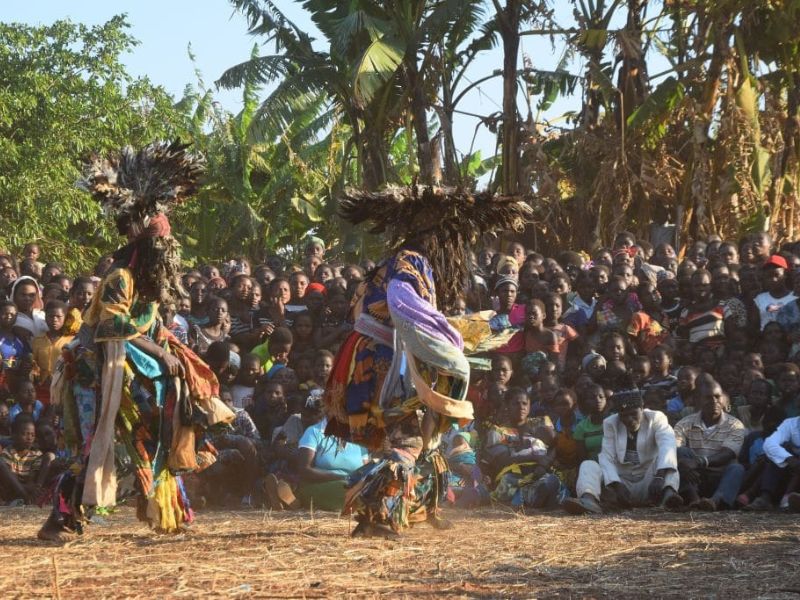
The dances of the Nyau involve intricate footwork, jumps, acrobatics, mimed fights, and the casting of dust in the air. Dancers respond to specific rhythms and drum calls, depending on the type of mask or character.
Although it may be considered a popular dance by many, this is certainly not the case; the Gule Wamkulu should rather be regarded as a religious dance, as its function is to communicate with the ancestral world.
In 2005, Gule Wamkulu was ranked among the 90 masterpieces of the oral and intangible heritage of humanity, under a UNESCO program for the conservation of intangible cultural heritage.
The traditional Malawian Gule Wamkulu dance is also known as pemphero lathu lalikulu la mizimu (“a great prayer for our ancestors”) or gulu la anamwaliri (“ancestor dance”).
In the dance/ceremony we saw, the masks and costumes are within a circle formed by the village’s people; the positions of the people in the circle reflect their roles in society.
Some masks took sand from the ground and cast it to the spectators, in the front row there were the children, who ran away and then returned to their initial position.
⛪ When the first colonists arrived in Malawi, they of course tried to ban this “devilish thing”… But, as it very often happens with the catholics, they ended up mixing elements of the Christian mythology into the shamanist practice: the great mother became Maria, the white colonists Saint Peter, and so on.
Malawi Initiation Ceremony and the World of the Traditional Spirits
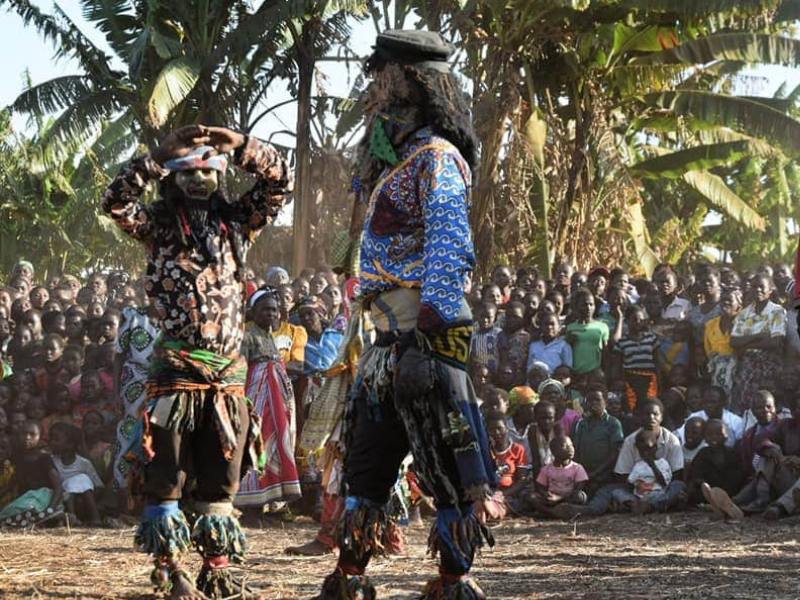
The initiation of men into the secret society takes place in a burial ground in the woods, where the initiate must reside for a week (this period was much more extended in the past).
Novices are beaten and whipped with branches while learning the discipline – a practice that continues even once they become part of the cult.
The initiation rite is complex and differs between groups; in some cases, the initiate is required to suck blood from live chickens, handle harmless snakes (sometimes used during rituals), and perform other amenities.
In some villages, the newly initiated are blindfolded for three days, followed by a two-week ban on speaking. Initiation often involves circumcision.
Not much else is known about the Nyau initiation ceremonies in Malawi; these practices are among the best-kept secrets of this traditional cult.
During the ritual, the men of the Nyau are regarded as true spirits and cannot be considered human beings, even though the women recognize their husbands, fathers, brothers, and uncles.
In Malawi, identifying a man wearing a mask is a serious violation of the secret of the traditional Nyau religion and can be punished severely.
Uninitiated men, women, and children can be chased by Nyau artists, and non-members are discouraged from approaching during funerals.
In part, this serves to prevent outsiders from being disrespectful, from failing to understand the importance of a “good” burial, and from failing to recognize the meaning of the dead’s presence.
So that the most important moments of the community’s life, weddings, funerals, new chiefs, and such, assume a triple significant, existing in three different worlds: the material plan, the Christian faith and the world of the traditional spirits. (read more…)
Like Traditional Festivals?
Cap Go Meh – Having your Soul pierced by the Spirits in Indonesian Borneo
The Pasola of Sumba Island – The Blood Must Be Shed
The Malawian Masks of Gule Wamkulu
The variety of masks representing spirits and ancestors is enormous and constantly growing, unlike the animal structures that instead remain similar to themselves.
The masks are therefore not only traditional but also constantly evolving to respond to changes in real society. There is a mask for everything; the whole universe is represented in the upside-down world of the Nyau.
Some mask carvers are professionals, while others are occasional artisans. The costumes are generally made with banana leaves and other materials; for example, we have seen t-shirts of famous soccer teams.
Over 400 masks associated with the Nyau society and the Gule Wamkulu ritual are on display at the Chamare Museum in the Dedza district (MUA Mission), Malawi.
Nyau masks are made of wood and straw and are divided into three types:
- The first belongs to the masks made of natural materials (feathers, straw, and others) – the least important
- At the second are the wooden masks – important but common
- The third is a large zoomorphic structure that envelops the entire body of the dancer – the rarest and most powerful
Wearing the latter type of costume, dancers tend to turn around and turn around in a movement known as nyau yolemba. These are representations of a wide variety of characters, including wild animals such as antelopes, lions, and hyenas.
With names like Bwindi, Chibano, and Wakana, the masks portray a variety of traits and types, including a womanizer, a helpless epileptic, allegorical figures such as lust, greed, madness, vanity, infertility, witchcraft, and ambition, and even a helicopter.
The masks and exhibitions represent all of humanity and the whole world of spirits. Among the many types of masks, traditional and non-traditional, we list some of them:
- Bwana wokwera pa ndege/pa galimoto (Mister in a plane/in a car). This mask shows how those who have already had money and power in their lives will also keep them once they have passed into the ancestral world.
- Chabwera Kumanda (the one who came back from the grave) is a character who misunderstands people, an ancestor who hunts people in their own dreams to get attention and offers (eg, beer, meat, etc.). During his dance, Chabwera Kumanda is in fact pursuing the spectators, thus emphasizing the character’s wickedness.
- Kasinja or Kamchacha is the messenger of important ancestors. Sometimes it acts, in part, as an anchorman, telling which masks or animal approaches to perform in its dance.
- Kondola, which originated as Msakambewa (“Hunter of mice”), then turned into Ndola (a man in a copper mining town), subsequently changing once again into Chizonono (someone suffering from gonorrhea), is an example of a mask that has transformed due to change, political pressures, and social influences.
- Maliya (from Maria) represents an ancestor with a kind heart. This dancer will sing and dance with the people—one of several examples of the cultural mix between Christianity and Nyau.
- Mfiti (sorcerer) wears a very ugly mask and, in general, has a demolished and bristly appearance. The external form recalls its evil character since it is believed that sorcerers kill people with their juju (magic power).
- Simoni (from Saint Peter) wears a red mask, resembling a “white man” with sunburn, and a suit made of rags. This character seems to be clearly the caricature of an English colonialist.
- Makanja (mask on stilts) is a warrior and acrobat with great power, epitomizing a Makanja, who requires a high level of juju. Makanja stilt walkers are among the most powerful masks in the Nyau hierarchy.
Like African ancestral cultures? Read also
> Lake Eyasi Guide [Tanzania] Hadzabe Bushmen, Walking Safaris
Animal-Structure Costumes in the Gule Wamkulu
The members of Nyau who wear animal structures represent wild animals or nyama za ku tchire; they appear at the time of people’s deaths and are therefore both feared and revered.
There is a hierarchy among the animals, with some highly respected (such as njobvu, the elephant) and others less important.
It is also believed that highly respected animals represent very important ancestors, serving as leaders or members of the Nyau cult.
Most animal structures are barrel-shaped, with a bottom-entry hole. Inside the structure, the bars are mounted to enable rotation.
All the structures cover the dancer entirely, whose footprints are swept away by members of the Nyau with brooms of branches. Here are some structures, explained in order of importance:
- Njobvu (the elephant) is the most crucial figure of them all. Four Nyau dancers are needed to move this structure.
Njobvu remembers a critical leader, since the elephant is the most important animal for the Chewa people because of its size and danger. This rare structure is seen only at the chiefs’ funerals.
- Ndondo (the snake) is the second most important structure and is carried by up to twelve men. It also serves as an important ancestor and is often seen at funerals of Nyau members.
- Mkango (the lion) recalls the evil spirit of an ancestor, which attacks and kills people. Therefore, some people run away as soon as they see Mkango approaching.
The figure of Mkango explains that the ancestors should not be bothered, just like a lion should not be bothered, as it could attack people for their disrespect.
- The antelope forms are considered the most beautiful and the most frequent in the Gule Wamkulo.
Often covered with intertwined maize shells, these masks are the first to appear in performances commemorating the deceased and representing the union between the dead and the spirits/ancestors.
Their performance marks a moment of remembrance and celebration of life. The most important is the already mentioned Kasiyamaliro (leaving the funeral/burial).
Dance and Culture for Socio-political Change in Malawi
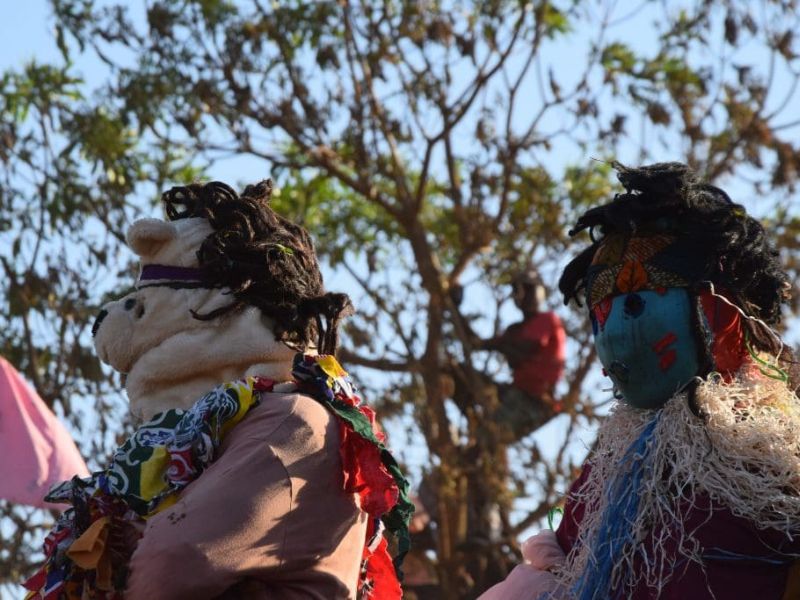
The traditional Gule Wamkulu rite is not just about unusual costumes and terrifying masks. The dance is used to convey a message.
The Gule Wamkulu unites the worlds: the human, the animal, and the spiritual world, presenting figurative discourses that, however, often address practical questions concerning the life of the village and the community, questions that are difficult to talk about, such as HIV/AIDS or sex. These topics are addressed through dance.
The Nyau dancers also have the power to criticize the leaders and the government. They use humor and satire to make political statements. They have the strength to do so because, while they dance, they are seen as spirits, not humans.
Even political leaders have harnessed the power of this traditional cult. The founding president of Malawi, Hastings Kamuzu Banda – who was himself Chewa – used Nyau’s performances to intimidate people who were perhaps critical of his regime or to “keep the population in line”.
We felt like being in the way of the ceremony, to some people we were welcomed guests but to some other we are intruders. We stayed about 30 minutes, we would have liked to stay forever but didn’t want to ruin the ceremony with our presence and our bulky bikes. We have experienced what we really wanted to feel… It was intense and astonishing, these feelings will never leave us… Hopefully we’ll back into the circle one day (read more…)