

Last Updated on 17 January 2026 by Cycloscope
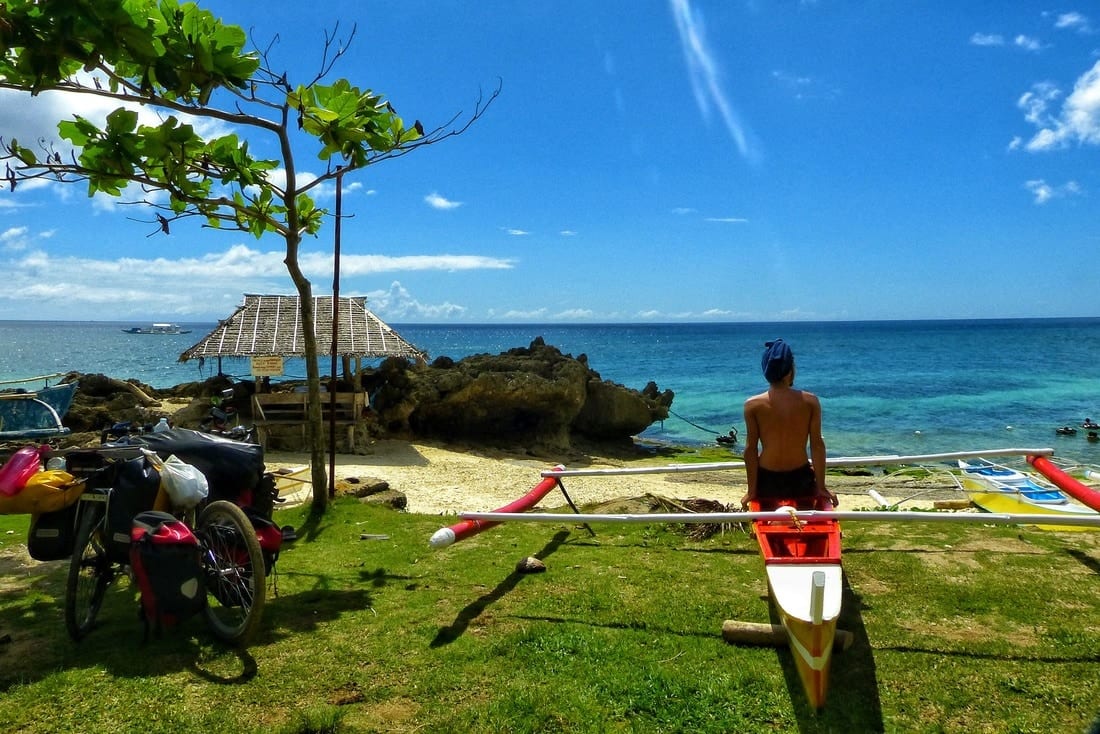
Cycling and backpacking in the Philippines on a budget
A budget travel guide for adventurous wanderers
Although ours was a bike trip, this article aims to be a travel guide with useful tips, also for those backpacking in the Philippines on a budget.
Disclosure: Some of our articles contain affiliate links. This comes at no additional cost for you and helps us keep this website up and running. (as Amazon Associates we earn commission from qualifying purchases)
We ended up bicycle touring the Philippines almost by fortune, for a series of coincidences, but this was the country where we really thought to stay for a while.
This is because the Philippines is a fun, friendly, and beautiful country, rich in positive vibes and human creativity.
Moreover, the Philippines is also a very cheap destination, cheaper than the already low-cost mainland Southeast Asia, a real paradise for budget travelers, be they cycling tourists, hitchhikers, backpackers, or all sorts of wanderers with a little sense of adventure.
Ours was a one-month cycling trip mainly in the Visayas, the central archipelago of the Philippines. As usual, we think that a bicycle is the better tool for deeply exploring, getting in touch with the real, and experiencing landscapes and people.
Nonetheless, it’s also the best way to keep the travel budget very low. Even though cycling in the Philippines is inexplicably underrated, you should really consider it.
If you want to know about where to go, jump to our Philippines itinerary or straight to the articles about Bohol, Negros, Guimaras, and Panay!
Learn more about bikepacking and backpacking in the Philippines
Communicate when traveling in the Philippines
The language barrier is often a big frustration when traveling, but you would be happy to know that this is not the case in the Philippines. Not all of you may know that all Filipinos speak very good English.
The school has been in English since the primary levels, so while this may have caused a cultural loss for the Philippines, it comes in very handy for the bike traveler or backpacker who wants to make local friends.
There are many languages in the Philippines, but Visayan and Tagalog are the most widespread. Learning some Visayan words will earn you nice smiles; people are more proud of their language here. Anyway, it’s not a must; you will get many smiles anyway.
Where to sleep almost for free
Free camping in the Philippines
The Philippines is a crowded place; you are never too far from other people. Thus, when considering free camping, curiosity and even a bit of risk must be weighed.
It’s very easy to camp on the beaches, but the verdurous interiors are more of a gamble. Camping is tolerated by the authorities at the time of writing this.
Backpackers’ and bike travelers’ friendly accommodation
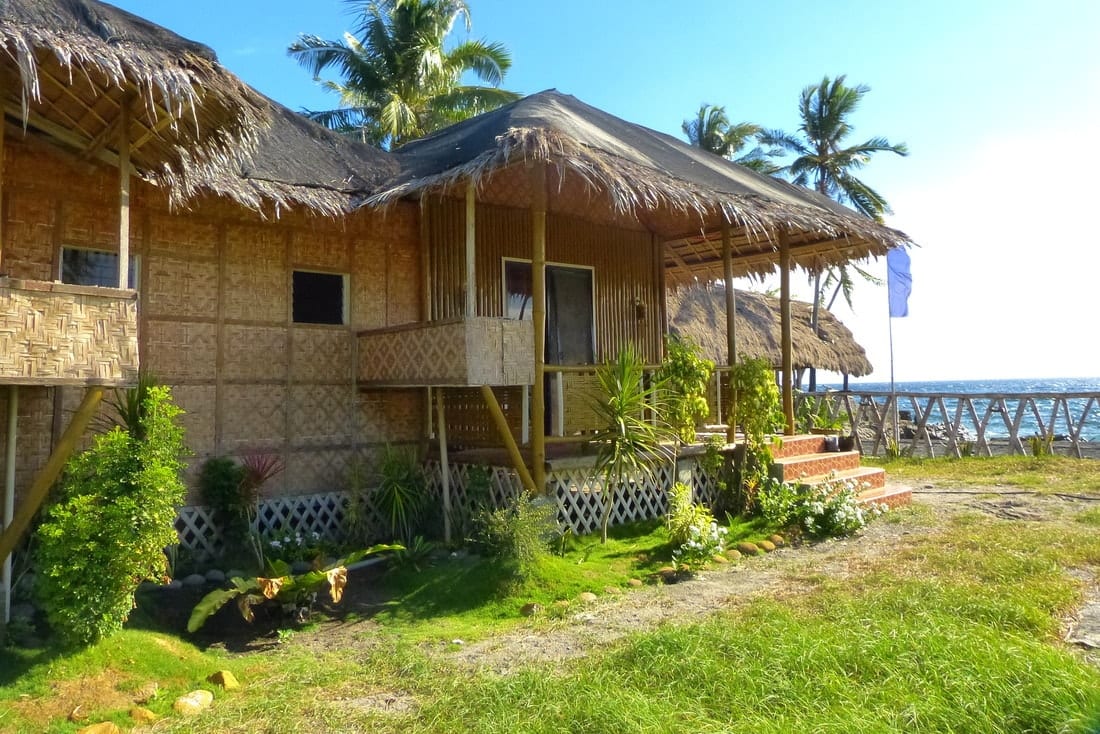
Cheap accommodations are easy to find in the more touristic areas, though not as common on the lesser-known paths, where the hidden beauty of the Philippines is sometimes to be found.
Consider a cheap room for up to 500 pesos (10€). More popular areas often offer great value for money. Check out these affordable resorts in Batangas.
In less tourist areas, love motels are a good value; they have a price per hour, but you can get a whole-night deal, and bargain hard.
Couchsurfing is quite popular in medium/big cities, but don’t expect it to be easy. It might be worth a try anyway when backpacking the Philippines. Warmshowers has a few active members who are very nice to meet.
While Filipinos are generally very friendly and smiling people, being invited by strangers to their homes never happened to us; it’s one of the few countries in twenty-six so far (2018) where nobody even treated us to a meal. But it might have been just a case.
We found it common in the Philippines for locals to think all foreigners, no matter whether they are backpackers or cyclists, are rich (we were asked seriously whether we had come by private plane).
So they will try to charge you often higher prices, sometimes even crazily higher. Bargaining for a reasonable price is often necessary, especially for accommodation and sometimes even for cigarettes.
Food
How to eat on a budget in the Philippines
When it comes to meals, you can really stay on a tight budget in the Philippines, with a basic one in a cheap restaurant going around 1/1.50€. Vegetarian options are not many.
But not everywhere will you find a restaurant. If you are on the road, you will get to know the eateries.
Those are stalls where already-cooked food is served; the range of choice really depends on the area. In some guiltily forgotten stretches of coast in Negros, you could happen to find just a few boiled fish for kilometers.
Though mostly of a middle- to low-level, eateries can sometimes be surprising and give you a taste of real Filipino street food and homemade cuisine.
Another positive aspect of this place is that you can eat a lot for less than 1€. Beware of your immune system’s strength if you’re flying straight from a very high-hygiene-standards country.
Very common are food carts selling fried chicken for as low as 10 pesos per piece, and hamburger stalls where you can buy a burger and grab one free, two hamburgers for 0.40€. Even though not very healthy, sometimes junk food is just what we want. Especially for this price.
Bakeries are another good deal; they are almost in every village and give you a vast choice of very cheap, decent sweets for 2/5 pesos, almost free.
Supermarkets are rare and can be found only in the major towns. Don’t expect the Japanese variety here. In the countryside, there are small shops that sell all the basics. Even though those are not very common, always having a little food is a good precaution.
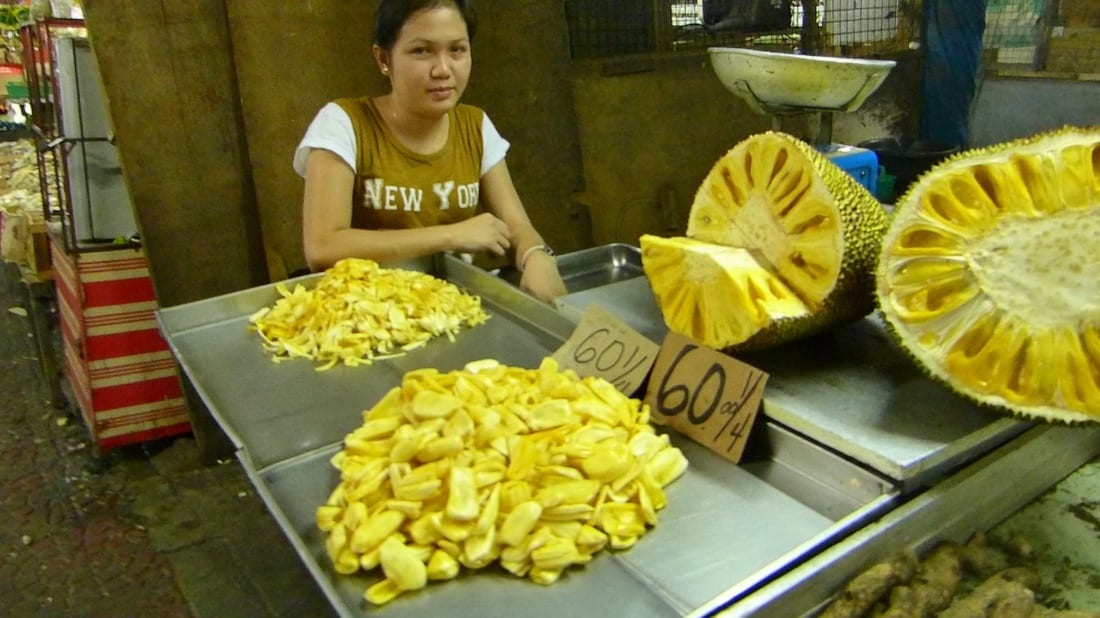
Tropical fruit of the Philippines
Fruit comes in an overwhelming variety throughout the whole year, but it’s not as cheap as you may have thought. Anyway well worth it, you don’t want to miss the tropical fruit experience for just a few bucks.
Local markets are where the best deals can be found; they are nice, dark, sometimes crowded, and regularly dirty places to have a taste of real local life.
Liquids
Tap water is not drinkable, but water refill shops are everywhere. In these places, you can fill your bottles for almost nothing, sometimes even for free.
Beer is widespread and the cheapest in Southeast Asia. 26 pesos is the price of a small (33cl) beer in the Philippines supermarkets. Another thing to enjoy in here.
Local Ron is dirt cheap and surprisingly good; you can buy half a liter for less than one dollar, and, though I am not a sommelier, I can say that it tastes better than many commercial Ron sold in Western countries.
Remember that getting drunk while cycling or backpacking in the Philippines (or any other country) is not a smart idea.
Connectivity in the Philippines
Free wi-fi hotspots are not common here. This is not Korea, but it is very easy to get a local SIM card with data traffic. Those are available in every mobile phone shop and even in stall-style shops.
Activities in the Philippines
The Philippines has so many beautiful and interesting things to do for free that you don’t really need to spend money on activities. Some of those are even unethical, like swimming with whale sharks in Cebu.
Worth a few bucks to visit some offshore small islands, like Malalison in the Panay area.
Cycling Philippines – Road conditions
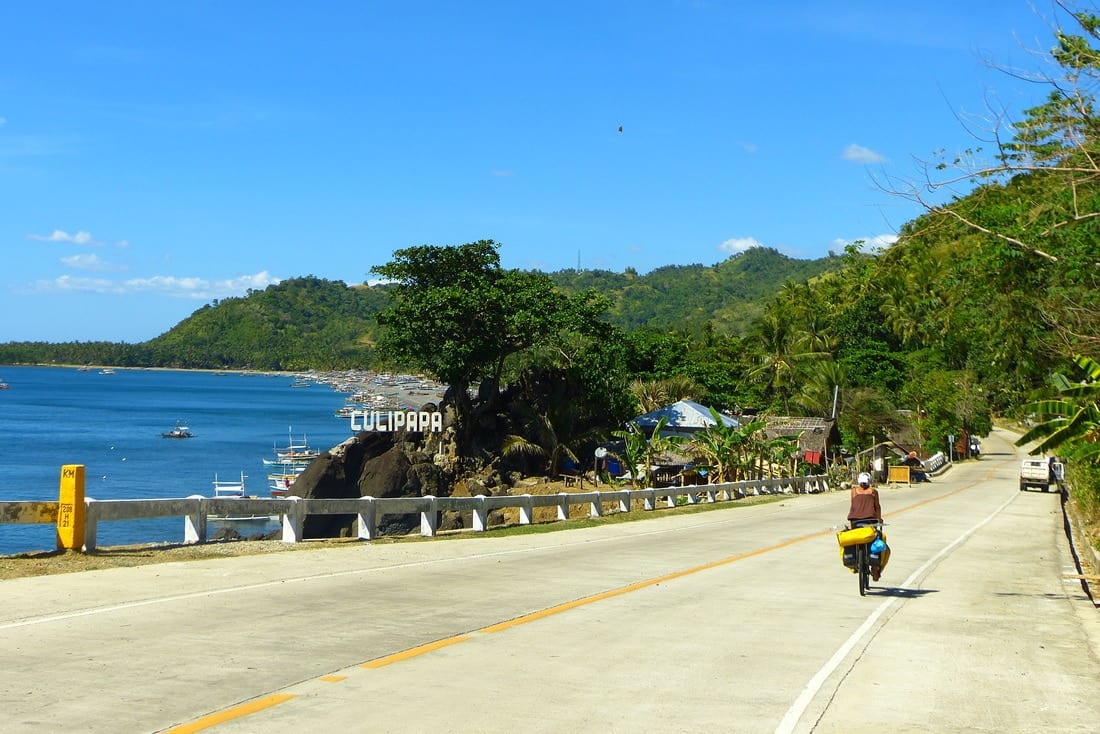
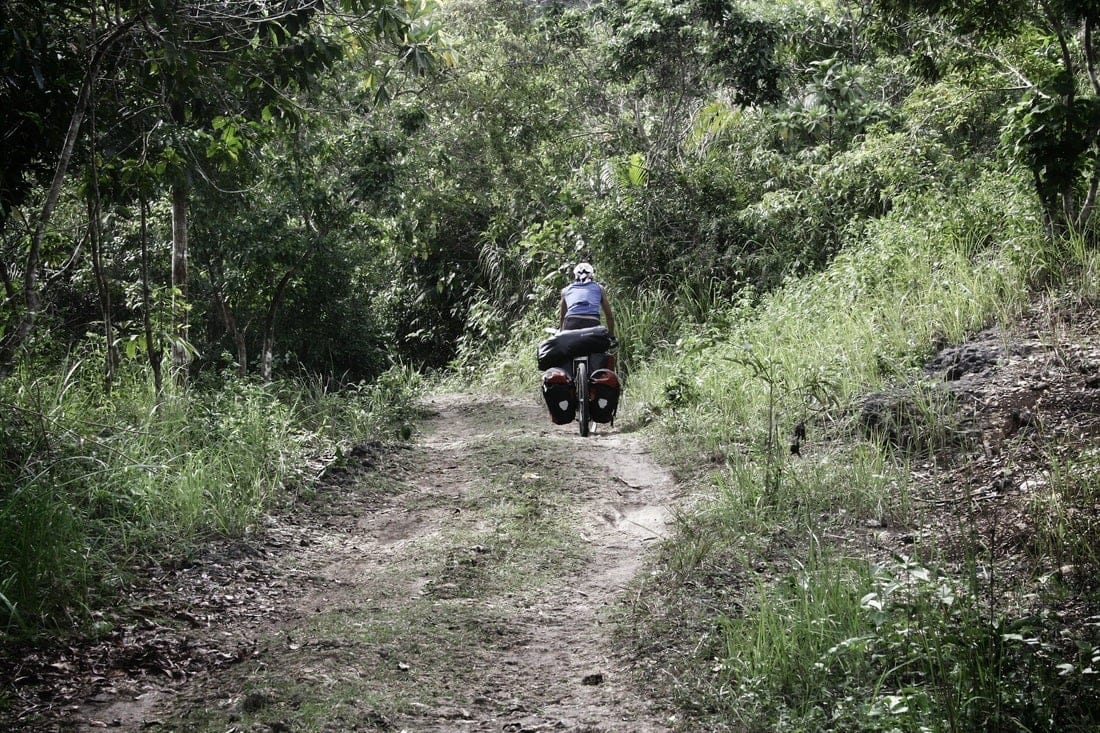
Roads in the Philippines are surprisingly good for a country as poor as the Philippines. Most of them are sealed, with asphalt or sometimes concrete, and you can find dirty tracks if you try to get deep into side roads to find a spot to free camp, for example.
It’s easy to find plenty of dusty roadworks; usually, they are not long stretches, and they are for making everybody’s life easier in the future, so tolerate them.
A nice thing for beginners considering a bicycle trip in Southeast Asia is that it’s really easy to ride long distances in the Philippines without needing to shift gears. Coastlines are mostly flat, and landscapes are beautiful.
Traffic in medium/big cities is always a mess, with local transport darkening the air with its pollution.
But just outside the urban area, traffic lights, and you will share the road with a few jeepneys and tricycles.This will stay true only if you avoid the main roads.
Anyway, you will seldom find yourself alone if you cycle in the Philippines, as long as you stick to the pavements.
The road network doesn’t give you a lot of choices but there’s usually at least one alternative, consisting often of riding the island from the other side, if the main road follows the east coast you will choose to ride the west.
Transportation in the Philippines
Traveling in the Philippines by ferry boat
Yes, islands. Many, small and big, far away and close to each other, an archipelago indeed. So, dealing with boat transfers is almost unavoidable when cycling or backpacking in the Philippines.
Ferries in the Philippines are managed by plenty of companies, understanding the schedules it’s a brain-toasting game, better just to show up at the port or the jetty for medium/short distances and find out there. The view from the deck is often pretty spectacular, and it is to me a significant part of the trip.
Insider Tip! It can get surprisingly windy and chilly when traveling by boat in the Philippines, even when it is very hot. Always include a light windstopper in your Philippines packing list.
Philippines speedboats
There are several kinds of boats that connect these 7,641 islands. So-called fast boats are the most common and frequent for medium/short distances.
Usually, medium-sized two-story ferries with the bottom one enclosed and air-conditioned to arctic temperatures, and the top one open to the sides, your choice.
Odd-size baggage is kept on a small open deck at the stern of the boat and covered by a waterproof tarpaulin, this is where your bicycles will end up, together with all sorts of heavy and odd stuff the Pinoys always carry on these ferries.
The loading procedure is not super-easy; there is a small plank that connects the stern deck to the jetty, always with steps. Usually, porters on these ships don’t charge any tip, but I will avoid letting them handle my bike without my supervision.
An odd-size baggage fee always applies, together with a port fee, all of which are to be paid at a different desk, while ubiquitous mariachi-like guitar bands play folk songs in front of the closed gates to the jetty. It’s more fun in the Philippines.
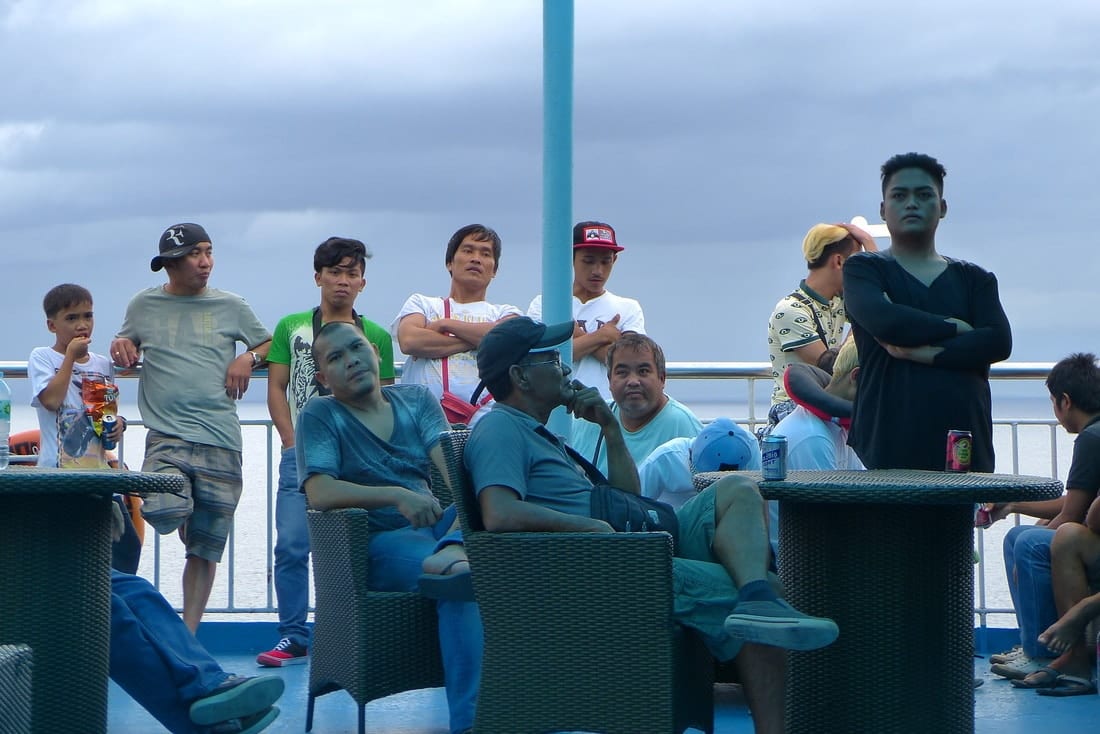
RoRo ferry, the bigger ships
If you want to avoid the pain of loading and don’t mind going a little slower, there is always at least one RoRo ferry that connects adjoining islands.
Those are the ferries where the vehicles are loaded, which are much easier to board and have larger decks. Their departure schedules are not as frequent as the fast boats, usually one or twice a day, and there are even fewer boats on the long-distance routes.
RoRo ferries are indeed sometimes the only option for distances above 100km, and if not, they are way cheaper than a fast connection.
For the long rides, the boats are equipped with rough, common dorms, no blankets provided, and a smelly experience.
But these boats can be a lot of fun, with a simple bar, karaoke (called videoke), and sometimes even unexpected group dances performed by the crew(!). It’s more fun in the Philippines.
Pump boats – only for the fearless
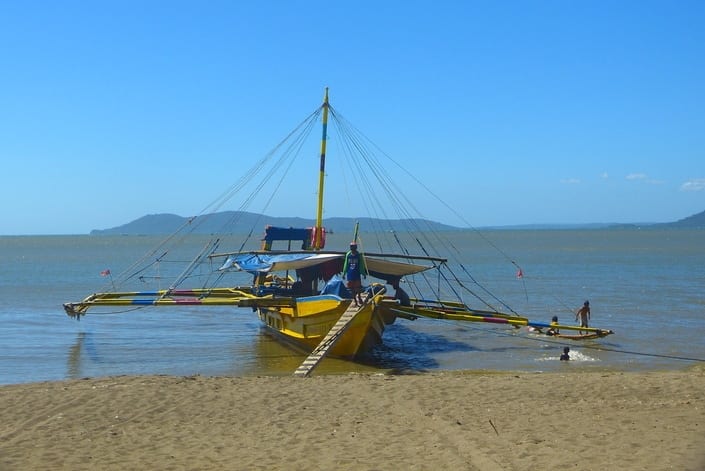
Pump-boats are used for short distances; traditional wooden boats with two floaters on each side.
Loading cargo here is much worse than on the fast ferry; there’s not even a jetty, and you get on the boat straight from the beach, dragging your bike through the sand.
You won’t be alone, though, because people also used to load scooters on these boats; you will be amazed to see how they do.
Sailing on a pump boat is an experience in itself, but it can also be a scary one. In less touristy areas, these boats can be maintained, but without any safety equipment at all; avoid them if the sea looks rough, especially if you are seasick. Our sailing from Negros to Guimaras was one of these bad-feeling experiences.
Overall safety is honestly a concern when traveling by boat here, given quite a few recent fatal accidents.
More information on ferry connections in the Philippines, with links to the main companies’ unreliable websites (where you can find schedules for boat trips), can be found in this article.
Land Transportation
This is where Filipino creativity really blows your mind. Local transport here is weird and noisy, with handmade vehicles of several types.
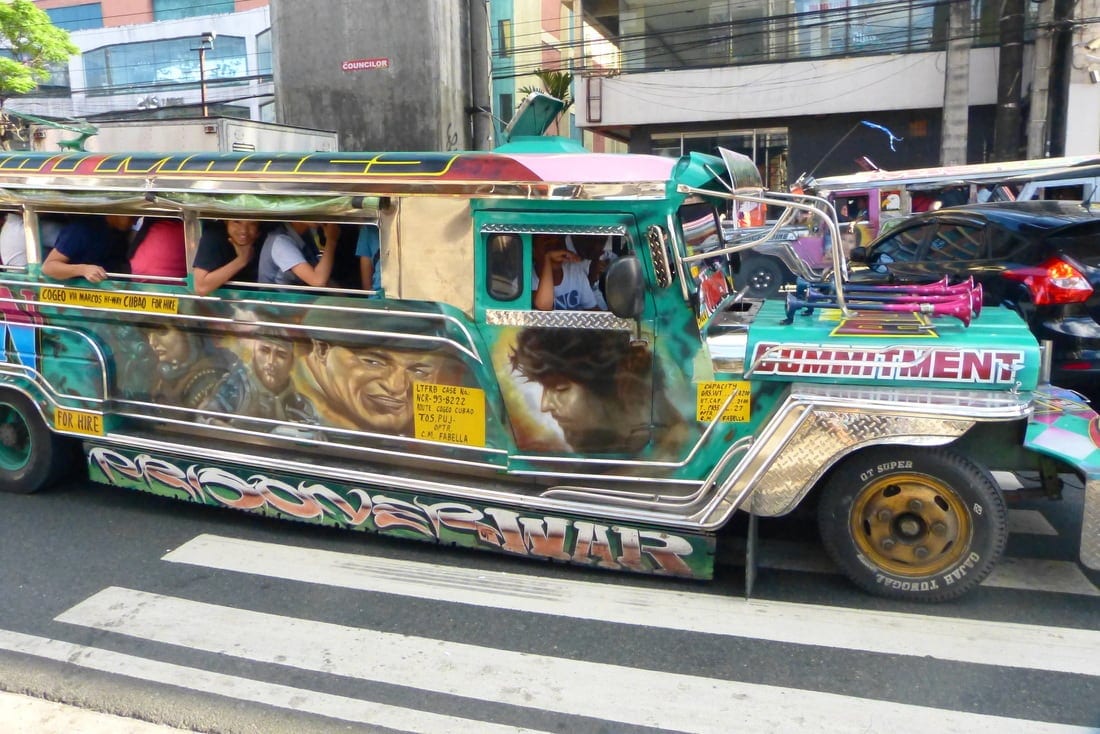
Jeepneys are my favorite; this sort of crazy minibuses was originally made by modifying American four-wheel drive military vehicles left behind after the war. Now they are almost 100% handmade; you can see the hammer marks on the hull.
Usually spray-painted with kitsch designs that often include: a Christian figure (Jesus, St.Nino, and Maria are the most common), a member of the family’s portrait, and something about speed or superheroes (Ferrari, horses, Spiderman, and even manga heroes).
Jeepneys connect villages in the islands, and I bet it’s not hard to put your bike on the roof, although we never tried.
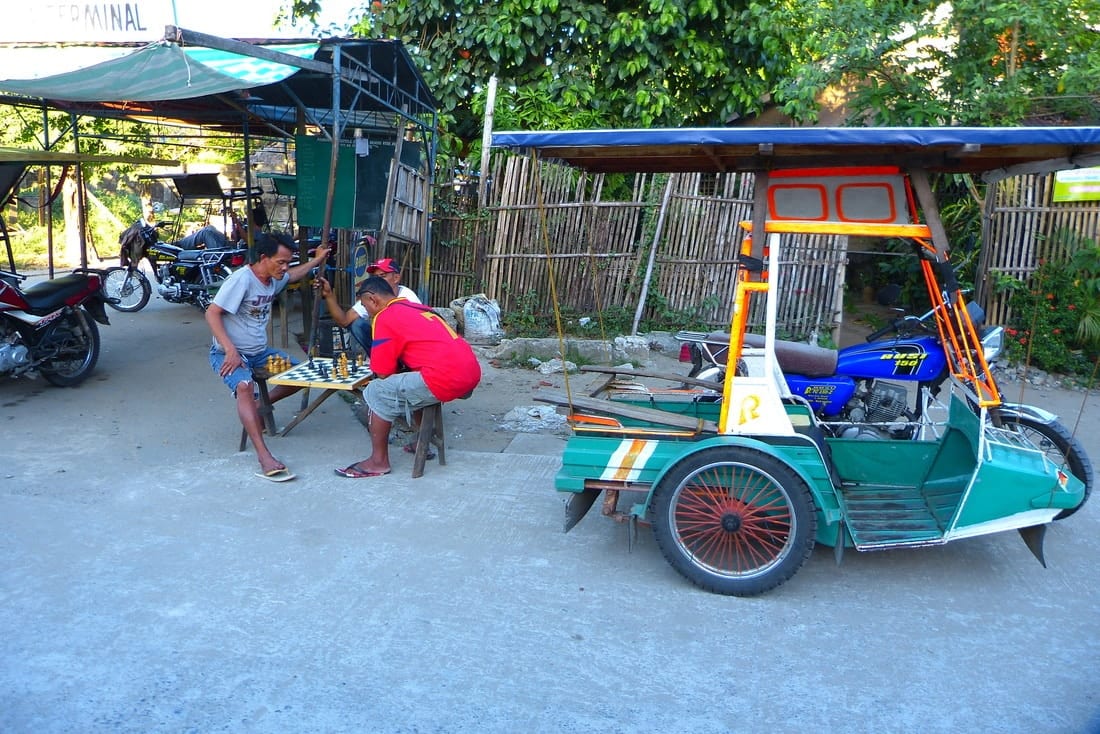
Tricycles are also very funny; they are small motorcycles with a covered, handmade sidecar in various shapes.
It’s not rare to see as many as 15 people on one of these toys. They are good for short distances (up to 10km).
Not a great option for cyclists, even though I would not be surprised if the driver could find a place for all your stuff for a small surcharge.
Long-distance buses are available in major towns and are more common in Luzon (the largest island where Manila is located).
It’s usually possible to put bikes on these buses, paying a small overcharge directly to the driver.
Be careful of your luggage if it is in the trunk when the bus stops, especially in big cities. Your best bet would be to travel with a carry-on backpack so you always have it with you.
Overall, public transportation is a great, easy, and cheap way to backpack the Philippines on a budget. The lack of comfort is compensated for by memorable experiences.
Flying in the Philippines
The Philippines’ national airline is Cebu Pacific, one of the most bike-friendly airlines. They offer very cheap rates on sports equipment up to 40kg and fly to many destinations in the Philippines and Eastern Asia at a low cost.
Weather in the Philippines
From the useful weather-and-climate.com:
“Most of the Philippines has a typical tropical marine climate. So you will find typical hot and humid weather throughout most of the year. From June to September, the country experiences a rainy season. In this period, typhoons are common. From October to February, the northeastern monsoon brings cold winds from the north, creating cool, dry weather. From March to May, the Philippines experiences very hot summers. The country’s average temperature ranges from 25 to 32 degrees Celsius (78-90° Fahrenheit), with humidity around 77 percent. Highland areas are much cooler, with nighttime temperatures at night dropping to 20 degrees Celsius (68° Fahrenheit)…“
This scheme can be delayed and modified during El Niño occurrences.
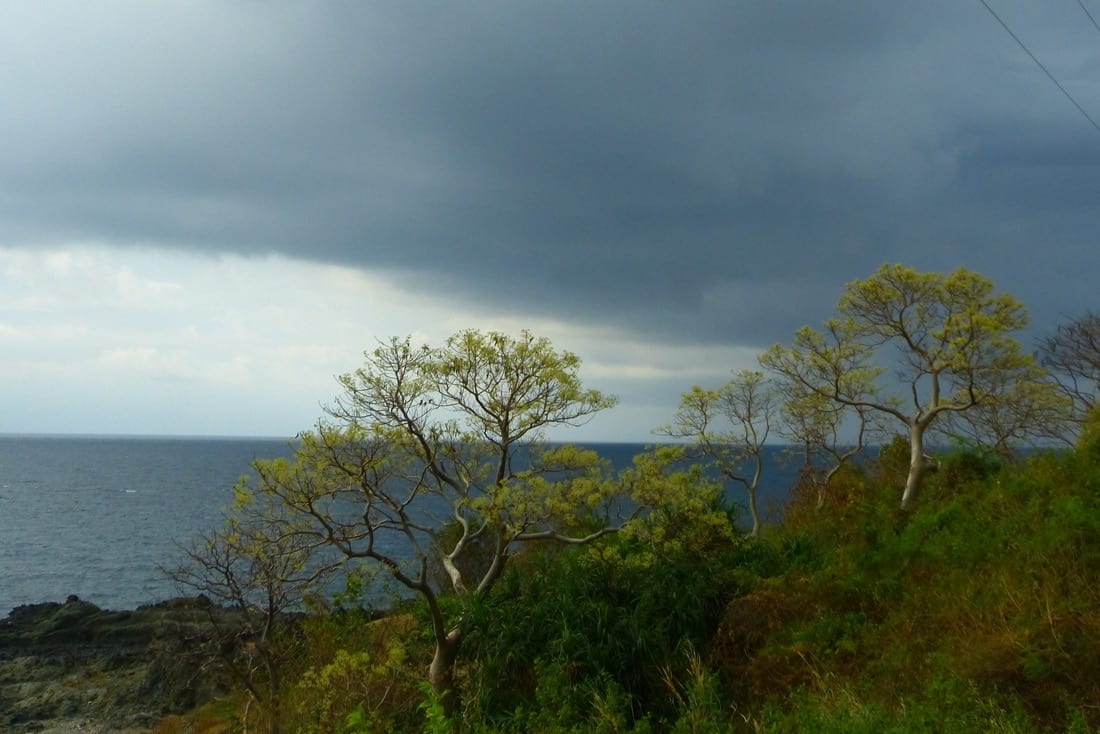
Expect short tropical showers even in the dry season, and welcome these as appropriately refreshing moments from the usual bloody hot.
Consider this when planning steep climbs in the interiors; it’s not for the fainthearted. If you suffer from the heat, stick to the beautiful coastlines, with the sea always by your side for a quick cooling.
Safety concerns in the Philippines
Criminal rates in the big metropolitan areas of the Philippines are high, but don’t imagine some sort of far west; it is not.
Watch your things as usual, keep your money safe, and, as a general rule of common sense, don’t show off your wealth if you have any. Watch your step in the darkness, and look far ahead to where you’re heading to be warned in advance of suspicious situations (these rules are valid everywhere in the world).
In the rural areas, the atmosphere is really relaxed and people are mostly friendly, it’s a crowded place so you could happen to meet some crazy or drunk, or some desperately poor fellow looking for your sandals. Take care of your stuff if you wild camp.
Suggested itinerary map
Here is the map of our Philippines tour, as recorded by our GPS. It includes elevation profiles. Jump to our bicycle touring or backpacking in the Philippines itinerary for more details on our suggested routes.
Follow our budget-friendly adventures