

Last Updated on 17 January 2026 by Cycloscope
Bicycle Touring in Borneo between Malaysia and Indonesia
How to cycle past the border and find yourself in the wilderness of Kalimantan
As far as we could figure out, there are three international overland border crossings between Sarawak (Malaysia) and Kalimantan (Indonesia):
- the busiest and biggest at Entikong (ID) – Tebedu (MY), on Malaysian H21 south of Serian
- the small Lubok Antu (MY) – Nanga Badau (ID), next to the reservoir of Batang Ai
- The little-known Aruk (ID) – Biawak (MY), near Lundu
Disclosure: Some of our articles contain affiliate links. This comes at no additional cost for you and helps us keep this website up and running. (as Amazon Associates we earn commission from qualifying purchases)
Two more land crossings are between Serikin, Sarawak, and Jagoi Babang, West Kalimantan, and Bakelalan, Sarawak, and Long Bawan, North Kalimantan. Still, these are closed to foreigners(if you have different knowledge, please comment).
The only border where you can get an Indonesian Visa on arrival is Entikong-Tebedu; for all other options, you should already have a visa in your passport.
Being already in Lundu, willing to avoid busy highways, always aiming for backdoor entrance to off-the-beaten-path destinations, and, most important of all, having a wonderful 60-day Social Budaya Visa for Indonesia, we decided to cross the border of Biawak – Aruk, in this remote point:
GPS coordinates
1°36’43.8″ N 109°40’46.9″ E
Lundu to Aruk/Biawak border – 25km
It has been a wonderful two months here in Malaysian Borneo; so much of it will stay in our most dear memories, but it’s time to change, time to explore a fascinating and mystical country we’ve dreamed of visiting since childhood: Indonesia.
Saying goodbye to the Rafflesia, we leave Lundu to reach the Biawak – Aruk border after just 25km. There’s a restaurant before the border on the Malaysian side, and we eat here, worried about the nothingness that we may find on the other side.
Everybody scared us about this route, saying the road is terrible and that there’s nothing on the way; most of these people, though, have never been here and speak from hearsay.
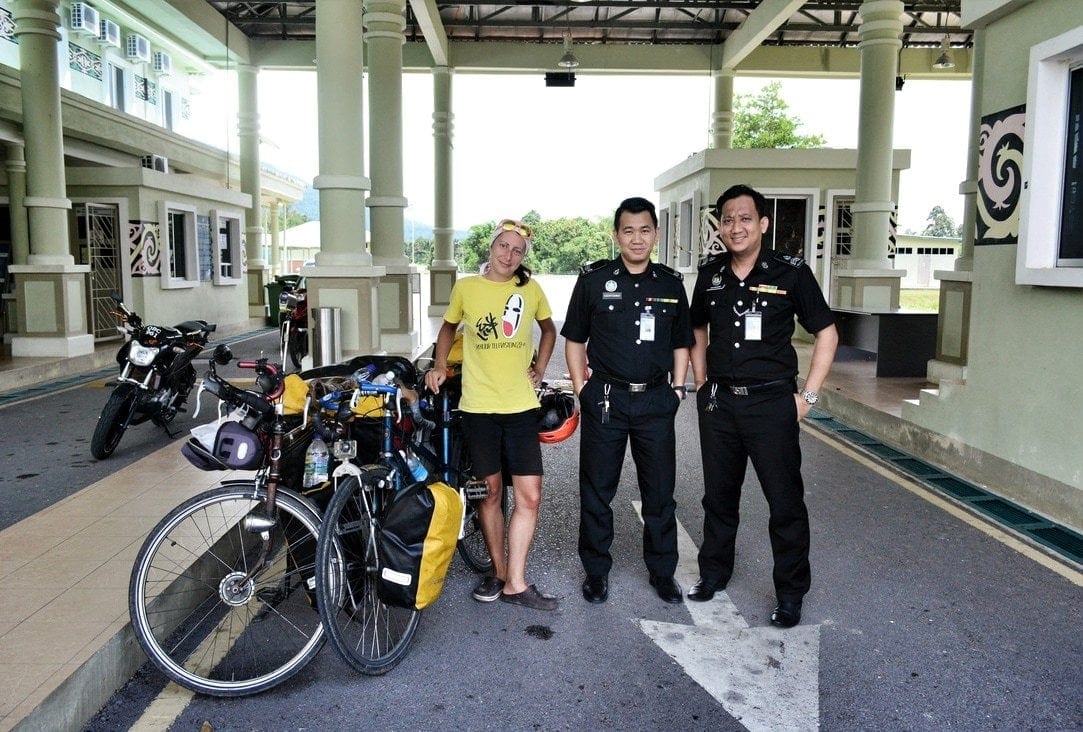
Of course, not many foreigners cross the border here, so we have to take pictures with everybody, the Malaysian police first, and then the Indonesians. Apart from this pleasant waste of time, the crossing is pretty straightforward (even though I got a wrong stamp, but I’ll realize this later on, check your stamp before leaving!).
As soon as we set foot on Indonesian land, we find out that the “awful road” panic is quite baseless, at least for now. The road here is paved, and there are so many different little restaurants. We stop to drink a cup of coffee while waiting for the usual shower to pass by.
Aruk border to the unnamed village’s church – 33km
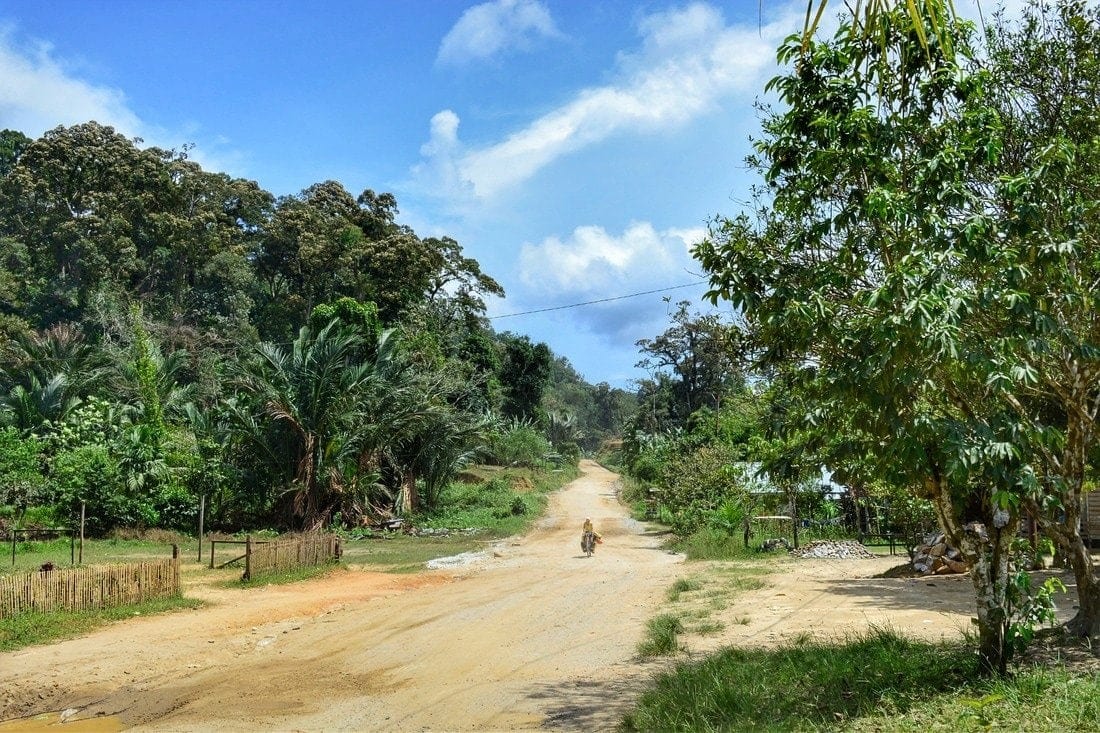
After a few kilometers, the dirt road begins, is flat and easy to ride, and we pass through very nice little villages. We note immediately that Indonesians are very different from Malaysians.
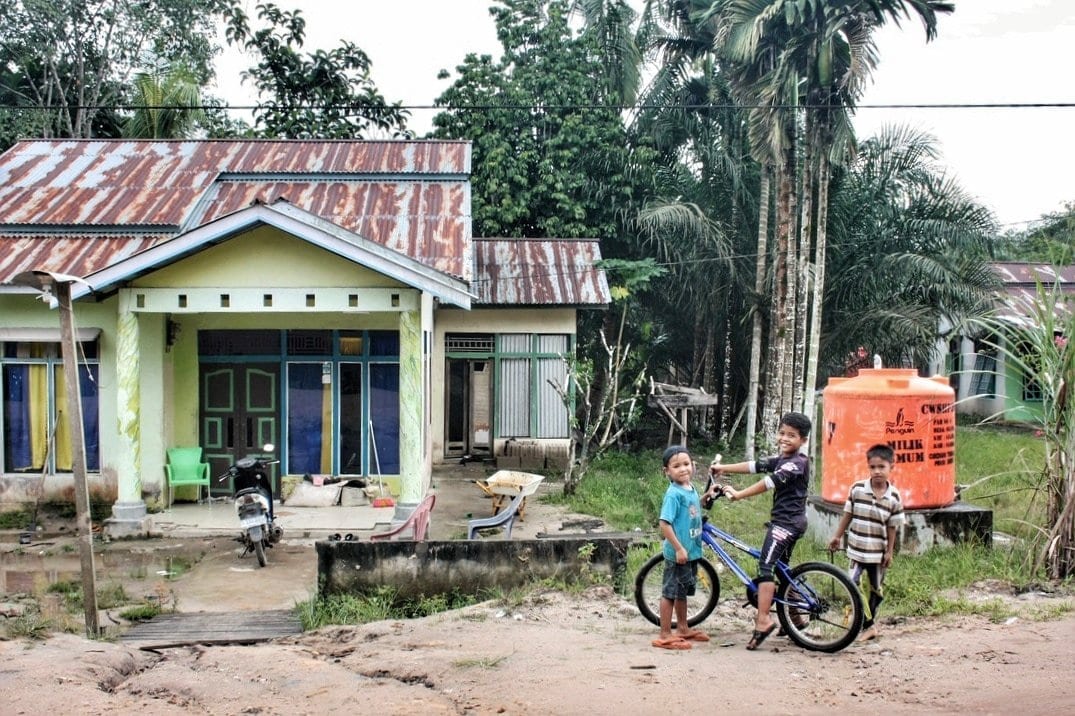
The Malays were not very surprised to see us, but here everybody greets us: “Hello Miss” or “Hello Mister”, it doesn’t really matter to whom it is addressed. They stop us and ask for pictures together.
Almost nobody speaks English here, so we will learn a few words of Indonesian, which is nearly identical to Malaysian. Even nature is immediately different, wilder, and lusher, at least in this area.
20km past the border, there is a short climb, of course, here the road conditions are the worst seen so far, and, as in the greatest classics, a tropical storm begins while we’re coping with the steepest part, which immediately becomes muddy and slippery.
The guys behind us on a motorbike fall off, and luckily nobody gets hurt, so we start laughing at our misadventures.
They’re wondering where we’re going and where we’ll sleep. We tell them we don’t know and that we will find a campsite somewhere.
It’s five in the afternoon. One of them is a priest, and he tells us that he knows another priest who can accommodate us 10 kilometers away. They ride a motorbike to warn us of our arrival.
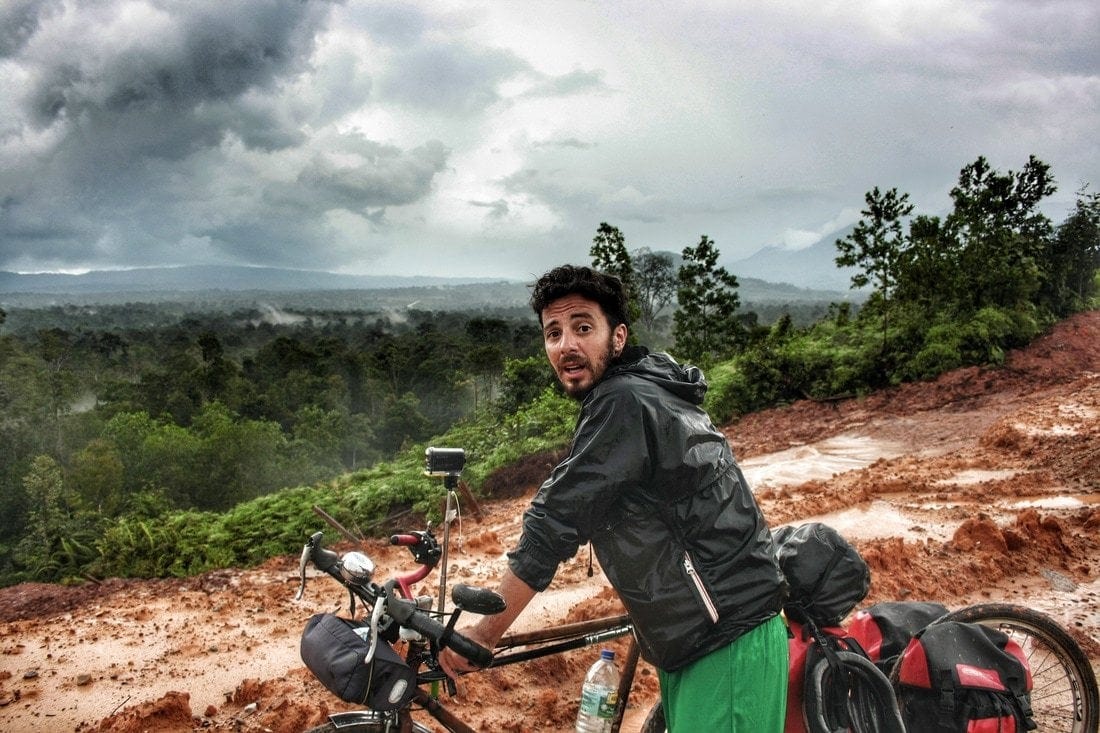
Rode those ten kilometers, we arrived in a small village of five or six houses, a man who didn’t look like a priest at all came out of the bar and waved us! He’s indeed the rude deacon of the small local church.
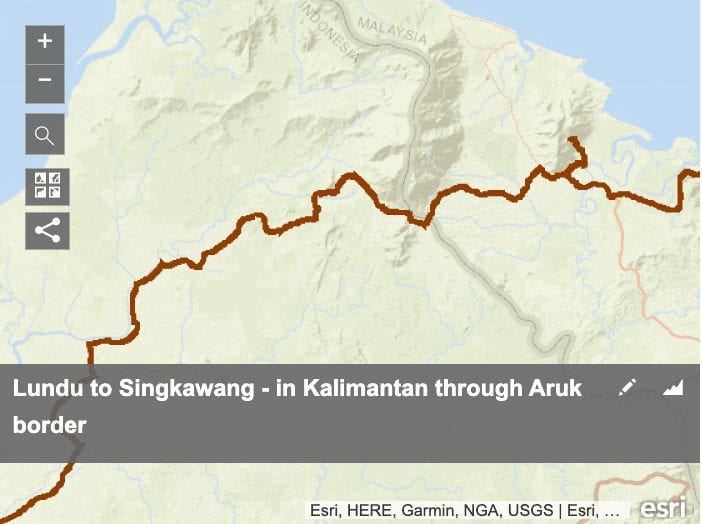
He brings us to a house with several small rooms housing children aged 12 to 16, probably an orphanage (see the map). We are given one of those rooms. He does not speak a word of English, but he’s funny in all his roughness and hoarse yelling.
We take a bucket shower and go to the bar where we met him before, but he’s not there anymore. All the people in the village are there, but not him. We meet him again in the morning, have breakfast together at his sister’s bar, take a photo, and head to Sambas.
Unnamed village to Sambas – 50km
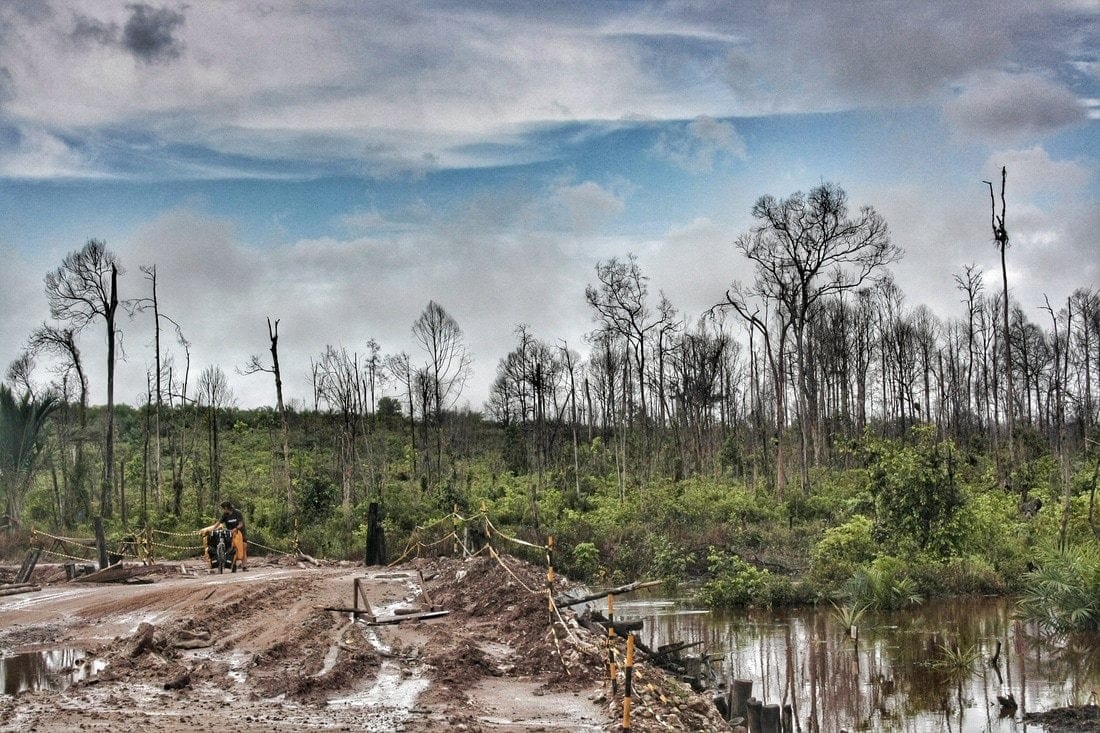
All night it rained, and the road had become a river of mud. In particular, there are a few stretches where roadworks are underway; here, trucks with their weight sink into the mud, creating veritable rivers.
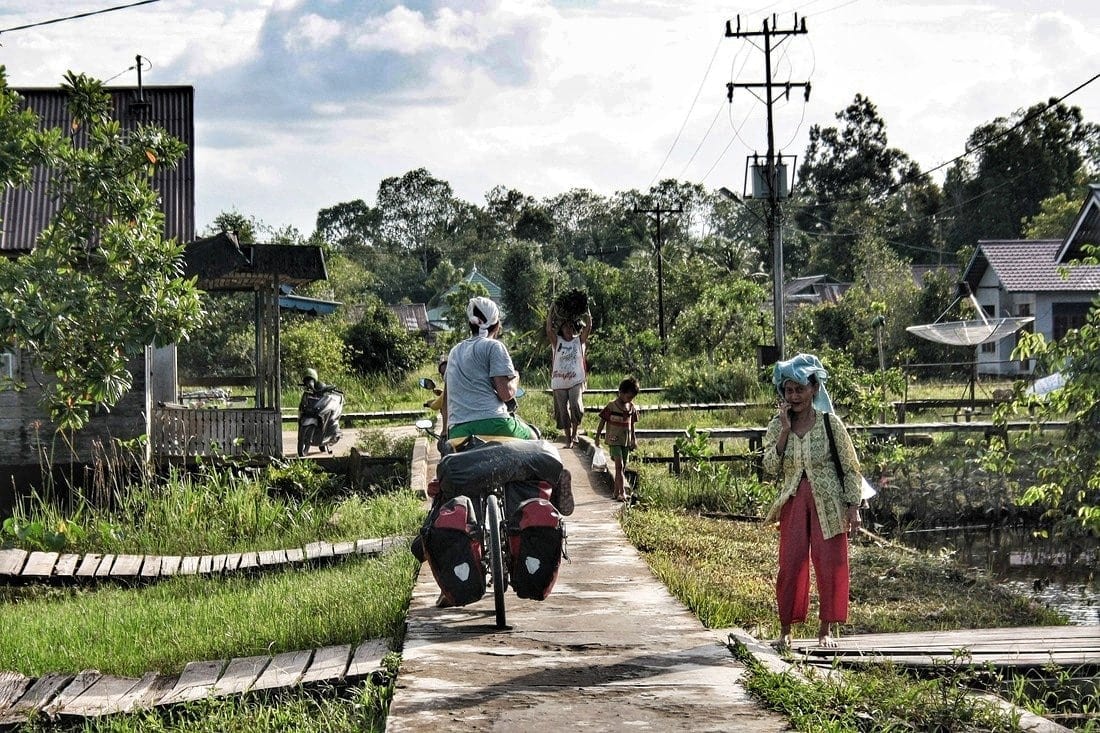
When, finally, the asphalt begins again, driven by a masochistic instinct, we abandon the main road for an alternative route.
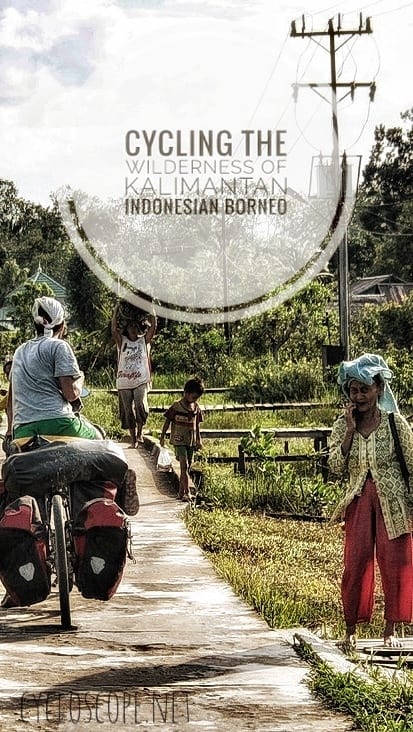
In the beginning is full of holes then it improves and becomes a narrow concrete path, where only bicycles and scooters can pass, we pass through beautiful villages along the river.
The houses are built on the marsh; they are colorful, made of wood, and so different from each other. If we meet someone coming from the opposite direction, we have to stop; this road is that narrow.
But it’s here that finally, after more than two months on this island, we feel as if we are in the Borneo of novels, wild, lush, and populated by outlandish folks.
We finally arrive in Sambas, where we find an inn for 125,000 rupiahs, 8 Euros. Huge and spotless room with a great view of the river and, not least, alongside a car wash.
Very profitable business here, since anyone who comes from the road we have traveled has to wash his/her vehicle.
We bring the bikes covered in mud and they wash them carefully, we ask how much it costs, but they don’t want any money.
Like this article? Please share it!
Have thoughts about it? Comment!
Our previous adventures in Borneo
pt1: from Kota Kinabalu to Tenom, crossing the Crocker range
pt2: Jungle Train, from Tenom to Beaufort
pt3: crossing Brunei by bicycle
pt4: around Miri, Lambir Hills and Logan Bunut national parks and Tusan Beach
pt5: the caves of Niah National Park
pt6: from Belaga to Kuching by boat
pt7: Kuching and Bako National Park
pt8: Rafflesia in Gunung Gading National Park
pt9: Overland Border crossing from Sarawak into Kalimantan, the secret Aruk border (you are here)
pt10: Sambas, the wooden Venice of Indonesian Borneo
Reportages
Chap Go Meh in Singkawang: piercing yourself with swords to please your Gods
Hydroelectric devastation in Borneo
Part 1: Interview with SaveRivers
Part 2: a visit to Sungai Asap
Here are some general hints for budget travel in Borneo (by bicycle or not)
Map of the road from Lundu to Singkawang through Sambas and Aruk
Follow Us