

Last Updated on 17 January 2026 by Cycloscope
Things to do in Nusa Penida
the ultimate travel guide and itinerary to see the best of the cursed
sister of Bali
Explore the black magic island: beaches, temples & more
In this article, we won’t just offer you another list of things to do in Nusa Penida but also an insight into its peculiar culture and the myths that envelope it.
Disclosure: Some of our articles contain affiliate links. This comes at no additional cost for you and helps us keep this website up and running. (as Amazon Associates we earn commission from qualifying purchases)
Although it has recently become more heard of, Nusa Penida is still the less touristy place around Bali, but that’s not going to last long, so you better head there as soon as possible.
Here the Balinese culture is more authentic, visiting Nusa Penida will get you an idea of how Bali probably looked like 40 years ago.
As soon as we approach the port of Sampalan, we immediately notice how clear the water is, we can see meters deep. Setting foot on the island, wandering a bit around in search of an accommodation, we see many bare-brested women, as it was common on Bali up to 50 years ago.
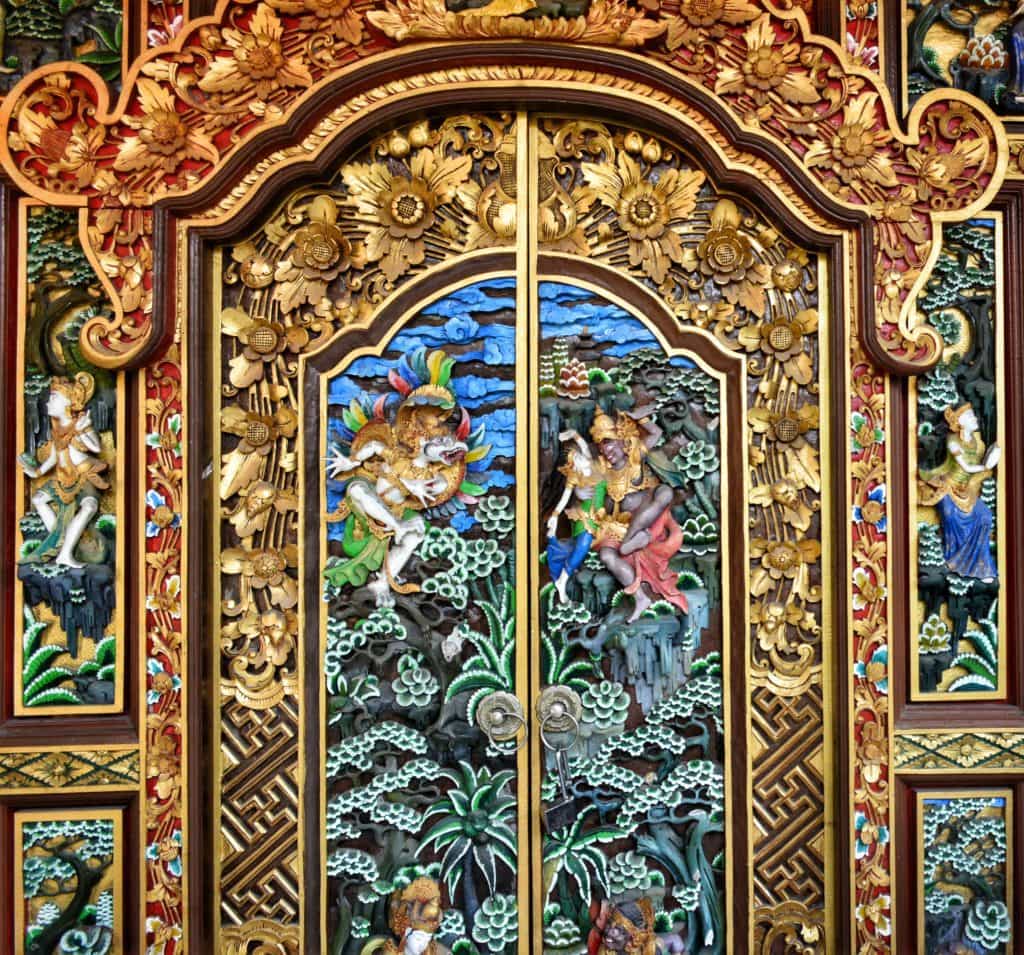
The architecture is in typical Balinese style, each house has its own shrine, the doors beautifully decorated with intricat mythological motifs.
Check also
Cycling Bali: itinerary and hacks to explore Bali by bicycle
Where to see Legong and Barong, the traditional Balinese dance
History and modern practice of Kecak, the “monkey chant” of Bali
Things to do in Nusa Penida in a Nutshell
- Diving (Manta Point)
- Snorkeling (Crystal Bay)
- Swimming
- Hiking (Teletubbies Hills, Tembeling Forest)
- Visit Temples (Cave Temple, Car Temple)
- Cycling around the island
- Birdwatching (look for the Bali Starling)
- Playing Gamelan with Locals
5 Facts to Know about Nusa Penida
1 – The island of darkness
Here they live, mulling over evil doings in the darkness of deep caves, below the nervous waters crashing on the deadly cliffs. All those things whose names must be kept secret.
Nusa Penida is the nemesis of Bali, its dark sister, the place where all the evil entities reside. Ghosts, demons, dark spirits, and the most fearsome of them all: I Macaling, the bearer of diseases.
Also known as Jero Gede Macaling, this dark manifestation of God is blamed for every environmental disaster in Balinese land.
Stories of his origins mostly refer to the half-mythological times of the Majapahit invasion of Bali, when he was still a human, hand of the King Dalem Dukut, ruler of Nusa Penida.
Thanks to his army of invisible creatures (wong gamang), I Macaling repelled the invasion of the Majapahit twice before being killed by the fang of a Naga (holy snake, or dragon).
His name indeed comes from the word Caling, fang in Balinese. It was this metaphysical battle of light and darkness that gave the island its name. Nusa Penida, the island of priests.
His power though was so great that he became a God, capable of bringing havoc to the kingdom. Only by paying him the due respect, disasters can be prevented.
That’s why every Balinese Hindu must make a pilgrimage to this island at least once in a lifetime (the more, the better) to visit the Pura Dalem Ped, the temple where I Macaling is buried.
Nusa Penida is still considered Angker (scary, terrifying) by the Hindus of the “mainland”, black magic is believed to still be practiced. Some locals told us that it’s true.
In any case, Balinese Hinduism respects both good and evil, which are equally necessary to keep the universe in balance.
2 – Geography of Nusa Penida
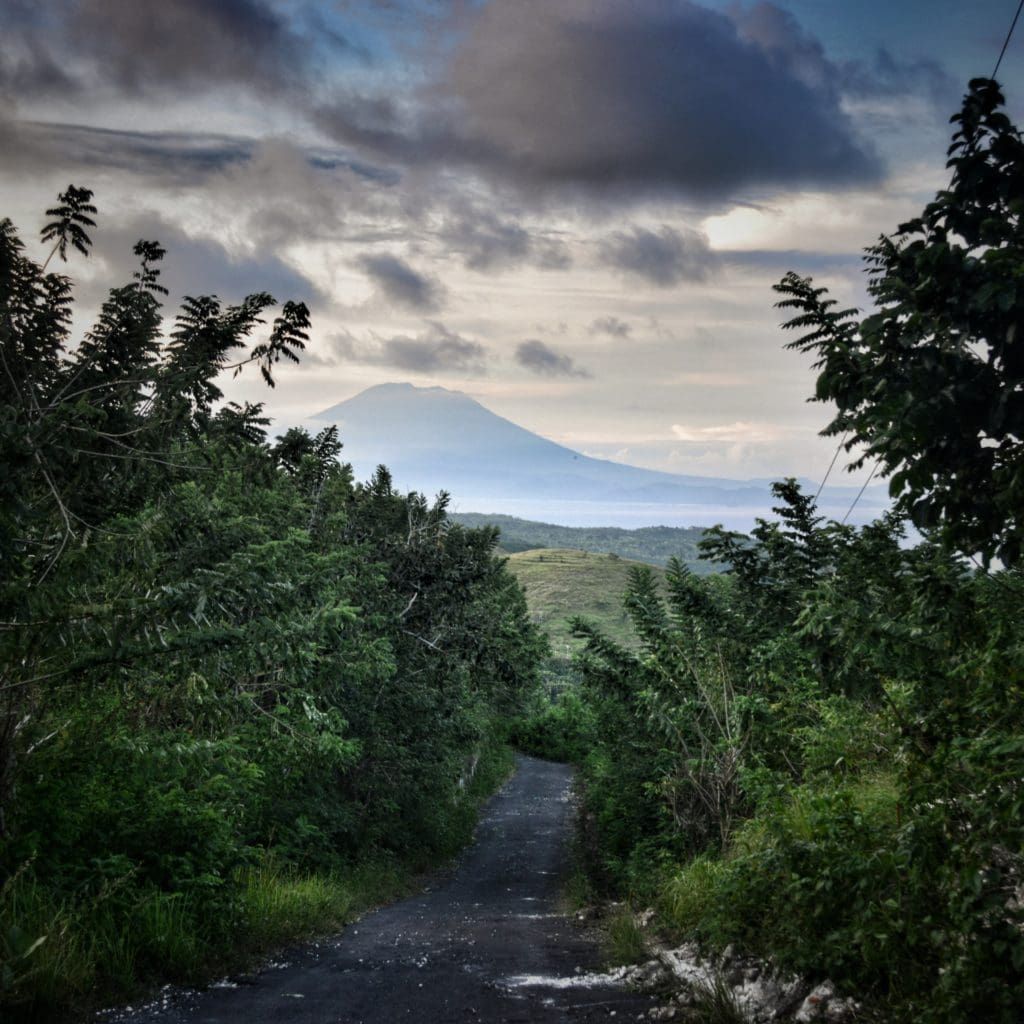
That Nusa Penida is the nemesis of Bali is also just so evident when you first cast your sight on it.
Its territory is completely different: although it is a great destination for a tropical holiday, Nusa Penida is pretty arid for being so close to the equator, with low vegetation and no volcanic sand.
Nusa Penida is a limestone plateau, mostly made of white rocks. Except for a few wells drilled in the low coastal regions, all local water comes from concrete cisterns called Cubang. There is generally a large, concrete underground storage tank, again lined with concrete.
Cultivating rice is almost impossible, and all of it is imported. Nusa Penida’s economy is largely based on fishing, corn, sweet potatoes, and, most importantly, seaweed.
3 – The seaweed farming in Nusa Penida
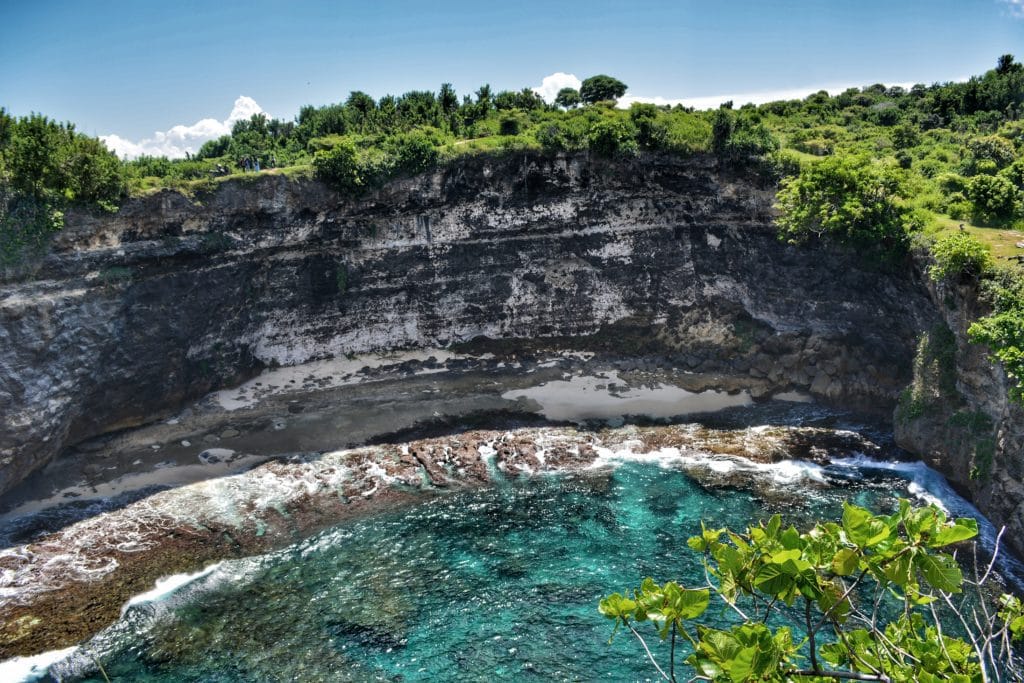
The largest and most interesting export industry is the commercial cultivation of seaweed, which takes place along the northwest coast of Lembongan, in the channel between the two small islands, and along the north and northeast coasts of Nusa Penida.
Almost 900 families, or a total of about 2,700 people, participate in this industry on Nusa Penida. The beach-dried product is sent by boat to the mainland and exported from there, either to Japan or to Denmark, for processing into Agar or Carrageenan.
4 – The rarest bird in the world, the Bali Starling
Nusa Penida and the neighboring islands of Lembongan and Ceningan are bird sanctuaries. The island communities have used traditional Balinese village regulations to create the sanctuary with the help of the Friends of the National Park Foundation (FNPF).
In 2006, all 35 villages (now 41 villages) agreed to make bird protection part of their traditional regulations (“awig-awig”).
Since then, the FNPF has rehabilitated and released various Indonesian birds, most notably the critically endangered Bali starling, which is endemic to Bali but had declined to fewer than 10 in the wild in 2005.
After a two-year program by FNPF in which 64 cage-bred birds were rehabilitated and released onto Nusa Penida, their number had increased to over 100 in 2009. Other released birds include the Java sparrow, Mitchell’s lorikeet, and sulfur-crested cockatoo.
It is possible to join a volunteering program with the FNPF. We’ll talk about that later, in the “Things to do in Nusa Penida” section.
5 – Public Gamelan Orchestras
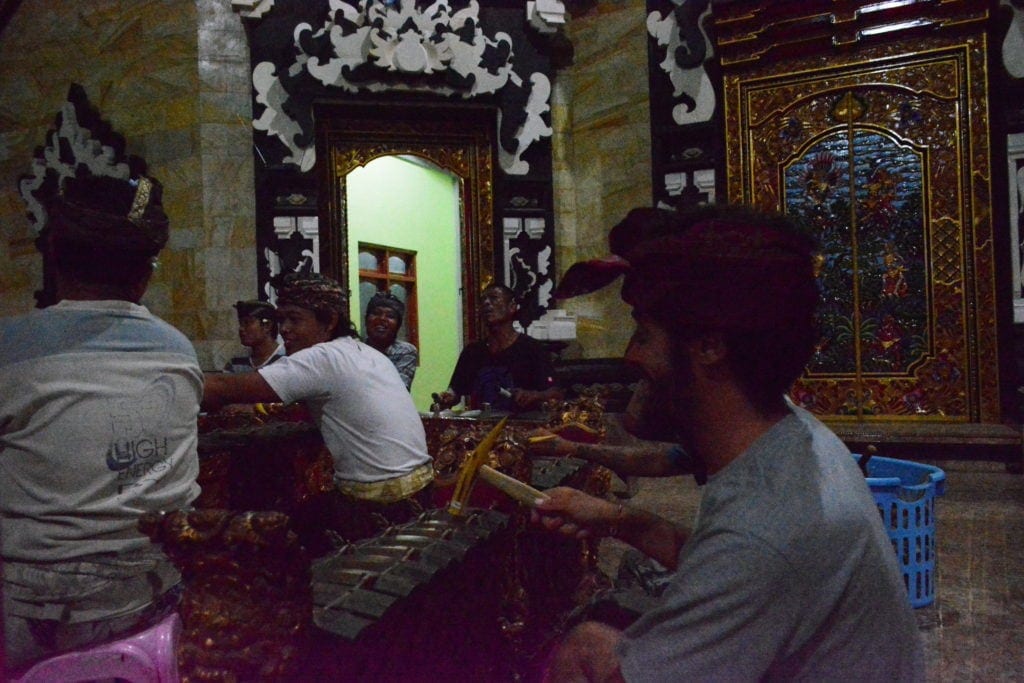
Have you ever dreamed of playing Gamelan music? I did. In Nusa Penida, you can try it for free! Each village has its own Gamelan orchestra (a set of gong instruments, drums, and cymbals) available for everyone to use. Just go in and play!
In the evening, the villagers often gather here and invite you to join. Don’t worry, they are not professionals, and they will direct you to the easier instrument and explain what to do.
Although these can also be found in Bali, in Nusa Penida, they are very common, and locals will be more welcoming since they see fewer tourists here.
Where to Stay in Nusa Penida
Accommodation
Until just a few years ago there were only a few guesthouses on the island, the situation has changed but not much, accommodation in Nusa Penida is still scarce and mostly concentrated around a few spots.
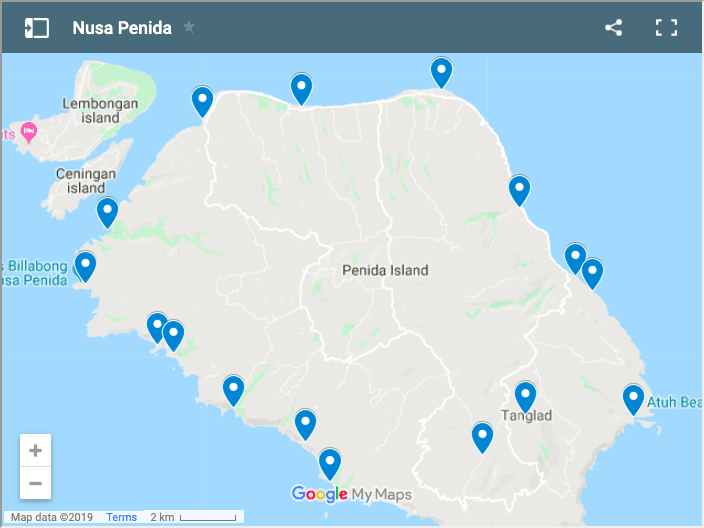
There are indeed only two “urbanized” areas in Nusa Penida, the one around Ped in the northwest and Sampalan in the North. Besides some remote resorts near the beaches, all of the accommodations are around these two spots.
Prices are slightly higher than in Bali, but with a bit of bargaining, you can find a comfortable guesthouse for 15/20 USD per night if you are on a budget.
Free Camping in Nusa Penida
Nusa Penida is a free camping paradise. The island is sparsely populated and, unlike Bali, farming is rare.
So there’s plenty of land for you to pitch your tent, even near some stunning spots like Broken Beach or Kelingking (also known as T-Rex viewpoint). Pack food and water, as there are very few places to find them.
What to see while traveling to Nusa Penida
Best Beaches of Nusa Penida
Crystal Bay
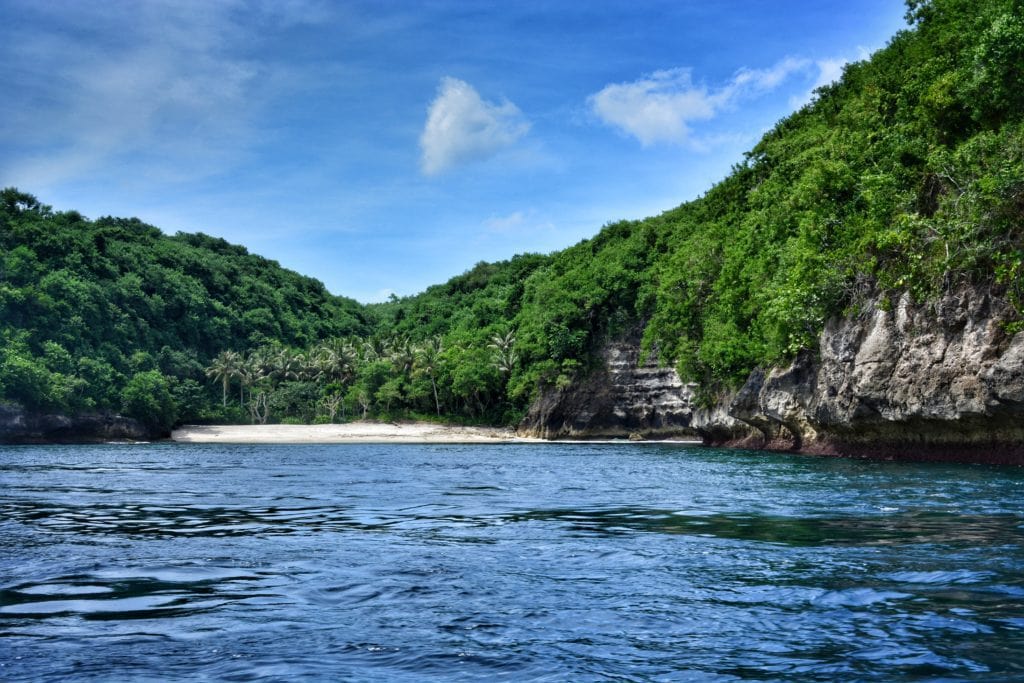
The “easiest” and most accessible snorkeling point in Nusa Penida, Crystal Bay, is an arched strip of white sand with a lively coral reef just offshore.
The geography of the bay keeps the water calm even when the sea is rough (which is the norm in Nusa Penida), however, the sea gets deep and we experienced here some of the strongest currents ever, be careful.
There’s a pricey but nice resort right next to the beach. Crystal Bay is just 9km from Ped, and the ride is easier compared to the rest of the island.
Broken Beach (Pasih Uug) and Angel Billabong
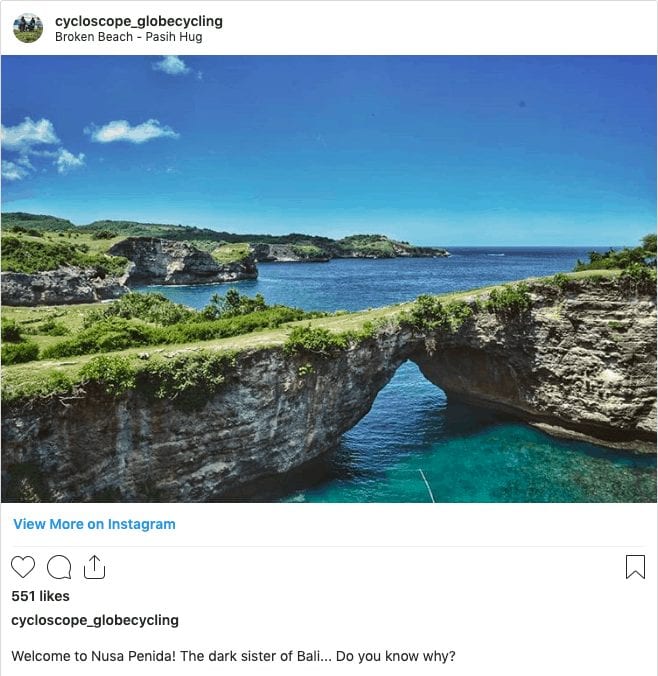
Situated on the easternmost corner of Nusa Penida, Broken Beach is not a beach. It is instead a huge circular hole in the cliff, with an arch connecting it to the sea. It was probably a cave before the ceiling collapsed.
The view is quite mesmerizing, with the rough sea crashing in big waves on the cliffs. Watch out not to be dragged by one of those for some Instagram vanity.
Angel Billabong is a nearby natural “infinity pool” filled with water and marine life splashed in by the very same rough sea.
There is a stall selling water and snacks, and it’s possible to camp in this spectacular location. Although only 20km from Ped, it will take about 1 hour to get here because the road conditions are quite extreme.
Suwehan Beach
Suwehan Beach is a secluded, untouched, pristine white sand beach with a limestone pinnacle as a guest star. It is located at the bottom of a hill and, despite it being halfway between Crystal Bay and Broken Beach, you’ll have to make a detour, riding the usual narrow and rocky road, before hiking down for about ½ hour. Safety is again non-existent so wear proper shoes.
Kelingking – also known as the T. rex viewpoint
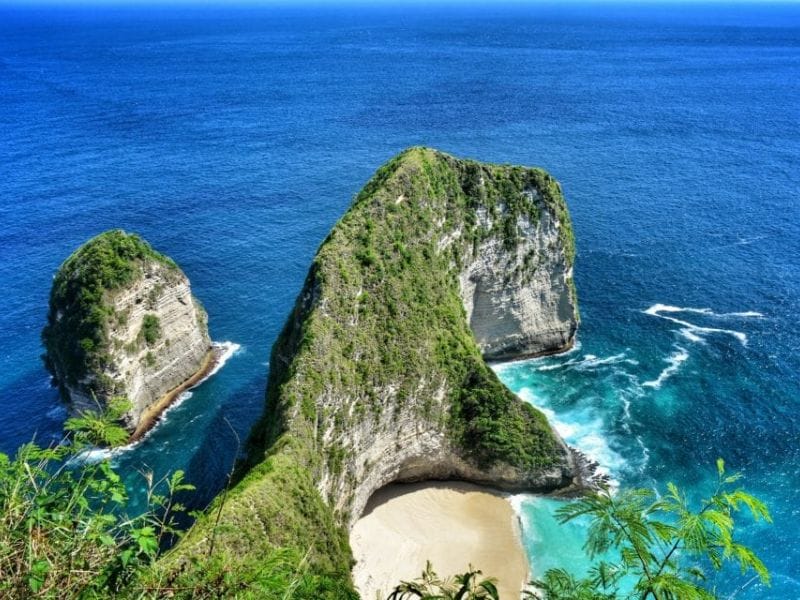
The most “Instagrammable” place in Nusa Penida is also the main reason why this island is getting more and more under the radar lately.
While the shape of this bluff resembles more a whale to us (or a hand with a pinky finger for the locals, since Kelingking means indeed pinky finger), it doesn’t really matter where it brings your fantasy to wander, it’s just undeniably astonishing.
There’s a sort of path to get down to the beach that is honestly quite dangerous, so watch out if you want to venture down. We didn’t because we found it too scary, and we heard the waves and currents don’t allow us to swim down there.
Atuh Beach
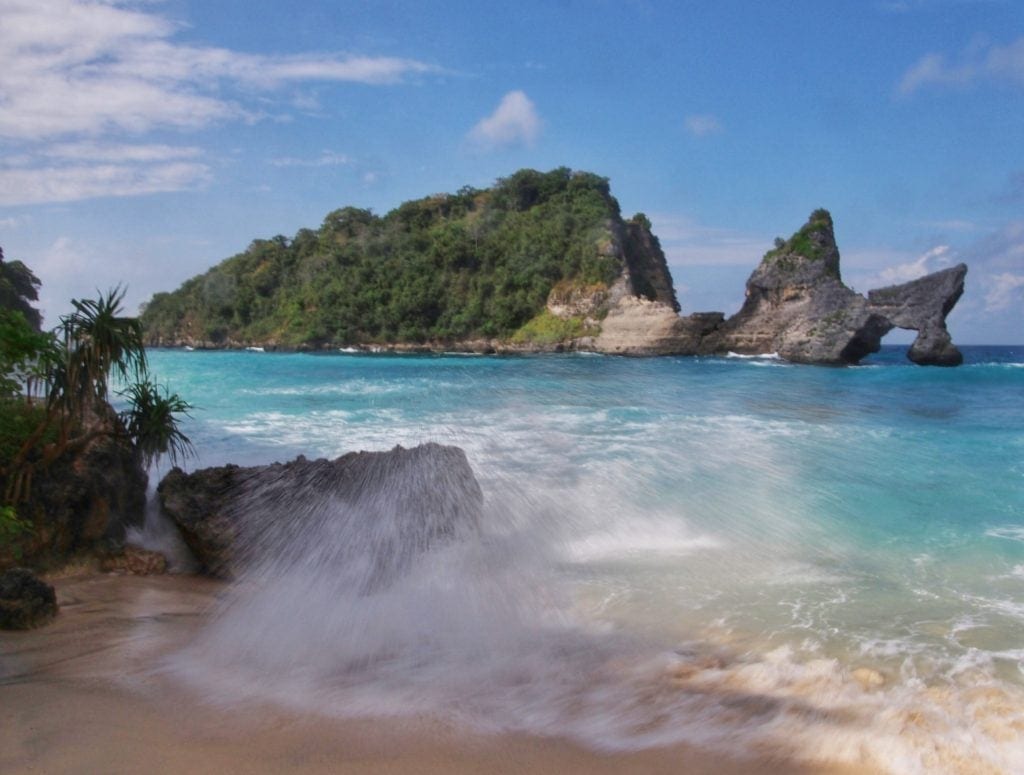
Sitting on the westernmost point of Nusa Penida is another mindblowing beach featuring otherworldly rock formations.
You can reach this place from the north route (paved) or the south one (the hilly interior passing by the Teletubbies hill). Either way, you’ll have to leave the main road and ride the usual rocky track.
From the viewpoint, there are two ways to get to the beach, one route with proper stairs and another one which is just a path. Take the stairs. The place is more pleasing when the tide is high.
Pura Paluang (Car temple)
The cutest temple in the world was one of our favorite attractions on Nusa Penida. Located very close to the Kelingking T-Rex viewpoint, there’s really no reason not to visit it during your trip around Nusa Penida.
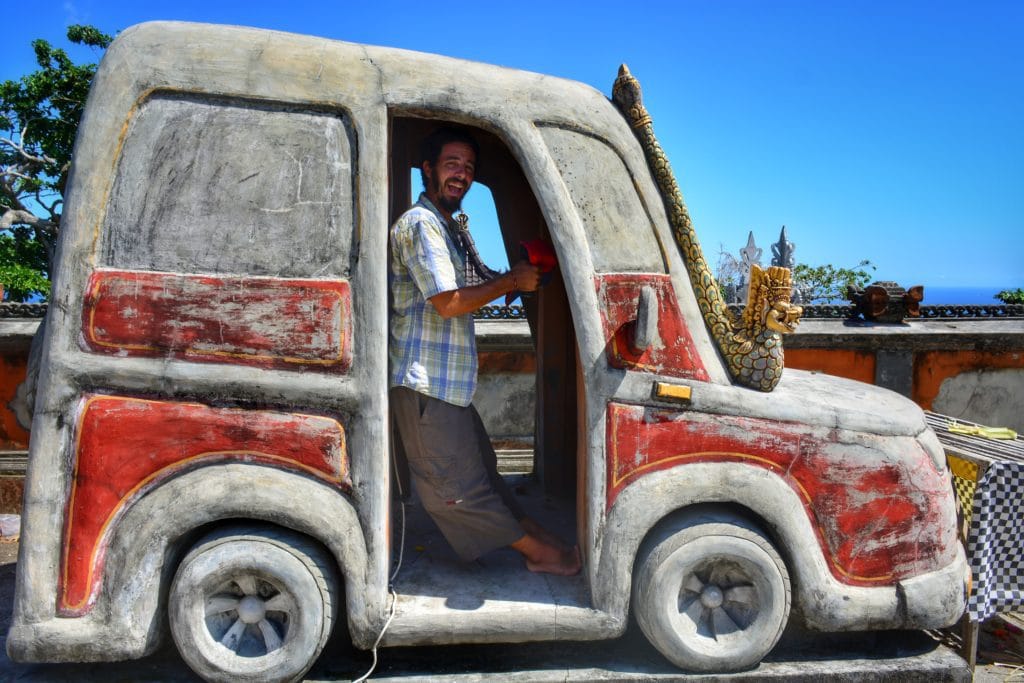
The peculiarity of this temple is that two of its shrines (pelinggih) are shaped like cars. The story behind Pura Paluang (also spelled Puraang) says that a local wanted to establish a plantation here. But there was a large rock that needed to be moved.
After being transferred, the stone returns to its original place the next day, again and again. According to the story, during the night, local residents often heard the car’s roar and horn.
They made this temple, where locals bring their vehicles for a blessing. The view from Pura Paluang is truly stunning.
Temples of Nusa Penida
Goa Giri Putri Cave Temple
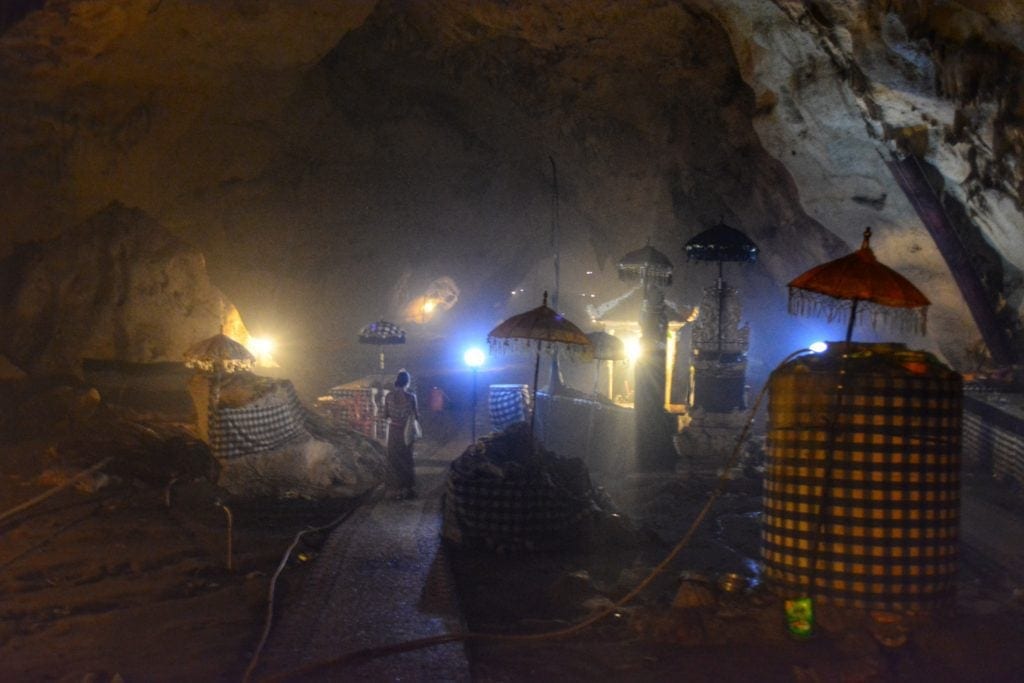
The Goa Giri Putri Temple is another unmissable spot for travelers to Nusa Penida, one of the Island’s major cultural attractions.
This large cave temple is in the village of Suana, on the northeastern part of Penida. Clear signs lead you to the site along the Jalan Ped-Buyuk main road.
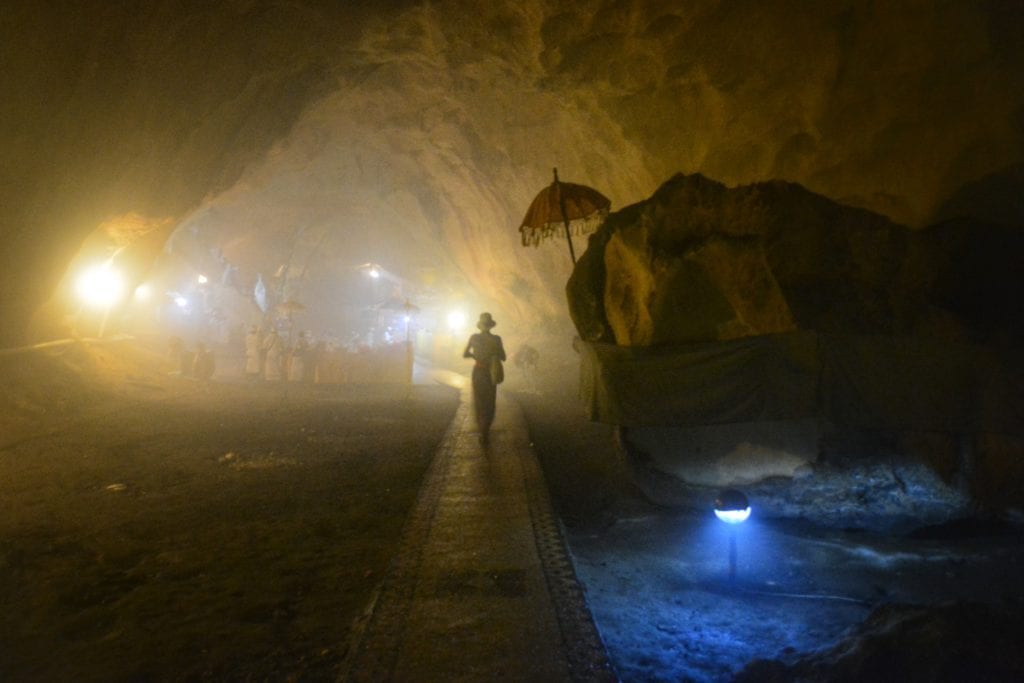
A shrine and a priest’s praying shelter guard its entrance, as usual, you have to rent a sarong to get in. The entrance itself is a very narrow hole in a rock face.
You’ll need to stoop low to squeeze through. But when in, you’ll be amazed to find out how big is this cave.
There are lights but very soft and lots of incense. The atmosphere is magical and powerful. There are many pilgrims, probably coming from Bali.
At the Goa Giri Putri Temple, there are a total of six praying spots. One at the outside entrance and five inside the cave. Visiting pilgrims must go through all of them consecutively.
Another unique feature of this cave temple is the final praying spot. This is devoted to Chinese deities such as Guanyin, the Goddess of Mercy, and the god of the earth and sky.
It’s adorned with red Chinese lanterns and ornaments that you would usually find at a Chinese temple. Many pilgrims pray here and ask for the blessings of better business and prosperity.
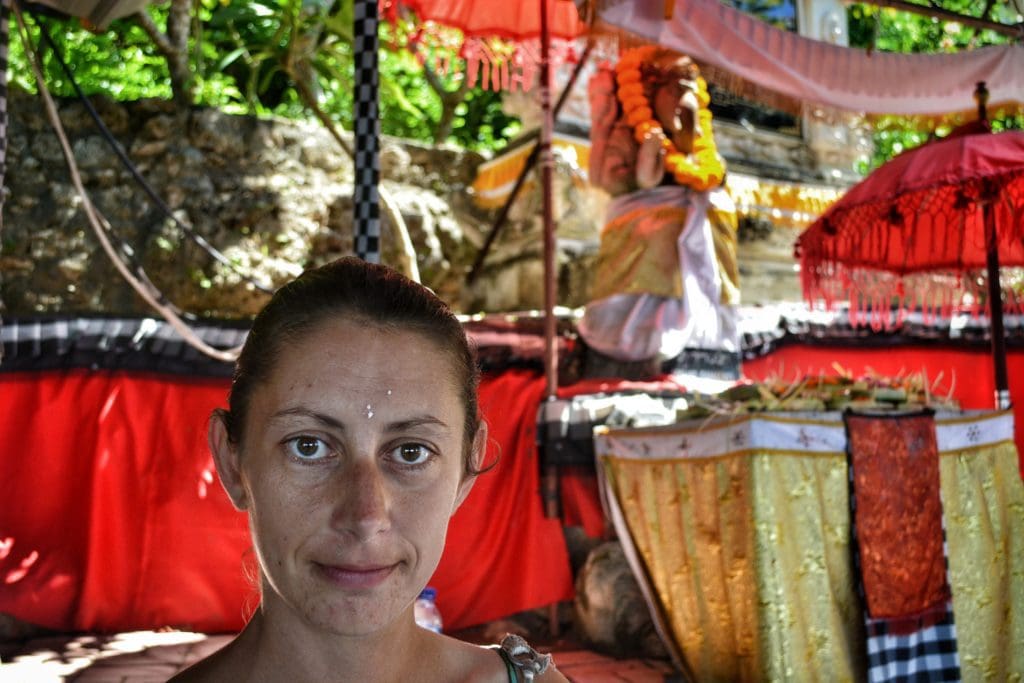
At the end of the cave, there is a Hindu and Buddhist temple, all together. Ah, not far from a statue of Confucius. We are witnessing the ceremony from a little distance, but the priest invites us to sit down and bless us with holy water, we must purify our talk and our thinking. Then he gives us some rice that we have to stick to our foreheads and put on white, red and black bracelets, to represent the three most important Hindu deities. We really feel a bit blessed.
Pura Batu Medawu and Pura Batu Mas Kuning
Two more important Hindu temples are on Nusa Penida, situated close to each other at the eastern end of the northern main road.
Pura Batu Medawu is made of white stone and its architecture is particular and beautiful, while Pura Batu Mas Kuning is a small but important temple, whose story comes from a big fish that was washed here by the sea, and, when thrown back on the water, was found again near Pura Dalem Ped, the residence of I Macaling.
The fish was believed to be cursed since most of the seaweed crops went to waste that year. So the temple was built to avert the curse.
Pura Dalem Ped
Pura Dalem Ped is the most important temple in Nusa Penida, despite being not particularly spectacular, this big temple is the home or Geru Gede Macaling, or I Macaling, his evilness in person.
As previously mentioned, each Balinese of the Hindu religion must come here at least once in a lifetime to honor the dark side, so as to keep life in balance. The temple is located in Ped, and it’s very easy to access.
More places to see in Nusa Penida
Tembeling Natural Pools and Forest
Among the few jungle areas in Nusa Penida, Tembeling is a stunning place with holy significance. From the small parking area, there’s a ten-minute easy hike through luxurious jungle, past a small temple, before you get to a fresh natural spring just a few meters away from the ocean.
There are three pools; the top one, hidden in a small cave, is a sacred pool where bathing is not allowed. For ceremonial purposes, the water there is holy, and there’s a small shrine.
The second pool is the big one, about 80 square meters and 5 meters in depth. According to local custom, only males are allowed to swim here. But when we saw a local couple bathing together, we went for it too.
The third pool, small and shallow but still inviting, is for the women. Located down by the beach, it offers a pretty view and a water drop that provides a pleasant natural massage.
The beach itself is majestic, surrounded by tall, vertical cliffs and with a limestone pinnacle standing in the middle.
Peguyangan Waterfall
Peguyangan Waterfall is a small waterfall dropping into the sea. There is a small temple and a holy pool at the base. To reach it, you’ll have to go down hundreds and hundreds of steep steps, a pretty scary staircase with great views of the cliffs.
The hike down takes about 30 minutes, and add 50 minutes for the return. One more unmissable thing to do when backpacking Nusa Penida.
Teletubbies Hills
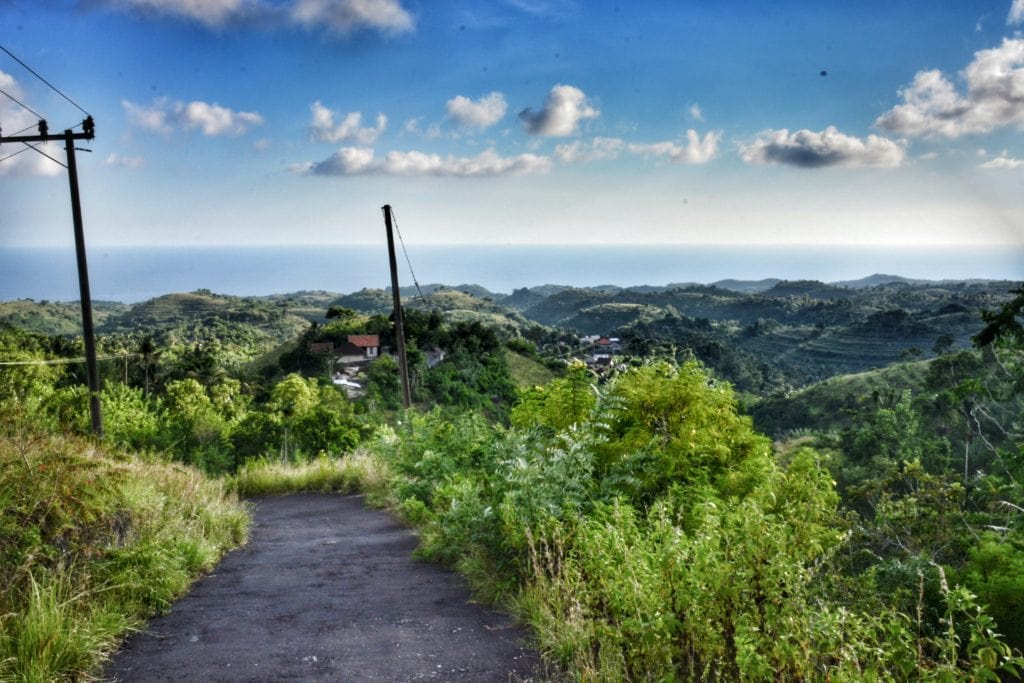
Ok, hang tight. There’s actually a village in Nusa Penida called Teletubbies (it is actually spelled Teletubbies). It’s located in the south-west of the island, not too far from Atuh Beach, and accessible by a rollercoaster road that’s actually paved (even though it’s potholed).
The surrounding hills are just like those inhabited by cheerful puppets, they remind a bit of Bohol’s Chocolate Hills. I don’t know who had the brilliant idea of calling the village like this, or whether the inhabitants are happy.
More things to do in Nusa Penida
Diving and Snorkeling in Nusa Penida
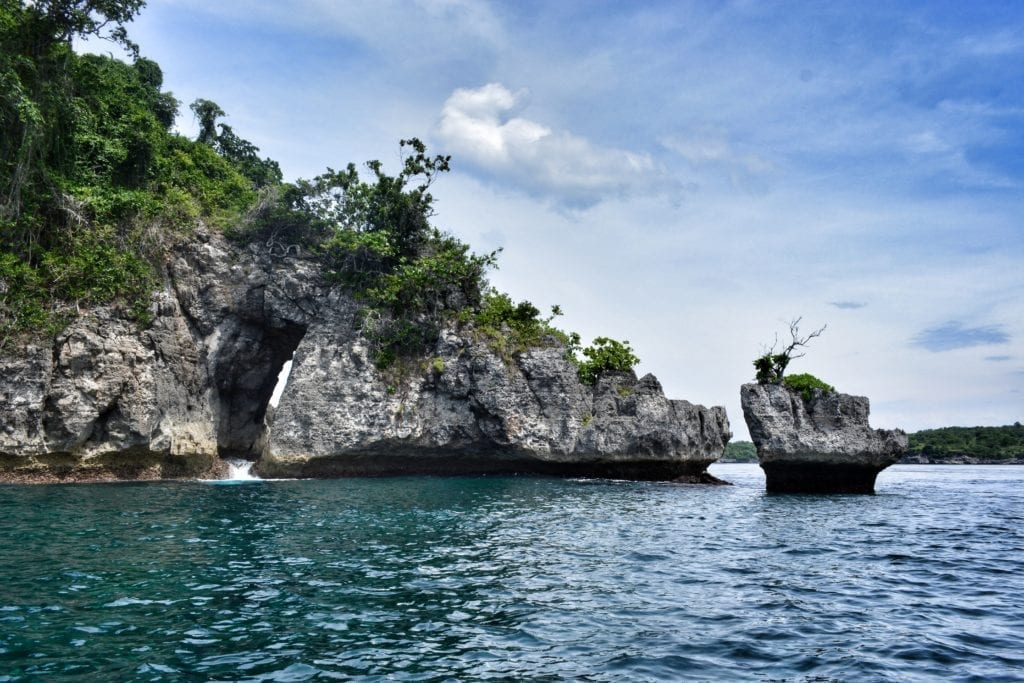
Nusa Penida is a world-class diving destination, with a living coral reef and a bustling marine life. The main stars of the island are the giant manta ray, the sunfish, the whale shark (not common), and the huge tuna.
There’s also a fake underwater temple put there just for the tourists, but it’s still cool to swim around.
Unfortunately, when we tried to get to see the mantas, the sea was too rough to reach the Manta Point. The ride was very bumpy and even a bit scary at some points.
It’s possible to spot the mantas from above the manta point, but we couldn’t figure out how to get there, even though we tried hard.
Taking a boat ride around Nusa Penida
This is usually part of the snorkeling/diving excursion, but it’s seriously worth going for a boat ride, even if you are not willing to snorkel.
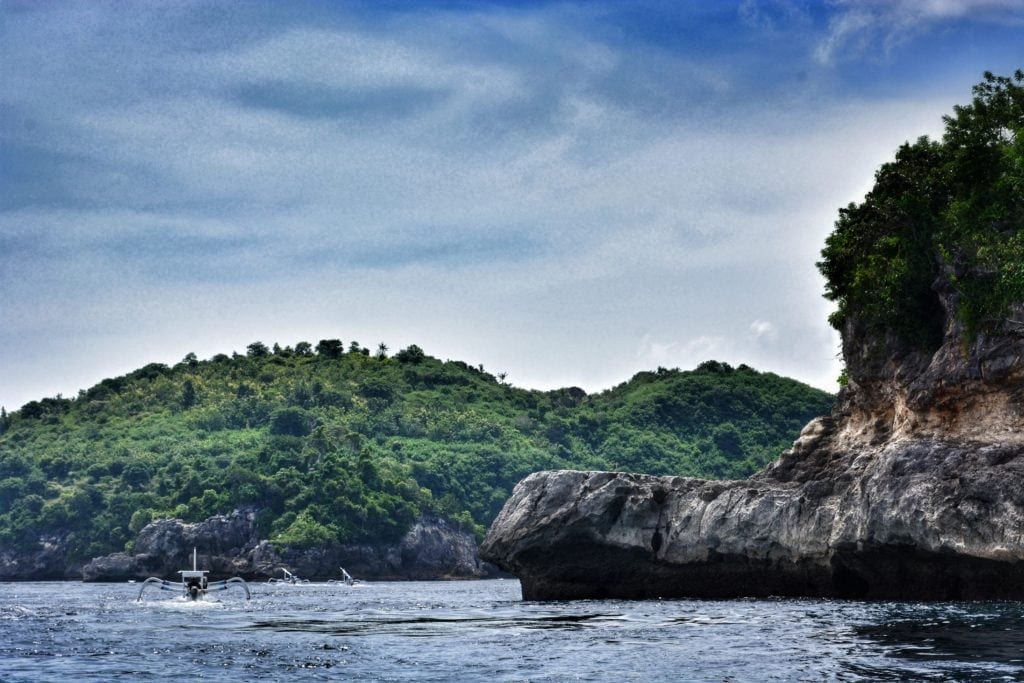
The south coast of the island is a continuous rugged cliff, dotted with big caves and spectacular pinnacles. The sight of the waves crashing on the cliffs is really dramatic and totally worth it.
Seaweed farming
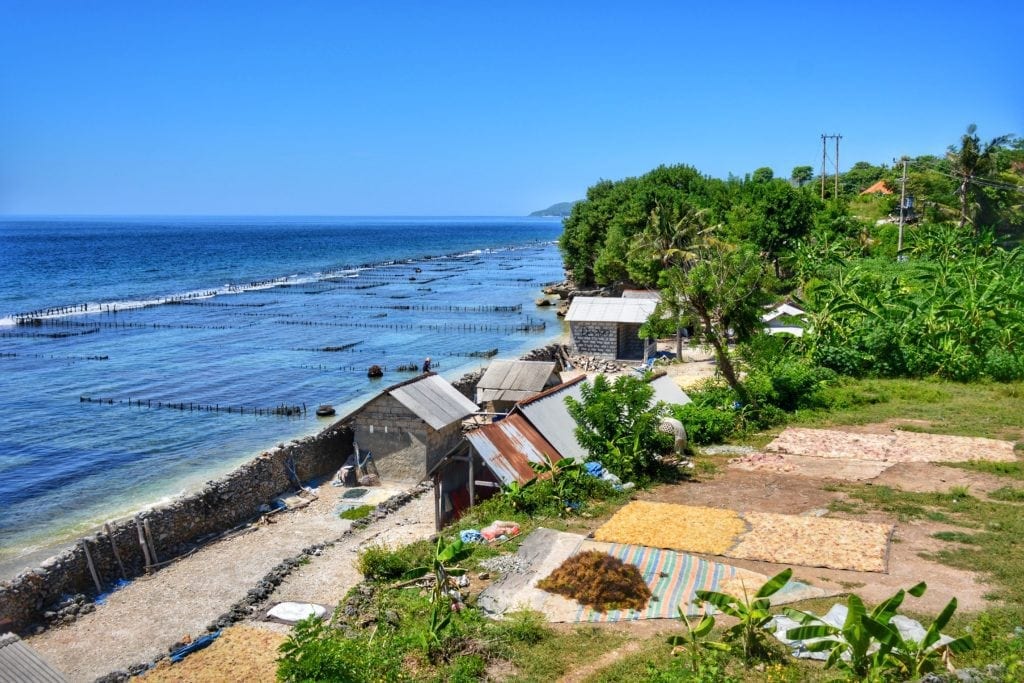
The north coast of Nusa Penida is instead lined with peculiar seaweed farms. That’s where the island’s main income comes from nowadays.
The sight of the farms and the weeds lying to dry under the sun gives a somewhat romantic insight into Nusa Penida’s rural lifestyle. Including this area in your Nusa Penida itinerary is very easy. The road is paved, and even buses go there!
Volunteering at the Friends of the National Park Foundation
You can sleep and volunteer at this association, which manages the bird sanctuary. It’s actually great if birdwatching is your thing, since this is the best chance to see the rare birds endemic to this island. The accommodation is pretty basic and a bit pricey at 16/18€ per night.
I think it’s still a nice initiative and a great experience, if you want you can also sleep elsewhere and come here to volunteer, this is the website of the association.
Traditional Sarong Weaving at Tanglad Village
The most authentic and unique sarongs are hand-woven in the village of Tanglad. Nusa Penida is famous for two motifs: Rang Rang, based on a mountain motif called Gunung, and Cepuk, a “star-in-a-diamond” motif.
One full-size sarong can take up to two months to create and costs around 700,000 to 800,000 IDR. These pieces are exported to Ubud and are usually doubled in price by the time they arrive.
Get in and around in Nusa Penida
Cycling and motorbiking around Nusa Penida – roads and advice
Bringing a car to Nusa Penida is one of the worst ideas; there’s only one decently paved road on the island, along the northern coast. All of the other roads are pretty rough, small, and hilly, going from potholed concrete to stone tracks.
Cycling is an option if your bike can withstand these road conditions, though we strongly advise leaving most of your gear behind.
Renting a motorcycle is the most practical option; a decent deal will be about Rp 60,000 per day. Finding it is the least of your problems; they will most likely find you (otherwise, just ask around).
Local public transport is in small old bemos or on the back of a truck. Those are basically only available on the main road, along the north coast.
Although distances might seem short, keep in mind that road conditions will really slow you down. Be sure to fill your tank before heading into the hills, as fuel will be used quickly in these rough conditions. If you run out of gas, ask around. Some people sell bottled gasoline for double the price or more.
Ferry schedules from Bali to Nusa Penida
Quite troublesome up to a decade ago, getting to Nusa Penida now is quite straightforward. There are public boats from Sanur, Kusamba, and Padang Bai in Eastern Bali.
From Padang Bai
The cheapest way is catching the daily public ferry at 11:00 am. It’s a large boat that can board vehicles, the only chance to bring your motorbike, car, or bicycle to the island.
A passenger ticket costs Rp 31,000 each way and can be purchased at 10:00 am at the “Loket” inside the building. To bring your own motorbike, an additional Rp 50,000 is charged at the gate as you drive up. Bicycles go for free.
This ferry arrives in Sampalan on the northeast corner of the island, just off the main road. This is a preferable way to get in and out of Nusa Penida.
The boat is fairly stable on the water, you’ll have great views, bathrooms, and the possibility to walk around the boat. The ride takes about 1 hour.
There is also a smaller private speed boat service that typically carries up to 20 people. This departs from Padang Bai beachside every morning.
You should be on the beachside by 06:30 to catch this public speedboat. Buy the ticket from the ticket office near the beach and wait until the boat has enough passengers to depart. The ticket costs Rp 45,000 each way for locals and Rp 75,000 for foreigners.
This smaller boat requires wading through thigh-deep water and being packed in like sardines. It’s fast but not really as comfortable as the less expensive ferry.
From Kusamba
Gangga Express operates several speedboats a day from Pelabuhan Tribuana in Kusamba. The price for foreigners is Rp 100,000 each way, and it takes about 30 mins.
There is a daily public boat between Pelabuhan Tradisional in Sampalan and a port next to Pelabuhan Tribuana in Kusamba. It leaves Sampalan around 6 am and returns straight away after reaching Kusamba. The price is Rp 45,000, and it takes 45 mins.
From Benoa Harbour
Quicksilver runs daily cruises from Benoa Harbour in Bali to its monstrous pontoon, which floats off the northwestern shore of Nusa Penida. The trip includes water sports activities centered on the pontoon. Rp 570,000 per persona.
From Sanur
If you are staying in Sanur, scheduled departures to Nusa Penida from Sanur Beach are at 07.30 and 16:30. Departures from Sampalan, Nusa Penida, are at 08:30 and 15:30. It’s a new speedboat service, with just 2 departures daily to Nusa Penida.
One way is Rp 75,000/person for locals and Rp 175,000/person for foreigners. Operated my Mola Mola Express.
Caspla Bali Boat, Sanur Beach in front of Ananda Beach Hotel, (+62 361 791-2299). From Sanur Beach at 08.00, 11:00, 14:00, and 16:30. Departures from Buyuk, Nusa Penida at 08:00, 12:3,0 and 16:00. One-way fare Rp 150,000/person and return Rp 300,000/person.
Maruti Express, Hangtuah Street (Sanur beach) in front of Diwangkara Holiday Villa, (+62 813 3875 4848) departures at 08.30, 10.00, and 16:00; from Nusa Penida at 07.30, 09:00, and 15:00. One way Rp 175,000, return Rp 300,000.
From Nusa Lembongan
Public boats depart daily at 06:00 close to the suspension bridge between Nusa Lembongan and Nusa Ceningan and run to Toyapakeh or Buyuk Harbour in northern Nusa Penida.
There are also services from the Jungut Batu area of Nusa Lembongan to Nusa Penida. All of these can be a little ‘worrying’ at times and are often very crowded.
Charter boats are also available, departing from and arriving at the same area as the public boats. If you are staying on Nusa Lembongan, ask at your hotel.
If not, go to the shoreline near the suspension bridge or to the beach at Jungut Batu, and ask around amongst the boatmen. Rates can vary, but expect to pay around Rp 300,000.
Info in this paragraph is mostly taken from Wikitravel.org
Check also