

Last Updated on 17 January 2026 by Cycloscope
Where to see the Kecak traditional show in Bali. Its origins and meanings: how a sacred ritual turned into a profane performance
Indonesia is a cradle of cultures, a cosmos where each island is a separate planet, interconnected with the others but unique in its deepest cultural expressions, religious beliefs, and languages.
Disclosure: Some of our articles contain affiliate links. This comes at no additional cost for you and helps us keep this website up and running. (as Amazon Associates we earn commission from qualifying purchases)

Among the 17,504 (maybe) Indonesian islands, Bali is undoubtedly the most famous, one of the most visited places in the world.
Although many tourists come here for the beaches, parties, and scenery, Java and Bali have been visited and studied by scholars from around the world for at least 2 centuries for their unique cultures and art forms, traditional dances, theater forms, music, and rituals.
The shadow puppet show Wayang Kulit, the “eyes dance” to the sound of the Gamelan orchestra, usually known as Legong, might be the most familiar, but there are literally hundreds of performing arts in Bali. Among these is a very peculiar art form named Kecak.
Check also
Legong and Barong – where to see traditional dances in Bali
Cycling in Bali – itinerary and tips to explore the best of Bali
How I got to know about Kecak
I first came across Kecak through the 1992 movie Baraka. I own many of Ron Fricke’s films, and my fascination with other cultures and my desire to explore and experience the world, though already present, were given a substantial boost by them.
The Kecak scene in Baraka stunned me so much that I promised myself I would witness it in person, sooner or later. And I did, getting to see, moreover, the first woman’s Kecak group in history.
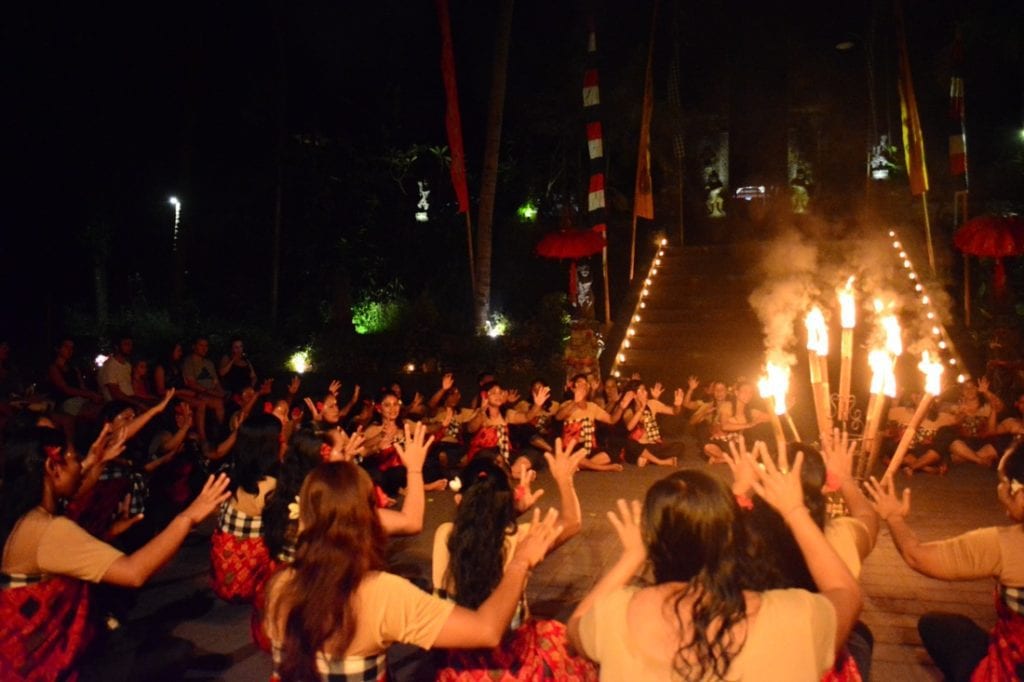
Ten bamboo torches enlight the court of the temple, a group of women of all ages, maybe 50 or 70 of them, march in and form a circle. They are simply dressed, modest sarong tied around the waist by a scarf, a red hybiscus flower on the right ear, a white one on the left. And suddenly there’s an explosion of sound, a complex vocal polyrhythm without any tone, a hail storm of voices. Hands move frantically, everything follows the command of a choir mistress.
The origins of Kecak
Balinese people are mostly Hindu, though Balinese Hinduism differs significantly from Indian Hinduism. Being isolated from contact with India, its artistic and ritual expressions have been strongly influenced by Javanese culture.
Although the form Kecak dates back to the 1930s (we’ll see that later), this ritual chant-and-dance form is much older and rooted in Balinese ancestral culture.
The musical accompaniment of the gamelan mulut (mouth gamelan), or the cak chorus, can indeed be found in several Balinese rituals involving the performers’ trance state, such as the tari sang hyang, or “dance of the heavenly goddess”.
In this ritual, dancers were possessed by gods, thereby chasing away evil spirits, the culprits of ominous happenings. The tari sang hyang is a very holy rite, performed in the inner area of the temple, where only “priests” or holy persons are allowed.
Kecak against deadly diseases: the story of Bona village
It’s probably in the light of this tradition that we can understand this story, told by the Jakarta Post, about a village called Bona in the early years of the 20th century.
Blighted annually by a deadly pox that washed over the village, with monsoons bringing storms in November, Bona’s villagers knew every family would lose at least one member to the disease.
People were ill, they were vomiting, and they had diarrhea. Things worsened until the sick were vomiting blood and had fevers. A lot of people died, and their skin turned black. In one day, there could be as many as four funerals, the next five, and on it went, day after day, week after week, year after year.
The temples were all closed. People couldn’t enter; every family had lost someone, and so they were all unclean. No ceremonies were held for the dead, who were so many.
Making enough racket to wake the dead was the only method they could fathom to ward off the deadly disease. One night, there was a man who became possessed by the rhythm, not the rhythm of the gong, but of human voices. From that moment, the disease started to ease, and the death and the illness stopped.
Bona villagers continued to perform this rite every 6 months until the 1970s, when dancers began to be invited to perform for tourists. After realizing that this would deprive a holy practice of its meaning, the Bona villagers halted the practice altogether; they no longer do the Kecak.
The history of modern Kecak
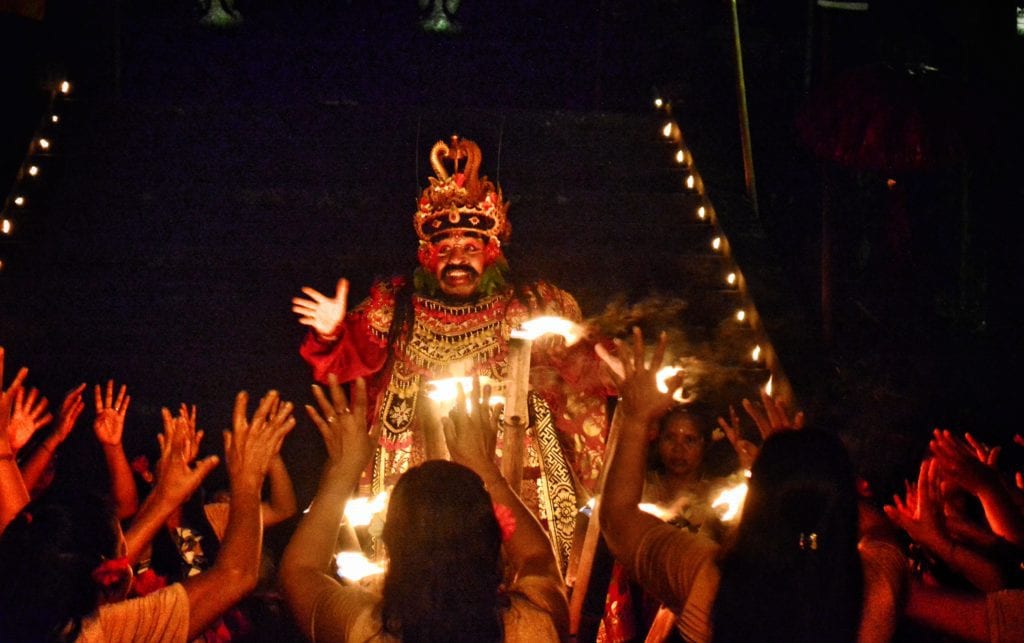
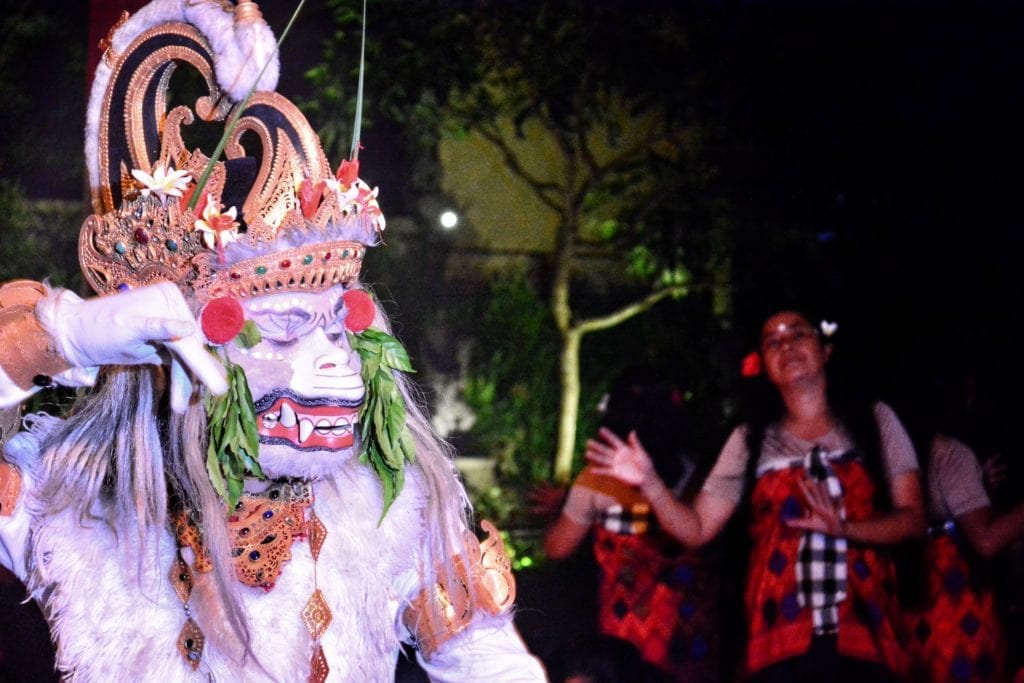
Than a big bearded man comes in, his dress a piece of art, his expressions funny and terrifing at the same time. He is Ravana, the nemesis of Rama, ready to kidnap the beautiful Sita… but Hanuman, the monkey warrior is ready to fight for his master’s wife
The 30s were a very complex period in Bali’s history. The Dutch had taken over the island in 1908, through fear and civilian massacres. The military interventions, however, were followed closely by coverage of the bloody conquest of the southern part of the island, which shocked the West.
The image of the Netherlands as a benevolent and responsible colonial power was seriously affected. The Netherlands, also under criticism for its policies in Java, Sumatra, and the eastern islands, decided to make amends and announced the establishment of an “Ethical policy.
The Dutch in Bali turned into students and protectors of Balinese culture, and efforts were made to preserve it as a “living museum.” In 1914, Bali was opened to tourism.
In the meantime, following the orientalist fascination generated by the 1900 Paris Universal Exposition, flocks of Western artists began to flow to Indonesia. Among them was the German artist Walter Spies.
Spies stumbled upon the Kecak, which was probably already being popularized, and he liked it. Working with Wayan Limbak, they arranged performances featuring elements of Legong and stories from the Ramayana, organized tours abroad, and thus made the Kecak internationally known.
Nowadays, Kecak and the first all-women group
Nowadays, Kecak is mainly developed by Spies and Limbak, with the Cak choir accompanying classic scenes from the Ramayana. Performances last between 60 and 90 minutes and are usually followed by a so-called fire dance, borrowed from religious rites such as the tari sang hyang jaran.
The religious meaning is absent; indeed, the performance is staged in the most external area of the temple rather than its inner core, a zone that, even though consecrated, is meant to host profane activities.
Kecak evolved into something different, and it is exciting to underline the creation of the first all-woman Kecak group in 2004. Kecak was meant to be a men’s activity, but these ladies broke the rule with a fantastic show. We were lucky enough to see their performance, and their stubborn dedication and achievements, which were really touching to me.
Nevertheless, Kecak maintains its charm; the sounds make the spectator dizzy, the costumes of the main characters are beautifully intricate, and the firelight and overall atmosphere have a magical, enchanting aura.
Where to see Kecak in Bali
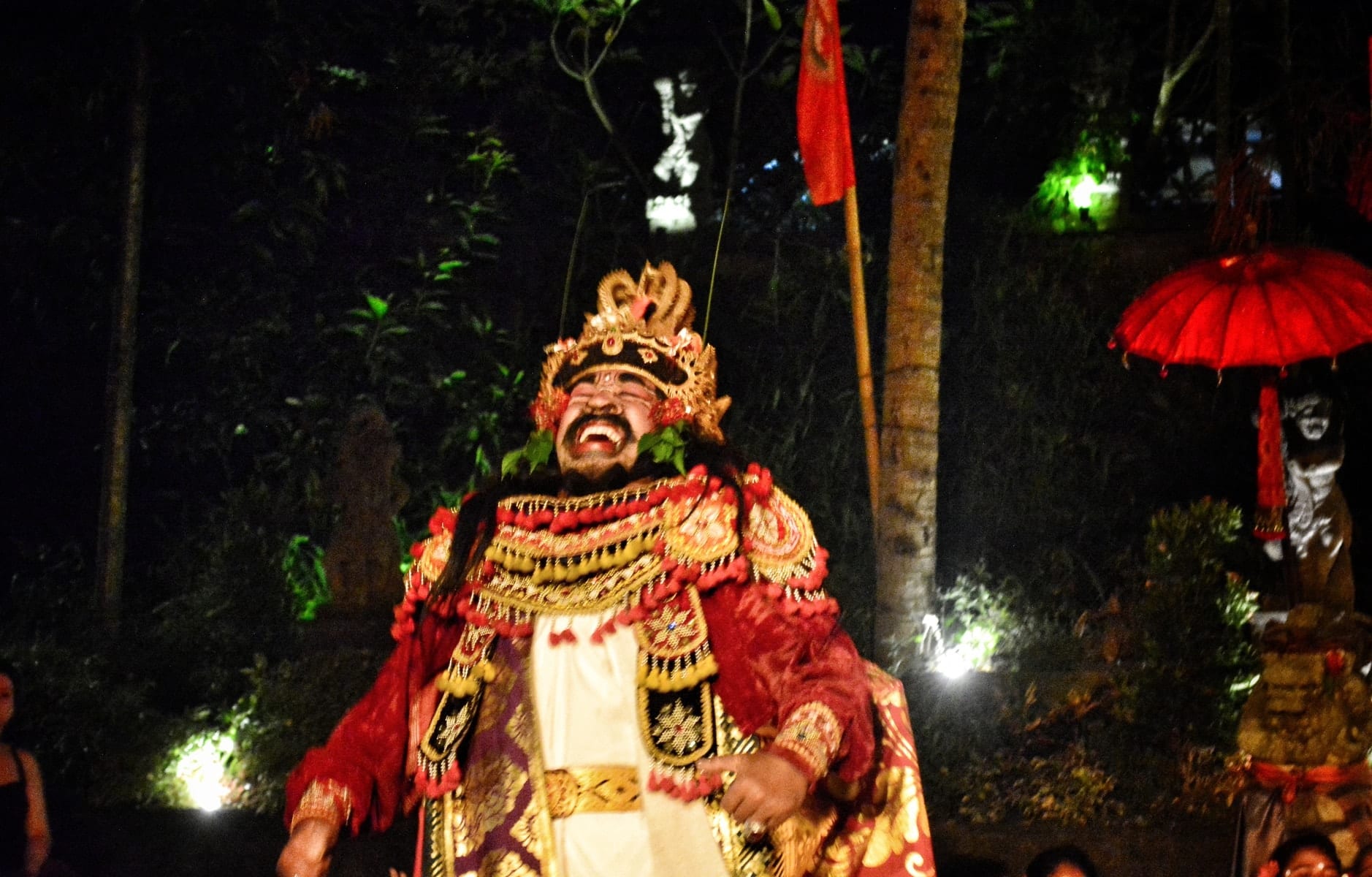
The town of Ubud, the cultural center of Bali, is undoubtedly the easiest place to see traditional dance and music performances.
Although it’s true that, while roaming around Bali, it’s highly probable to stumble upon traditional celebrations and rituals that involve many kinds of dances, theater, and music, there’s almost no way to plan that; the only way to see a real Balinese ceremony is to be in the right place at the right time.
In Ubud, there are performances every day (except for Nyepi, the Silent Day), and Kecak is staged at least 3 times per week.
The venues are mainly in Ubud town center, not far from the Royal Palace, while some activities take place in nearby villages, such as the Jegog (the bamboo Gamelan); for these shows, free transport from the Ubud Tourism Office is provided.
Every day, there are several performances, so it is easy to get to see whatever fancies you most, even if your time is short.
The tourist information center, located near Ubud’s main crossroads in the north of the town (near the Royal Palace), can provide you with a list of upcoming shows, including timetables and fees. You can check the schedule online here.
The entry fee for most shows is around 7 USD.The shows last about 90 minutes, and they all take place around 7 or 7:30 pm.
Check also
Legong and Barong – where to see traditional dances in Bali
Cycling in Bali – itinerary and tips to explore the best of Bali
Read it later! Save it on Pinterest.