

Last Updated on 18 February 2026 by Cycloscope
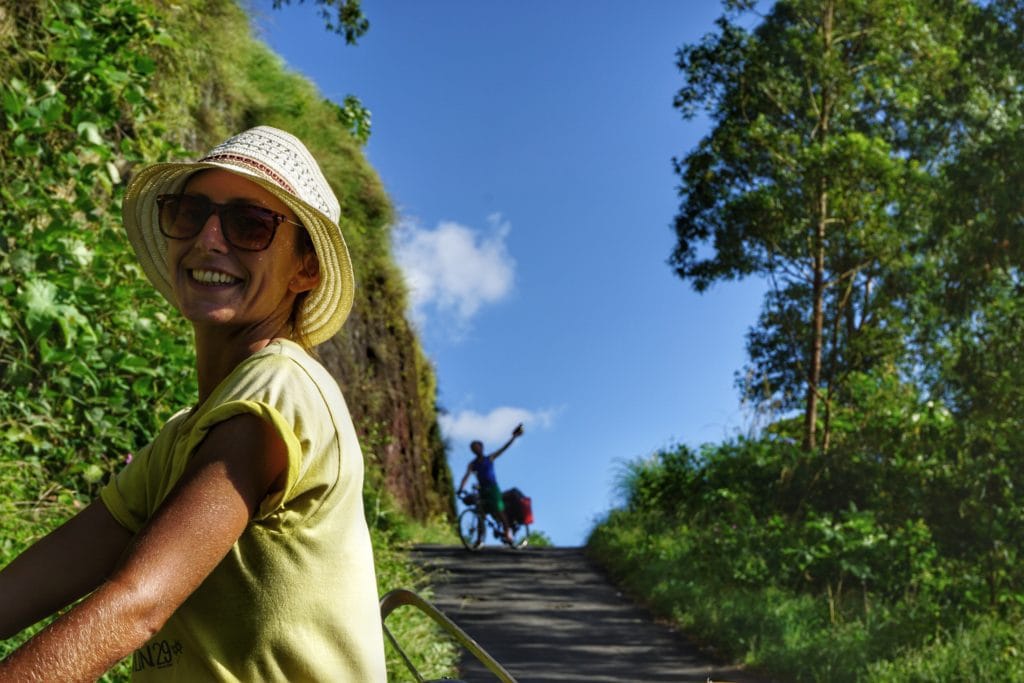
First-hand tips, advice, and itinerary to travel to Bali on a bicycle
Is Bali a suitable destination for bike holidays?
Bikepacking around Bali on a budget, off-the-beaten-path
Bali is certainly one of the most visited places in the world; it was even named the best place to visit on the planet by the TripAdvisor community.
Disclosure: Some of our articles contain affiliate links. This comes at no additional cost for you and helps us keep this website up and running. (as Amazon Associates we earn commission from qualifying purchases)
Its beauty, though, is not about beaches (which are pretty average and even poor compared to other places in Indonesia), but about its unique culture, art forms, and lush mountainous interiors.
Iconic rice paddies, thousands of temples, ceremonies accompanied by mesmerizing music, and two active volcanoes make Bali a must-visit, once-in-a-lifetime destination.
Cycling in Bali, though, is very tough. With a very hilly interior and crazily steep roads, it’s certainly not a bicycle-touring destination for beginners, especially if you’re sensitive to the heat.
A bicycle trip, anyway, is still one of the best ways to experience Bali in all its fascination, which is to be found far from the most popular tourist routes.
Check Also
Cycling Indonesia – a full guide and 9 itineraries
Where to see traditional dances in Bali: Legong and Barong
5-day cycling itinerary in Bali
- Stage 1: From Ubud to Batur Lake (37km)
- Day 2: Around Lake Batur (29km)
- Day 3: Cycling from Batur to Kubu (29km)
- Day 4: From Kubu to the easternmost tip of Bali (35km)
- Stage 5: From Mt. Agung to Ubud (74km)
This is our Bali bike tour in a nutshell. But before diving into the cycling itinerary, let’s get the basics down for organizing a bicycle touring trip in Bali.
Cycling The Roads of Bali
The main road in Bali is a ring skirting the whole island’s coastal perimeter. In its southern section, it’s a wide highway, often very busy and not very pleasant to cycle, while the northern and western stretches are narrower and quieter.
Many roads cut the island from north to south; they are all steep climbs, but they are also worth cycling. South of Ubud is the bustling capital of Denpasar, a hot and hellish place for a bike traveler.
Further south is the tourist area of Kuta, which we absolutely advise avoiding unless you fancy some clubbing.
Kuta is just a tourist zoo full of drunks, with an unworthy beach and everything overpriced.
Road conditions are generally good, though the terrain can make for roller-coaster-style ups and downs that can be exhausting. Some side roads may be unpaved, but those are mostly dead ends or village streets.
Free Camping in Bali
Bali is not camping-friendly. The island is very populated, and each available corner is cultivated: rice paddies, orchards, or fruit trees. The only areas that are not are just too steep to pitch a tent.
Camping is possible on Bali’s many beaches, and there are some cool spots along the hiking trails, though these latter are not accessible to a loaded bicycle.
There seem to be no laws about free camping in Indonesia; just exercise the normal precautions and keep clean.
Where to sleep in Bali
Accommodations in Bali are really great value. It’s easy to find basic guesthouses for about 10/15€, which are usually much better than everywhere else in Indonesia. If you’re willing to spend a bit more, let’s say 20/25€, you can really treat yourself to some luxury.
Big rooms, swimming pools, and nice locations are common around Ubud, Amed, and other major towns. Another great base, with cozy hotels, is Canggu on the west coast of Kuta. Bargaining is possible in both less touristic areas and major ones outside peak seasons.
Food
Food in Bali is probably the best in Indonesia, although outside the tourist areas, it can get monotonous again.
There are amazing supermarkets in Ubud and Denpasar, where you can stock up on Western goods if you miss your favorite cheese or want to cook pasta on your camping stove.
Bali is also the best place in Indonesia for drinks; there are even a few places selling craft beer in Bali.
In more remote areas, though, it is not always easy to find food, so having a backup plan is always worth it.
Water Supplies
Tap water in Bali is not drinkable; unfortunately, you’ll have to rely on bottled water or fill your bottles from restaurants’ water tanks. There are no coin water dispensers like in Malaysia or the Philippines.
Water in the mountains though is pristine so you can drink from one of the many waterfalls of Bali, be careful though if you’re not at a high altitude.
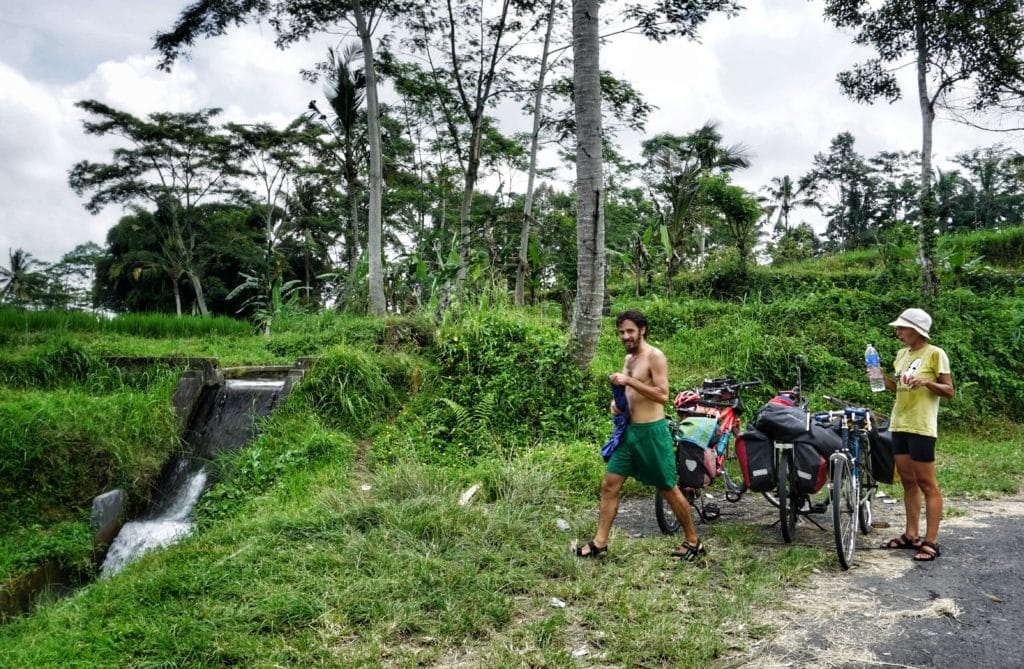
To rinse off sweat, the best are rice paddies’ irrigation canals, also called (by us) ball-washers.
Weather and best times to visit Bali for a bicycle trip
Bali is located very close to the equator, you can expect an average year-round temperature of around 30°C, with a humidity level of about 85%.
Bali’s central mountain area is cooler and also rainier than the coastal areas. Temperatures can drop to 15 degrees in certain areas, especially higher up near the volcanoes, such as Kintamani.
The dry season is from April to September; Bali is busier during this period, and sunny skies are good for enjoying the beaches, but it’s not the best cycling weather here.
The rainy season is from October to March, with fewer tourists around, but the full rainy season can have an average downpour rate that could put your spirit down.
Overall, in our humble opinion, the best time for a bike trip in Bali is the end or beginning of the rainy season, when the skies are often cloudy. We think this is the best time to cycle through the whole of Southeast Asia, following the end of the rainy season.
Anyway, especially in recent years, seasons aren’t reliable across the whole of SEA anymore. Sometimes even the locals are surprised by how dry a rainy season can be, and how rainy a dry season can be.
Wi-Fi and Connectivity
Wi-Fi is available in most (if not all) guesthouses in major tourist towns like Ubud or Amed.
Overall, it is very uncommon to find accommodation that doesn’t provide wifi, even the more basic ones have it. Bigger restaurants also have Wi-Fi, while minor eateries (warung) often do not.
Indonesian SIM cards are easy to purchase, can be found literally everywhere, and are among the cheapest in the whole Southeast Asia.
Language
Like each island in Indonesia, Bali has its local language, indeed, more than one. There are different ways to communicate between the cast and clan members.
Balinese society has deep feudal roots and in many ways even today it’s still “quasi-feudal”, some social protocols of the times of the kings are still in place.
Most Balinese belong to the Sudra caste (anak jaba, outsiders) and speak the common Balinese language among themselves.
Bahasa Indonesia, the Indonesian national language, is, of course, spoken almost universally, so learning a few words will make you appear nicer. Indonesian is one of the easiest languages in the world.
English is more common here than anywhere else in the country, although don’t expect everyone to speak or understand it. In tourist places, of course, that is very common, but outside them, try first with very basic phrases and speak slowly.
Scams and Safety
Although Bali may be considered pretty safe, scams and petty crimes like pickpocketing are more common here than on other Indonesian islands. I guess the axiom is: more tourists = more scams.
Try to get an idea of a fair price and stick to it; pay a bit more if really needed, but just a bit. Please don’t fall for the scammers by thinking it’s still cheap to you. Beware of getting drunk in Kuta clubs and exercise the standard precautions.
Drugs are very common in Bali, but keep in mind that Indonesian laws contemplate the death penalty for drug crimes.
Our Bikepacking Trip in Bali
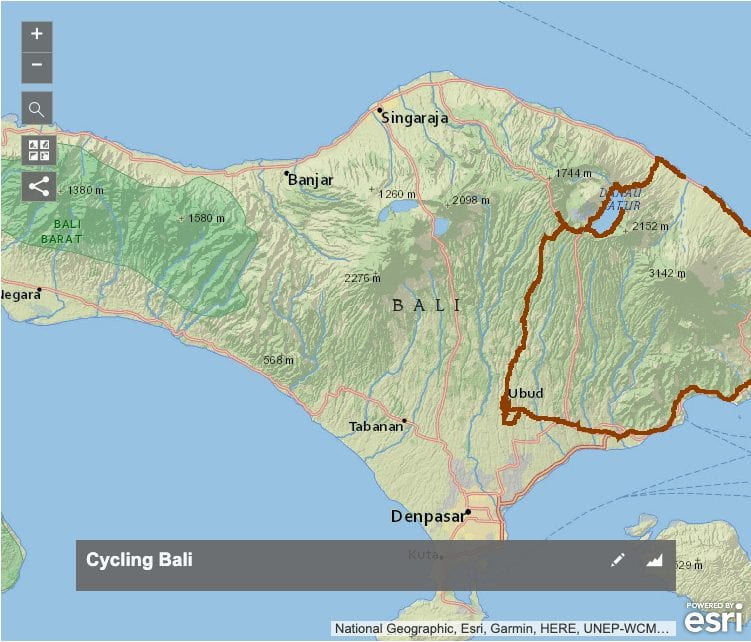
If you want some ideas for a Balinese route and which roads to avoid, here is the map of our route.
Choosing a bicycle touring route for Bali
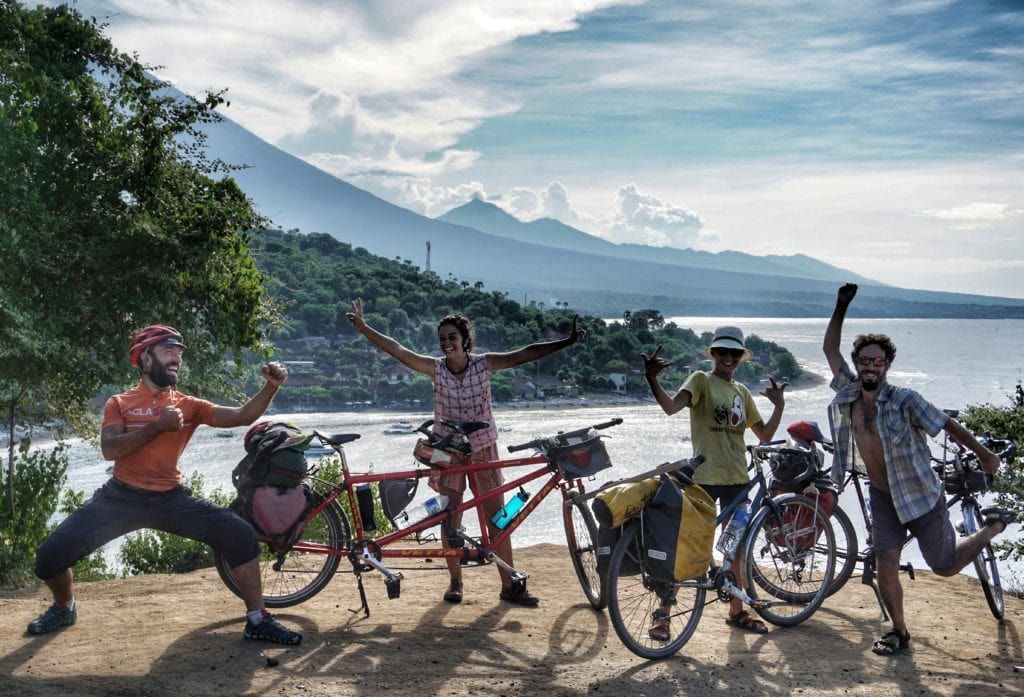
As already mentioned, Bali is very hilly, so there is no way to avoid steep climbs if you want to visit the interiors. And you want to, since it’s here that Bali’s unique beauty and hidden gems are to be found.
Our route will start in Ubud, Bali’s tourist capital. It’s worth spending a few days in Ubud, watching some traditional performances and visiting local attractions such as the Monkey Forest.
We’ll then head north to Lake Batur and the volcano of the same name. From there, we’ll head to the north coast at Kobu, cycle along it to the westernmost tip of Bali, and return to Ubud along the south coast.
This whole loop turned out to be very beautiful but tough; it’s 250 km, and we cycled it in 6 days.
Bikepacking Bali – Stage 1: From Ubud to Batur Lake (37km)
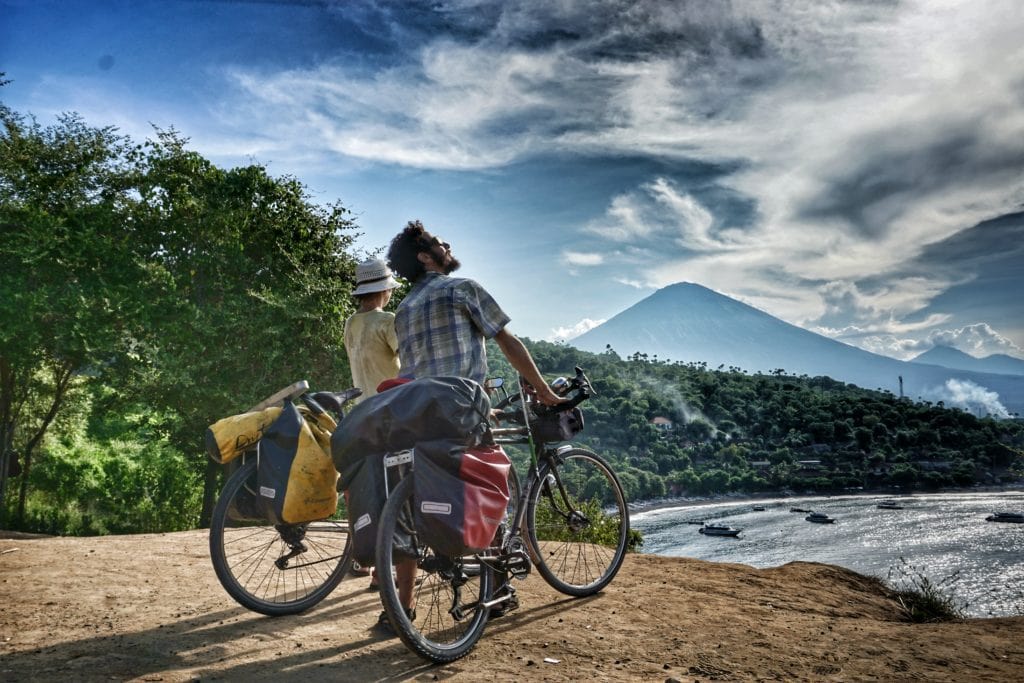
As it is our first time cycling in a loop, we are pretty happy to leave much of our baggage at the guest house. We are as light as we have ever been.
The plan was to leave at 9 am, but at 11, we were still drinking an excellent espresso by Antonio (Mamma Mia, the best Italian restaurant in Bali, we became addicted to after so much crappy food in Flores).
To reach Lake Batur, the highest lake in Bali, located inside the caldera of the homonymous volcano, we’ll be facing 1,000 meters of ascent today. There are several parallel roads from Ubud to Batur, and all have very similar gradients. So we decided to go for the smaller one.
Just outside Ubud, the road begins to rise, but maybe the 20 fewer kilos or the coffee boost make it seem less heavy.
The road is narrow, but there is not much traffic, and we are soon to cross rice fields, villages, and an infinity of temples. At lunch, we stopped for the usual rice with various things, and we already missed Antonio.
Balinese ceremonies and greasy peasy uphills
In the afternoon, we stumble upon a ceremony at a country temple, and many women are coming with the classic ritual offerings on their heads. In addition to flowers, incense, and fruit, roast chickens and pig heads are not lacking.
I’m menstruating, so I’m forbidden to enter the temple. Probably in the evening there will be music and dance, but it is still too early to stop; we continue towards Lake Batur.
The climb is getting more intense; my rear derailleur looks like it’s going to die soon, my chain is constantly on the ground, and my hands are getting very oily.
In the last section, we are all pushing our bikes, except Daniele, who, stoic, feels like “the Pantani of the third millennium” (cit.).
At the top, the rewarding view of Lake Batur and the majestic volcano relieves us all from the suffering. We thought we could find a place to camp here, but there aren’t many options, and it’s a bit late and chilly.
But above all, a guy with a very funny wig intercepts us and drags us to his guest house. He says that he’s a cyclist too, and we can sleep there, leaving an offer.
There is hot water, and the wife cooks us dinner. We put on our socks for the first time in months and sleep under the blankets. If we were not in a hurry, we would gladly stay here for a couple of days to cool down.
Bicycle Touring Bali – Day 2: Around Lake Batur (29km)
We go to the nearby village of Kintamani to fix my derailleur and visit the Pura Ulun Danu Batur temple, dedicated to the goddess of lakes and rivers. To enter the Balinese temples, it is mandatory to wear a Sarong, a cloth wrapped around the waist and reaching to the ankles.
It is possible to rent it on the spot, but we bought two to save money and to be able to enter all the temples, even those without ticket offices or rental services.
After paying the entrance fee of 35,000 IDR, you have to go through a room where they rent or sell sarongs.
We point out that we already have ours so we do not need anything, a lady says that we must also wear a belt at the waist, and a piece of cloth, and Daniel must put the traditional hat on his head, we know it is not true.
She asks us for a crazy price, something like 5 USD, more than a new Sarong. After a long discussion in which I pointed out to the lady that trying to defraud people and make money with religion will not be good for her karma, we will only go out by renting the belts for a small charge.
The temple is interesting, rebuilt on the caldera ridge in 1926 after an eruption of Mount Batur destroyed the old one down in the crater. There are a large number of shrines and a huge eleven-roofed meru.
Lake Batur
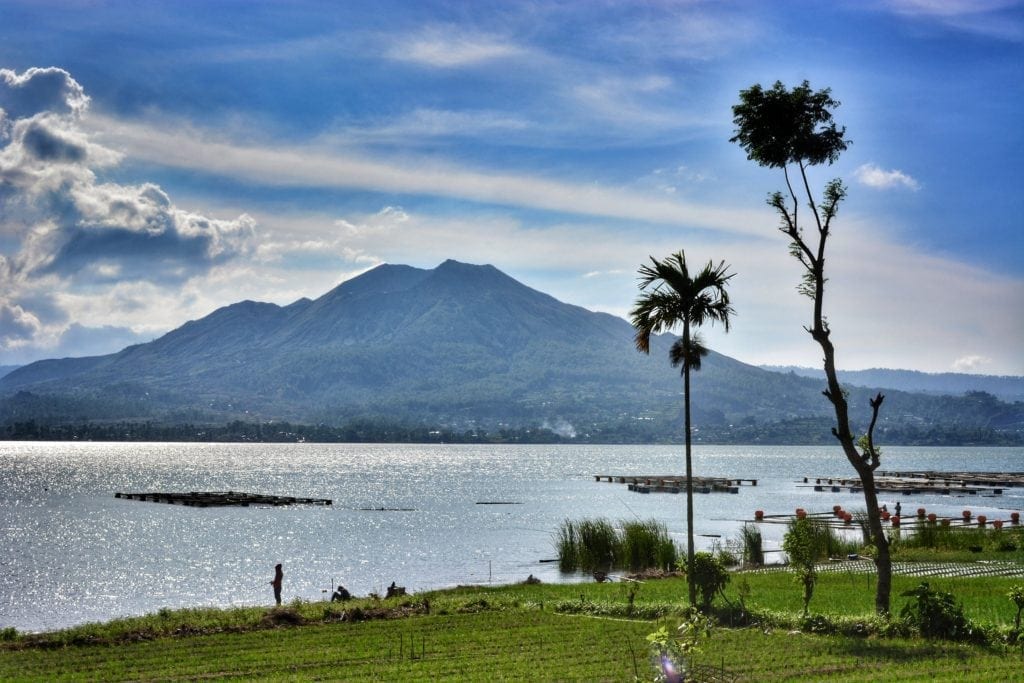
There’s a dirt track going down in the caldera of Batur Volcano; mountain bike tours are held there, but it seems a bit rough for our loaded bicycles. So we take the asphalt road that goes down to the lake, and on our left is the volcano Batur.
Even this road is quite a roller coaster with a couple of ups and downs at 20%+ gradients. Moreover, there are twists covered in slippery sand, and I even get a flat tire.
We reach the last village where the ferries to see the Trunyan cemetery depart from, where the road ends, and there’s no choice but to backtrack. In the village, which is indeed called Trunyan, there are no guesthouses.
We ask a guy where we can sleep, and he shows us one of his house’s rooms, but it’s too small for the four of us. Besides that, he also wants a lot of money, and the village generally doesn’t have a good atmosphere.
Bali is not like the rest of Indonesia, although the locals are generally friendly, scams are more common.
The relationship with garbage, though, is the same; people throw it directly into the lake in front of the houses, and the children bathe between bottles and plastic bags.
Cockfighting in Bali
Cycling our way back, we come across a roster fight. It’s very popular in Indonesia, although illegal. Except here in Bali.
The Balinese, in fact, have told the government that for them, cockfighting is a religious ritual, and therefore, the government allowed them to continue practicing it.
It’s pretty obvious there is nothing religious here, just people betting money. Unfortunately, we did not bet because we would have won.
To the roosters, have a knife applied to the paw so the opponens gets cut. Eventually, one of the two cocks dies, and whoever survives is the winner, pretty neat.
Folk dances of Bali
Struggling along the roller-coaster road, we are finally back to where we started. We found a guest house for 100,000 rupiahs.
From our rooms, we hear music in the distance. Even though it’s already dark and we’re pretty exhausted, we decide to go see what’s going on. And we don’t regret it.
There’s a ceremony in a nearby temple, and Gamelan music plays loudly and frenetically. The place is packed with locals, and an incredible variety of dances is performed.
They are not professional dancers, but it looks like everyone in Bali has some artistic talent. The costumes are amazing, as usual.
These are not the kind of court dances like Legong and Barong, but folk ones, although some are pretty complex. A real ceremony, completely different from the ones “packaged” for tourists in Ubud.
In Bali it is easy to come across ceremonies, there are recurrences and festivals all the time.
Day 3 – The steepest road in the world: Cycling from Batur to Kubu (29km)
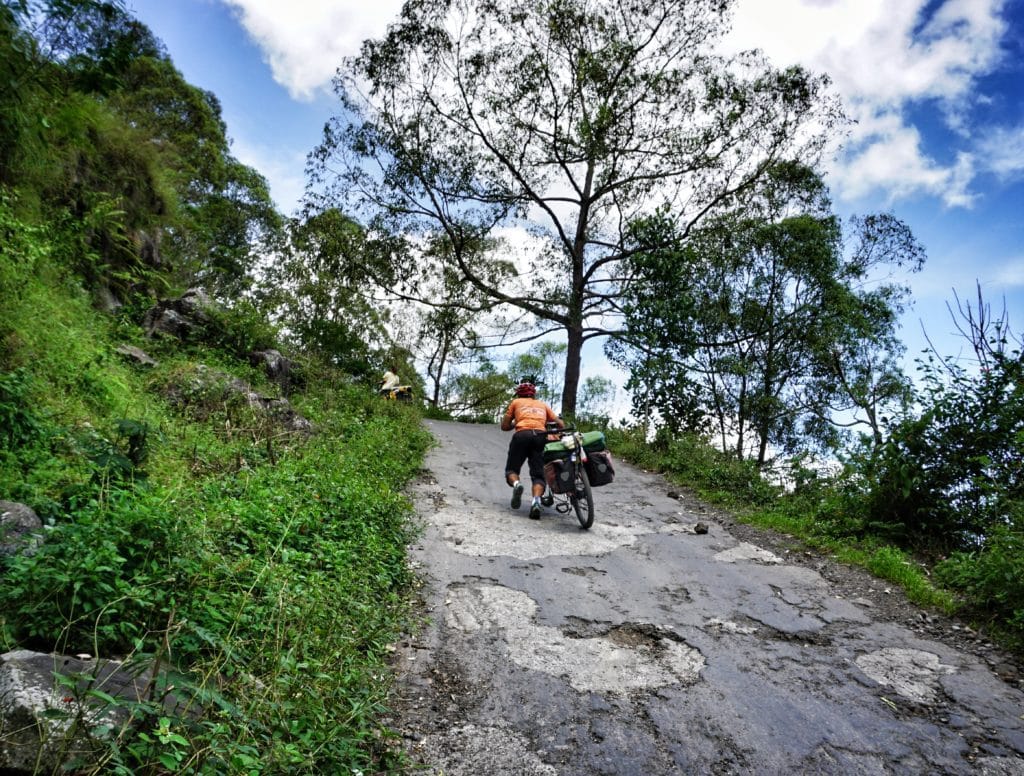
Today we should go down, and so we are happy, but it does not last long. After skirting the lake with a view of Lake Batur on our left, 2 kilometers of unbearable climbing await us; we have to push the bike in two. And then the descent is even more impractical.
The road that descends from 1200 meters to sea level is about 7 kilometers long! The slopes are impossible; we have to do it all on foot, with bikes fully braked. Stefania helps me, and somehow we do it. It takes all day.
Once we get to the beach, we finally take a bath, happy to be able to put on a bathing suit without attracting people’s looks (like what happens in some more remote areas of Indonesia).
We find a good camping spot by the sea, a beautiful sunset, a cool breeze, and perfect sleep.
Bali Bike Trip – Day 4: From Kubu to the easternmost tip of Bali (35km)
Today, we’ll go around Mt. Agung, Bali’s highest peak at 3,031m. It is, of course, an active volcano. We leave early and stop by a beach along the way for a little ‘snorkeling.
Another small climb is ahead, and it looks like there are no places to sleep, neither guesthouses nor camping spots.
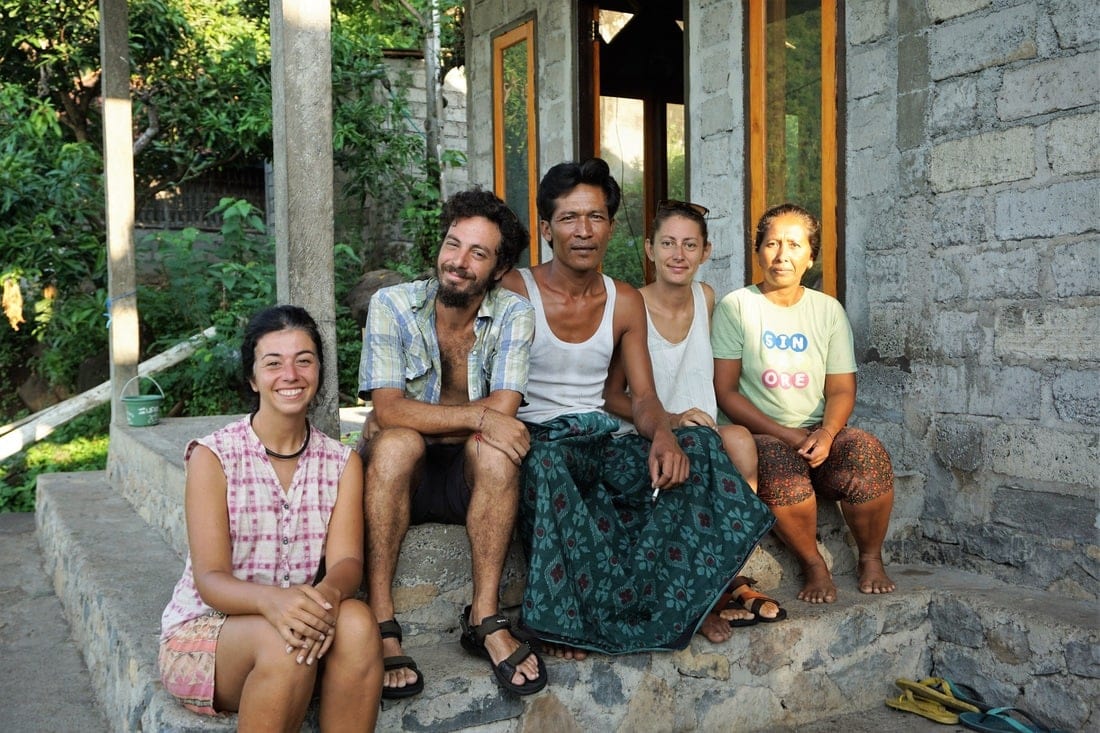
We stop in a little village, right on the eastern tip of the island, to ask for the nearest guesthouse. A guy offers us hospitality at his house; they prepare two rooms, and we will sleep in the living room.
There is no way to make him change his mind. They cook fish, rice, and hard-boiled eggs, all very spicy, and we think of Antonio.
This remote village is one of the poorest we have seen in Bali, but they are much better off than on other Indonesian islands we visited before.
They have water, a TV, a washing machine, and electricity. We leave an offer to the family, even though they try to refuse it in every way.
Cycle Touring Bali – Stage 5: From Mt. Agung to Ubud (74km)
We have to go back to Ubud, the Godimundi have their flight to New Zealand the day after tomorrow. We are very tired in our legs; I cannot bend my knees after those ten kilometers of crazy descent.
At lunch, while eating yet another Nasi Goreng (fried rice in palm oil), we think of evil plans. The idea is that Daniel and Alessandro go on the tandem, and Stefania and I, who have the flu, go by bus.
But then, on a full stomach and after coffee, we decide to keep on pedaling. At worst, we’ll take a ride.
We cycled the main road, which was quite busy, and there was not much to see besides the wide black sand beach near Padangbai.
Antonio and Mamma Mia are always closer; we have to make it. We imagine ourselves sitting at the table with a plate of goat’s sauce tagliatelle in front of us and riding fast. We arrive right at dinner time.