

Last Updated on 2 January 2026 by Cycloscope
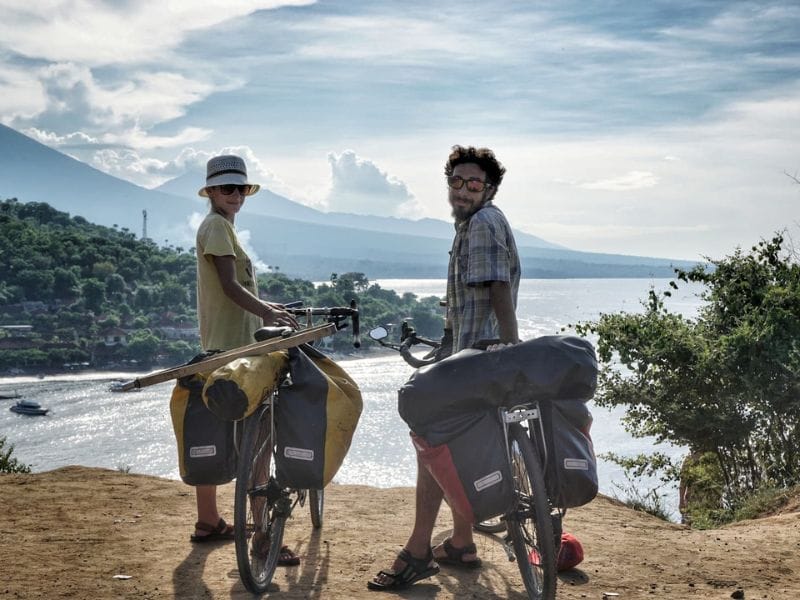
Cycling Indonesia – everything you need to know about
Bicycle touring and bikepacking the archipelago of marvels
(with 9 island itineraries and GPX tracks)
Indonesia might not be a cycling-friendly destination for cycle-touring beginners, but among the 42 countries we’ve explored by bike so far, it consistently ranks as our number-one favorite.
Disclosure: Some of our articles contain affiliate links. This comes at no additional cost for you and helps us keep this website up and running. (as Amazon Associates we earn commission from qualifying purchases)
With more than 17,500 islands, Indonesia is a universe you could never finish exploring. Each island is a planet in its own right, with distinct languages, cultures, religions, architecture, and landscapes. Cycling in Indonesia never becomes monotonous.
We spent three full months bike touring across the country, cycling through the islands of Borneo, Java, Flores, Sumba, Sumbawa, Lombok, Bali, and Nusa Penida. We often think about going back to do more; we truly left our hearts in Indonesia.
Traveling through Indonesia by bike, however, is certainly not without challenges. Extreme heat, heavy downpours during the rainy season, steep hills, language barriers, limited food availability on some of the more remote islands, and difficult access all make cycle touring or bikepacking in Indonesia demanding.
This doesn’t mean you have to be a trained semi-pro to travel Indonesia by bike—just be realistic and avoid overestimating yourself, especially if you’re not used to the heat.
Bits and Facts about Indonesia
- Climate: Tropical
- Currency: Indonesian Rupia (+/- 730Kw to 1$ – 840Kw to 1€)
- Visa: 30 days/75$ on arrival for most countries
- Population: 246 million (2017)
- Population Density: 140 pp x sqKM
- President: Joko Widodo
- Resources: oil, copper, tin, bauxite, timber, gold, natural gas, nickel
Indonesia is the world’s fourth-largest country by population and the largest Muslim-majority nation.
More than 50% of Indonesia’s population lives on the island of Java, which has a population density of about 940 people per square kilometer—one of the highest in the world.
Cycling Culture in Indonesia
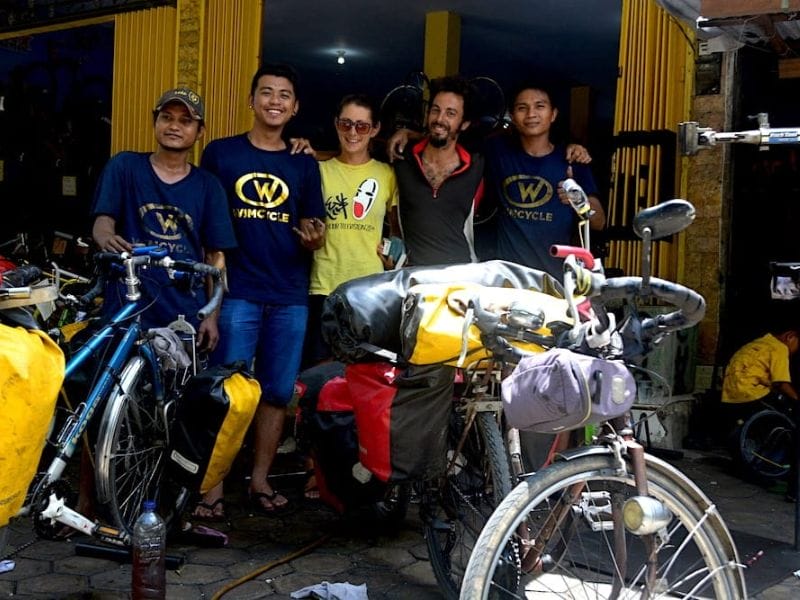
Indonesia is a very hilly country, and getting around by bicycle is not easy for locals, so a strong cycling culture is not yet widespread. Unfortunately, Indonesia has developed more of a motorbike culture than a cycling-oriented one.
Cycling as a sport in Indonesia, however, is gaining increasing popularity, especially among the rising middle class. Many local bike races and Critical Mass events now take place across the country. The Tour of Indonesia is part of the UCI calendar, while the newly launched Tour de Flores aims to join the international cycling circuit within the next few years.
Mountain biking and road cycling in Indonesia are growing steadily, but bicycle touring in Indonesia has seen particularly strong development. More Indonesians are now embarking on bike trips both within the archipelago and abroad, and the cycle touring community continues to expand.
To meet local cyclists and fellow travelers, refer to the Warmshowers Indonesia Facebook group.
What to bring when cycling in Indonesia
Indonesia is a tropical country, hot year-round—you definitely won’t need winter gear, although a light jacket is recommended as temperatures drop at higher altitudes.
Rain gear won’t really keep you dry during a tropical downpour; we usually found shelter or simply got wet, and sometimes a sudden shower is even welcome.
A regular touring bike works perfectly in Indonesia, but a basic, inexpensive mountain bike will do just as well. Just make sure you have adequate gearing for the steep hills.
Camping in Indonesia is not essential for bike travel. Guesthouses are affordable, and camping is often difficult or unpleasant. You can carry minimal camping gear as a backup, but it’s generally unnecessary.
Visa for Indonesia
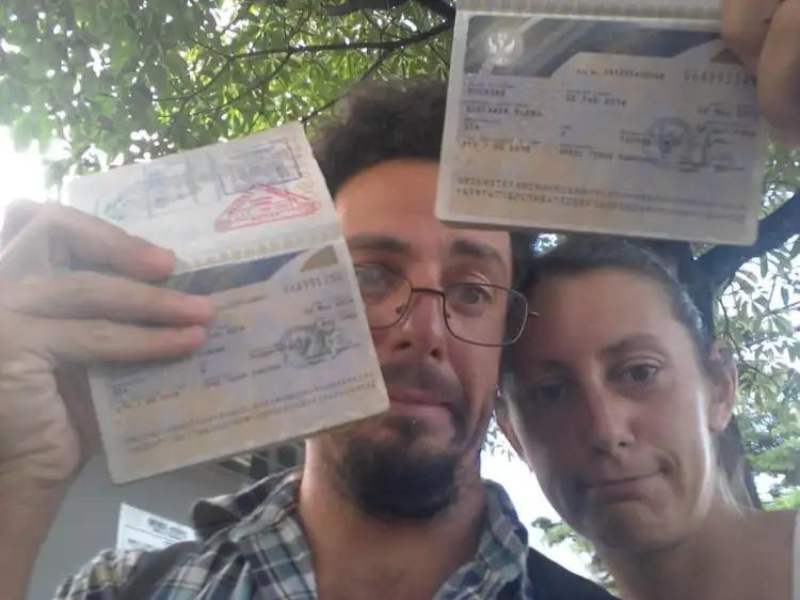
Citizens of most nations (around 170 countries) can obtain a 30-day tourist visa on arrival at almost any port of entry. Indonesia, however, is a vast and incredibly diverse country, and if you plan to explore beyond the highlights, a 30-day stay is often not enough—you’ll need a longer visa.
This is especially true if, like us, you’re traveling by bicycle. While the visa can be extended to 60 days, you won’t always be close to an immigration office, as Indonesia is large and often remote.
We entered Indonesia with the Social Budaya Visa (Social Visit Visa), which allows you to stay in Indonesia for 60 days and is extendable up to six months in total. This means you can apply for a 30-day extension up to four times.
We applied at the Indonesian Consulate in Kuching, in Malaysian Borneo. It happens to be one of the best places to do it: processing takes only half a day, meaning you apply in the morning and collect the visa in the afternoon.
Social Budaya visa can be requested at every embassy and most of the consulates of the Republic of Indonesia.
This article explains how to get this type of Visa. If you need to know
how to extend a Social Visit (Social Budaya) Visa, everywhere in Indonesia, click here
Weather – Best Time to Cycle in Indonesia
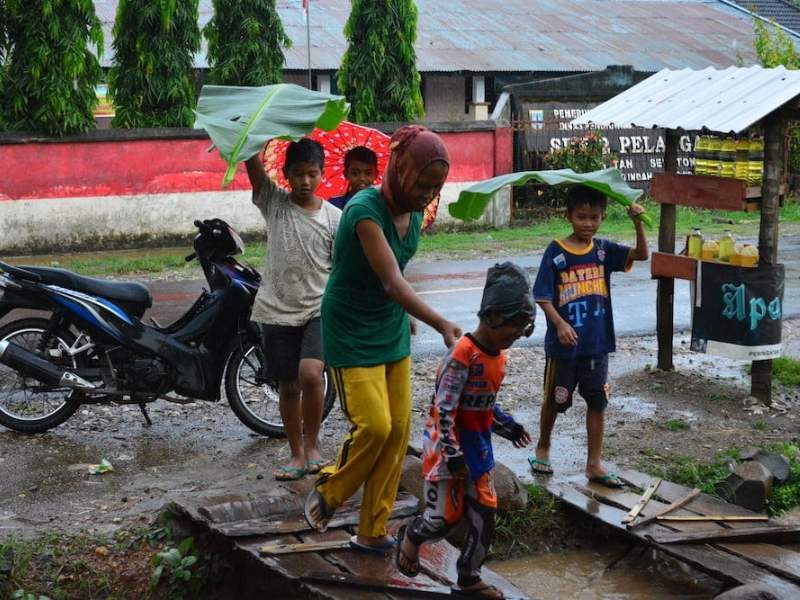
Cycling in Indonesia during the peak of the rainy season can mean riding under constant rain for hours—or even days. Some of the many Indonesian islands are among the wettest places on Earth.
Western Sumatra, Java, Bali, and the interiors of Kalimantan, Sulawesi, and Papua receive more than 2,000 millimeters (78.7 in) of rainfall per year.
These extreme variations in rainfall are linked to the monsoon system. Generally speaking, Indonesia has a dry season (June to October) and a rainy season (November to March), although conditions can vary greatly from island to island.
Local wind patterns further complicate matters, making rainfall in Indonesia difficult to predict, especially across such a vast country.
Temperatures, on the other hand, remain fairly constant throughout the year, and the only real way to escape the heat is by climbing to higher elevations.
Ideally, the best time for cycling in Indonesia is toward the end of the rainy season, when cloud cover and short showers help offset the heat.
If you plan to cycle mainly on dirt roads, however, the dry season is a better choice—unless you enjoy getting stuck in the mud. This is especially true for the wetter regions mentioned above, while Nusa Tenggara generally offers road conditions that hold up better year-round.
Geography of Indonesia

Indonesia is an archipelagic state of more than 17,000 islands, spanning over three meridians (and therefore three time zones) across two continents.
Roughly half of Indonesia lies on the Asian continental shelf, while the other half sits on the Australian (Oceania) Plate. These two tectonic plates meet between Bali and Lombok.
Indonesia lies entirely along the Pacific Ring of Fire, one of the most volcanically active regions in the world. The country is home to 127 active volcanoes, some of which are truly spectacular and well suited to extreme bikepacking.
Given Indonesia’s vast size and geographic spread, it’s difficult to identify features common to the entire country. Each island is unique: while many are mountainous or hilly, vegetation types and coastal landscapes vary greatly from one island to another.
Where to stay when cycling in Indonesia

Accommodation in Indonesia ranges from ultra-cheap guesthouses to hostels and backpackers’ lodges, all the way to high-end luxury resorts.
Basic guesthouses typically cost between $10 and $20 for a double room. Prices vary by island: Java, Bali, and Sumatra offer the cheapest and best value (especially Bali), while islands like Flores or Sumba tend to be slightly more expensive.
Some guesthouses can be a bit dirty, and cockroaches are not uncommon. Rarely, there’s a restaurant or bar on the premises.
Most accommodations provide free drinking water, though it’s often worth spending a few extra dollars for a place that does. Bottled water can be relatively expensive.
Mid-range hostels, lodges, and backpackers’ accommodations cost around $30–$50 for a double room. Some have bars or restaurants, and many can arrange meals if requested in advance.
For luxury accommodation, prices can soar, but some resorts are true paradises, offering unforgettable comfort and views.
Campsites and Wild Camping in Indonesia

Since overlanding in Indonesia is not exactly easy, campsites are very rare—only a few exist across the entire country, mostly in Java and Sumatra.
Wild camping in Indonesia is challenging. The country is densely populated, hot, and humid—even at night—and terrain is often rough and steep.
Less populated islands like Sumba and Sumbawa offer some decent spots, but if you want to camp, the safest and most practical approach is to ask a local homestead for permission to set up your tent on their land.
Roads of Indonesia
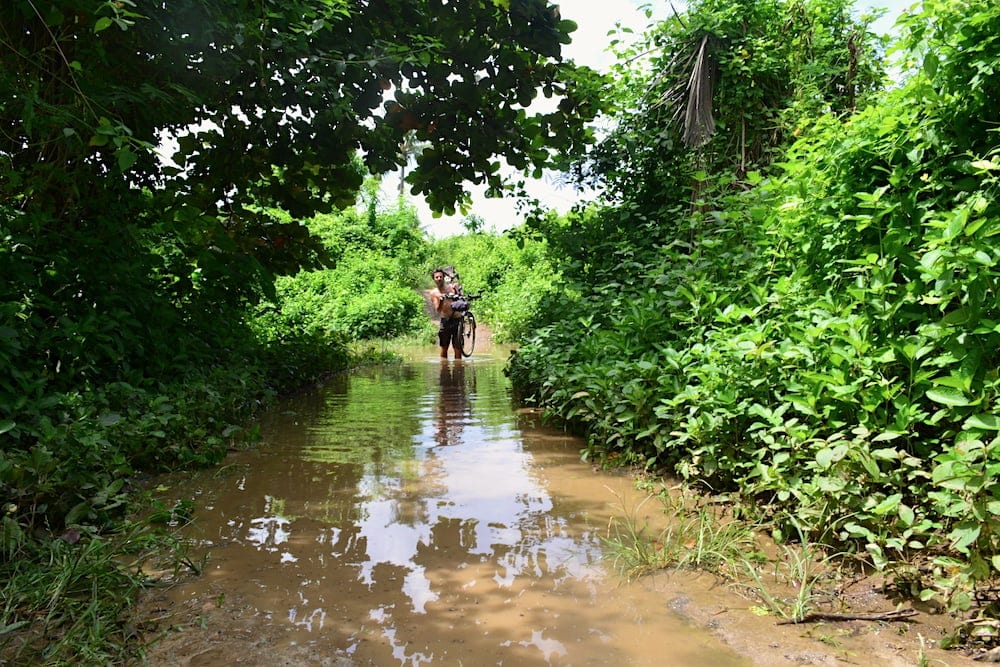
Although conditions vary widely, Indonesia generally has well-paved roads connecting most of the islands. Traffic can be among the worst in the world in Java and Southern Sumatra, and main roads in Bali also get very busy.
On most remote islands, you might find only a single paved road, while most side roads are gravel. That said, we rarely encountered truly terrible roads.
The main exception is Papua, which has almost no roads—making cycling in Papua extremely difficult, if not impossible.
Island Hopping with Bicycles in Indonesia

How do you get your bike from one island to another? Indonesia is connected by a system of ferries and fast boats that link major islands—Sumatra to Java, Java to Bali, Bali to Lombok or Nusa Penida, and so on. These connections are generally easy to navigate.
There are usually two types of ferries for these relatively short rides: RoRo ferries (Roll-On/Roll-Off, which carry cars and other vehicles) and speedboats. Some speedboats allow you to bring your bike on board, but it’s usually easier—and cheaper—to use a RoRo ferry, even though they are slower and less frequent.
To reach more remote islands, you’ll need to either fly or embark on multi-day journeys aboard the national flagship company, Pelni.
Pelni ships connect Indonesia’s far-flung islands, from the western tips of Sumatra to eastern Papua, covering almost a continent. Sailing on a Pelni ship is an experience in itself, offering a glimpse into the life of the Indonesian people—though it’s not always a comfortable one.
Some Pelni ships are well-maintained and surprisingly clean (by Indonesian standards—meaning only a few dozen cockroaches). However, others may have been neglected, with faulty engines, poor safety equipment, and the potential for long delays, general discomfort, and—literally—millions of cockroaches.
Pelni schedules are also notoriously unpredictable, affected by weather and other delays. Overall, while Pelni does an incredibly difficult job, even the most patient travelers can lose their nerve after repeated delays or unanswered calls.
This is the website for the schedules and booking, a bit difficult to use. We hope to write a guide about Pelni ships soon.

Food in Indonesia: Restaurants, Eateries, and Street Food in Indonesia
Indonesia is a food-rich tropical country, offering almost everything: fruit, fish, chicken, various meats (including pork in non-Muslim regions), and a wide variety of vegetables. Unfortunately, finding these ingredients is not always easy, especially in more remote areas.
Getting good food in Indonesia can range from very easy to incredibly challenging. In Bali, Java, and other major tourist hubs, there are plenty of restaurants, including some very good ones at reasonable prices—a meal in an inexpensive tourist restaurant typically costs $3–$7.
In places like Sumatra, Sumba, Sumbawa, and even Flores, finding decent food can be difficult outside the few major tourist spots.
Eateries are the most common type of restaurant in these regions. Food here is usually pre-cooked and often poorly preserved—kept on non-refrigerated glass shelves, sometimes under direct sunlight. If you have no alternatives, it’s best to choose hot dishes like stews or curries, which last longer before spoiling.
Food stalls in markets, on the other hand, are much more reliable. Food is mostly prepared on the spot and is usually fresh. Here, you can try local favorites like Gado-Gado, Satay, and other traditional dishes. Markets make excellent stops for the hungry cyclist.
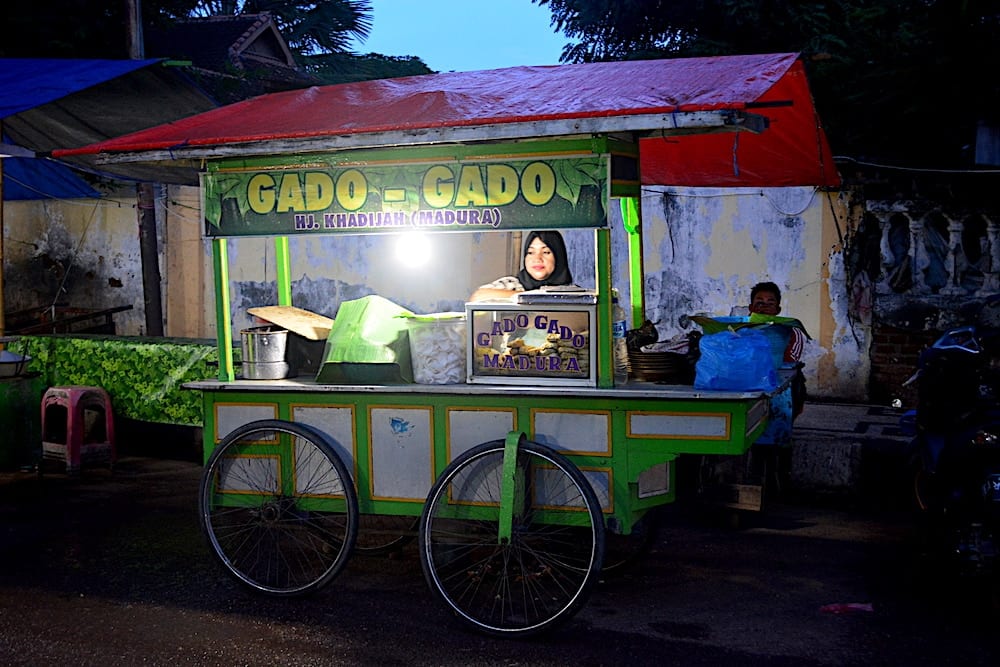
Food to try in Indonesia
- Gado-Gado
- Satay
- Babi Guling
- Jackfruit curry
Refer to this article for more denominations and descriptions of Indonesian food
Supermarkets and Grocery Stores in Indonesia
Properly stocked supermarkets in Indonesia are mostly found in the largest cities on the major islands. Even in Bali, supermarkets are limited to areas like Ubud, Kuta, and Denpasar.
Supermarkets carrying Western food are rare on most other islands. Even Mataram, the bustling capital of Lombok, has only a modest supermarket.
Small local shops typically sell only basic staples: rice, instant noodles, sometimes pasta, and occasionally canned food—mostly sardines.
Fruit in Indonesia
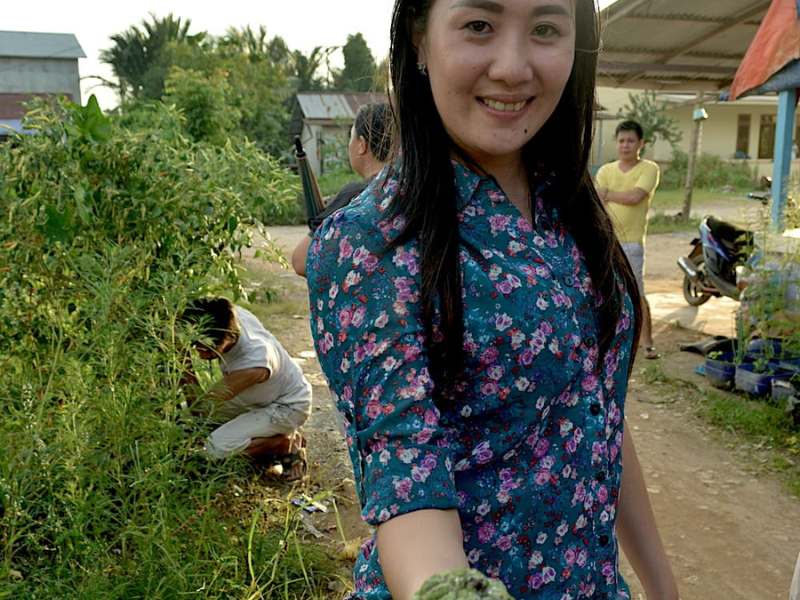
A fruit-based diet is the best option when cycling in Indonesia. Hundreds of different tropical fruits are available year-round, with some trees and plants fruiting up to three times per year.
Mangoes, bananas, watermelon, dragonfruit, mangosteen, rambutan, coconut, and many other fruits are easy to find, often sold along the road by street vendors and small stalls.
Drinking in Indonesia
Indonesia is a Muslim-majority country, but it also has significant populations of Christians, Hindus (mainly in Bali and parts of Lombok), Buddhists, and many other religious groups—some of which are not officially recognized by the government.
In Muslim areas, finding beer or alcohol can be difficult; your best bet is often Chinese-owned shops.
In Christian and other religious regions, beer is generally easy to find. A local Bintang typically costs around $1.30 USD. Traditional alcoholic drinks like Arak or Tuak may also be available from locals, but caution is advised—they can sometimes be unsafe or poisonous, so buy only from trusted shops or establishments.
Water Access in Indonesia
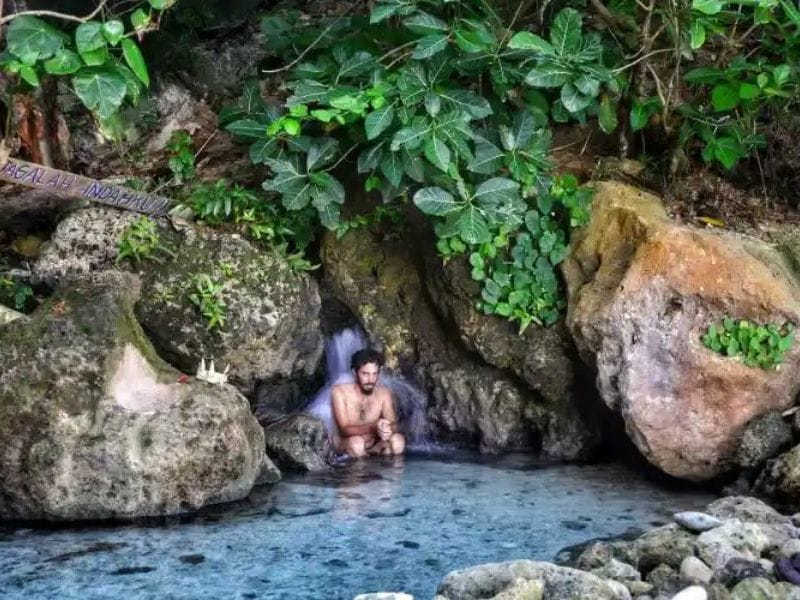
Tap water is not drinkable in about 98% of Indonesia. Refill your bottles at restaurants or guesthouses whenever possible; otherwise, you’ll need to buy bottled water, which isn’t cheap—about $1.20 USD for 1.5 liters.
Most of Indonesia is wet year-round, so there’s no shortage of freshwater streams to rinse off sweat. If you dare, you can even bathe in a rice field canal—but be cautious of polluted streams near cities.
Many restaurant toilets provide buckets and sometimes the handy butt-gun, a useful extra to help you stay clean on the road.
You might be interested in The 10 Best Travel Water Filters and Purifiers for Cycle Touring, Bikepacking, and Hiking
Language in Indonesia
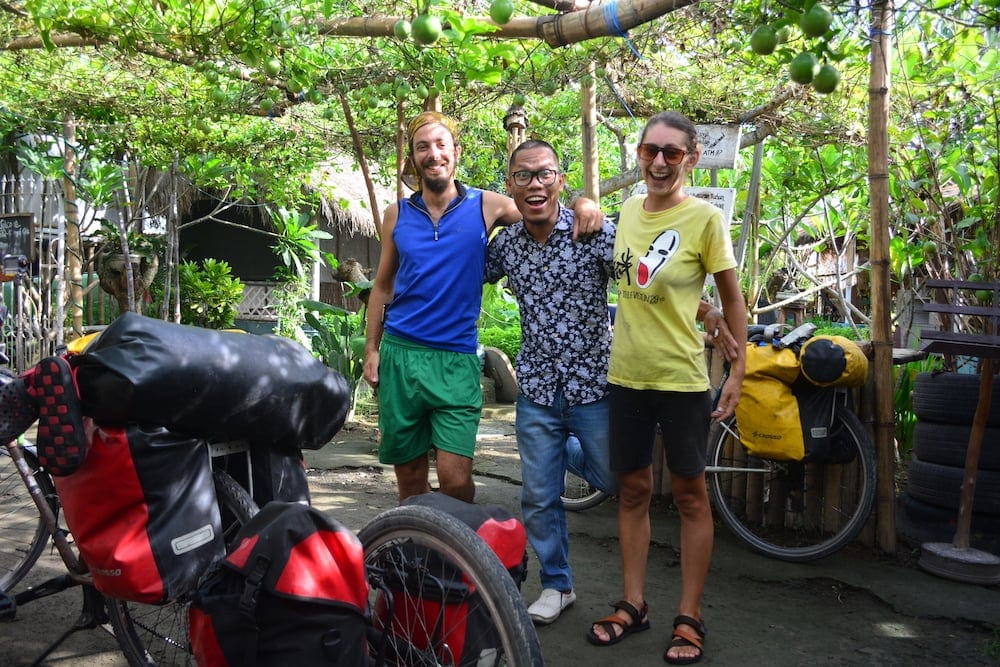
Over 300 native languages are spoken in Indonesia. While Bahasa Indonesia is the mother tongue of only about 7% of the population, it serves as the national language and is spoken as a second language by around 200 million people.
Bahasa Indonesia is a very simple language and is almost identical to Bahasa Malaysia. Learning a few basic words is easy—and definitely worth trying when traveling in Indonesia.
English is not widely spoken outside of the tourism industry. In most areas, especially beyond the major cities and islands, you’ll encounter few English speakers. Keep your sentences simple, speak slowly, and try to adapt your accent to make communication easier.
Useful Phrases in the Indonesian Language (Bahasa Indonesia)
- Permisi (per-mee-see) / excuse me
- Terima kasih (te-ree-ma ka-seeh) / thank you
- Ya – Tidak (ya – tee-dak) / yes – no
- Sama-sama (saa-maa saa-maa) / you’re welcome
- Saya tidak mengerti (saa-yha tee-dah me-nger-tee) / I don’t understand
- Di mana toilet? (dee maa-naa toilet?) /Where is the bathroom?
- Belok kiri, belok kanan (bae-lok kee-ree, be-lok kaa-naan) / turn left, turn right
- Enak (e-nak) / delicious
- Berapa harganya? (be-raa-paa harr-gah-nyaa) / how much is this?
- Terlalu mahal (ter-laa-luw maa-haal) / too expensive
- Ini, itu (ee-nee, ee-two) / this one, that one
Numbers
- Satu (saa-too) / 1
- Dua (doo-wa) / 2
- Tiga (tee-ga) / 3
- Empat (em-paat) / 4
- Lima (lee-ma) / 5
- Enam (é-num) / 6
- Tujuh (too-jooh) / 7
- Delapan (dhe-laa-paan) / 8
- Sembilan (sem-bee-lan) / 9
- Sepuluh (se-poo-looh) / 10
- Ratus (raa-toos) / hundred
- Ribu (ree-boo) / thousand
- Nama kamu siapa? (naa-maa kaa-moo see-a-pa) / what is your name?
- Nama saya … (naa-maa saa-yaa …) / my name is …
And then the most important word of them all, the one you’ll hear every day
- Bule
Bule is a generic term to describe foreigners, especially those who are Caucasian-looking. It’s not meant to be derogatory, although some foreign tourists have found it racist or inappropriate. The truth is, most of the time, it’s just a common descriptive term used among locals.
Cycling Itineraries in Indonesia
With so many islands, all different and beautiful, it’s hard to choose an itinerary for a bicycle trip in Indonesia. We cycled in 8 different islands during our 3-months stay, and we liked them all.
Cycling Java
As already mentioned, Java is the most populous island in Indonesia and has among the highest density of inhabitants in the world.
Although its landscapes and cultural marvels are certainly an interesting attraction, most of Java is not pleasant to cycle at all, just too much motorbike and minibus traffic, unbreathable air, and often a lot of concrete.
East Java, though, is a bit different, with fewer vehicles and fewer big cities… and it is one of the most scenic volcanic regions of Indonesia.
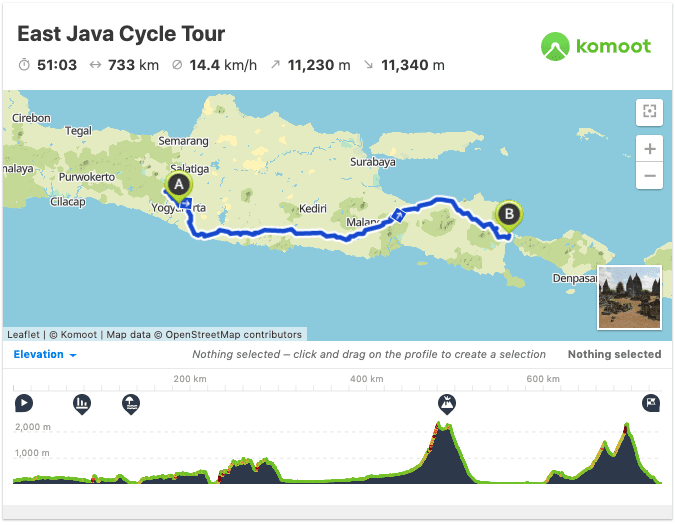
Staying off the main roads as much as you can, you can enjoy exploring Java by bicycle following this suggested itinerary:
Starting in the cultural capital of Jogjakarta, passing by the big temples of Borobudur and Prambanan (the most famous UNESCO sites in Indonesia), visiting most of the best attractions in Central Java, the Mount Bromo, and the Ijien to reach the easternmost tip of Java, from where you can sail to Bali (from where you could fly out, see below).
Bali by Bicycle

Bali is certainly one of the most visited places in the world, it was even awarded the title of the best place to visit on the whole planet by the TripAdvisor community.
Its beauty, though, is not about beaches (which are pretty average and even poor compared to other places in Indonesia), but in the unique culture and art forms, the lush mountainous interiors, the many volcanoes and waterfalls of Bali, and the affordable and restorative yoga retreats.
Iconic rice paddies, thousands of temples, ceremonies accompanied by mesmerizing music, and two big active volcanoes make Bali surely a must-visit once-in-a-lifetime destination.

Cycling in Bali, though, is very tough. With a very hilly interior and crazily steep roads, it’s certainly not a bicycle touring destination for beginners, especially if you suffer from the heat.
A bicycle trip, anyway, is still one of the best ways to experience Bali in all its fascination, which is to be found far from the most popular tourist routes. There are several tour operators offering bicycle holidays in Bali; we, of course, recommend doing it yourself.
Bali also has one of the better-connected airports in Indonesia; you can fly for cheap from the Denpasar Airport to many destinations within Indonesia and out of the country.
You can read our full article on Cycling in Bali and check our suggested itinerary
Cycling in Nusa Penida
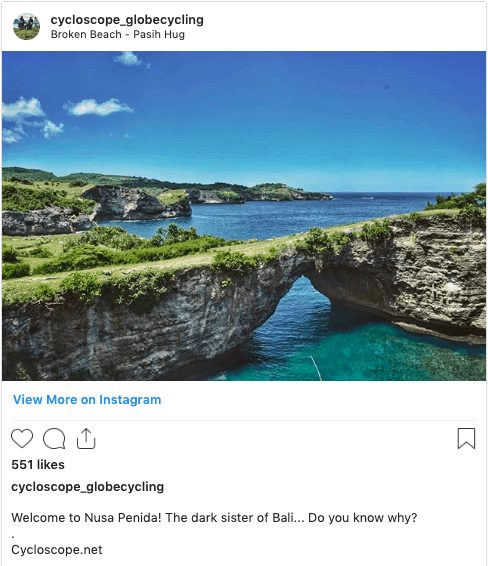
Nusa Penida is often called the dark sister of Bali—a mystical island where, according to local lore, ghosts, demons, and dark spirits roam, including the fearsome I Macaling, the bearer of diseases.
A deeply magical destination not to be missed, Balinese culture is even better preserved here than on Bali itself.
The landscape of Nusa Penida is very different from its bigger sister: much drier, with low vegetation and no volcanic sand. The island is dominated by a limestone plateau, mostly made of white rocks.
Aside from the main coastal road in the North, most roads on Nusa Penida are rocky, gravelly, and extremely challenging—especially on a loaded bicycle. If you plan to cycle here, consider leaving part of your luggage in Bali.
Despite the tough roads, the island is breathtaking, with stunning cliffs, white-sand beaches, crystal-clear waters, and unique temples that make the journey worthwhile.
Refer to our Nusa Penida Travel Guide for itineraries and points of interest
Lombok on a Bike
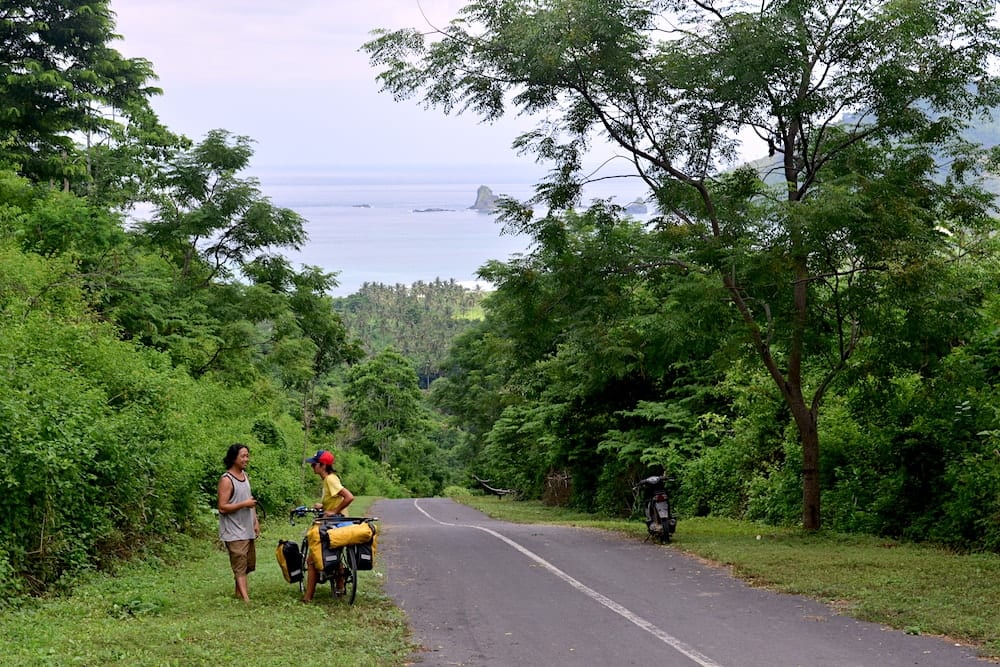
Lombok is very small, with most of its land occupied by the gigantic and spectacular Mount Rinjani, the second-highest volcano in Indonesia at 3,726 meters (12,224 ft).
It’s a Mulsim majority island with the Sasak as the main ethnic group. Another unique cultural pearl of Indonesia, Balinese Hinduism, is also present. The name Lombok means chilly in Sasak… be warned.
There’s a main ring road going around the island, which is nice in the North and the East but a bit busy in the more populated West, where the capital Mataram lies.
Mataram itself is a good spot to extend your Indonesian visa, and a lively city where we had good times.
The nearby Gili islands and the town of Senggigi have a backpacker vibe (which often means they are also kind of a tourist trap), but that coastal road is scenic and easy to ride.
The South is wilder, with the best beaches and most interesting dirt roads, the wide sand beaches at Kuta Lombok, and the fascinating Sekotong Peninsula with its less-known Gili Islands.
The island can be deeply explored in just about 4 days following an itinerary like this, adding three more days to relax by the beach or climb Mount Rinjani and make it an unforgettable week in Lombok.
Sumbawa
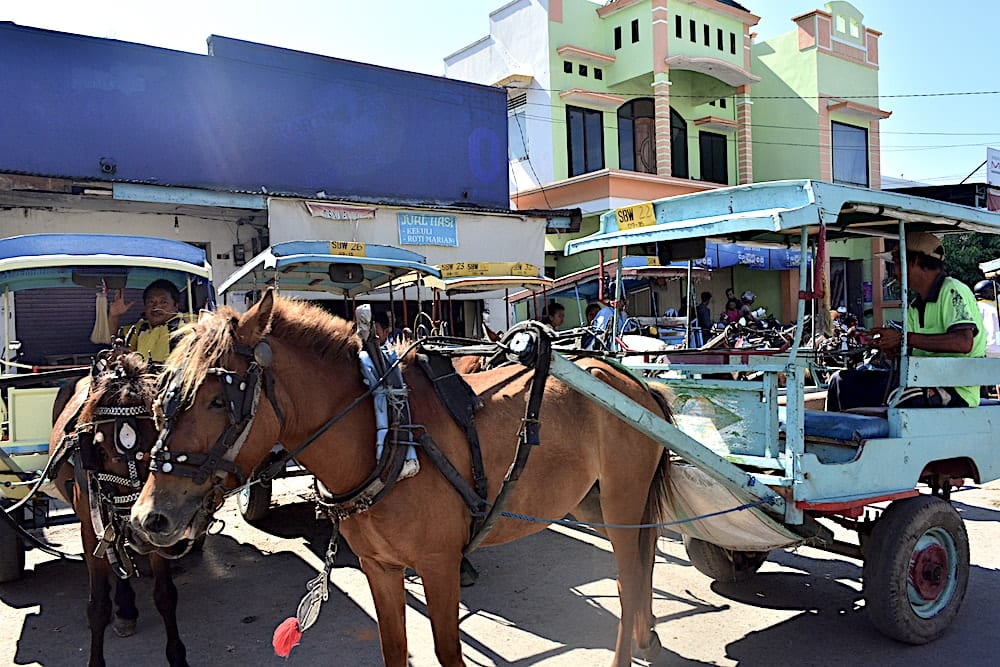
Located in the middle of the Lesser Sunda Islands chain, with Lombok to the west, Flores to the east, and Sumba further to the southeast, Sumbawa is a rather large and sparsely populated island.
Sumbawa has one of the driest landscapes in Indonesia, with generally lower altitudes. The island is dominated by Mount Tambora, the famous volcano historically linked to dramatic global climate events.
For us, Sumbawa was perhaps our least favorite Indonesian island—but that doesn’t mean it isn’t interesting and beautiful. Cycling options are limited, mostly confined to the main road that runs from west to east across the island.
Sumbawa is a Muslim-majority island, home to three different ethnic groups, each speaking their own language. The island is notable for its colorful architectural styles and the small horses that are still widely used for transport.
Do You Dare Cycle in Sumba?
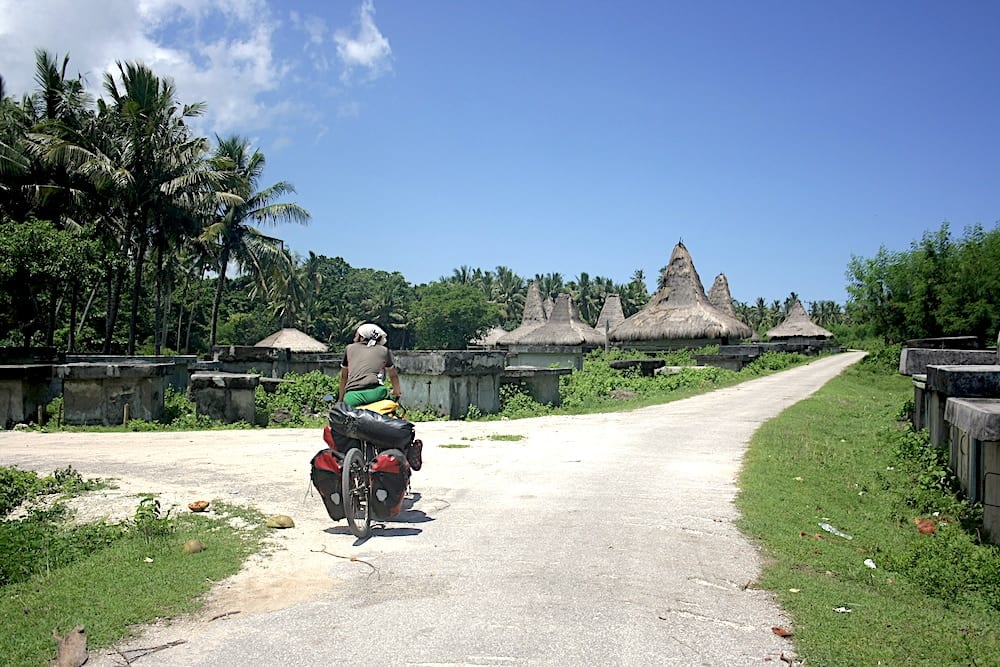
Sumba Island, part of the East Nusa Tenggara archipelago, has around 650,000 inhabitants and is one of the poorest islands in Indonesia, relying mainly on agriculture and livestock.
More than half the population lacks access to safe drinking water, and malaria and dengue are common. Medical care is limited: doctors are scarce, and those available can be expensive.
Historically, the island was colonized in the 16th century, but neither the Portuguese nor the Dutch established a full-fledged colony here.
The island offered sandalwood and a little more, not very profitable compared to spices from nearby islands. This lack of interest has favored the maintenance of an original culture and religion, one of the last megalithic cultures surviving on the planet.
Sumba feels like another world, almost stuck in a different time and space. The island is surrounded by untouched white-sand beaches, and its low vegetation is reminiscent of Nusa Penida. The roads are similarly challenging, especially when heading into the hilly interior or down to the beaches.
For us, Sumba was one of the most intense and rewarding islands in Indonesia. The hardships involved in getting there are more than worth it—you won’t regret it.
The “easiest” way to reach Sumba is by taking a hectic and fairly dangerous RoRo ferry from Bima, Sumbawa.
If you want to know more about this incredible island, have a look at our article about the Pasola of Sumba, an ancestral ritual still performed nowadays, which we had the luck and honor to witness.
Cycling Flores Island

Flores is an island in the East Nusa Tenggara archipelago of Indonesia, best known for Komodo National Park—the only place in the world to see Komodo dragons—and as a diving mecca.
Flores is one of the poorest islands in Indonesia, yet also one of the richest in cultural and geographic diversity.
The island features 17 volcanoes, six distinct languages, and traditional cultures and costumes that remain closely tied to ancestral practices. Its tropical vegetation is punctuated by patches of jungle and majestic spiderweb rice paddies, not to mention its stunning beaches.
Flores is becoming more and more popular among the more adventurous tourists, mostly fed up with the crowds of Bali and the Gili islands.
Even though most of them stick to the western part, using Labuan Bajo as a base to explore Komodo National Park, there’s much more to see in Flores, and bicycle touring is the perfect way to see it.
Check out our Full Guide about Cycling in Flores Island
Sumatra
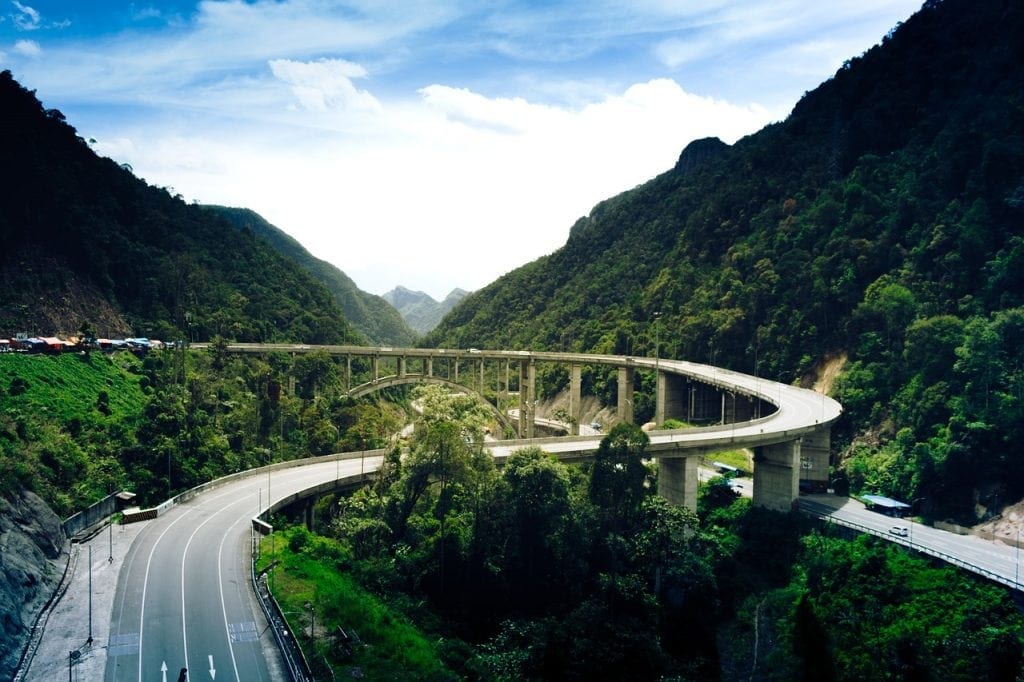
Sumatra is the sixth-largest island in the world, with a lot to see and do – unfortunately, we haven’t been to Sumatra yet, so we’ll rely on second-hand information.
The best part of Sumatra for a cycling trip is probably the North, wilder, and more mountainous, with the well-known Toba Lake and the less popular Mount Sinabung as two of the many highlights of this island.
Sumatra used to be home to a huge rainforest, which is constantly being destroyed by manmade fires in order to make space for oil palm plantations.
Avoid the dry season at all costs because it’s then (August/September usually) that the fires are at their peak, making the air unbreathable as far as peninsular Malaysia.
Aceh Region has been devastated by the 2004 Pacific Ocean tsunami and kept constantly in unrest by a minority of radical Muslims.
Sulawesi
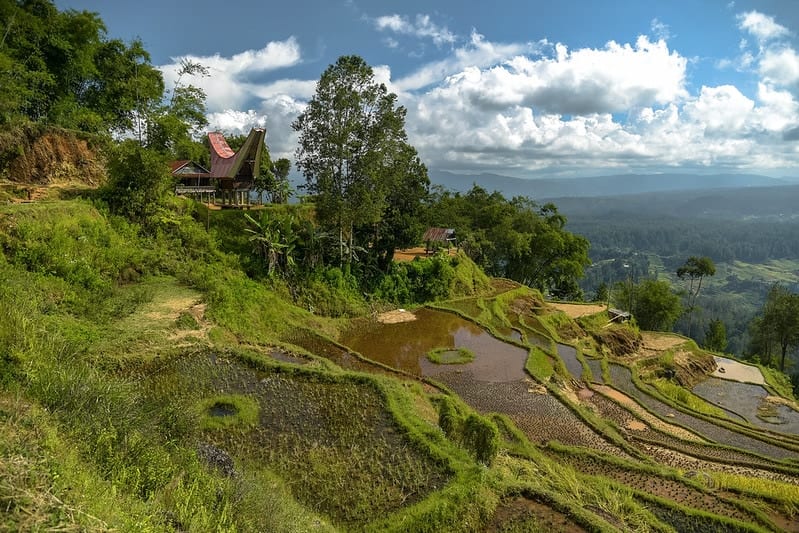
Sulawesi is another island that we haven’t had the chance to visit yet. Its weird shape makes it not so easy to explore throughout. Sulawesi is also home to unique cultures and art forms, like the famous Toraja Culture.
The South of Sulawesi, near the capital of Makassar, can be very busy with traffic while heading north things get wilder and more interesting.
Conclusions
Indonesia is not an easy country to cycle in, but there literally isn’t a more interesting place to visit in the world.
We hope this blog article/guide has given you all the basic info about cycling in Indonesia and that you’ll start planning your trip now.