

Last Updated on 19 January 2026 by Cycloscope
How to choose the best mountain bike computer?
A thorough comparison of the top speedometers and MTB GPS devices for sat nav
Whether you approach mountain biking as a hobby or a sport, chances are you still want to keep tabs on your performance. But what is the best mountain bike computer? Why should you use a GPS device?
Disclosure: Some of our articles contain affiliate links. This comes at no additional cost for you and helps us keep this website up and running. (as Amazon Associates we earn commission from qualifying purchases)
How we compile our gear guides: during the almost 10 years of cycloscope.net our team personally tested dozens of similar pieces of gear. For what we can't test personally, we involve other people in the cycling community to give their feedback and opinion about gear they have used. Our decade-long experience in bicycle touring enables us to find the key cons and pros of every product we mention.

While roadies and bikepacking enthusiasts might as well opt for one of the many smartphone apps, for mountain bikers, having a dedicated bike computer is almost mandatory, unless you want to replace your phone every month.

The 13 best MTB computers
in-a-nutshell
7 best GPS mountain bike computers
- Bryton Rider s800 [+/- $350]
- best budget MTB GPS
- Garmin Edge 1050 Solar [+/- $680]
- best MTB computer for Pro riders
- Garmin Edge 550 Solar [+/- $350-450]
- budget Garmin MTB GPS device
- Garmin Edge 850 [+/- $550]
- best midrange Garmin MTB computer
- Wahoo ELEMNT ROAM V2 [+/- $400]
- An affordable MTB computer for pros
- Garmin Edge® Explore 2 [+/- $300]
- best GPS device for MTB touring
2 best MTB Speedometers
- Cateye Padrone [+/- $55]
- best mountain bike speedometer for minimalists
- Garmin Edge® 130 Plus [+/- $180]
- best entry-level Garmin computer
2 more honorable mentions
- LEZYNE Mega XL GPS Bicycle Computer [+/- $200]
- Hammerhead Karoo 3 [+/- $400]
The best MTB cyclo-computers
compared by price and technical specs
So, here we go! Let’s dive into the comparison of the best mountain bike computers! We have divided our selection into 3 categories to facilitate navigation.
7 best GPS mountain bike computers
Bryton Rider s800 [+/- $350]
best budget MTB GPS
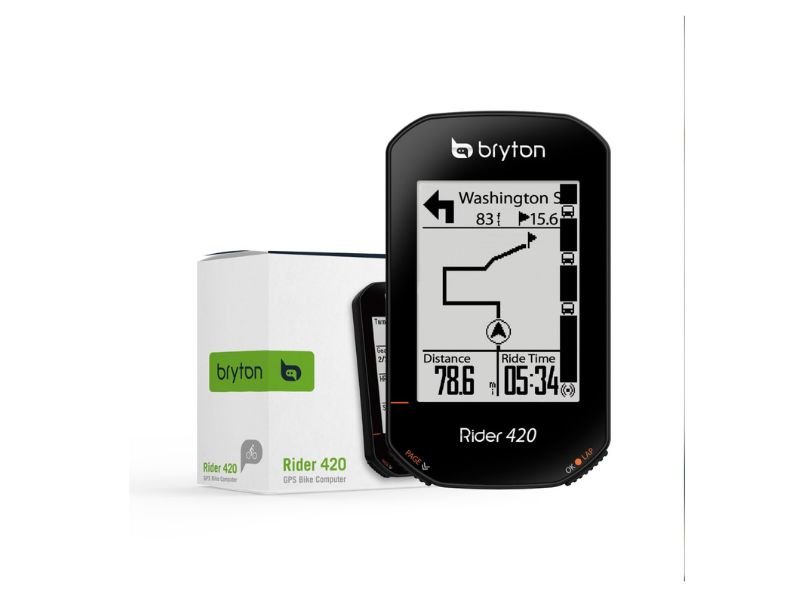
Let’s begin with a fairly inexpensive option: the Bryton GPS Rider S800, with a large color touchscreen that is bright and easy to read even in direct sunlight.
The interface allows up to 12 data fields per page, making it even easier to understand performance in real time.
Unlike the older B/W models, the S800 is a full-color cartographic GPS, with preloaded OSM (OpenStreetMap) maps and improved on-device navigation.
Rider S800 supports electronic gear systems, including Shimano Di2, Campagnolo EPS, and SRAM eTap. Instead of checking your crank and cassette, you can get all the gear information directly on the device, including the gear ratio, gear combination, and even the system battery life.
It can receive multi-band GNSS signals, including European, Russian, Chinese, and Japanese satellites. It is equipped with a barometric altimeter, and its rechargeable battery provides up to 36 hours of operation.
PROS: excellent battery life, affordable price, very good phone app, barometric altimeter, color touchscreen.
CONS: navigation is still less advanced than premium Garmin units.
Who is this for?
The Bryton Rider S800 is an absolutely no-bullshit MTB computer. Reliable, fast satellite reception, modern touchscreen navigation, and outstanding battery life make it one of the best budget cartographic GPS units for mountain bikers.
Garmin Edge 1050 Solar [+/- $660]
best MTB computer for Pro riders
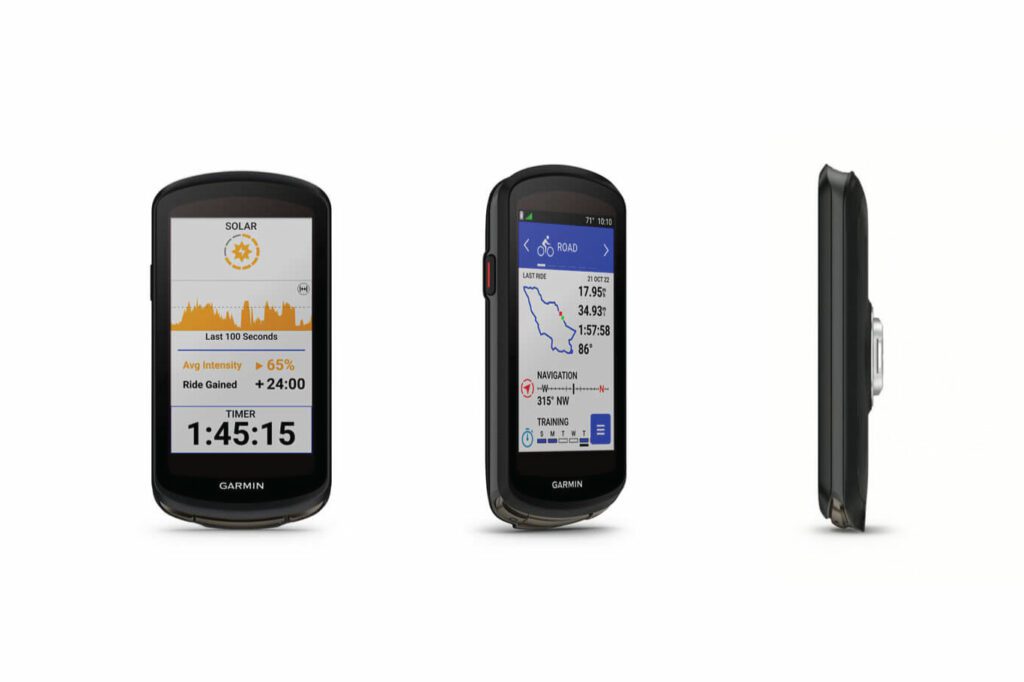
Let’s move to the high-end of MTB GPS computers with the Garmin Edge 1050 Solar, a device clearly aimed at pro riders and serious enthusiasts.
The unit features a large, extremely bright color touchscreen, now easier to read in all lighting conditions, including direct sunlight. Solar charging extends battery life during long rides, especially on open terrain.
The Edge 1050 Solar offers multi-band GNSS, advanced trail maps, fork-sight trail navigation, and the full Garmin performance ecosystem, including training load, recovery, stamina, and MTB-specific metrics.
It supports electronic shifting systems, power meters, smart trainers, radar, lights, and all ANT+ and Bluetooth sensors.
Battery life is excellent, with solar assistance helping it last well beyond standard GPS units during long days on the trail.
PROS: best-in-class features, solar charging, outstanding screen, advanced training, and navigation.
CONS: very expensive, overkill for casual riders.
Who is this for?
The Garmin Edge 1050 Solar is built for pro riders, racers, and anyone who wants the most advanced MTB GPS available today.
Garmin Edge 550 Solar [+/- $350-450]
budget Garmin MTB GPS device
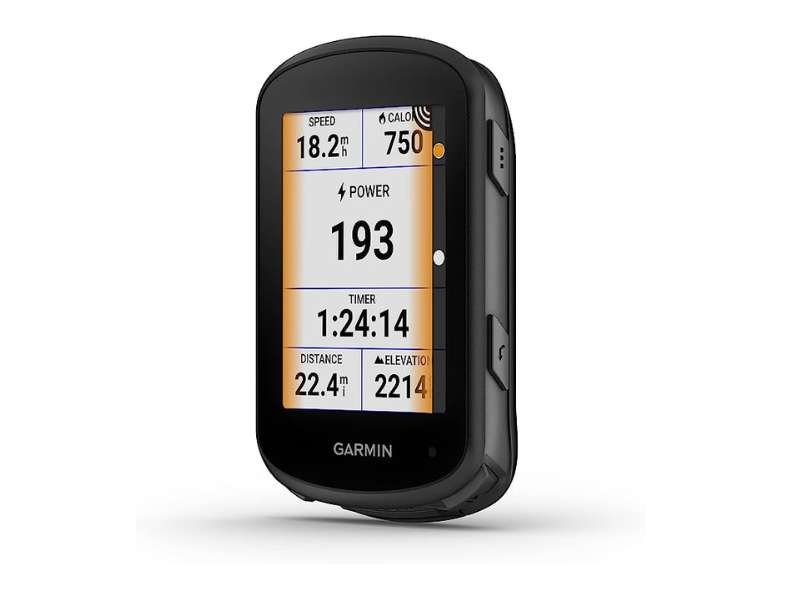
The Garmin Edge 550 Solar sits in Garmin’s mid-lower range and is designed for riders who want strong performance features without paying flagship prices.
It uses button-based controls instead of a touchscreen, making it reliable in mud, rain, and gloves. Solar charging improves battery efficiency during long rides.
The Edge 550 Solar includes multi-band GPS, trail navigation, ClimbPro, MTB dynamics, and structured workouts.
Despite its compact size, it integrates fully with Garmin’s ecosystem and supports all major sensors and electronic drivetrains.
PROS: accurate GPS, solar-assisted battery life, compact and durable.
CONS: no touchscreen, smaller display than higher-end models.
Who is this for?
The Edge 550 Solar is ideal for riders who want a reliable Garmin MTB GPS with modern features at a more accessible price.
Garmin Edge 850 Solar [+/- $550]
best midrange Garmin MTB computer
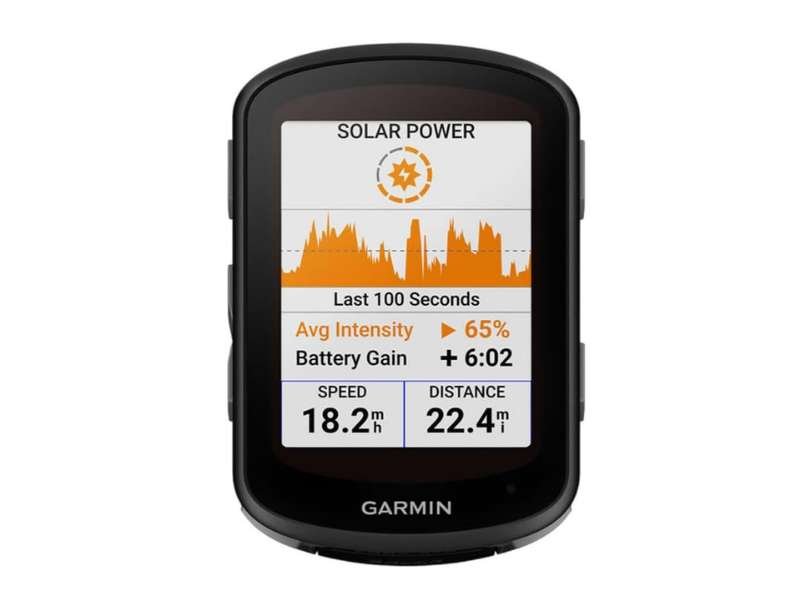
The Garmin Edge 850 is Garmin’s best midrange MTB computer, balancing advanced features with a more reasonable price point.
It combines touchscreen and button controls, offering flexibility in all riding conditions. Navigation is fast and detailed, with excellent trail coverage and MTB-specific data fields.
The Edge 850 includes multi-band GNSS, ClimbPro, MTB metrics, training load analysis, and full sensor compatibility.
Battery life is strong, easily lasting a full day without solar assistance.
PROS: excellent navigation, touchscreen + buttons, advanced MTB metrics.
CONS: still expensive, no solar charging.
Who is this for?
This is the sweet spot for serious MTB riders who want top-tier navigation and training features without going full flagship.
Wahoo ELEMNT ROAM V2 [+/- $400]
An affordable MTB computer for pros
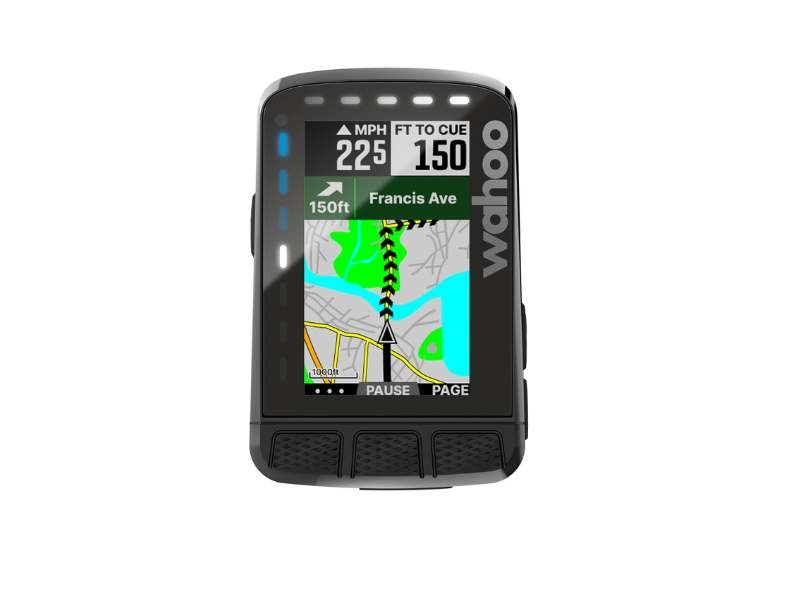
The Wahoo ELEMNT ROAM v2 presents notable updates within a familiar exterior. While its visual design remains largely unchanged, featuring the same screen size, LED indicators, and (slightly larger) button layout, the device boasts substantial enhancements in its functionality.
The Roam V2’s key advancements lie internally. It now incorporates dual-band GPS for enhanced accuracy, especially in challenging environments such as dense forests or tall buildings.
Storage capacity has been expanded to 32GB, accommodating more routes, maps, and workouts. The inclusion of a compass and gyroscope sensors offers potential benefits, though Wahoo has yet to fully implement their capabilities. The device introduces Summit Segments to aid pacing climbs, pre-loaded routes, Systm Outdoor Workouts for training, and Public Route Sharing.
Wahoo excels in user-friendliness. The screen remains easily readable on the go, and the map design makes navigation straightforward. The accompanying app functions seamlessly, ensuring consistent synchronization between the device and the app.
While the claimed 17-hour battery life falls short of some competitors’, the Roam v2 retains Wahoo’s convenient phone integration for simple setup and customization, global map downloads, and the quick-zoom function for adjusting displayed data fields.
Data capabilities are comprehensive. The device offers over 20 data field categories for customizable pages, encompassing metrics ranging from basics like distance and climbing to more advanced parameters like muscle oxygen and power.
The Elemnt Bolt v2, controlled by buttons rather than a touchscreen, continues Wahoo’s legacy of easy setup and customization. The companion app streamlines screen personalization, reflecting changes instantly on the computer.
A standout feature is the SUMMIT functionality, which intuitively anticipates grade changes and utilizes color coding to enhance road visualization. The SUMMIT FREERIDE feature detects climbs in advance, and SUMMIT SEGMENTS provide visual cues for climbs regardless of the active screen.
The Elemnt Roam V2 complements the Wahoo Elemnt Bolt V2 in the product lineup. While the Bolt targets performance-oriented riders with a compact design and color screen for navigation, the Roam stands out as a larger unit that emphasizes navigation assistance.
With a 2.7-inch display (compared to the Bolt’s 2.2 inches), the Roam offers extended battery life (up to 17 hours), dual-band GPS, and integrated accelerometer, gyroscope, and compass features.
PROS: cheaper than others, good phone app, barometric altimeter, magnetic compass, comes with 3 different mounts
CONS: short battery life
Who is this for?
The Wahoo ELEMNT ROAM v2 suits mountain bikers seeking an advanced GPS device without breaking the bank. It offers accurate navigation, customizable data fields, and Summit features to anticipate terrain changes.
Garmin Edge® Explore 2 [+/- $300]
best GPS device for MTB touring
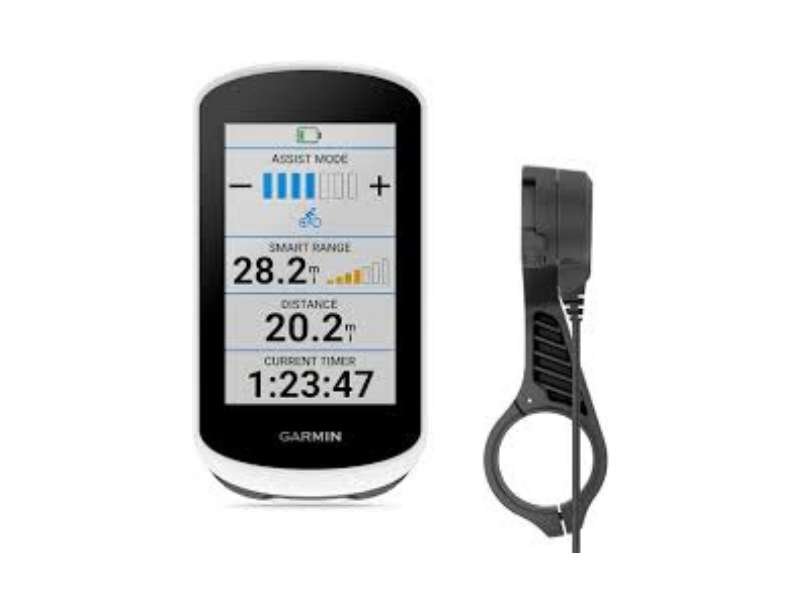
Ok, this is getting insane, so many different Garmin models with very similar features, it is honestly challenging to understand the differences.
With the Explore 2 – compared to its more expensive sibling, the Edge 1040 – there’s less emphasis on training, no Strava Live Segments, no Virtual Partner, no Advanced Workouts.
The Explore is indeed Garmin’s series that has historically catered to bike touring, targeting users who prioritize a larger display and comprehensive navigation tools over advanced training metrics.
New features include an updated user interface, downloadable global cycle maps, a barometric altimeter, Garmin ClimbPro, and expanded sensor support (including power meters and inReach satellite). The eBike features have also been expanded.
Notable differences from the higher-end Edge 1050 include a lower price of $299, a smaller display, no Strava Live Segment support, limited activity profiles, and no structured workout support.
Both models feature color touchscreens, with the Explore 2’s 3-inch screen at 240x400px. Despite lacking some high-end features, the Edge Explore 2 offers a balance of navigation capabilities and essential data for cyclists who seek dependable guidance and larger-screen real estate, making it a versatile choice for a wider range of riders.
It does feature an accelerometer for Incident Detection and supports e-bike monitoring.
An important improvement on the first Explorer is the longer battery life. Garmin indeed added a battery-saver option for 24 hours of battery life in navigation mode (up to 34 hours of GPS ride time w/o nav).
PROS: altimeter, WiFi, great routing
CONS: no SD card slot
Who is this for?
The Edge Explore 2 is the best GPS computer for MTB touring. For those riders who want a reliable navigator and do not care too much about training data.
2 Best MTB Speedometers
Cateye Padrone [+/- $55]
best mountain bike speedometer for minimalists
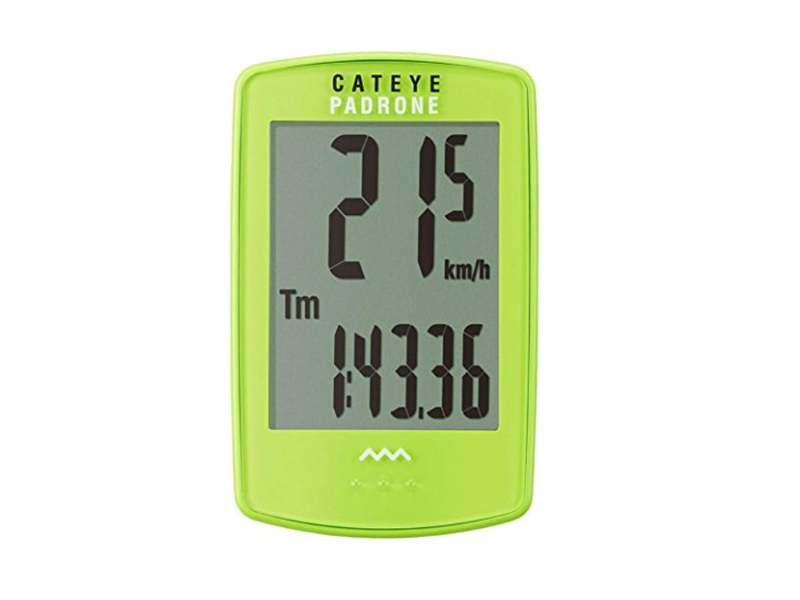
The Cateye Padrone is a reliable cycling computer and speedometer that excels in simplicity and functionality. While lacking GPS capabilities, it fulfills basic cycling data needs exceptionally well.
The larger screen, 85% bigger than Cateye’s Urban Wireless, displays easy-to-read metrics such as current speed, total distance, trip distance, elapsed time, max speed, and average speed.
Its slim profile, 22% thinner than comparable models, enhances aesthetics and mounting options. Setup is hassle-free with a speed sensor, magnet, and two-part mount, allowing bar or stem placement. Scrolling between screens is intuitive, and the unit weighs a mere 31.5 grams.
Though it lacks GPS, the Padrone remains an attractive option for those who prioritize essential ride data over navigation.
Its simplicity, easy setup, lightweight design, and comprehensive metrics make it a reliable companion for a wide range of cycling activities. The only notable challenge is removing the unit from the bracket because of a secure fit.
Who is this for?
For cyclists seeking a straightforward cycling computer without GPS complications, the Cateye Padrone is an effective, user-friendly choice.
Garmin Edge® 130 Plus [+/- $180]
best entry-level Garmin computer
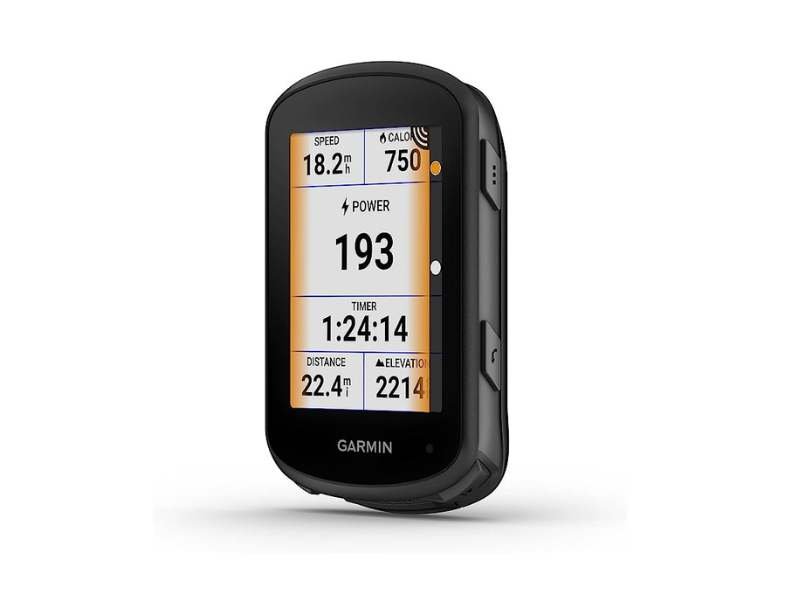
The Garmin Edge 130 Plus stands out as the brand’s smallest and one of the most compact cycling computers available. Despite its diminutive size, it packs a punch in terms of features.
The device’s straightforward design comprises five buttons for easy navigation. Its simplicity is refreshing, offering a singular ‘ride’ profile with no multiple bike options.
For mountain biking, the Edge 130 Plus introduces valuable updates. The inclusion of hang-time dynamics, which record jump distances and heights, enhances the off-road experience for enthusiasts.
Furthermore, the ‘ClimbPro’ feature provides detailed climb information during planned routes, making it especially useful for navigating challenging terrains. Garmin’s PhysioTrueUp ensures accurate physiological data across multiple devices, enhancing training insights.
The device supports various training sensors via Ant+ and Bluetooth, including power meters, heart rate monitors, and more. With compatibility across GPS, Galileo, and GLONASS satellites, it ensures reliable tracking.
Additionally, its stable smartphone connection and notification features, such as WhatsApp messages, are convenient for connected riding.
While lacking advanced mapping capabilities compared to larger models, the Edge 130 Plus offers excellent value for its compact size.
It’s versatile enough to excel on daily commutes or longer rides, including lighter navigational tasks.

Who is this for?
Overall, its combination of size, features, and reliability makes the Garmin Edge 130 Plus an appealing choice for mountain bikers seeking a capable and compact cycling computer.
2 more honorable mentions for the best MTB computer
Three more products have piqued our curiosity, but we haven’t had the chance to test them; we hope to write more about them in the future.
Lezyne Mega XL
The Lezyne Mega XL focuses on exceptional battery life, simple navigation, and a large monochrome display.
It’s not the most advanced GPS on the market, but it excels for long rides and bikepacking.
Hammerhead Karoo 2
The Hammerhead Karoo 3 improves on its predecessor with faster performance, a brighter screen, and smoother navigation.
It offers one of the best mapping and UI experiences available, especially for trail riding.
How to Choose the Best Computer for Your Mountain Bike
Many people still believe that adding a computer to your MTB setup is a hassle. Reality couldn’t be more different. Mountain bike computers are neither large nor intrusive. They might have been at first, but a lot about them has improved since then.
Now, riders from all over the world can benefit from real-time data from a compact, elegant computer that tracks time, speed, distance, elevation, and more.
The best part about attaching one to your mountain bike is that such a gadget might be enough to improve anyone’s skill set. Here are the most significant things you need to know about choosing the right MTB computer for you.
Bike Computer VS Smartphone
Although smartphone apps have evolved significantly and bike phone holders are safer, this combo still falls short of the convenience of a cycling computer.
Mountain bike computers are built to take all the hardships of the road without flinching. They last forever, and so do their batteries when compared to a phone tracking a route.
It is not always easy to find a place to recharge, especially when bikepacking in the wild. Of course, there are battery packs or portable solar panels that can guarantee you a few days of battery life, but… nothing compared to the best GPS MTB computer, which can last up to 72 hours in constant use.
Another reason is that all cycling computers are fully waterproof. Let’s say the same can’t be said about smartphones, except for some heavy-duty models.
With a dedicated device, all the info will always be on hand: you can track your position, average speed, ETA, and even cadence.
Some of the most advanced cycling computers can also give you information about your gears, their ratios, and your heartbeat; they can even be uploaded to Strava in real time!
So, to summarize, the strengths of MTB computers are:
- resistance to falls, impacts, and accidents in general
- battery life
- water resistance
- advanced performance meters
Pro tip: Use apps on your smartphone or PC to create routes and itineraries, then import them to your GPS device to follow them.
What Type of Rider Are You?
The first step in choosing the perfect mountain bike computer for your needs is to determine your riding style. Depending on your skill level, performance, and the amount of time you allot for the activity, you are either a beginner, a casual biker, an enthusiast, or a competitive athlete.
How to Choose MTB Computers for Beginners
As a rule, beginner mountain bikers do not need to visualize too much data. Therefore, a primary computer that displays total distance, average speed, and duration is more than enough. It is also mostly right for casual riders.
- Pick a basic unit that is small, lightweight, with a long battery life.
- For essential purposes, you can find affordable models that will meet your needs entirely.
How to Choose MTB Computers for Advanced/Enthusiasts
When it comes to enthusiastic riders who see MTB as a hobby, things tend to change a little.
Belonging in this category means that you most likely made a habit of hitting the trails during the weekend.
You might even be training to expand your skill set and become stronger in the sport.
For this reason, you will benefit from supplementary data such as a speed and cadence sensor and a heart rate indicator.
- Pick a device that adds these features to the basic package; they will turn your mountain bike computer into a reliable ally on your journey toward peak performance.
- Keep in mind that the device’s interface must be user-friendly, so you can access any information you want with ease.
- Such MTB computers may be larger and heavier than their simpler brethren, and probably more expensive. However, if you want reliable metrics to smooth your path from “enthusiast” to “professional,” such investments will pay off. You have to know a few more things before we tackle the “expert” category of riders.
- If you are interested in collecting collateral data from your rides, such as heart rate, pedaling cadence, and power, you need connectivity and peripherals for your device. Of course, you can buy cadence sensors and heart rate straps as extra gadgets or as part of a GPS bundle.
- Remember, however, that you will probably have to pay more for power meters.
How to Choose MTB Computers for Pros
Finally, it is time to discuss the needs of the professional athlete. If you perform MTB professionally, then you already know that a basic gadget or one with minor extra features won’t be enough.
- Smartphone connectivity, tracking, WiFi, navigation, temperature, and altimeters are thus required at this point.
- You should not forget the ANT+ interface – a feature you will find useful and that you often encounter in most new GPS units.
Fulfilling Your Tech Needs
Another aspect to keep in mind when choosing your mountain bike computers is the fulfillment of your tech needs.
Many casual riders feel the investment is superfluous, since everyone has a smartphone nowadays that can easily substitute for such a gadget via a specialized app.
While these apps can perform essential functions, such as tracking distance or speed, they are ultimately counterproductive.
Not only do most additional features require an extra fee, but they also quickly drain your phone’s battery.
After a while, you might find your device depleted mid-ride, with all your previous progress lost.
While the sensors provide information on speed, heart rate, and cadence, the GPS calculates distance, aids navigation, and shows your altitude. With all this information, you are bound to perfect your riding style and become more than a casual or enthusiastic mountain biker, but only if that’s what you want, of course.
Moreover, they need individual cases to mount the phones on the handlebars in the correct position, and these cases are not cheap.
Using a smartphone instead of an MTB computer comes with many other drawbacks (accidents destroying your expensive phone being just the tip of the iceberg). For this reason, your best bet is purchasing a wireless computer. They are relatively inexpensive and do the job accurately thanks to integrated sensors. Moreover, they come with a solid build and resistance to wear, tear, and everything cool about mountain biking.
- For added functionality, choose one with an inbuilt GPS system, and do not forget about the ANT+ interface, which you will not find in most smartphones.
The advanced versions of computers also include data collection and reporting on calories burned, smart alerts including weather, turn-by-turn navigation, on-screen text messages, emails, and phone-call notifications, Bluetooth connectivity (in addition to ANT+), incident alerts, battery-saving mode, and stress score, among others.
The Bottom Line
Mountain bike computers are hardly the bulky devices they once were. With the advancement of technology, riders now benefit from sleek, optimized devices that can track everything from speed to heart rate and tell you exactly where you are at all times.
Depending on the type of biker you are and the tech needs you have, you will undoubtedly find something out there that works for you and with you in perfect balance.
Check our article
> The Best GPS for Bike Touring and Bikepacking