

Last Updated on 13 January 2026 by Cycloscope
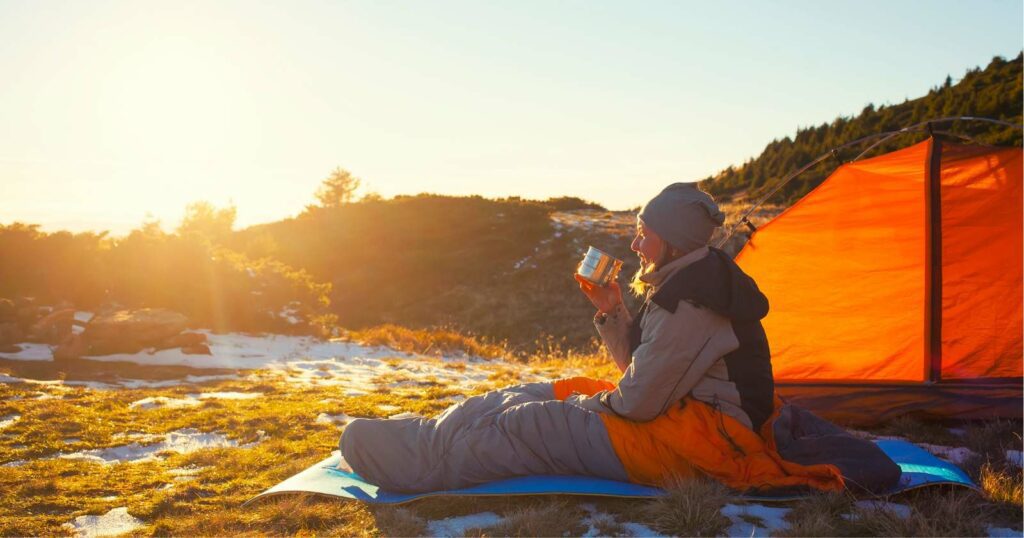
The best sleeping bags for cycle touring and bikepacking! Quilts, mummy, side-sleepers, winter, summer, hooded, ultralight, 0-degree, cheap, budget, affordable!
In the world of bikepacking and cycle touring, a reliable sleeping bag can make all the difference between a pleasant experience and a nightmare. But what makes a good bikepacking sleeping bag, and why is it crucial to choose the right one?
Disclosure: Some of our articles contain affiliate links. This comes at no additional cost for you and helps us keep this website up and running. (as Amazon Associates we earn commission from qualifying purchases)
How we compile our gear guides: during the almost 10 years of cycloscope.net our team personally tested dozens of similar pieces of gear. For what we can't test personally, we involve other people in the cycling community to give their feedback and opinion about gear they have used. Our decade-long experience in bicycle touring enables us to find the key cons and pros of every product we mention.
First and foremost, your choice of a sleeping bag should be relative to the place and season of your adventure. Different environments and climates require different levels of insulation. If you’re cycling through the balmy summer days of a Mediterranean coastline, you can get away with a lightweight, inexpensive sleeping bag.
But venture into the crisp alpine air or undertake an autumnal journey through the highlands, and you’ll need a bag that can handle cooler temperatures (plus a properly insulating sleeping pad).
Material matters, too. Sleeping bags are available in various fabrics and fillings, each with its own unique set of benefits. Down insulation, for example, offers exceptional warmth-to-weight ratios and compressibility, perfect for those looking to minimize pack size and weight.
On the other hand, synthetic insulation performs better in damp conditions, retaining its insulating properties even when wet. This is a vital consideration if your journey might involve unexpected rain or humidity.
Price is another factor that reflects the quality, durability, and temperature rating of a sleeping bag. In warmer climates, you can certainly opt for a budget-friendly choice.
However, if you’re planning winter adventures or traveling through colder regions, investing in a higher-quality sleeping bag becomes essential. A well-designed, pricier bag will not only keep you comfortable but also stand the test of time.
Best Sleeping Bags For Bikepacking In A Nutshell
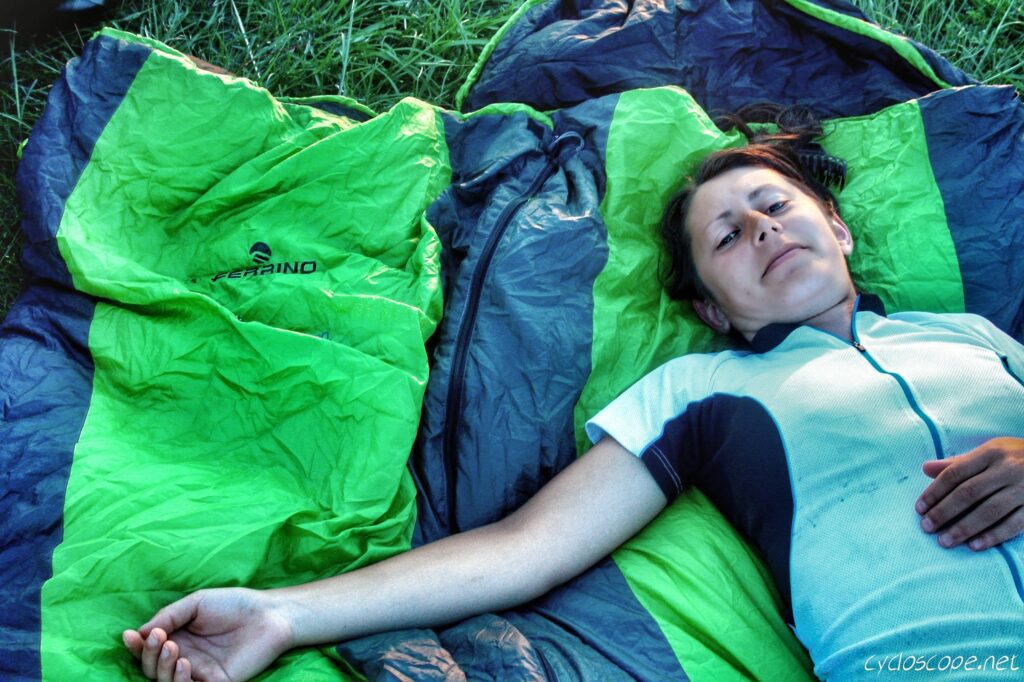
The Very Best Bikepacking Sleeping Bags from Summer to Winter
- Therm-a-Rest Hyperion 32F/0C Ultralight Down Mummy
- best bikepacking sleeping bag for mild temperatures
- NEMO Forte 20
- Best Eco-Friendly Sleeping Bag (Great for Side Sleepers!)
- Sea to Summit Spark Ultralight 18F
- best ultralight winter sleeping bag for bikepacking
- Sea to Summit Ascent AcIII 0
- best bikepacking sleeping bag for couples
- Nemo Sonic-20
- best touring sleeping bag for extremely cold temperatures
Cheap & Best-Value Bike Touring Sleeping Bags [under $100]
- Big Agnes Sidewinder
- 2026 Editor’s Pick!
- Naturehike 0 Degree Down Mummy Sleeping Bag
- budget summer quilt for ultralight bikepacking
The Very Best Bikepacking Sleeping Bags
from Summer to Winter
Therm-a-Rest Hyperion 32F/0C Ultralight Down Mummy
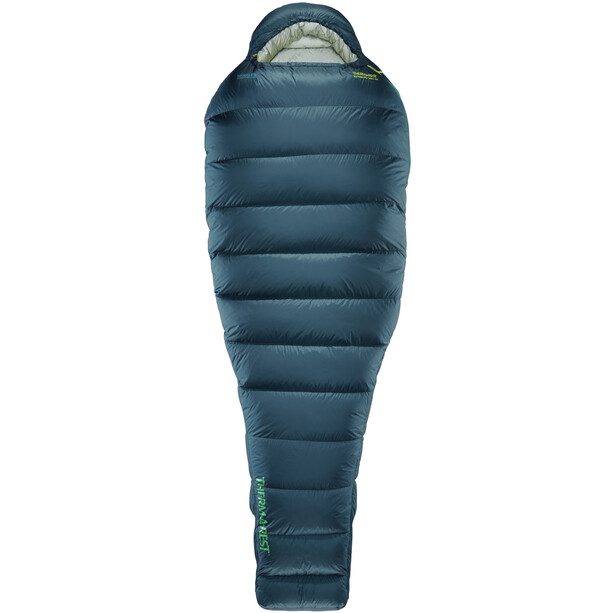
- materials: down and ripstop nylon
- temp rating: -6° C
- weight: 567 grams / 1 lb. 4 oz.
- packed size: 3 liters
- price: from $239.95
This is a great bikepacking sleeping bag for spring and summer temperatures. The Therm-a-Rest Hyperion 20 resists moisture perfectly with its water-repellent fabric. This makes it comfortable and dry even when the tent condenses.
I also like that the down is certified under the Responsible Down Standard, meaning it is collected ethically.
Besides, it is super comfortable, and the baffles keep the down in place, so you avoid it clumping and creating uncomfortable balls and cold, empty spots.
However, the best thing about this sleeping bag is that it packs up small and is super light, so you can easily store it away in your bike pack. There is no arguing that one of the best bikepacking sleeping bags out there.
NEMO Forte 20
best eco-friendly sleeping bag (great for side sleepers!)
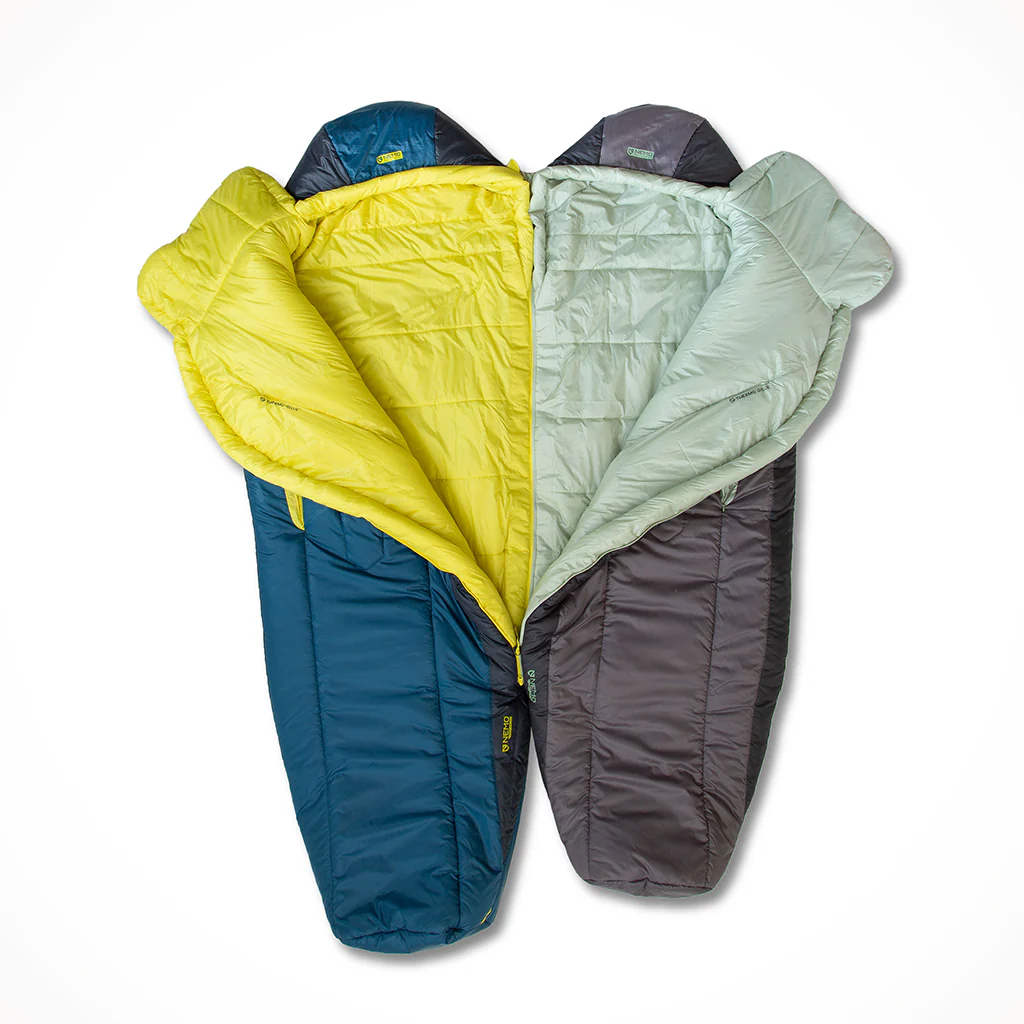
- materials: synthetic / 100% recyclable
- temp rating: -7° C
- weight: 1.4 kg / 3 lb 2 oz
- packed size: 12 liters
- price: from $219.95
A fabulous vegan-friendly sleeping bag for bikepacking featuring synthetic and 80% recycled materials.
The sleeping bag is breathable and water-repellent, so you do not have to worry about getting wet from tent condensation. I also love that it has an integrated pillow pocket where you can easily stuff a jacket to sleep more comfortably.
It also comes with full-length zippers on opposite sides for men’s and women’s so that you can connect them together if you want to get cozy.
But for me, the best part of this sleeping bag is its spoon-shaped design, which makes it easier to move knees and elbows around inside.
Finally, this sleeping bag comes with NEMO’s lifetime guarantee, making it a sustainable choice for serial bikepackiers.
The only downside of this vegan sleeping bag is that it is slightly heavier than other similar down options on this list.
Sea to Summit Spark Ultralight 18F
best ultralight winter sleeping bag for bikepacking
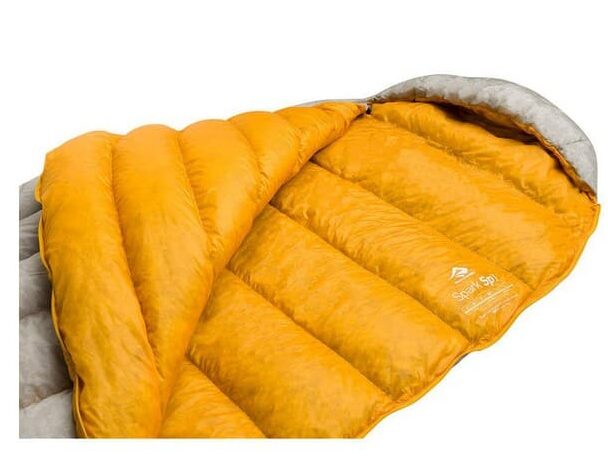
- materials: Ultra-dry down and nylon
- temp rating: -8° C
- weight: 430 grams / 0.95 lbs
- packed size: 6 liters
- price: from $509
A great bikepacking sleeping bag that is super lightweight. Especially with the latest upgrades it has seen, with a super-thin outer layer making it even more ultralight, and vertical baffles in the torso area preventing the down from clustering inside the bag.
This is not the best option if you expect to cycle in cold regions, but it is perfect for those nights around 0°C.
Among the specs that I love about this one is the 2-way zipper that goes all the way down for good ventilation. It also means it can be used as a blanket. Besides, it packs up small, so it does not take up too much space in your pack.
I would say that this is a tremendously reasonably priced bikepacking sleeping bag for the quality you get. The Sea to Summit Spark Ultralight 18F will for sure accompany you on adventures for years to come.
Sea to Summit Ascent
best bikepacking sleeping bag for couples
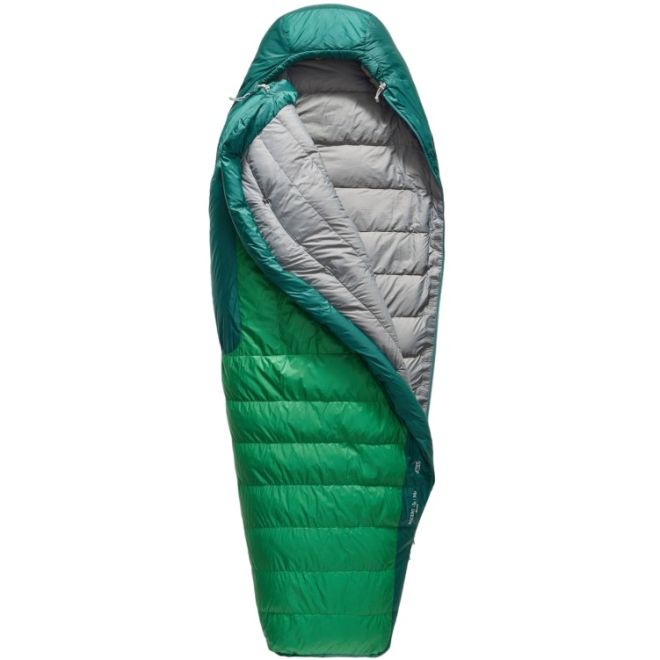
- materials: Down and 20-denier nylon
- temp rating: -10° C
- weight: 1.33 kilos / 2 lbs. 15 oz.
- packed size: 8.2 liters
- price: from $499
This high-quality bikepacking sleeping bag from Sea to Summit is great for slightly cool temperatures, keeping you comfortable down to -10°C.
The water-resistant Ultra-Dry down keeps you dry and warm when the tent condenses during the night.
One of my favorite features of this sleeping bag is the zipper system. The main side zipper is full-length, allowing you to connect it to other Sea to Summit sleeping bags. On the other side, a half-zip provides ventilation when needed.
At the bottom, there is a separate zipper for ventilation of your feet, if needed. This is also ideal if you want to keep the sleeping bag on while walking around on cool mornings.
The only downside to this sleeping bag (besides the name) is that the hood is wide and slides off easily, unlike other bags on this list. Nonetheless, this is a truly durable bikepacking sleeping bag that will keep you warm.
NEMO Sonic -20
best touring sleeping bag for extremely cold temperatures
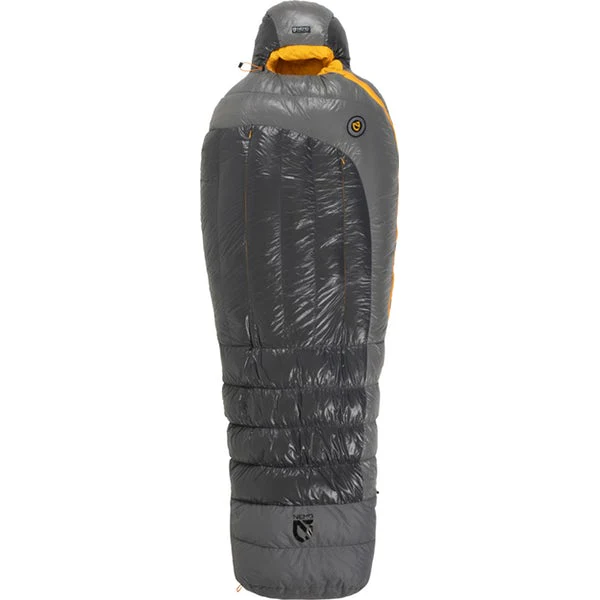
- Materials: Down and recycled nylon
- temp rating: -29° C
- weight: 1.75 kilos / 3 lbs. 14 oz.
- packed size: 21.2 liters
- price: from $494.93
This cold-weather sleeping bag from NEMO is hands down the best option for cold-weather cycling trips at an affordable price. Not surprisingly, it is on the heavier side, but it also holds near -30° C, which is pretty solid.
I love how it is a sustainable alternative, meeting the bluesign® criteria and using recycled materials in the cover and lining.
The baffles keep the down in place and ensure no heat loss. It is also a winner in wet conditions with its hydrophobic down and waterproof coating.
Even when sleeping in freezing temperatures, moisture inside your tent will freeze before turning into water that drips onto you and your sleeping bag.
That makes it so incredibly important to keep the sleeping bag dry inside so you do not get wet at night, and this sleeping bag ensures exactly that.
As an extra cool feature, the toe box functions as a waterproof barrier, making it the perfect place to dry clothes when needed.
On the downside, it does take up more space than the other sleeping bags on this list, though that’s expected with all cold-weather gear.
Cheap & Best-Value Bike Touring Sleeping Bags
[under $100]
Big Agnes Sidewinder
2025 Editor’s Pick!
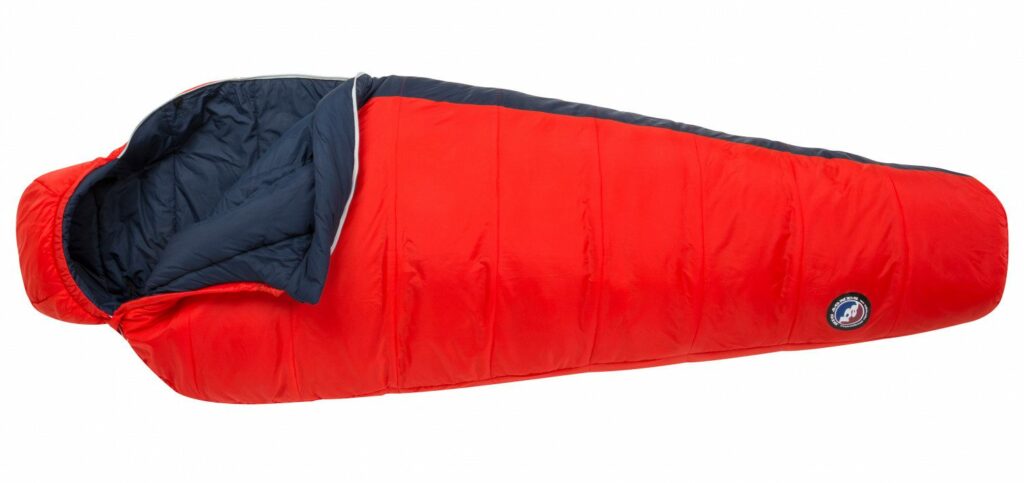
- Materials: Fireline Pro Synthetic Insulation with a ripstop shell
- Weight: 1.6 lbs / 725g
- Packed size: 7.5 x 8 inches
- Temperature Rating: 30°F | -1 C
In a world filled with high-tech materials and complex engineering in sleeping bags, the Buell 30 sleeping bag is a refreshing example of simplicity that gets the job done. Surprisingly roomy for its weight and compact size, it’s an ideal choice for restless sleepers like me.
What sets it apart is its ability to offer comfort without sacrificing packability. I managed to compress it down to a mere 8.5 by 9.5 inches, leaving plenty of room in my bikepacking mini pannier for other essentials.
Despite its affordable price, the Buell 30 maintains its quality with a basic synthetic fill and a rugged ripstop shell, foregoing the need for elaborate baffling or welding.
Now, let’s discuss its performance. Priced at around $110, this sleeping bag kept me warm in temperatures above 30°F.
I particularly appreciate the draft collar, which snugly wraps around my neck to retain warmth and keep cold drafts at bay. Additionally, the ergonomic hood fits my head perfectly, keeping cold air out. At just 1.5 lbs, this is the best budget sleeping bag for bikepacking!
Naturehike 0 Degree Down Mummy Sleeping Bag
cheap ultralight quilt sleeping bag

During our bikepacking adventure through Africa, we relied on the Naturehike ultralight down sleeping bag—an extremely lightweight and compact solution. Despite a few compromises typical of ultralight gear, this Naturehike product proved to be reliable and efficient.
This Naturehike model is among the lightest sleeping bags in its category, weighing just 1.26 lbs (570 g). The bag is insulated with goose down and wrapped in a 15D / 400T nylon shell, balancing warmth, durability, and minimal weight. Its slim profile makes it particularly appealing for bikepacking and fast-and-light touring setups.
With a full size of 74.8 × 28.3 inches, it provides adequate sleeping space without excess bulk. When packed, it compresses down to only 4.7 × 10.2 inches, which is impressively small for a down sleeping bag and easy to fit into a fork cargo cage or compact bikepacking bag.
Naturehike’s smart construction focuses on efficiency, using lightweight materials and optimized insulation placement to achieve a strong warmth-to-weight ratio. This design makes the sleeping bag well-suited for mild to cool conditions, especially during spring and summer trips.
At just over 1.25 pounds, the sleeping bag takes up very little room once compressed, leaving space for extra layers or small accessories. Its compact size is a major advantage for minimalist riders who need to maximize storage efficiency.
The Naturehike ultralight sleeping bag uses durable yet lightweight fabrics, making it a solid budget-friendly option for bikepackers and backpackers who want dependable down insulation without the high cost of premium ultralight brands.
That said, there are a couple of downsides worth noting: the sleeping bag does not include a hood, and while the zipper functions well, it may not be as durable as those found on higher-end models and could require replacement after years of heavy use.
check also
> 11 Best One-Man Tents for Bikepacking & Cycle Touring: 1-person lightweight shelters
> 10 Best Ultralight Sleeping Pads for Bikepacking & Camping – For All Budgets!
> 11 Best Camping Stoves For Bikpacking and Cycle Touring
How to choose the best sleeping bag for bikepacking and cycle touring
Deciphering Sleeping Bag Temperature Ratings
Understanding sleeping bag temperature ratings is crucial for choosing the right one for your adventures.
The European EN 13537 Standard, adopted by many sleeping bag manufacturers, serves as an official classification system. However, this standard excludes bags for extreme temperatures and military use.
To receive an EN temperature rating, sleeping bags undergo lab testing, which determines four key factors:
- the Upper Limit (temperature for a standard male to sleep without perspiring),
- Comfort (temperature for a standard female to sleep comfortably),
- Lower Limit (temperature for a standard male to sleep without waking in a curled position),
- Extreme (minimum temperature for a standard female to survive without hypothermia risk).
These ratings assume the subject is using a sleeping pad or tent and wearing one base layer of thermal underwear.
However, standards like these aren’t universal truths, as individual factors like hydration, nutrition, altitude, and gear quality also influence perceived temperature comfort.
Transparency regarding which EN rating factor manufacturers refer to varies, making it essential to assess sleeping bags holistically.
Choosing Between Mummy and Rectangular Sleeping Bags
Selecting the right sleeping bag shape is a balancing act between warmth and comfort. Mummy-shaped bags, narrower and designed for winter use, trap heat efficiently due to their reduced internal volume.
However, their limited mobility may not suit everyone and can lead to overheating in warmer conditions.
It’s essential to recognize that there’s no universal “4-season” sleeping bag; your choice should align with the climate zones you’ll encounter during your hikes, backpacking trips, or bikepacking adventures.
A mummy bag excels in cold environments, while rectangular bags offer more freedom of movement but may not provide adequate insulation for winter conditions.
check also
> 3-Season Tents VS 4-Season Tents – What Should You Bring With You?
Down vs. Synthetic Insulation
Two primary materials fill sleeping bags: bird down (usually duck or goose) and synthetic materials.
While synthetic fillings are often found in budget sleeping bags, they’re less efficient at retaining warmth compared to down. However, some lightweight and cost-effective sleeping bags feature down insulation, offering a compelling compromise between price and quality.
Down has additional benefits, including greater compressibility (reducing packed size) and lower weight.
The quality of down can vary, and the fill power ratio is a crucial indicator. Down with higher fill power offers superior insulation-to-weight ratios, resulting in lighter and warmer gear.
For example, a down with a fill power of 800 can expand to fill 800 cubic inches of space with one ounce of down.
While higher fill power contributes to superior warmth-to-weight ratios, other factors, such as baffle design and shell fabric quality, also influence a sleeping bag’s warmth.
Understanding Fill Power
Fill power is a critical specification for down insulation, indicating its quality and insulating capability. It measures how well down clusters can loft or expand to trap air, creating warmth.
Fill power is expressed in cubic inches per ounce (in³/oz) or liters per gram (L/g) in the metric system. For instance, down with a fill power of 800 means one ounce of that down can expand to fill 800 cubic inches of space.
Different fill power ratings generally signify varying insulation and packability.
- Low fill power (300-500) provides decent insulation but may require more volume for the same warmth, often found in budget-friendly products.
- Medium fill power (550-700) strikes a balance between performance and cost, common in mid-range gear.
- High fill power (750-900+) offers exceptional insulation, resulting in warmer, lightweight, and packable gear, commonly used in premium products.
Keep in mind that a sleeping bag’s warmth also depends on factors like the total amount of down, baffle design, and shell fabric quality. Thus, when selecting gear with down insulation, consider fill power alongside other elements to strike the right balance between warmth, weight, and comfort.
Eco-friendly sleeping bags: Is down ethical?
The use of down fillings in sleeping bags does raise ethical concerns, primarily related to the sourcing of down. Down is typically obtained from the plumage of ducks and geese, and ethical issues arise when birds are mistreated or subjected to inhumane conditions during feather harvesting.
One major ethical concern is live plucking, in which feathers are forcibly removed from live birds. This causes immense pain and suffering to the animals. Additionally, birds may be raised in overcrowded, unsanitary conditions on some farms, which can lead to health issues and poor welfare.
To address these concerns, some companies have adopted ethical sourcing practices and certifications that ensure the down used in their products is obtained in a humane and environmentally responsible manner.
One such certification is the Responsible Down Standard (RDS), which sets strict guidelines for the treatment of birds and the traceability of down from farm to product. The RDS ensures that live-plucking and force-feeding are prohibited and that birds are raised in healthy, humane conditions.
Another certification is the Global Traceable Down Standard (TDS), which focuses on traceability and transparency in the down supply chain, ensuring that down can be traced back to the source.
Consumers who have ethical concerns about down fillings in sleeping bags should look for products that carry these certifications. Supporting companies that adhere to these standards can help promote ethical practices within the industry and reduce harm to animals.
on a budget?
> 10 Best Lightweight Budget Sleeping Bags
What makes a sleeping bag good for bikepacking?
A bikepacking sleeping bag should balance weight, warmth, and pack size. Ultralight down or synthetic bags that compress small are ideal because they save space on your bike and reduce overall load without sacrificing comfort.
Down vs. synthetic — which is better for bikepacking?
Down insulation is lighter and compresses smaller, making it great for dry conditions and longer trips where weight matters most. Synthetic insulation performs better in wet climates and still insulates when damp, though it tends to be bulkier and heavier.
How do temperature ratings work?
Sleeping bag temperature ratings tell you the range of conditions the bag is suited for:
Comfort rating — the lowest temperature at which an average sleeper can sleep comfortably.
Limit rating — the lower bound where survival is possible for short periods.
Understand the climate you’ll ride in and choose a bag with appropriate ratings to avoid being too cold at night.
What’s the difference between a mummy and a rectangular sleeping bag?
Mummy bags taper toward the feet for better heat retention and lighter weight.
Rectangular bags offer more space and comfort but can be heavier and less efficient in cold weather.