

Last Updated on 23 December 2025 by Cycloscope
Cycling Puglia: Flat and Accessible Itinerary from Gargano National Park to Santa Maria di Leuca, via Sea Views, Trulli, Caves, and Monumental Olive Trees
In this article:
- Gargano – Peschici, Viesti e Mattinata
- Manfredonia – Margherita di Savoia
- Polignano a mare
- Ostuni, Alberobello, Castellana
- The Plain of Monumental Olive Trees
- Brindisi and Lecce
- Salento Coast
Disclosure: Some of our articles contain affiliate links. This comes at no additional cost for you and helps us keep this website up and running. (as Amazon Associates we earn commission from qualifying purchases)
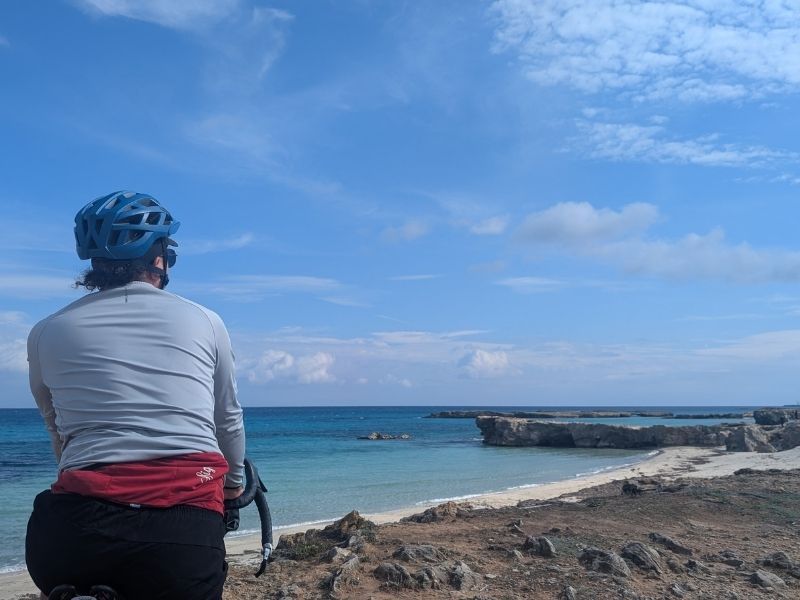
We cycled through Puglia from the Gargano in the north down to Lecce and on to the southernmost point of the coast at Santa Maria di Leuca. We also took a detour inland to visit Alberobello and see other interesting landscapes along the way.
Puglia is almost completely flat, which makes it suitable for all kinds of cyclists – beginners and experienced riders alike. There are no difficult climbs, only gentle ups and downs.
The coastal roads give you constant sea views, while inland routes take you through olive groves, white villages, and places like Alberobello with its characteristic trulli houses.
One piece of advice: don’t cycle in the middle of summer. Prices become very high, and the large number of tourists creates a lot of traffic on the roads, especially along the coast. We cycled in October and found it ideal – pleasant temperatures, far fewer people, and no heavy crowds.
If you’re looking for a cycling trip with sea views, quiet villages, and easy riding, Puglia is a great choice.
Here you can see the GPX map of our itinerary. We arrived in Puglia from Rome, crossing the country coast to coast, and then we proceeded to Albania and the Balkans.
Gargano
Our cycling trip in Puglia began in the Gargano area, the northern “spur” of the region. You could arrive here starting from Termoli (the closest train station), further north, but we preferred to take the train to San Severo. This allowed us to skip a busy section of the Adriatic state road, which can have heavy traffic.
From San Severo, trains operated by Ferrovie del Gargano run to Peschici Calenella station (a few kilometers from the town center, with bus connections available).
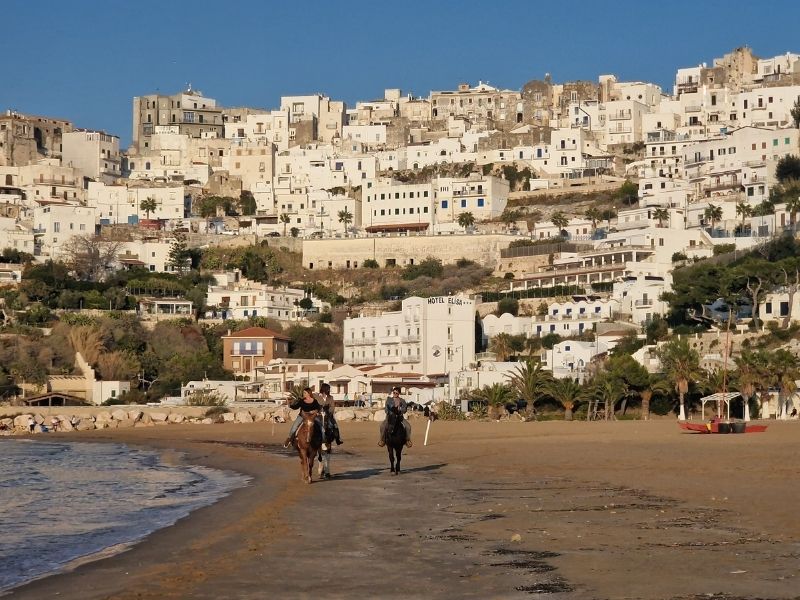
Peschici is a small coastal town perched on a rocky cliff about 100 meters above the sea, with whitewashed houses clustered together overlooking a sandy bay and the Adriatic.
The historic center features narrow winding streets, a Norman castle, coastal watch towers, and views of turquoise waters and nearby beaches, many of which hold Blue Flag awards for cleanliness.
It’s part of the Gargano National Park, with a small harbor from where boats depart to the Tremiti Islands.
We cycled in mid-October and enjoyed sunny days with pleasant temperatures and almost no traffic on the roads. Unfortunately, many campsites were already closed for the season, but we found affordable accommodation in bed and breakfasts or apartments. The main advantage was having the roads mostly to ourselves – traffic was very light.
From Peschici, we followed the coastal road south to Vieste, enjoying constant sea views. Then we took an inland route through the Gargano National Park, with good views over the coast and white cliffs before entering the dense Umbra Forest. The road eventually descends to Mattinata.
Manfredonia to Margherita di Savoia
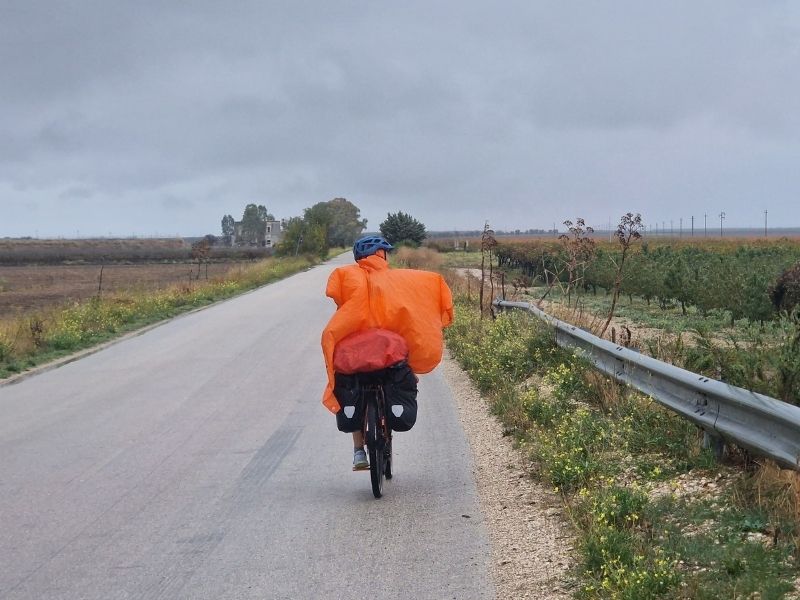
From Mattinata, we faced a short climb to avoid the busy state road. Once over that, the terrain flattened out completely, and the landscape changed noticeably from the varied scenery of the Gargano. Up to Zapponeta, the route passed through flat countryside that felt quite run-down in places.
From Zapponeta, we took the road along the salt pans to Margherita di Savoia. Whether it was the rainy day we rode it on or the autumn season, the area came across as rather unappealing.
From Margherita di Savoia, we continued along roads through open fields until reaching Barletta, a pleasant coastal city worth a stop.
Barletta features a historic center with narrow streets, a Norman-Swabian castle near the sea, the large bronze Colossus statue, and a Romanesque-Gothic cathedral.
Note that there are no trains between Manfredonia and Barletta. From Barletta, however, trains connect to many destinations, and bicycles travel free on regional trains in Puglia.
From Barletta, you can follow the coast through attractive towns like Trani, Bisceglie, and Molfetta before reaching Bari.
Trani stands out with its impressive Romanesque cathedral right by the sea, elegant harbor, and historic Jewish quarter. Bisceglie has a charming old center, a cathedral, a harbor, and nearby prehistoric dolmen sites.
Molfetta is a busy fishing port with a prominent old cathedral featuring distinctive domes and a lively waterfront.
From Bari, continuing along the coast leads to Polignano a Mare, a picturesque town perched on limestone cliffs overlooking the Adriatic, famous for its dramatic coves, sea caves, and pebble beach at Lama Monachile.
Polignano a Mare, Ostuni and the Via dei Trulli to Alberobello
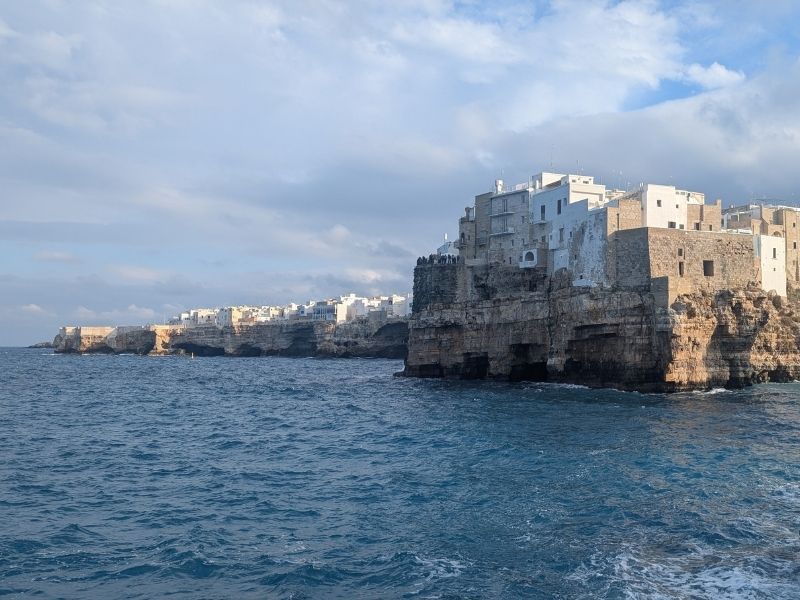
From Polignano a Mare, we recommend leaving the coast and heading inland toward Castellana Grotte. The Castellana Caves (Grotte di Castellana) are a major karst cave system, discovered in 1938, stretching over 3 km with a depth of up to 122 meters.
Guided tours are available in two options: a shorter 1 km route lasting about 50 minutes, or the full 3 km itinerary taking around two hours.
Both start from the impressive Grave Abyss and feature stalactites, stalagmites, fossils, and chambers like the shining White Cave (Grotta Bianca), known for its pure alabaster formations. You reach the white cave only with the longer tour; we took that one.
The constant temperature inside is around 18°C. The caves sometimes host events and concerts, taking advantage of the natural acoustics.
From Castellana Grotte, we took a quiet secondary road through fields dotted with trulli and ancient olive trees, leading to Alberobello.
This town is famous for its trulli – traditional dry-stone huts with conical roofs, built without mortar using local limestone. Over 1,500 trulli cluster in districts like Rione Monti and Aia Piccola, making Alberobello a UNESCO World Heritage Site since 1996 for its well-preserved example of this ancient building technique.
In Alberobello, you can follow the “via dei trulli” section, which is part of the Ciclovia dell’Acquedotto Pugliese – a long cycling route that traces the historic Apulian Aqueduct, one of Europe’s oldest and longest.
This path runs through rural landscapes, passing trulli, olive groves, and sections along the aqueduct’s service roads, promoting sustainable tourism in the region.
From there, the route continues to Cisternino and then Ostuni, known as the “White City” for its hilltop historic center of whitewashed houses, narrow streets, arches, and views over olive groves to the sea.
Many other towns in Puglia share this whitewashed look, but Ostuni stands out. The number of tourists was very high, so after a short walk through the center to see the cathedral and main sights, we decided to move on.
The Plain of Monumental Olive Trees
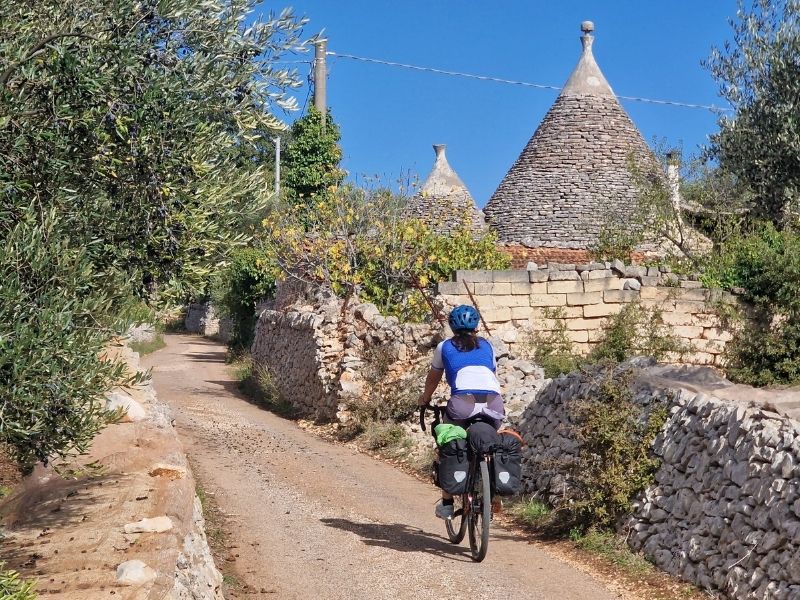
From Ostuni, cyclists have two main options to reach Lecce: continue inland through rural landscapes or follow the coastal route via Brindisi, which overlaps in parts with the southern section of the Via Francigena pilgrimage path. Both routes are almost entirely flat, making them accessible for most riders.
We chose the coastal option and rode through the area known as the Plain of Monumental Olive Trees (Piana degli Ulivi Monumentali). This stretch passes through what is called the “Itinerario dei Giganti” – a network of paths among some of the oldest and largest olive trees in Puglia.
The Plain of Monumental Olive Trees covers the territory between the towns of Ostuni, Fasano, Monopoli, and Carovigno, where the concentration of ancient olive trees is particularly high.
Many of these trees are estimated to be over a thousand years old, with some possibly dating back 2,000–3,000 years to the Messapian era. The landscape features a dense network of trails, ancient sheep tracks, and dirt roads winding through the groves.
The Millenari di Puglia project has identified, catalogued, and mapped the most impressive millennial olive trees, creating open-air itineraries that also include visits to traditional masserie (farmhouses) and underground hypogean oil mills – historic sites that highlight Puglia’s long-standing olive oil culture.
This section offers quiet roads, constant views of twisted ancient trunks against the red soil, and a real sense of riding through living history. From here, the route continues toward Brindisi and then south to Lecce.
Brindisi and Lecce

The itinerary continues south from the Plain of Monumental Olive Trees toward Brindisi. This port city has a long history as a gateway to the East.
Key sights include the Swabian Castle, the Roman column marking the end of the ancient Appian Way, and the unusual Aragonese Castle on an island in the harbor.
The historic center is compact, with a cathedral and some Roman remains. Brindisi also has a train station with good connections if you need to shorten or adjust your route.
From Brindisi, there are ferries every day to Vlora, in Albania.
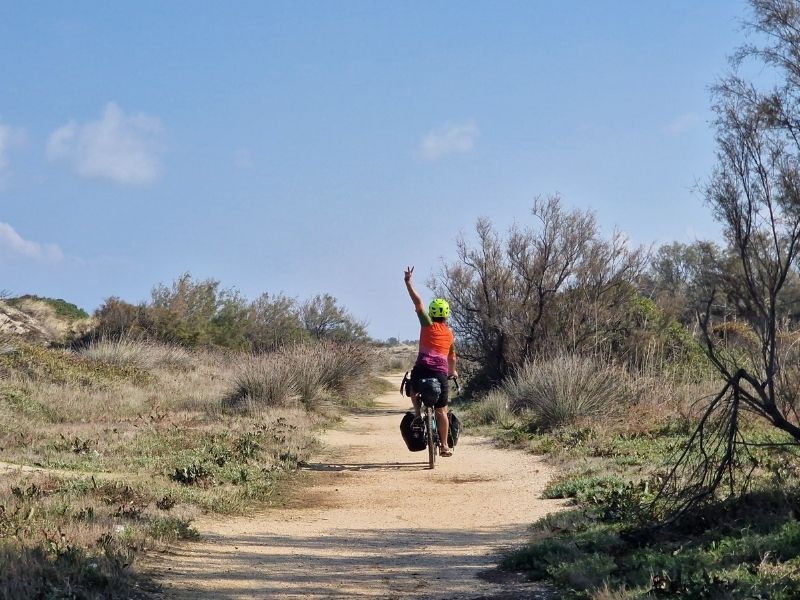
From Brindisi, the coastal road heads south toward Lecce. This section remains almost completely flat, passing through low-key seaside areas, small beaches, and protected natural reserves like Torre Guaceto (a WWF site with dunes and clear waters – worth a short detour if you have time).
Lecce and the Salento Coast toward Santa Maria di Leuca
Lecce is often called the “Florence of the South” for its rich Baroque architecture made from local soft limestone (pietra leccese), which carvers shaped into elaborate facades.
The historic center features Piazza del Duomo, the Basilica of Santa Croce, the Roman amphitheater, and countless churches and palaces. It’s a pleasant city to walk around, with good food options and accommodation. Trains and buses connect well if needed.
From Lecce, the route continues southeast toward the tip of the heel at Santa Maria di Leuca. You can stay close to the Adriatic coast or move slightly inland – both options are flat and quiet outside peak season.
The road passes through small towns like Otranto, a historic port with a dramatic castle, mosaic-covered cathedral (one of the largest medieval floor mosaics in Europe), and beaches below the old walls.
Further south, the coastline becomes more rugged with rocky coves and watch towers built against pirate raids. Places like Castro and Marina di Marittasi offer small harbors and clear water.
The final stretch runs along the scenic coastal road (SP 358) with views over the sea until you reach Santa Maria di Leuca – the official southernmost point where the Adriatic and Ionian seas meet.