

Last Updated on 23 December 2025 by Cycloscope
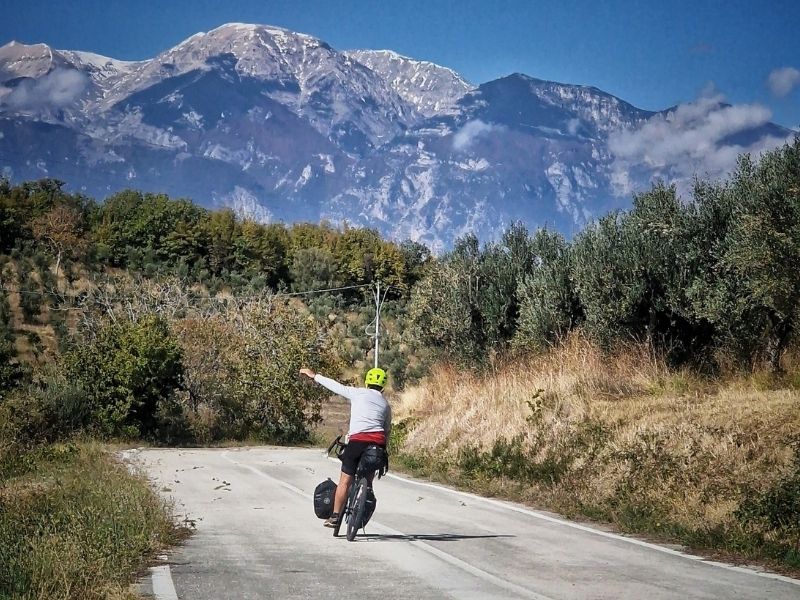
Cycling Central Italy from the Tyrrhenian to the Adriatic Sea – Our Itinerary – From Rome to the Adriatic, crossing the Apennines, medieval villages, Abruzzo National Park, and quiet autumn roads
This is the first part of our bike trip, which started in Rome and took us across the Apennines and the Abruzzo National Park to the Adriatic coast, one of the most scenic cycling routes in central Italy.
Disclosure: Some of our articles contain affiliate links. This comes at no additional cost for you and helps us keep this website up and running. (as Amazon Associates we earn commission from qualifying purchases)
From there, we continued towards Puglia, where we took the ferry to Albania and proceeded towards Montenegro, Kosovo, and Macedonia—but in this article, we’ll focus on the Italian section, our very own Tyrrhenian–Adriatic route.
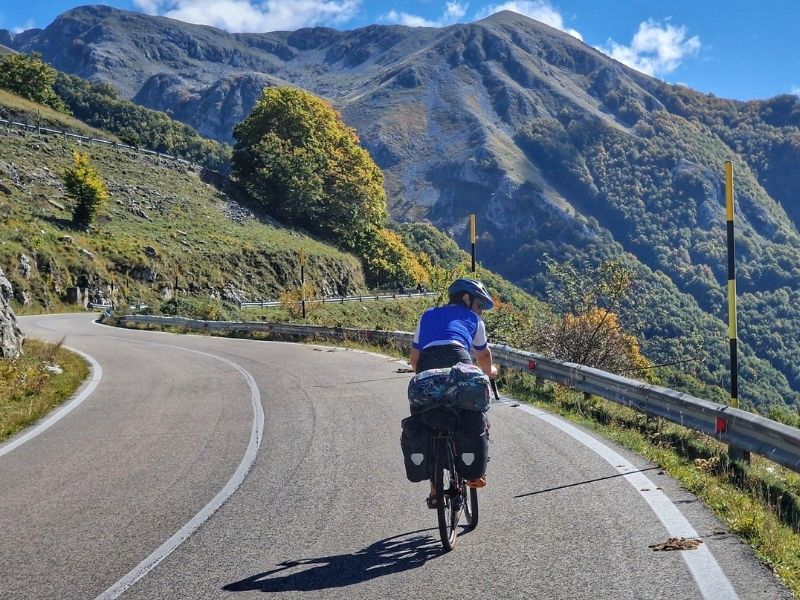
This road is a paradise for cyclists who love mountains, nature, and quiet secondary roads; there are only a few short sections that pass through roads with a bit more traffic.
In this first part of the guide, you’ll find practical tips, highlights, and route insights for the entire Italian section of our Tyrrhenian–Adriatic crossing — from Rome to the valleys and lakes of Abruzzo.
This is a perfect route if you’re planning a multi-day bike trip in Italy and want a mix of nature, culture, and good food and wine!
Italy Coast to Coast: Route Overview
- Total distance: 250 km
- Total elevation gain: 3740 m
- Number of days required: 5 to infinity
- Difficulty level: intermediate
- Bike type recommended: gravel/touring
- Road surface: 211 km asphalt / 11 km gravel / 30 km paved
- GPX: Komoot link
- Wild Camping: easy
- Accommodation: from 35 Euros
Best Season to Cycle the Italian Coast to Coast + Camping and Accommodations
We cycled in October, the perfect season (if it is sunny). During the day, the temperature is pleasant, but it can be cold at night, so you might need proper camping gear.
The great majority of campsites are already closed, there are not many tourists around, and it is pretty easy to wild camp. Also, being off-season, you can easily find cheap accommodations (around 40/50 euros a night for an apartment).
Last but not least, the positive aspect of cycling in autumn is the stunning colors of the forests, from bright yellow to orange to red.
1. Paliano – Fiuggi Cycling Path

We actually started from the town of Colleferro, near Rome. You can take a train with your bikes for free to get out of the city traffic if you are in Rome. From Colleferro, we took the Palianese road towards the bike path that connects the small town of Paliano to Fiuggi.
Although not very well known, it’s one of the most beautiful cycling routes in Lazio and will be especially rewarding for those who love peace, as the path doesn’t pass through any inhabited areas. The whole route is available on Komoot.
From Paliano, we continued towards the beautiful village of Piglio, where the grape festival had just ended — unfortunately, we missed it. Piglio is a medieval hilltop village, famous for its Cesanese wine, one of the oldest and finest red wines in central Italy.
Piglio to Alatri
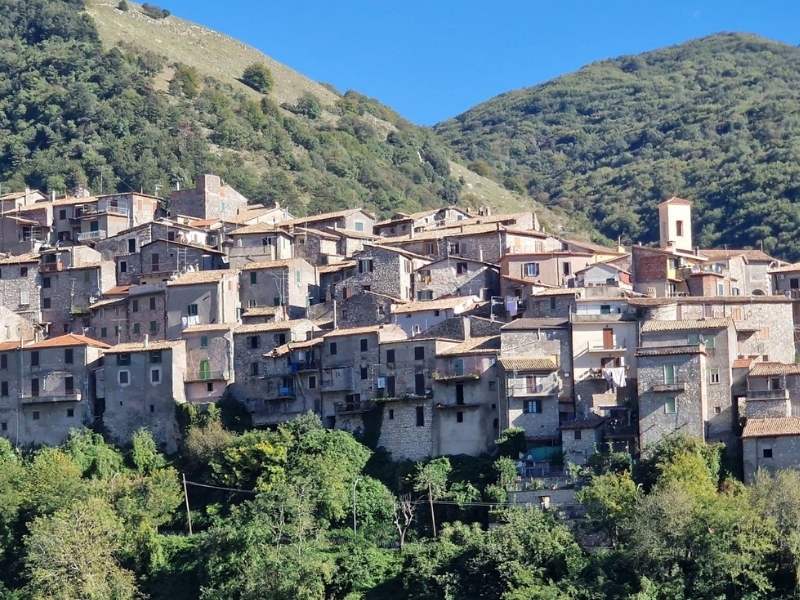
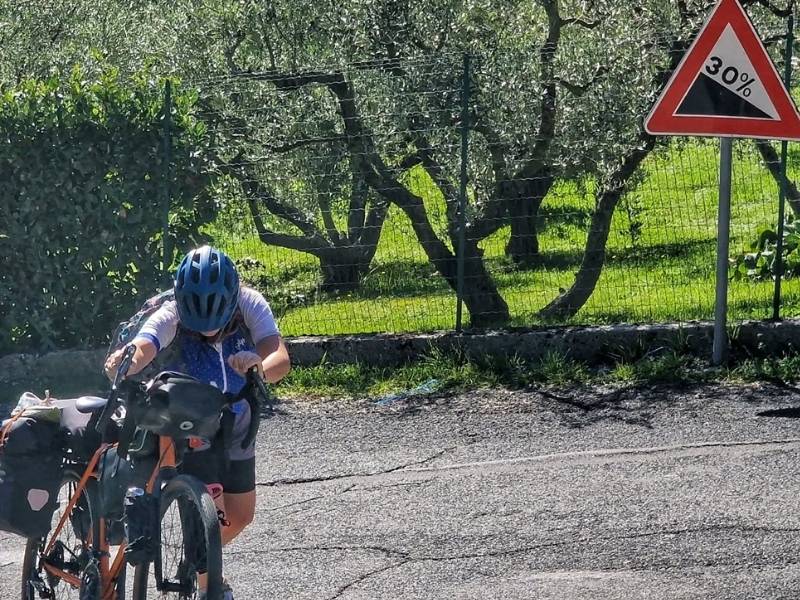
From Piglio, we take the road that climbs through the village — with gradients reaching up to 30% — leading us towards Altipiani di Arcinazzo.
The climb offers stunning views of the Sacco Valley below and the Ernici Mountains surrounding the area. The landscape changes as you ascend: vineyards and olive groves gradually give way to chestnut woods and open mountain meadows.
The small town of Altipiani di Arcinazzo, set on a plateau at about 850 meters above sea level, is a quiet summer retreat surrounded by forests and fresh mountain air.
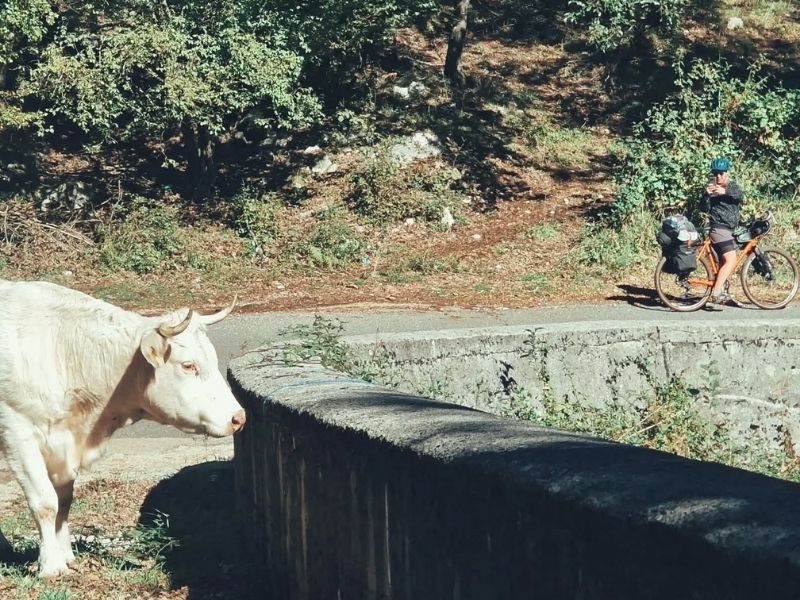
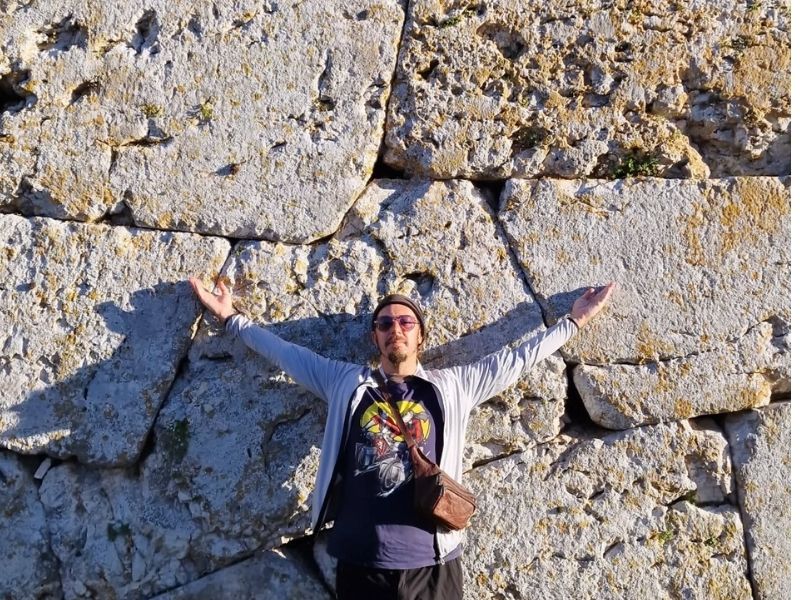
From here, a long and pleasant descent takes us to Alatri, famous for its mysterious Cyclopean walls.
These immense limestone blocks, perfectly fitted together without mortar, date back to the pre-Roman era and are among the best-preserved examples of megalithic architecture in Italy. The origins of the walls remain uncertain — some attribute them to the Hernici, others to even older civilizations.
From here, we take the road towards Sora, passing through Veroli, visiting the Abbey of Casamari, and then Isola del Liri.
The Abbey of Casamari, founded on a Benedictine site and expanded by the Cistercians in the 12th century, is a prime example of Gothic-Cistercian architecture, and Isola del Liri is famous for its waterfalls that run through the town center, contrasting with the historic Boncompagni castle and surrounding mountains. Here was the border between the Kingdom of the Two Sicilies and the Papal State.
Forca d’Acero Pass
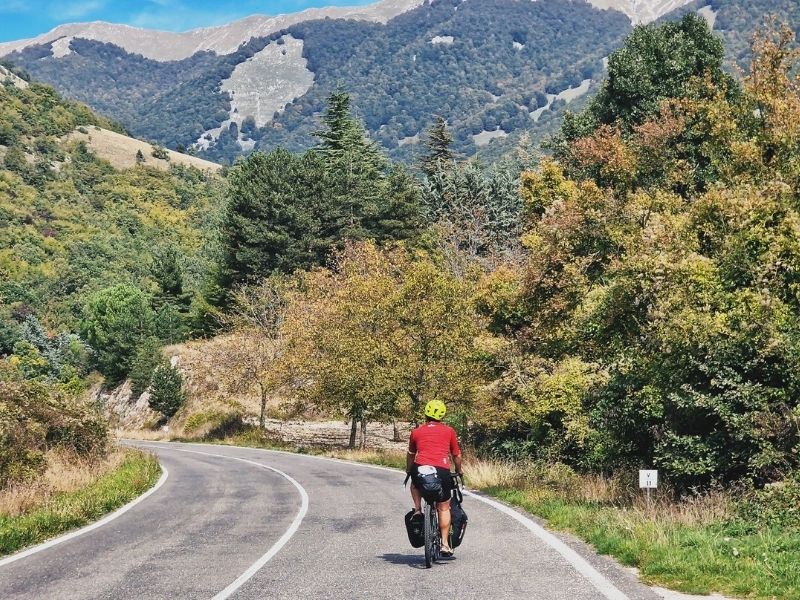
From here, the SR666 takes us up to Forca d’Acero Pass, at 1,573 meters above sea level. The climb is a bit steeper in the first part. If possible, avoid riding on weekends (we went up on a Saturday); unfortunately, weekend motorcyclists take over the road and drive as if they were on a racetrack.
It’s rather dangerous — the road is literally dotted with plaques commemorating motorcyclists who died here. Additionally, the constant noise of the bikes clashes with the peace of the surrounding landscape. Once past the pass, the motorcycles magically disappear, probably because they turn back.
Lago di Barrea
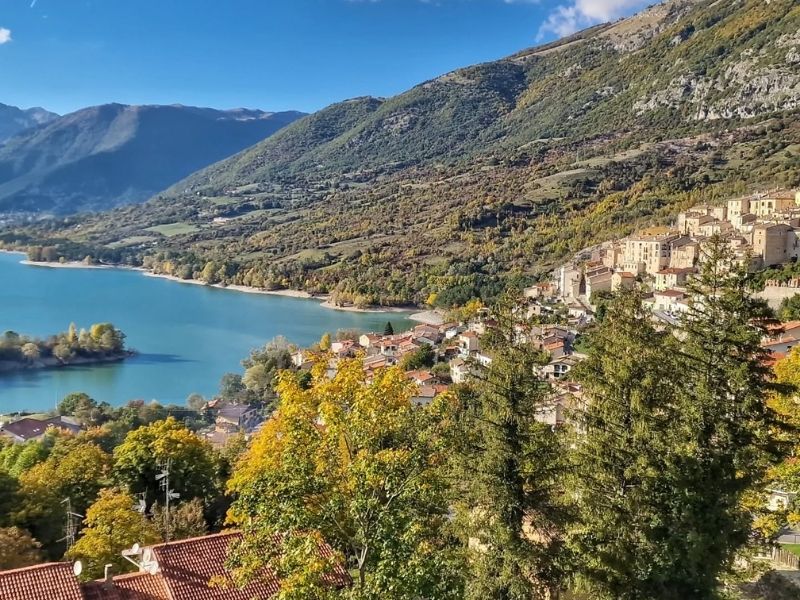
From the descent, we officially enter the National Park of Lazio, Abruzzo, and Molise. We descend to Opi and take the SS83, the Marsicana road, through the Val Fondillo and on to Villetta Barrea, from where the road runs along the lake to the town of Barrea, at 1,060 meters above sea level. The village is overlooking Lake Barrea, an artificial lake created in the 1950s.
The town preserves a medieval layout with narrow stone streets, a central square, and historic churches. Barrea is also famous for its wildlife, including bears, wolves, and deer in the surrounding forests.
From Barrea, the road climbs for another couple of kilometers before descending to a beautiful bike path leading to Castel di Sangro. From there, you can follow a nearly traffic-free road that runs parallel to the new highway.
Along the way, you pass through many abandoned or semi-deserted villages, as this area is among the most affected by depopulation and emigration in Italy. The quiet, empty streets and crumbling houses give the ride a haunting yet fascinating atmosphere, a reminder of the country’s 20th-century rural exodus.
We arrive in Villa Santa Maria almost by chance and find ourselves in the middle of the town festival, discovering that this is the birthplace of the patron saint of Italian chefs. Villa Santa Maria is known as the “Town of Chefs”, thanks to Saint Francesco Caracciolo, who was born here in the 16th century.
The village has a long culinary tradition, and every year the festival celebrates its gastronomic heritage with local dishes, cooking shows, and chefs from all over Italy returning to honor their roots.

From here, a beautiful road, once again free of traffic, takes us to the village of Bomba, with a stunning view of the Maiella Mountains, and from there, down to the sea.