

Last Updated on 27 December 2025 by Cycloscope
Our cycling journey through North Macedonia: Skopje’s statues, Matka Canyon, Tetovo’s Painted Mosque, Mavrovo National Park, and Lake Ohrid
This article tells our story of a cycling journey across North Macedonia, from the surprising capital Skopje to the shores of Lake Ohrid.
Disclosure: Some of our articles contain affiliate links. This comes at no additional cost for you and helps us keep this website up and running. (as Amazon Associates we earn commission from qualifying purchases)
Pedaling through riverside bike paths, dramatic canyons, mountain national parks, and historic towns, we explore monuments, Byzantine churches, Ottoman heritage, and wild landscapes—an unexpected, diverse, and deeply rewarding route through the heart of the Balkans.
In this article:
- Skopje and Matka Canyon
- Tetovo
- Debar Lake
- Ohrid
Skopje and Matka Canyon
We arrived from Kosovo and started our Macedonia exploration in Skopje. Skopje really surprises us big time! I don’t like looking up pictures of the cities I’m heading to, so I don’t spoil the surprise, but Skopje truly amazes us.
From the bus station, we take the bike path along the Vardar River: the city has a really well-developed and pleasant network of cycle paths, especially along the riverfront.
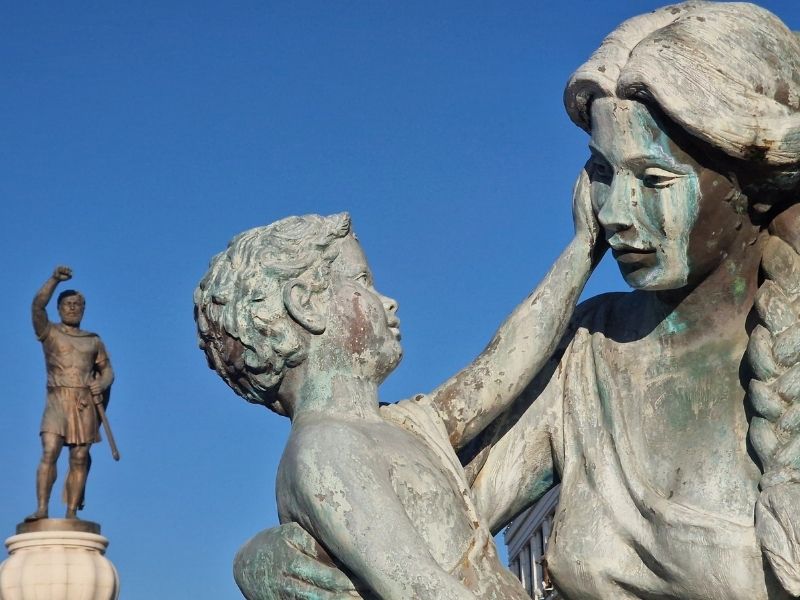
What we loved most were the statues, scattered everywhere in the city center. They are mostly part of the Skopje 2014 project, an ambitious urban redevelopment plan launched in 2010 by the government of the time to give the capital a neoclassical and monumental look, with hundreds of statues, fountains, bridges, and new facades.
The highlight is the gigantic equestrian statue of Alexander the Great (officially called “Warrior on Horseback”) in Macedonia Square, surrounded by lions and fountains.
The project was highly controversial: extremely expensive (over 500 million euros), accused of being kitsch and nationalistic, and above all, it irritated Greece, which considers Alexander an exclusive part of its Hellenic heritage.
To avoid further diplomatic tensions, many statues of ancient figures were given generic names (like “Ancient Warrior” for Philip II). After the change of government and the Prespa Agreement on the country’s name (North Macedonia), some plaques were modified to promote Greek-Macedonian friendship.
For the first time in our lives, we join an organized tour: they take us to the Millennium Cross, a gigantic 66-meter cross on top of Mount Vodno, built in 2002 to celebrate 2,000 years of Christianity. We go up by cable car from Sredno Vodno—an amazing panoramic experience with views over the whole of Skopje.
Then we visit a tourist complex styled like a traditional village (the so-called “Macedonian Village,” with hotels and restaurants recreating 19th–20th-century Macedonian architecture) near the church of St. Panteleimon in Gorno Nerezi.
The church, dating from 1164, is a Byzantine gem with extraordinary frescoes: considered among the most expressive of the Komnenian style, they even anticipate the Renaissance in their emotional depth and realism.
The most famous is the “Lamentation over the Dead Christ,” where Mary holds her son with a deeply human and touching grief, far from the rigid traditional Byzantine iconography.
From there, we head to Matka Canyon, a spectacular spot just 15–20 km from Skopje: an artificial lake surrounded by rocky cliffs, with hiking trails, kayaking, and medieval monasteries.
We take a short boat ride that brings us to Vrelo Cave, one of the deepest underwater caves in Europe, with impressive stalactites and stalagmites, small inner lakes, and atmospheric lighting.
Tetovo
From the center of Skopje, the bike path along the river accompanies you for about 6 kilometers until you exit the city. Once out of the city, however, the dedicated bike path disappears, and the road to Tetovo has heavy traffic—though there are no demanding climbs.
In Tetovo, there’s a hotel—NB Hotel & Spa—where for around 5 euros or a bit more you can access the heated indoor pool, jacuzzi, and saunas—perfect if you’re traveling like us in the colder season. Tetovo feels completely Albanian in atmosphere, with a strong ethnic Albanian majority.
The highlight to see is the beautiful Šarena Džamija (Painted Mosque, also known as the Colorful Mosque or Pasha’s Mosque). Originally built in 1438 and financed by two sisters, it was extensively reconstructed and decorated in 1833 by Abdurrahman Pasha.
What makes it unique is the elaborate painted decoration both inside and out: vivid floral, geometric, and landscape motifs (including rare depictions of Mecca and other towns), created with a technique using tens of thousands of eggs for the glaze. It’s one of the most outstanding examples of Ottoman Baroque art in the Balkans and a true gem.
From Tetovo, we take a quiet secondary road—very peaceful—that leads us to Gostivar. From there, the road merges with the main highway: it’s uphill, there’s no emergency lane, and traffic is heavy, especially trucks passing way too close. It’s not a huge number of kilometers of hell, but the climb makes it take a while.
Finally, around Novo Selo, we leave the highway and take the road toward Mavrovo, which, after about 6 kilometers of climbing, brings us to around 1,220 meters altitude and skirts the beautiful Mavrovo Lake (an artificial reservoir surrounded by mountains).
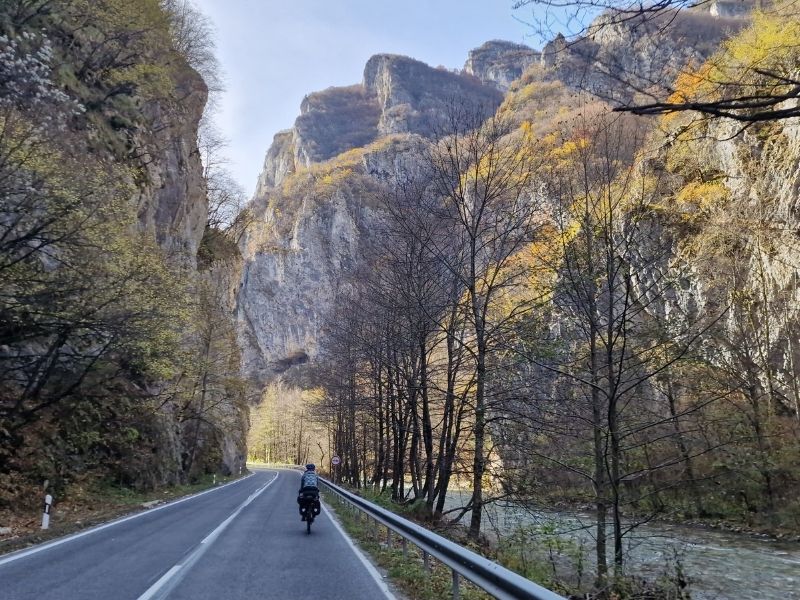
After leaving the lake, the road becomes even more stunning, gently descending along the spectacular Radika Canyon, part of Mavrovo National Park—the largest and oldest national park in North Macedonia, rich in forests, wildlife, and hiking trails. We sleep in Trnica.
The next day, we continue descending, noticing signs for countless hikes and trails in the surroundings. The wild camping possibilities here are endless.
Debar Lake
We continue following the river until the climb that takes us to Debar, from where we skirt Debar Lake (also known as Debarsko Ezero, an artificial reservoir on the Black Drin River).
There are a couple of climbs, a long flat section, and we pass through a new nature reserve area. Traffic on this road is nonexistent, but unfortunately, despite the beauty of the landscape, it’s hard not to notice the huge amount of garbage along the roadside.
As we approach Struga, on Lake Ohrid, traffic becomes intense. We continue pedaling all the way to the city of Ohrid.
Lake Ohrid is one of Europe’s oldest and deepest lakes (a UNESCO site shared with Albania), with incredibly clear, crystalline water—perfect for swimming in warmer seasons.
In Ohrid, we stop for a couple of days due to relentless rain—the joys of cycling in autumn! The lake is stunning, and the water is so clear that it must be amazing to swim in. Ohrid is a treasure trove of history and beauty: don’t miss the iconic Church of St. John at Kaneo, perched dramatically on a cliff overlooking the lake.
Samuil’s Fortress for panoramic views; the ancient Hellenistic theater; the Plaošnik archaeological site with the restored Church of St. Panteleimon and its impressive frescoes; the Church of St. Sophia with its medieval murals; and a stroll through the charming Old Town with its cobblestone streets, traditional architecture, and bazaar.
It’s often called the “Jerusalem of the Balkans” for its once 365 churches (one for each day of the year)—a perfect place to wander and soak in the atmosphere.
From Ohrid, you can head south along the road skirting the lake, or go toward Albania by passing the north of the lake and climbing to the border (at Qafë Thanë). From there, a road that—at the time of our trip—was very busy and not in great condition (perhaps also due to autumn floods) will take you to the Albanian city of Elbasan.
More articles about this trip: