

Last Updated on 17 January 2026 by Cycloscope
The traditional villages of the Ngada region, Flores, Indonesia: Bena, Gurusina, and Wolondopo, and their cultures and rituals. What to see around Bajawa
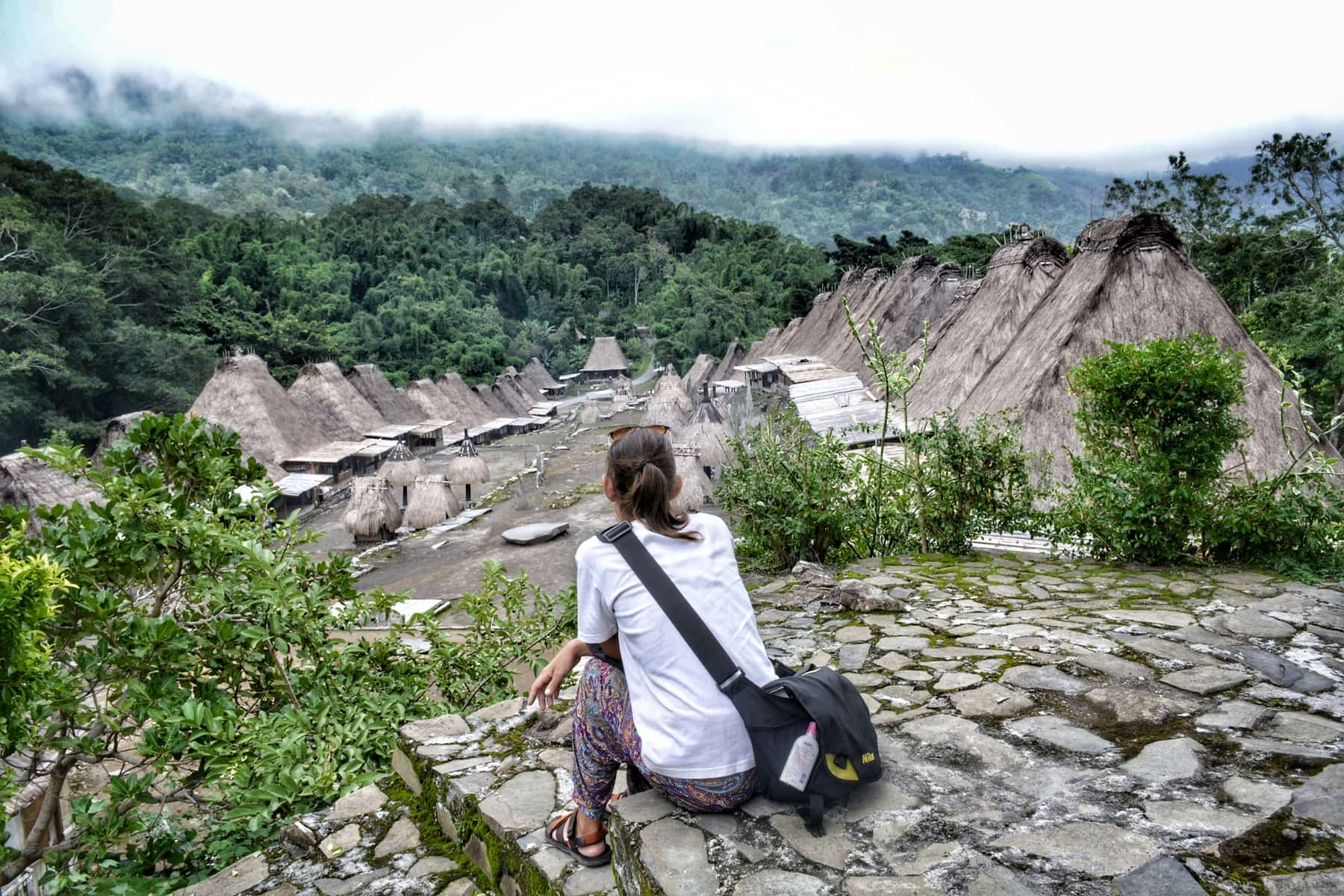
Probably the most interesting places to visit on Flores Island, at least for their cultural aspects, are Bena, Gurusina, and the other Nggai and Lio villages, which are timeless places where the way of life has remained almost unchanged for centuries.
Disclosure: Some of our articles contain affiliate links. This comes at no additional cost for you and helps us keep this website up and running. (as Amazon Associates we earn commission from qualifying purchases)
Set amidst the lush jungles and smoking volcanoes, Bena is said to have been founded some 1,000 years ago by Javanese sailors, whose ship was stranded on the south coasts of Flores.
Arriving here is like being teleported to another space and time, with women waving their Ikats on the carved wooden porches of the thatched houses, using traditional looms.
An old man, his teeth black from the chewing of betel, is drying cocoa nuts on the moss-covered ground. A megalithic altar sits in the middle of the village, reverberating with a thousand years of chants and screams of sacrificial buffaloes.
Bena is about 13km from Bajawa, and add a few more for Gurusina. Not far from Gurusina, there’s an almost secret spot not to be missed, the Malanage Hot Springs (GPS -8.883712, 121.003758 – Google knows). To get there, we advise you to rent a scooter in Bakawa (6€ per day). Hiring a guide is a good plus when visiting these villages.
If you’re interested in visiting this magical island, have a look at
The Perfect Flores Island Road Trip Itinerary
Advice for bicycle travelers and adventurers in Flores
and our in-depth articles about:
Maumere and Koka Beach, ghost horses on a white sand beach
Kelimutu Crater Lakes, the gate to another world
Forced religious syncretism – the Catholic Church and the traditional religions
Indonesia is a universe, and each island is a planet. Thousands of different cultures, languages, and beliefs gathered under one flag. Despite this enormous diversity, the Indonesian government recognizes only six official religionsIslam, Protestantism, Catholicism, Hinduism, Buddhism, and Confucianism.
There’s the seventh choice, and that’s atheism, a perilous choice since you’ll be marked as a communist, and Indonesia doesn’t have a nice relationship with communists.
Religion is recorded on the ID card, so each Indonesian citizen must select one of the seven options. In Flores Island, as it happens, and in Sumba and other Lesser Sunda Islands, the Catholic church takes advantage of the lack of government-run schools and hospitals, creating its own schools and hospitals and opening them only to the faithful, forcing many people de facto into conversion.
The Roman Church, though, is smart enough not to force people to completely abandon their rites, instead trying to blend them into Roman rituals, as it has done for centuries, more or less everywhere, from Southern Italy to the Philippines.
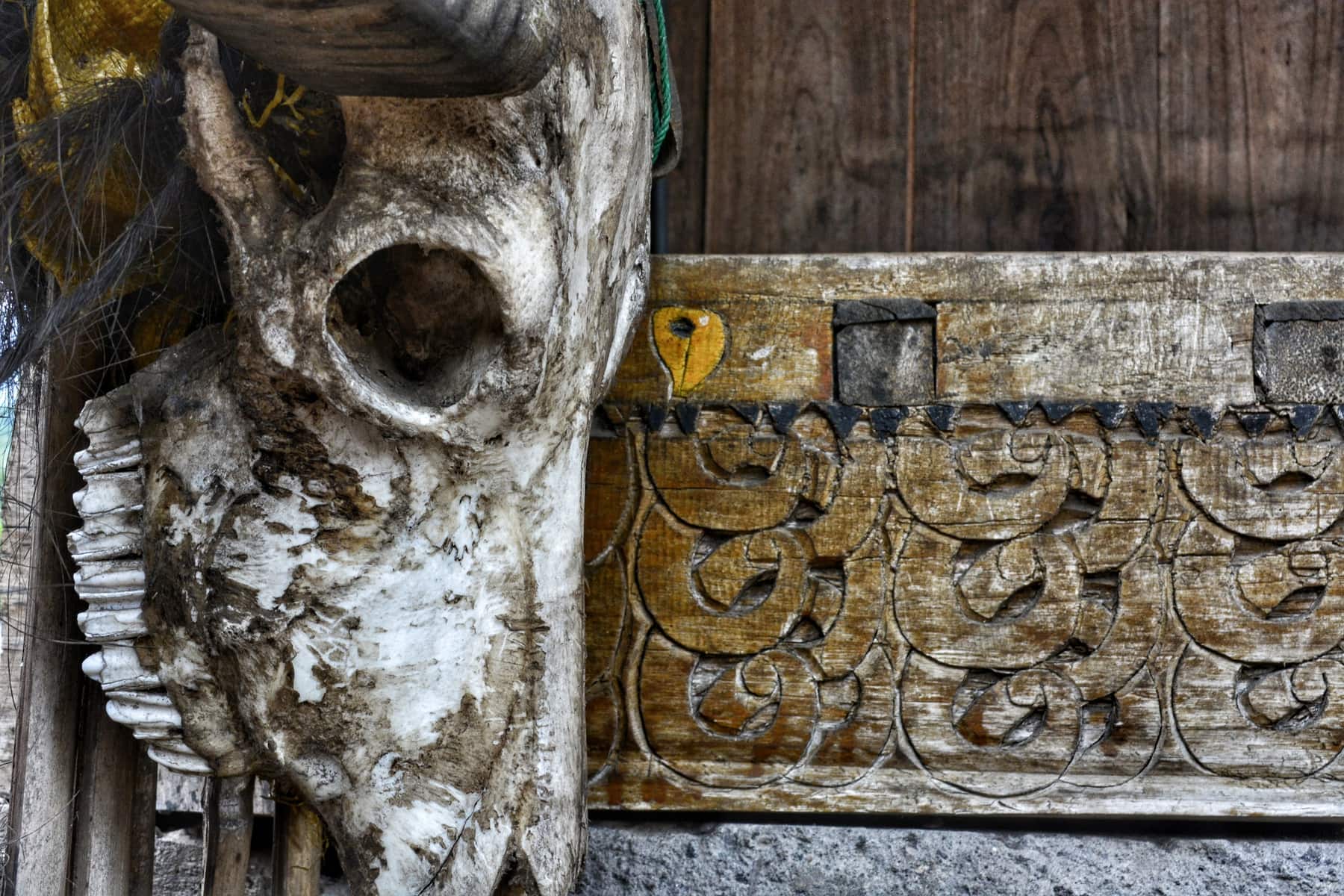
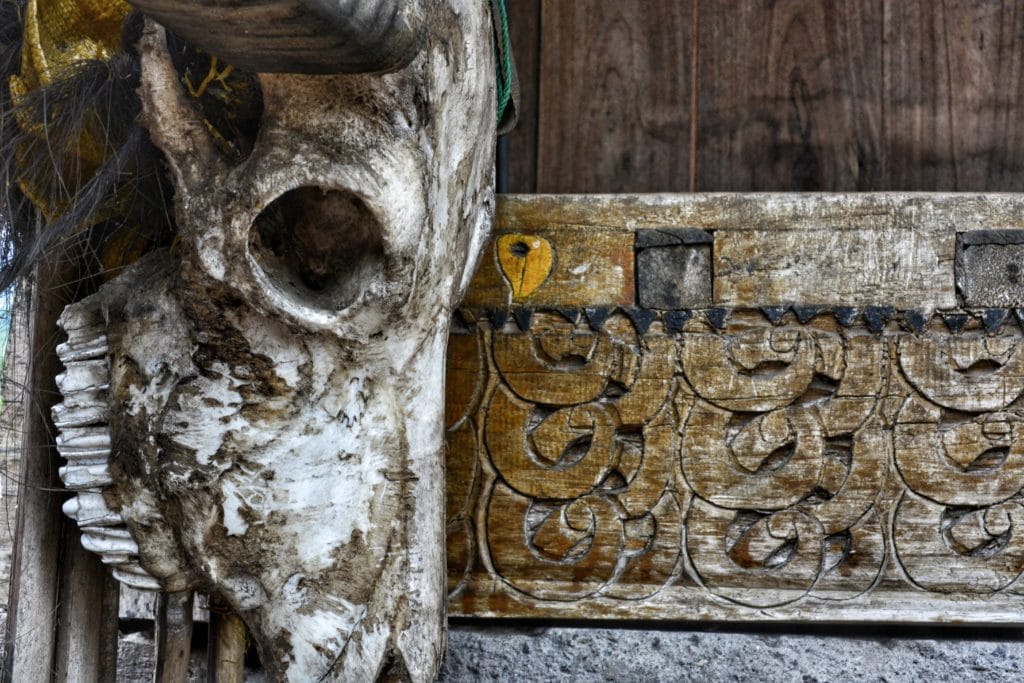
Indeed, Bena and the other ancestral villages in Flores still preserve their traditions; buffalo skulls and carved snakes beside the cross are a common sight here.
The houses of Bena
According to elders’ accounts, the village of Bena has never moved from its original location, making it unique among Ngada villages. There are nine clans in Bena, dwelling in 45 houses. Each clan has a main house and one or more support houses.
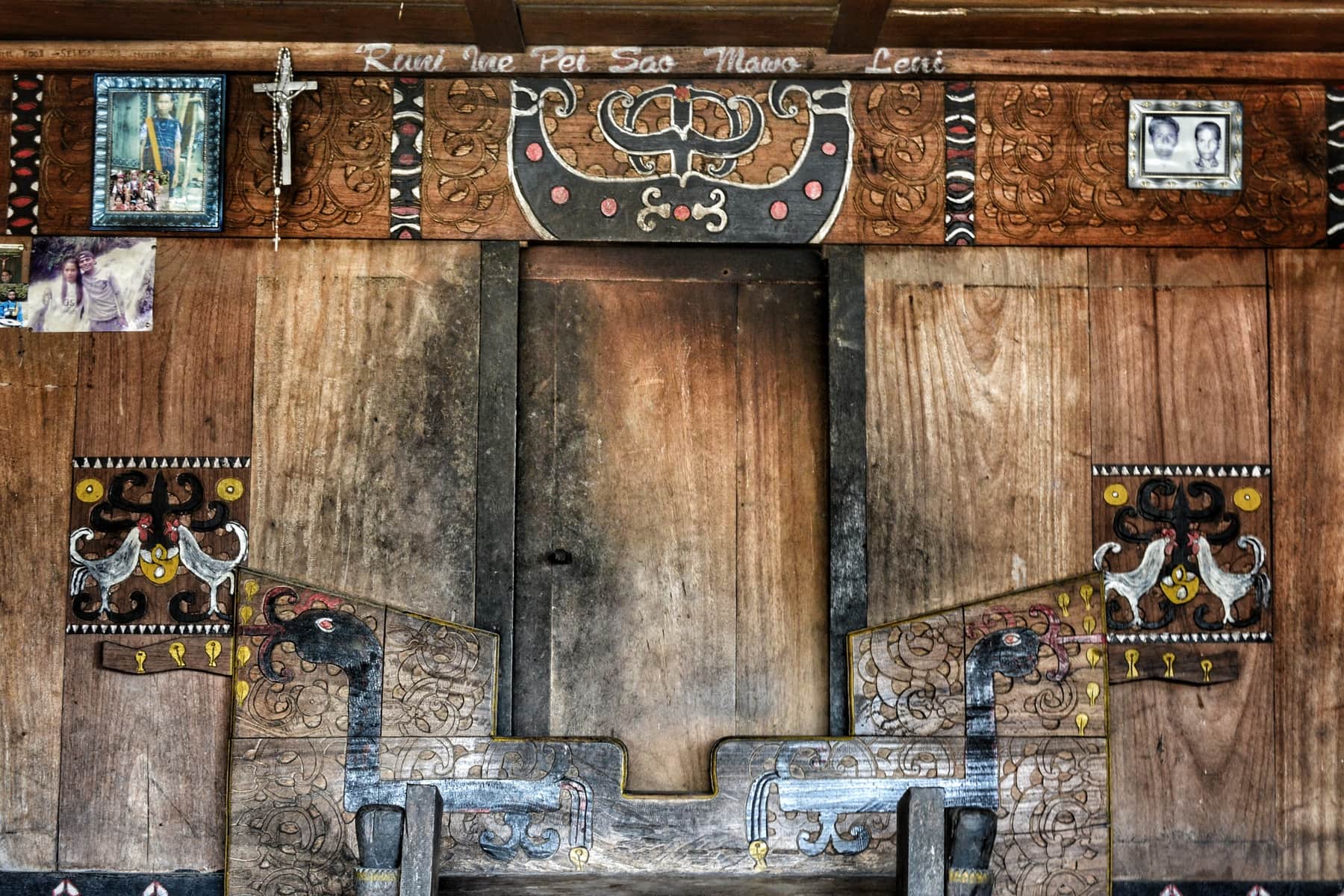
Every element of the house is highly symbolic; nothing is meaningless here. They present very intricate carvings. Manu, the chicken, symbolizes a person’s greatness, as the animal can reach a higher place.
A rooster is for daily life, as its sound wakes people every day at dawn. A horse symbolizes the striving for a better harvest. The snake is the sacred creature protecting the house from evil.
Male and female ancestors are represented on the roof: a hairpin inside a coconut for the female, and a statue wrapped in palm fibers, holding a machete and a spear, for the masculine aspect.
A tripartite cosmic idea is reflected in the construction of the houses, which have three structural levels (foundations, floor and walls, and ceiling), and a tripartite internal structure.
The veranda (teda moa) for informal situations is usually used by women, who wave as they look after the children. The teda one, the first internal level, is for official situations, such as guest reception.
The inner part (one sao) is the spiritual center of the house, accessed via a short wooden ladder; its entrance is a small door, through which each person entering must bow as a sign of respect.
Here, the Mataraga altar stands, a medium for connecting the gods with the earth. Here’s also the simple kitchen, made of stones, and an ngadhu (see below) to tie the animal before cooking.
Traditionally, all materials were interlocked without metal fasteners, although zinc roofs are now widely used.
Structure of the Ngada society and rituals in Bena
Set at the lower east side of Mount Inerie, Bena is considered the oldest Ngada village. Candlenuts, cocoa, and clove are the main products on which the traditional economy relies. Today, Ikat weaving and tourism have become a vital source of income for the villagers.
The Thursday Market in Jerebu’u, 3km south of Bena, is where villagers stock up on supplies. For additional items, they rely on the Boubou market in Bajawa.
Although village administrative authority roles are officially applied, traditional authorities, elder people for each clan, are the ones that really matter in organizing the communities.
The houses are placed all around the expansive yard (kisanatha), where the clan totems and the megalithic altar are placed.
The male ancestors of each clan are represented by the Ngadhu, a wooden pole carved with ritual motifs, thatched, and topped with a palm-fiber roof, with two hands holding a machete and a spear (as on the houses).
The Bhaga, a wooden box-shaped structure resembling the inner part of a house (one sao), represents the female ancestors. Each village has as many of these as the number of its clans.
The Reba ceremony
Every year, on the 27th of December, all the clans of Bena gather to discuss their problems and their future. The ceremony is also an expression of gratitude to the gods for the year’s harvest and a request for a blessing on the next.
This is the right time for a man to propose to a woman. The ritual takes three days: the initial day (laza rebha), when all the families gather at the leading houses to discuss, dine, and drink. The cleansing day (batu ngaza), with mass prayers, dances, and chants, ends with dinner once more—the third day with the sacrificial offering on the megalithic altar.
Traditional Ikat weaving
Ikat, or ikkat, is a dyeing technique used to pattern textiles that employs resist dyeing on the yarns prior to dyeing and weaving the fabric. It’s widespread across Indonesia and Malaysia.
The various motives applied to the Ikat each have their own symbolic meaning. There are children’s motifs that represent the seeking of knowledge. Horse motives waved if the ikat is used as a means of transportation.
Ghi-u, with its arched curves resembling mountains, is a sign that humans must live dynamically. Ube, in the form of a spear, is a marker of self-defense against the enemy. If the motive is larger, it’s called gajah and can be worn only by higher social ranks as a symbol of power.
Bhaga motives are a fertility symbol, worn by women with children. The distinctive feature of Bena’s Ikat is the use of indigo as the base color, whereas in other Ngada villages, it’s usually white.
Bicycle Touring from Moni to Ende – 62km: The Lio village of Wolondopo.
Our road trip, from Moni and Kelimutu to Bajawa by bicycle
After visiting the Kelimutu Crater Lakes and the Moni area, we depart again, heading towards Labuan Bajo along the main road. Another 10km uphill (reaching over 1,000msl), a short plateau between two valleys, and then begins the sweet descent.
Landscapes are becoming increasingly amazing, with terraced rice paddies, lush forests, and splendid waterfalls. We have to stop every five minutes to take a picture.
If you don’t go too fast, you may notice a small sign on the right-hand side of the street where the traditional village of Wolondopo is located, two kilometers away. A detour worth taking. The road is a steep climb to this fantastic little village, surrounded by jungle and coffee plantations.
The houses are made of bamboo; they have no windows and are completely open on the sides. Outside, there is a shared kitchen, where the villagers, in turn, cook for everyone. The inhabitants of this area are called Lio and are another Flores ethnic group.
People look at us astonished, we are aliens, I think here they rarely see a white man or a tourist in general, they must think we are lost—the beauty of bicycle touring in Flores (or everywhere else).
Ende
We continue the spectacular descent that, at a certain point, is blocked by a landslide. We stop to wait on the side of the road; there are food and drink vendors, which makes us worry about the wait. We wait an hour, eating hard-boiled eggs and drinking coffee, while the road is freed.
Back on the main road, we continue the descent, reaching the sea level in Ende, a typical Flores ugly town with a few nasty guesthouses.
We enter a restaurant to eat, but the food is literally rotten. We run away in search of a restaurant run by Chinese people, and we’re fortunate to find one. Aside from the stone in the dish, everything else is edible. In Flores, everything is nice except the food.
Road trip from Ende to Bajawa – 124 km
After a night in the city, we set off again towards Bajawa, which, of course, is 1200 meters high. In Flores, there is no escape; you climb to 1200, you go back to the sea, you go back to 1200, and you go back to the sea, and so on.
Cycling east, for the first 40km, the road is a beautiful coastal roller coaster. Black volcanic sand beaches are great for cooling off, but we encountered choppy water.
Then the climb to Bajawa begins, we stop at a bamboo restaurant run by a wife and husband, it starts to rain badly, and so they tell us that we can sleep there. We mount the tent to protect ourselves from mosquitoes.
Today we face the real ascent: long and steady, 80km up to 1,400 msl. It’s not as steep as the one to Moni, but its length makes it exhausting.
As usual on this road trip in Flores Island, jaw-dropping views are plentiful, with incredible rice terraces that make those of Bali pale in comparison. At about 1,000 msl, the vegetation changes completely, shifting from tropical jungle to almost alpine forest. It gets chilly, too.
Even along this road, there are few food options and no accommodation. Pack supplies and be ready to pitch your tent if you can’t make it up there, although it won’t be easy to find a camping spot.
After a quite devastating day, we somehow made it, and in the evening we arrived in Bajawa, where Daniele was happy to eat Sape Babi, pork skewers with peanut sauce.
Bajawa, the Nngada villages, and Malanage hot springs
Bajawa is a moderately large town by Flores standards, with ample accommodations, good dining options, and a vibrant market.
Bena is about 13km from Bajawa, and add a few more for Gurusina. Traveling by bicycle to these villages, however, is complex and time-consuming. Although the road is paved, the gradients are extreme for bicycle touring. We rented a scooter for 6€ per day.
Not far from Gurusina, there’s an almost secret spot not to be missed, the Malanage Hot Springs (GPS -8.883712, 121.003758 – Google knows). Here, an extremely hot spring flows into a cold river, bathing in this is just the perfect ending to a day, just moving around in the water, the temperatures change, allowing you to find your favorite temperature.
If you’re interested in visiting this magical island, have a look at
The perfect Flores Island Road Trip Itinerary
Advice for bicycle travelers and adventurers in Flores
and our in-depth articles about:
Maumere and Koka Beach, ghost horses on a white sand beach
Kelimutu Crater Lakes, the gate to another world
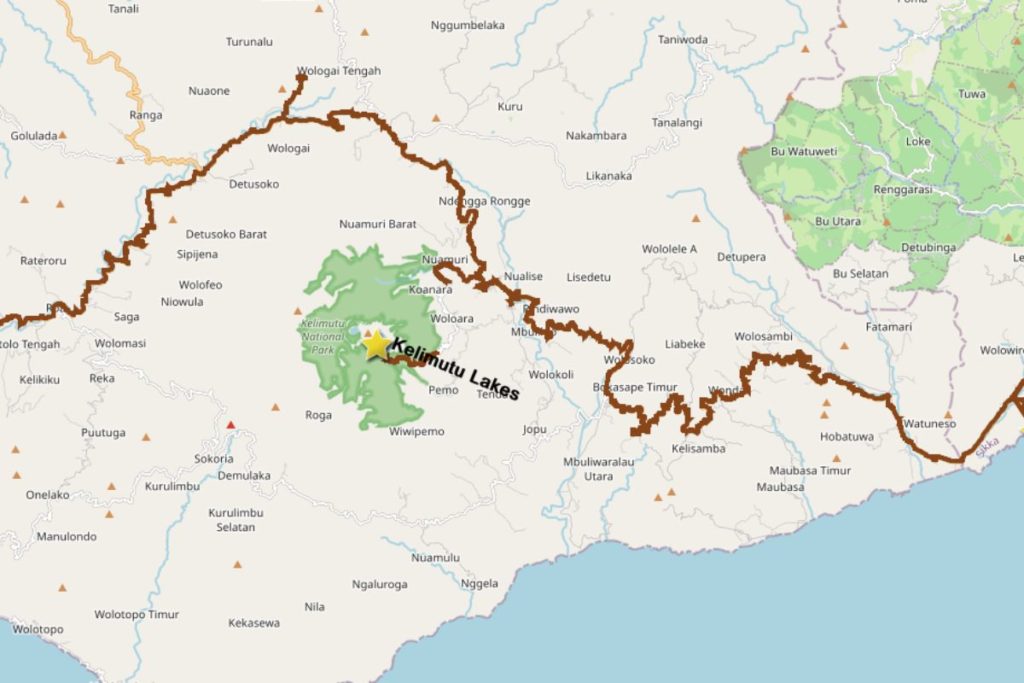
The route map of our road trip in Flores. Click the track for elevation data
Follow us while we get lost