
Last Updated on 17 January 2026 by Cycloscope
Kelimutu Volcano Crater Lakes travel guide
and Things to do Moni – West Flores, Indonesia
Flores Island is becoming increasingly popular among more adventurous tourists, mostly fed up with the crowds of Bali and the Gili Islands.
Disclosure: Some of our articles contain affiliate links. This comes at no additional cost for you and helps us keep this website up and running. (as Amazon Associates we earn commission from qualifying purchases)
Even though most of them stick to the western part, using Labuan Bajo as a base to explore Komodo National Park, do snorkeling or diving, and see the famous Komodo dragons.
The volcanic lakes of Mt. Kelimutu are the second-most-visited attraction in Flores, after Komodo National Park. The percentage of Komodo visitors that come here, though, is incredibly low, given the unique beauty of this volcano.
Flores is not just about Komodo; it’s one of the most beautiful islands in Indonesia, worth exploring in depth for its lush, mountainous interior, volcanoes, and ancestral cultures.
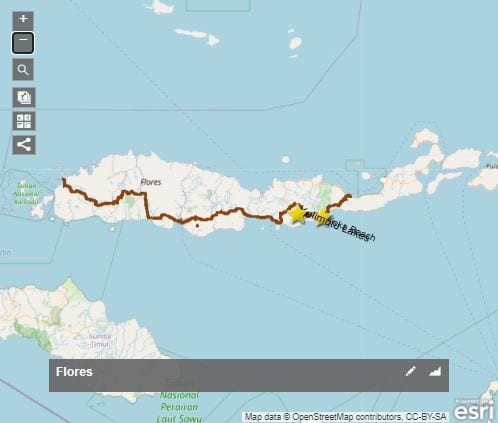
This article describes the second part of our bicycle trip in Flores, from Koka Beach to Moni and Kelimutu Volcano. It is part of our Full Flores Travel Guide.
Check Also
The Perfect Flores Island Road Trip Itinerary
Advice for bicycle travelers and adventurers in Flores
Check also our in-depth articles about:
Maumere and Koka Beach
The ancestral villages of Bena, Gurusina, and Wolondopu
Moni Travel Guide and things to do
Moni is almost a fake town, basically, a bunch of guesthouses that seem to have agreed to charge all the same price (10€), not very smart since some are way better than others.
Some offer breakfast; some don’t ask about it. Be sure to take a look at the room; some are really not worth the money.
There’s really not much to say about Moni itself; most of the restaurants are also guesthouses, and there’s a small market and a bar just out of town with a big mural of Bob Marley.
We stayed at Arwantiguesthouse after peaking at almost all of them. It looked to us like the cleaner and nicer one; the shower gave us some problems, but the owner helped us fix it.
Their restaurant was the best we tried in Flores, although the overall level of the Island is pretty low.
Just out of Moni, in the direction of Labuan Bajo, near the Bob Marley bar, there’s a nice waterfall where it is possible to bathe (not during the rainy season).
How we got to Moni, the road from Koka Beach
Our Flores bike trip travel journal, from Koka Beach to Moni
We leave the lovely Koka beach, Ricky, and his great-grandfather’s horse and head to Moni. Getting back to the main road, we were already soaked in sweat; this 1.3km must be like a 20% gradient.
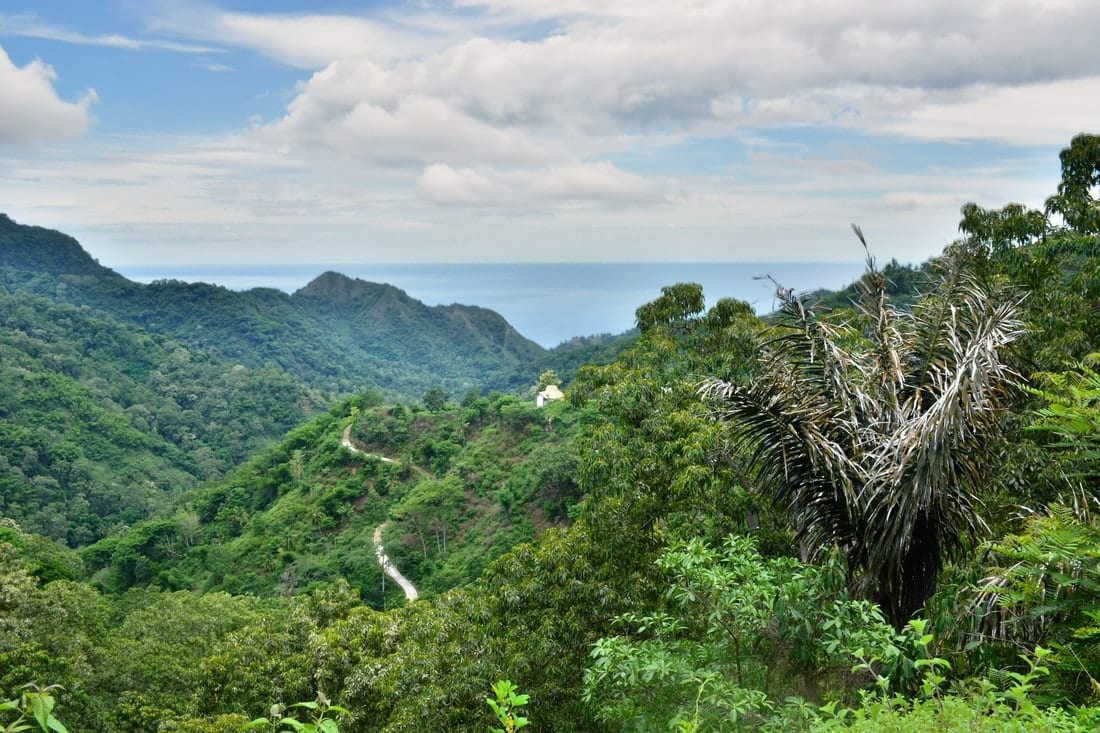
The first five kilometers on the main road are a slight downhill, then begins the ascent. Opening before our eyes a landscape of stunning valleys and jungle-covered mountains, we watch the sea appear and disappear in the distance.
There are many churches around. The people of Flores are mostly Catholic, although the island’s ancestral religion is still alive and kicking (we discuss this in our article about the Nggada village of Bena).
It’s hot, but there are so many rivers and waterfalls where we happily dive with all our clothes, in search of some refreshment.
There are no shops or restaurants along the way. After about 20 kilometers, we come to a small market where they prepare instant noodles while some children harass us. They are eventually chased away so the adults can start bombarding us with questions.
Fawns, Cows, Reggae Music, Betel Nuts, and More Facts about Flores
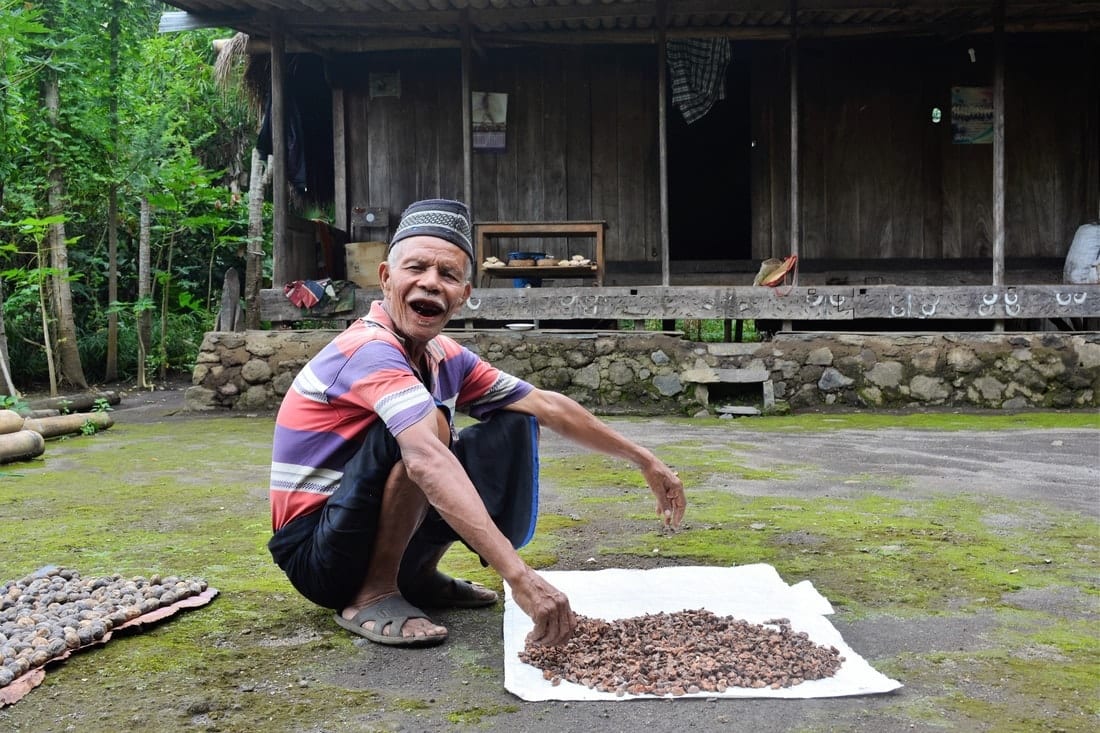
Everybody yells at us “buleh buleh”, which should mean white people, but in a sort of way similar to how “niggers” means black people. At least, I believe. White men should be “orang putih”, but we hear it very rarely.
We see the first bamboo houses with large traditional thatched roofs and so many cows that look like fawns. Women, but also some men, have reddish teeth and gums, when smiling at us they look a bit creepy.
Chewing betel nuts is very common here. It’s believed to have unlimited thaumaturgic properties, besides the drugging effects of the energy boost and the sweet feeling. Apparently, though, the side effects overcome the benefits, at least according to scientific studies.
After the lunch break, the ascent becomes more demanding, but the sky comes to our help. It’s the end of the rainy season and, fortunately, every afternoon the clouds come, and some refreshing shower pours down. Cycling in Southeast Asia during the rainy season is not bad at all!
We hear local reggae music coming from the houses and see lots of people on scooters carrying guitars. Looks like the younger generation here in Flores has adopted reggae as their new favorite style.
Arriving in Moni
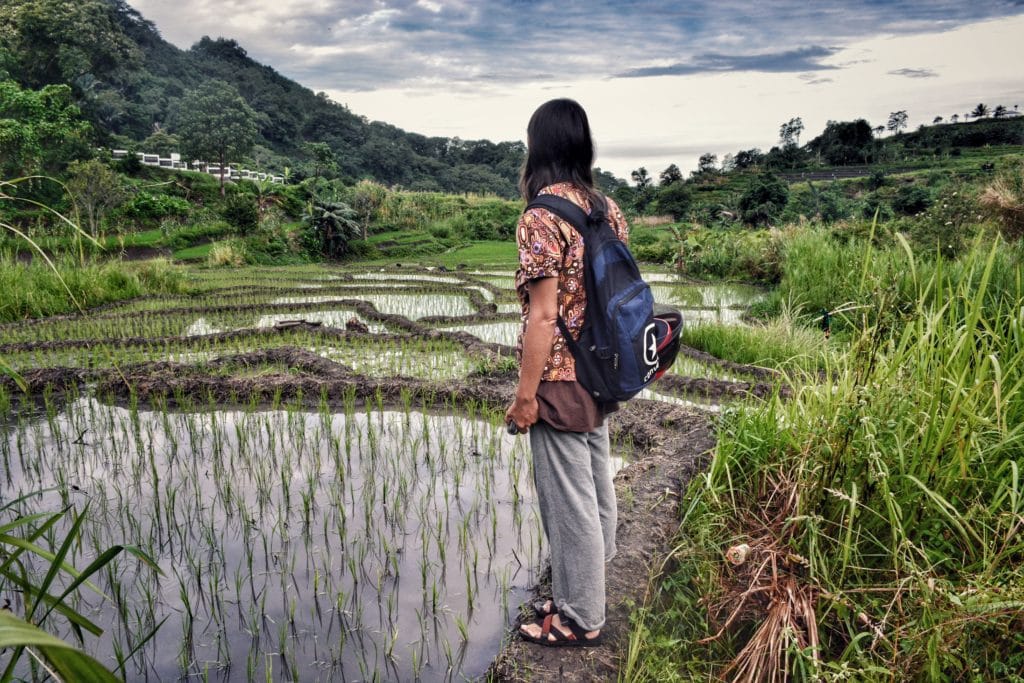
At 650msl, the road starts going down, and the landscapes are unreal. Forest, terraced rice fields, all of a bright green. We don’t like this descent though, since the road soon begins to go up again, this time steeper.
We are back at 250msl, frustrating. In 8 kilometers, the road reaches 700 msl again, then another 2 km downhill before we finally arrive in Moni at 1000 msl.
Moni is the village that serves as a base camp for visiting the Kelimuto Lakes. It is a small town born to welcome tourists; there are just homestays, restaurants, and a small market.
The price of all homestays is fixed at 10€. We finally have a hot shower after months. In the evening, it’s cool, and we sleep with the blanket. The owner cooks us noodles with fresh homemade tomato sauce, really good.
Kelimutu Crater Lakes
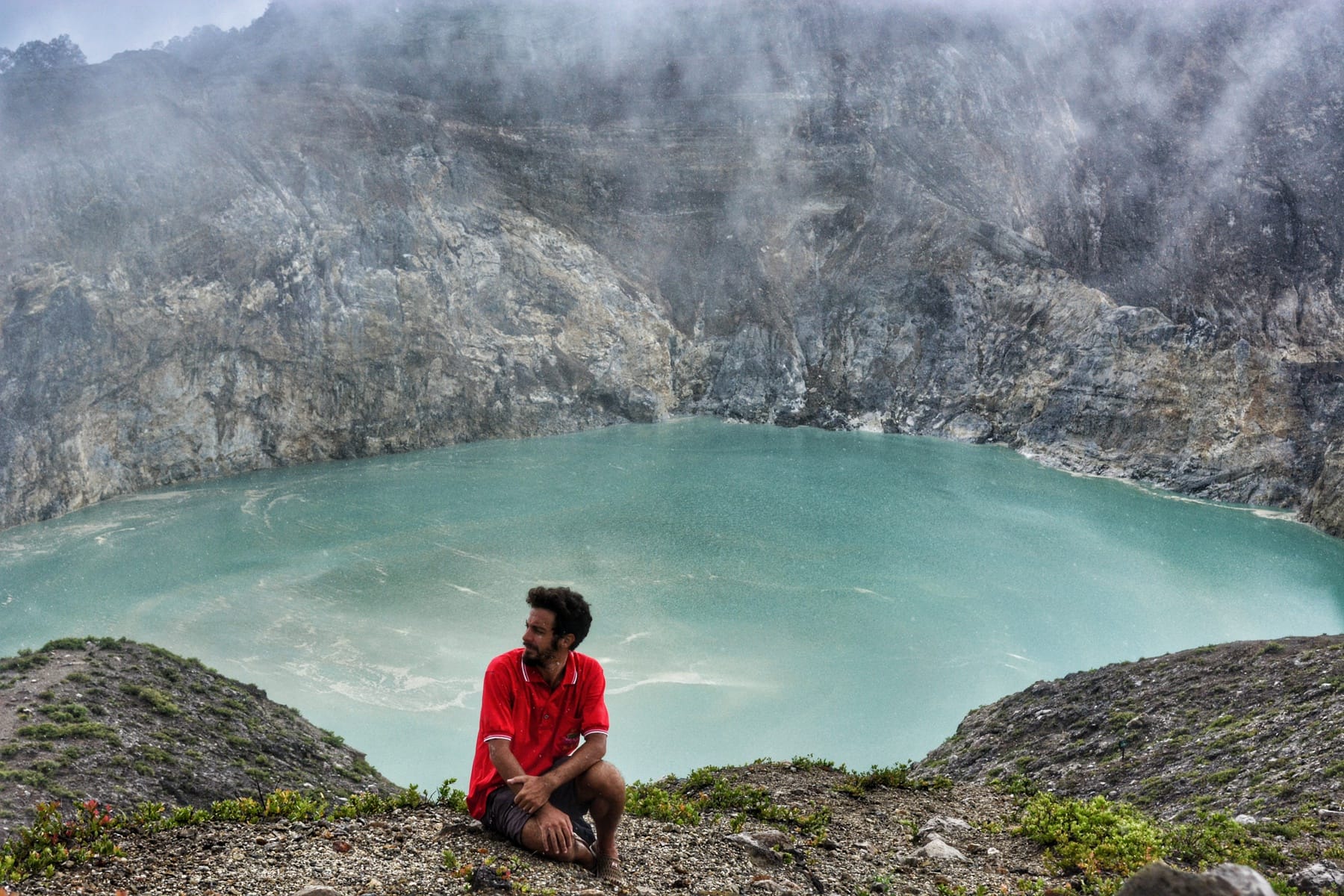
From Moni, we reach the Kelimutu Crater Lakes, the main local attraction, one that alone can be a good enough reason to come to Indonesia.
There are about 8km of steep road to reach this famous Indonesian landmark. We decide to rent a motorbike (6€ for the whole day) to have more time to spend at the lakes.
The climb, anyway, didn’t look so steep, and there’s not much of a hike to do up at the craters.
The road is spectacular, as usual in Flores, we advise not to hire a driver but to get up there yourself, renting a motorbike, cycling, or walking if you have time.
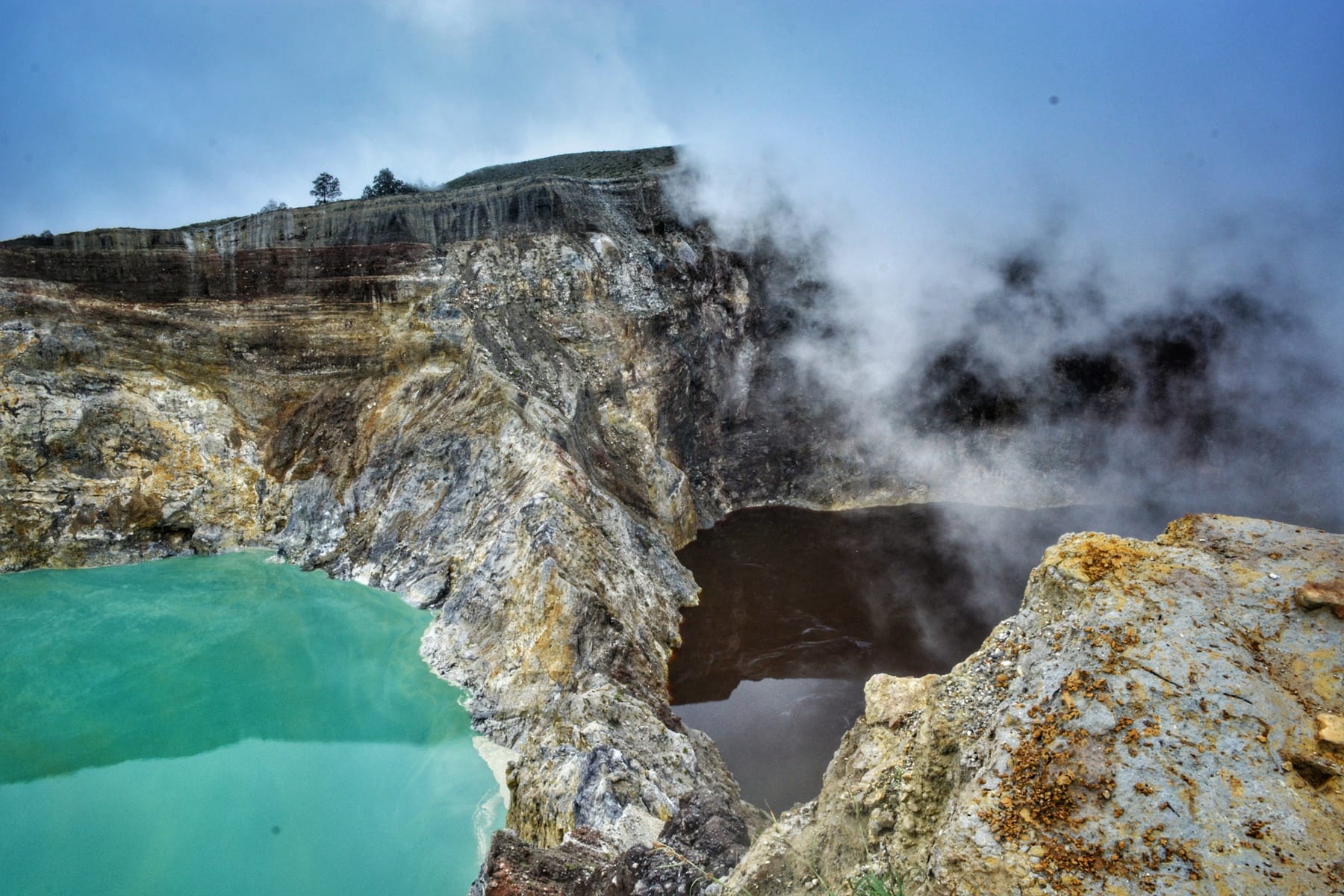
The Kelimutu is a dormant volcano whose craters are filled with water. The peculiar thing is that these lakes, despite being very close to each other, have very different colors. Moreover, they change color throughout the day, from black to red, green, and blue.
The Legend of the Kelimutu Crater Lakes
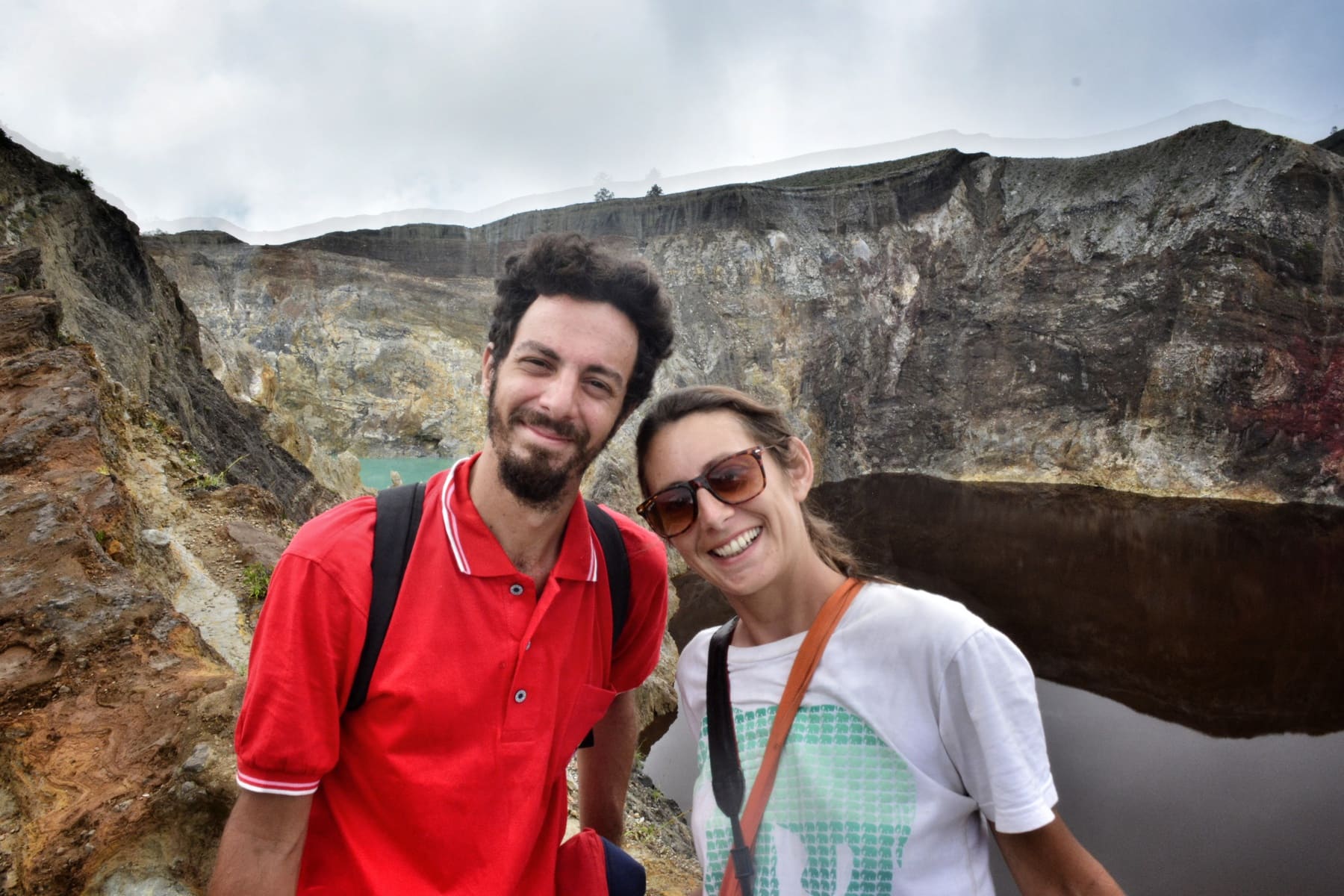
According to local beliefs, the lakes are where the souls of the dead go. The souls of the wicked end up in the Tiwu Ata Polo, the lake that is most often dark in color. The souls of young people go to Tiwu Nuwa Muri Koo Fai, usually blue-green, while those of the elders end up in the Tiwu Ata Mbupu, separated from the other two, which are usually deep blue.
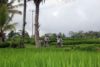
It’s said that the color change occurs when a new soul reaches the lake. Every year, a ceremony and a pilgrimage are organized from the surrounding villages to the lakes.
Entry fee and the hike to Kelimutu
We heard there’s a secret hike from Moni that lets you bypass the ripping-off entry fee. Indeed, the ticket costs 3000 rupees for locals (20 cents) and a steep, unreasonable 10€ for us buleh (12€ on Sundays!).
Anyway, it seemed that it would rain, and we didn’t know if the alternative path was in good condition, so we decided to go from the official entrance.
After a few hundred meters, we arrive at the first two lakes in the craters. Those are very close to each other and so different anyway. Appalling.
The third lake, Tiwu Ata Mbupu, is some 500 meters away, so there’s really nothing to hike up here. You’ll be done in one hour.
It’s very important to know that, almost every day, clouds gather above the Kelimutu in the early afternoon, making it nice and misty at first, and then totally invisible. Keep this in mind if you plan to do the whole hike from Moni or go in the afternoon.
Air Panas, the Kelimutu Hot Springs
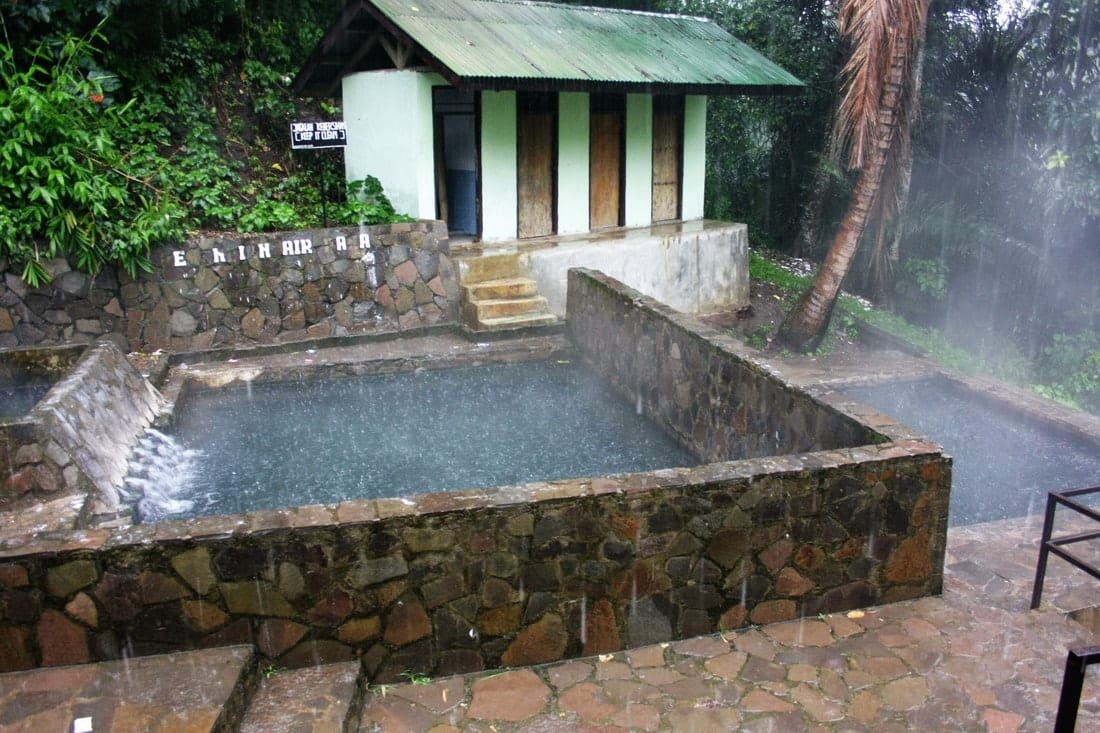
Turning back, we see it begins to rain a lot; we see the sign “Air Panas,” which means “hot water.” There are two free-access hot springs along the road from Moni to Kelimutu, providential to us since we caught a heavy downpour and the temperature up there wasn’t so warm.
The first one, Kolorong Air Panas, can be found on Google Maps. It is a large man-made tub, so we decided to stop here and wait for the rain to stop.
The second one is very small, hidden among the rice paddies, harder to find, and mostly used by locals. Indeed, a few kids are bathing with shampoo and soap.
How to Get to Moni (source – Wikitravel)
“Buses from Bajawa (7 hr, Rp 80,000) start at 6 am. Gunung Mas runs a 12-seater “Travel Bus” from Ruteng to Moni (continuing to Maumere) at 7 am and 1.30~2 pm. It takes 10 hr from Ruteng to Moni (6 hours from Bajawa), and they will pick up guests from hotels by prior arrangement.
From Ende, there are more options. Public cars (2 hr, Rp 40,000) and Toyota Kijang are normally the most comfortable options. Bemos (Rp 20,000) and buses (Rp 30,000) also ply the route in 2.5 hr.
If you’re feeling adventurous, ojeks will take you there for Rp 100,000, letting you make your way at your own pace and stop for photos along the very scenic route.
From Maumere (3-4 hr), there is the same plethora of buses (Rp 30,000) and public cars (Rp 60,000); just ask at your hotel.
From Riung, the public bus to Ende (50,000) leaves at 6 a.m., and you can catch a bus to Moni from there.” (info taken from Wikitravel.org)
Planning a trip to Flores? Check Also
The Perfect Flores Island Road Trip Itinerary
Advice for bicycle travelers and adventurers in Flores
Check also our in-depth articles about:
Maumere and Koka Beach
The ancestral villages of Bena, Gurusina, and Wolondopu
The route map of our road trip in Flores. Click the track for elevation data