

Last Updated on 16 January 2026 by Cycloscope
Things to do, see, and experience in Baku
Some not-fun facts about the dictatorship in Azerbaijan
Baku, the capital city of Azerbaijan, is the core of the dictatorship, the temple of the oligarchs. With a population of 2,374,000, this is the only big city in Azerbaijan, if you really want to feel the mood of the country that’s where you should be, but be aware (and I’m sorry to say that), it is not a great mood.
Disclosure: Some of our articles contain affiliate links. This comes at no additional cost for you and helps us keep this website up and running. (as Amazon Associates we earn commission from qualifying purchases)

In this blog post, we’ll describe our experience in the windy city of the Caucasus, I don’t know if this will help anyone planning a trip here, but if you’re thinking of visiting Baku you might find it interesting.
How the hell we got here
After bicycle touring the whole length of Azerbaijan from the southern border with Georgia, Elena collapses less than a hundred km from Baku. We just took a bus and arrived here, where a friend of a friend will host us for a few days.
Arrived at Baku’s bus station we asked a taxi driver how much he wanted to take us to the house of the guy who would host and he shot us a ridiculous amount of money, something like 30 euros. Besides, he doesn’t even know where the address is.
Some other gentlemen tell us the taxi drivers are crazy and give us directions.
Elena is still pale green, but we find out that the place is very close, so we try to cycle.
We immediately find the street, but the house number is a problem. The road is a string of Soviet apartment blocks without house numbers and without bells.
Fortunately, while we wander back and forth, Ismail (fictional name) appears before us. The father was playing chess somewhere and saw us passing, so he warned the son.
He lives on the 9th floor, luckily there’s an elevator and on a few trips we can bring all our things. We’ve been together for an hour, then he and his wife go out and Elena goes almost immediately to sleep.
The Caspian Oil-Pond-Front
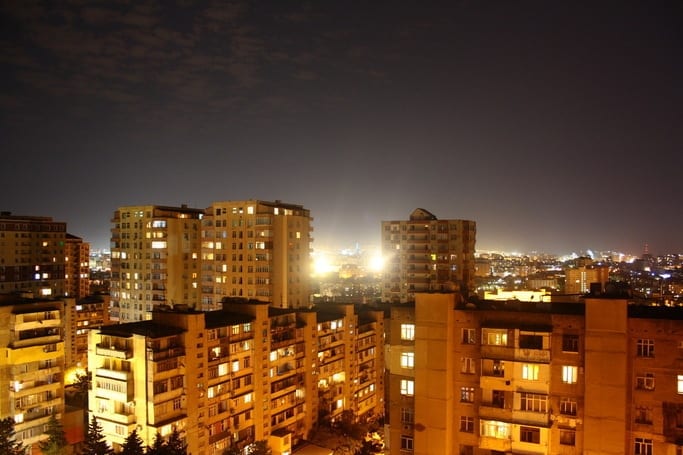
The apartment is really nice and big, and we have a room all to ourselves. Baku is hot, but luckily well-ventilated, and here on the 9th floor, even more so. They say the meaning of “Baku” is “the city where the wind blows”.
Our main aim here is to obtain visas for Uzbekistan and to find out how to take a ship across the Caspian Sea. Today and tomorrow, though, are holidays (for the end of Ramadan), so the port and embassy are closed. We’ll go on a city tour. Around 6 PM, we go out together with Ismail, who also must go downtown.
We take the subway, which is quite cheap. Everything else, instead, is very expensive. Especially the supermarkets here are more expensive than in northern Italy (and it is not easy), and salaries are quite low. As far as we understand, a teacher earns something like 300 euros per month.
Out of the subway, on May 28 street (May 28th is Republic Day), we find the usual statue of the former president and the usual quote. They are everywhere in Azerbaijan.
After the square, we head towards the Caspian seafront, which we could also call the oil pond front. The avenue is perfect, everything spotless, manicured gardens, not a cigarette butt on the ground (as befits a regime).
But the Caspian Sea is black, literally. That is, it’s oil, and it smells a lot. To see the fish swim there, eating crumbs and oil, is very impressive. Doesn’t really inspire a fish meal in Baku.
But the people here are sitting and enjoying, looking at the sea as if they are in Sorrento.
A first-hand account of the political repression in Baku
Petrol is cheap (60 cents per liter), and people are wealthier than in the countryside, or at least so it seems. For sure, they are richer than Georgians. And all thanks to the oil puddle they face.
They say that in ten years the oil will be over, but nobody seems to care much. The oligarchs have already accumulated enough Manat and have another ten years to accumulate even more.
The common people do not even know about this theory; the information is controlled by the government, and those who try to say something different (not just about oil) are arrested on absurd pretexts.
So, for those who don’t have access to the internet, or who maybe have never been abroad, and, above all, who only know the Azeri language, forming an opinion is not easy. Although, of course, everyone is aware of living in a dictatorship, I guess.
Ismail is part of a group of political dissidents, which is why we’re using a fake name. Because of the upcoming European Olympic Games, there has been a recent crackdown on dissent, even worse than usual.
To prevent any kind of action that could draw attention to the lack of democracy, freedom, and the many other political issues of Azerbaijan, the government arrested everybody they could suspect of being connected with independent political groups.
Among these, there are many friends of Ismail; just today, they arrested the lawyer who usually defends political dissidents. The accusations are always ridiculous, such as supporting Armenia; even worse, often the police place drugs in the houses or belongings of the victim, so as to charge him/her with drug dealing.
Most of the time, the convict has two choices: go to jail or enlist in the army. Needless to say, those who choose to enroll will be sent to the most dangerous positions in the Nagorno-Karabakh war, where they’ll be constant victims of hazing.
Baku’s Old Town
Going back to our tour, we must say there isn’t much traffic compared to Tbilisi, and drivers don’t seem psychopathic. It even happens that they stop to let you cross the street.
After our walk along the shore, we head to Baku’s old town. As far as we understood, until the discovery of oil in the nineteenth century (the first drilling of the world was made here), Baku was a village in the desert, ok, on the sea, but still in the desert, with a few thousand inhabitants; and in fact, this old town is very small.
The wall and the houses are completely restored; they now look “falsely old”. In short, the cleaning and rebuilding were a bit too much.
It seems that after the 2000 earthquake, UNESCO wanted to remove Baku Old Town from its list due to the lack of reconstruction, but it has been restored in this barbaric way, and UNESCO has readmitted it. Congratulations. Sure, a nice postcard for tourists.
We walk back towards home, passing through more “peripheral” streets. There, we see a more genuine Baku, even enjoyable.
But the fact remains that it’s a city of 2.5 million inhabitants, and it’s dead. In the evening, there’s nobody around, and in the center, there are very few pubs or bars. At best, someone plays backgammon in front of a house or in some other place where only tea is served.
No women, of course. Indeed, since we entered Azerbaijan, we never saw a woman driving. And when in the car, they always sit in the back.
Uzbekistan Visa Application in Baku
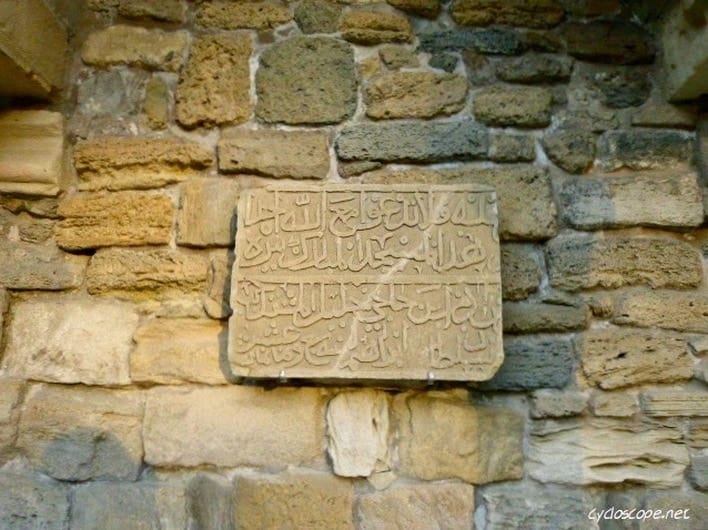
The next day, we went to the Uzbek embassy, which was pretty hard to find. The address on their website is something like “freeway street, house number…”, but I doubt that’s how they call this place in Azeri, and in fact, no one knows.
Fortunately, there’s a lady on the bus who helps us with the research, gets off the bus with us, and asks anyone. In the end, we see a long-haired blond dude; he knows, he comes from there. Just the fact that it exists is a consolation.
The employee’s slowness is incredible; it takes about 10 minutes to hand over the sheet to be filled out for the application. The man tells us that the visa should be ready next week. He goes out with us to smoke a cigarette. It’s a weird man; he looks really drunk.
Ferry to Kazakhstan, inquiring at the port of Baku
After the embassy, we leave for another visit to the port to check on the Baku-Aktau ferry.
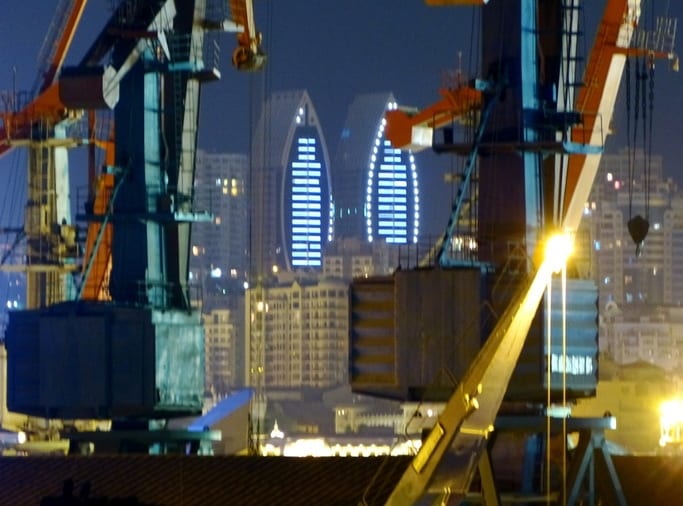
The road to the harbor is full of the usual “fake gardens” constantly under the sun, but with a perfect lawn and pruned plants. Always deserted. Across the road are the usual reptilian buildings, reptile-egg-shaped, to be specific.
We enter the harbor by a dirt road, with no indication. The only clue we have is that the ticket office is located behind a “gray heavy door”, and fortunately, we recognize it immediately.
On the door, many stickers were glued by tourists who passed before us. The only problem is that the office is closed and there is no one around. We walk towards the ships to look for someone, and we meet a policeman with another guy, apparently the clerk. They speak only Russian.
The clerk tells us the ticket costs $110. We understand it must be done on the day of the departure. Cash only. Let’s hope it’s true. Anyway, we went back home happy to have concluded something.
Here in Baku, there’s not much to see, so while waiting for the Uzbek visa, we’ll go visit Ismail’s cousin, who lives near Ivanovka, one of the last kolkhoz of the former Soviet Union, Lahic, up in the Caucasus, famous for the copper crafts and the typical houses, and Khinalug, the highest village in Europe.
How not to get a visa for Uzbekistan in Baku
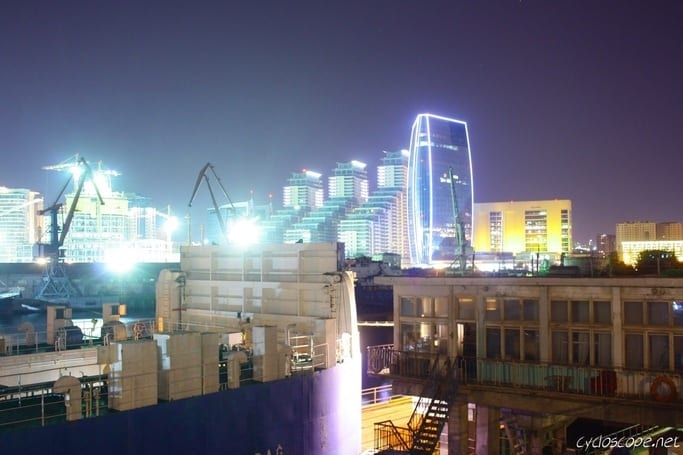
After our adventures in the Caucasus, we’re back into Baku’s pollution. The nose was again encrusted.
We call the Uzbek embassy, and guess what? The visa is not ready yet. It is not clear why. Our Azeri visa is expiring, so we went to the embassy to understand what’s going on.
And here we are at the embassy, in full combat gear. In front of the gate are three other cyclists, a British couple, and another English lady, a lonely hitchhiker at the age of 60, a cool woman.
We all submitted the application on the same day, almost two weeks ago, and there has been no news for anyone since. Something must have gone wrong that day.
After more than an hour of waiting, we entered the embassy, and the console told us that he hadn’t received any news from Tashkent, that his job is to check the computer every 3 hours, that he can’t do anything else, and so on.
Sure enough, when we submitted the application, he was drunk, so it’s likely he had completely forgotten to send the papers to Tashkent.
Then, he says absurd things like “Maybe you should apply from Bishkek because it is closer to Tashkent and so easier to get a visa” (wtf?!) I was not aware that fax was traveling by pigeons in Central Asia.
In the end, we agree to call him back in the afternoon to see if he can fix the mess that he created, even if we all know this is just a way to get rid of us. Our hopes of getting to Uzbekistan are becoming increasingly ephemeral.
Follow us, if you dare!