

Last Updated on 16 January 2026 by Cycloscope
Travel in Azerbaijan: a road trip to the former Soviet Union’s last Kolkhoz, Ivanovka. Here, it still works the old way; farming and breeding are collectivized
While looking for interesting things to see and do in Azerbaijan, we came across Ivanovka, the last kolkhoz in Azerbaijan and possibly in the whole former Soviet Union. A kolkhoz is a form of collective farming in which all villagers are workers and share the profits of their work in equal parts.
Disclosure: Some of our articles contain affiliate links. This comes at no additional cost for you and helps us keep this website up and running. (as Amazon Associates we earn commission from qualifying purchases)

Here in Ivanovka, collective farming is still practiced by the local ethnic group, the Molokans, a sect of ethnic Russians deported at the time of the Tsar for their refusal to adhere to the Orthodox rite. It’s weird to see that those keeping on with communism are the more religious in the country.
We traveled to Ivanovka during our bicycle trip in Azerbaijan. Take a look at our articles about
How do we get to Ivanovka from Baku
We go to the Baku bus station, and our host, Ismail, tells us to take two urban buses to get there. While stuck in a traffic jam for almost an hour, we realized that on foot we would already be there, so be aware when taking a bus in Baku.
To reach Ivanovka, we first have to go to Ismailli. The bus will leave in about an hour; it is a big coach with air conditioning. It takes about 3.5 hours for less than 200 kilometers.
The road is up and down, and the landscape is completely desert, but with fascinating dunes. We arrive in Ismailli at 7 pm, the cousin of our Baku host will shelter us here, but he can’t come to pick us up, he’s at work.
So we hitchhike. Pretty easy, there stops the first car we see! It just goes to Kurdmashi, the village where our new host lives, his name is Rovshan.
The driver who picked us up asked whose guests we were; they knew Rovshan and called him. We arrive at the market and wait there. After a few minutes, in fact (while all the villagers stare curiously), a white Lada with five people on board pulls up. A lady says “hello”; it seems she is our host (it is Rovshan’s mother, we realize later).
In some way we go, Daniele and I in the front seat and all the others (four people) behind. All of them have gold teeth, except Rovshan’s mother. I don’t know if I have already mentioned this, but here everybody has gold teeth.
The house is beautiful, all made of wood and with lots of windows. But in the summertime, life goes on outside, where there is a huge porch furnished with a kitchen, sofa, and a big carpet. There’s also a large, well-maintained garden full of flowers and vegetables.
We are immediately fed with some kind of bucatini, cooked for over 30 minutes. There are also the children of Rovshan, one about a year and a half old, called Ismail (again), and another about 7 years old.
Then there is the wife. And finally, around 10 pm, Rovshan also comes from work, as far as we understand (his English is a bit “fancy”), he’s an inspector for the municipality of Ismailli.
In Ivanovka: the Last Kolkhoz
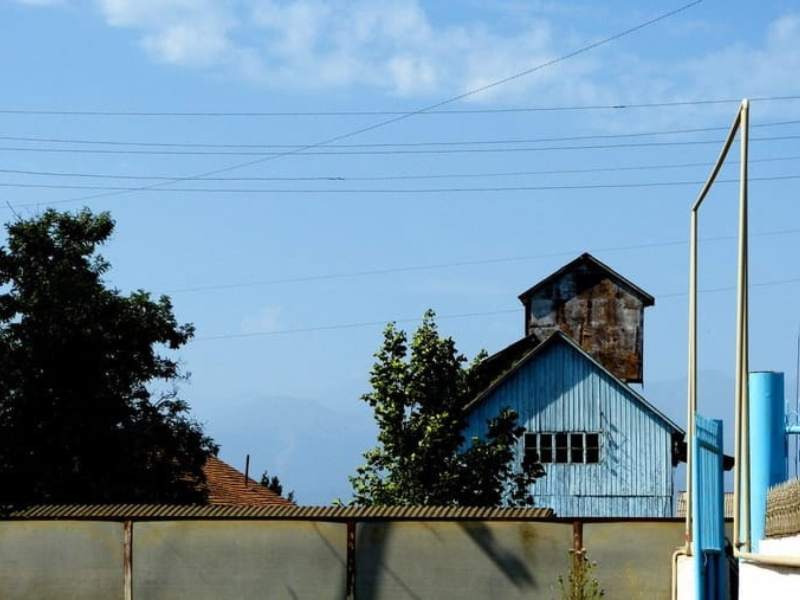
The next day, we go to Ivanovka, the last kolkhoz in Azerbaijan and possibly in the whole former Soviet Union. Here live the Molokans, a sect of ethnic Russians deported at the time of the Tsar for their refusal to adhere to the Orthodox rite.
80% of the population is composed of Molokan, and there are some “mixed” marriages that are not well received by the community. Some people do not even know a word of Azerbaijani, even if they have lived here for a few centuries.
Agriculture and farming are still practiced collectively. The kolkhoz is divided into departments, each focusing on a particular sector (tractors, vines, animals).
At the end of the year, they sell products on the market (no longer under the Soviet Union’s rules) and share the profits. It’s weird to see that those keeping on with communism are the more religious in the country.
Tanya, a Russian lady who has lived in Ivanovka for 6 years with her husband, John, a British man, and who runs a guest house, explains the operation of the kolkhoz. She offered us tea and gave us a bit of the wine produced there, then told us where to buy the cheese: “Blue Gate No. 2.”
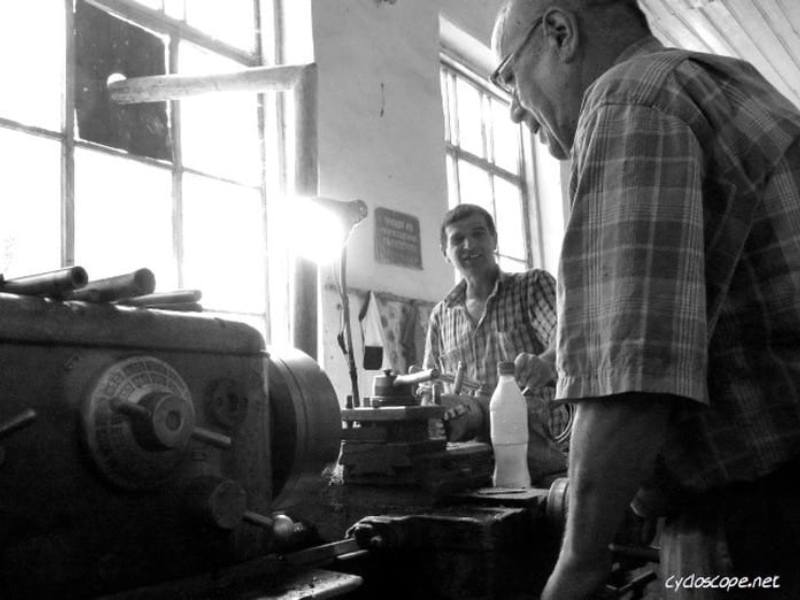
Let’s go for a walk around the fields, and here we find ourselves in the tractors department, a big yard where these old fossils are parked, but they still seem to work. Then there is the workshop for repairs.
While we’re out there, the manager (who looks like the guy from CSI Miami, but with gold teeth) takes us for a “tour” of the factory. It seems to leap in time. Then he takes us into his office and prepares tea again.
Meanwhile, workers always come to show him their work; he gives them some notes, but we do not understand what they are. After the visit to the tractors, we walk through the fields, where there are vineyards, and then a “roadblock”. In practice, a small house where the men are drinking tea.
They tell us we can not proceed further because there are buffalo. And they again offer us tea. Then we go buy the cheese Tanya recommended and get back to hitchhiking for Kurdmashi. One of the guys who drives us is offering a ride to Lahic tomorrow. It’s a funny man and, needless to say, with gold teeth.