

Last Updated on 17 January 2026 by Cycloscope
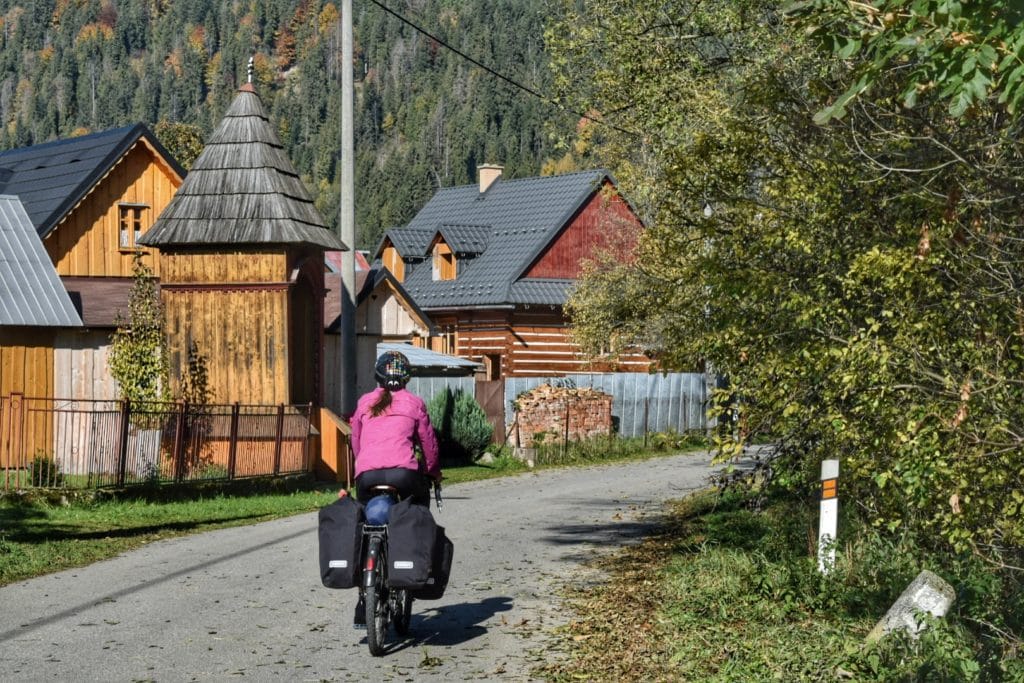
Osturna, Slovakia: history, architecture, what to see, where to stay. A guide to a hidden gem of the Carpathians
There are many small and hidden gems in Slovakia, one we really feel like recommending is the fairy-tale village of Osturna, near the Polish border (see map).
Disclosure: Some of our articles contain affiliate links. This comes at no additional cost for you and helps us keep this website up and running. (as Amazon Associates we earn commission from qualifying purchases)
This was one of the best days of our whole 5-month Europe bike trip, a day full of marvel, an area of Slovakia you really shouldn’t miss when traveling here.
Osturňa is the westernmost settlement of the Lemkos. They are traditionally Orthodox, use the Cyrillic script, and preserve a unique and wonderful architecture.
Why not do some cycling in Slovakia?
What about a bike trip to Poland? Check all the best routes!
About Osturna
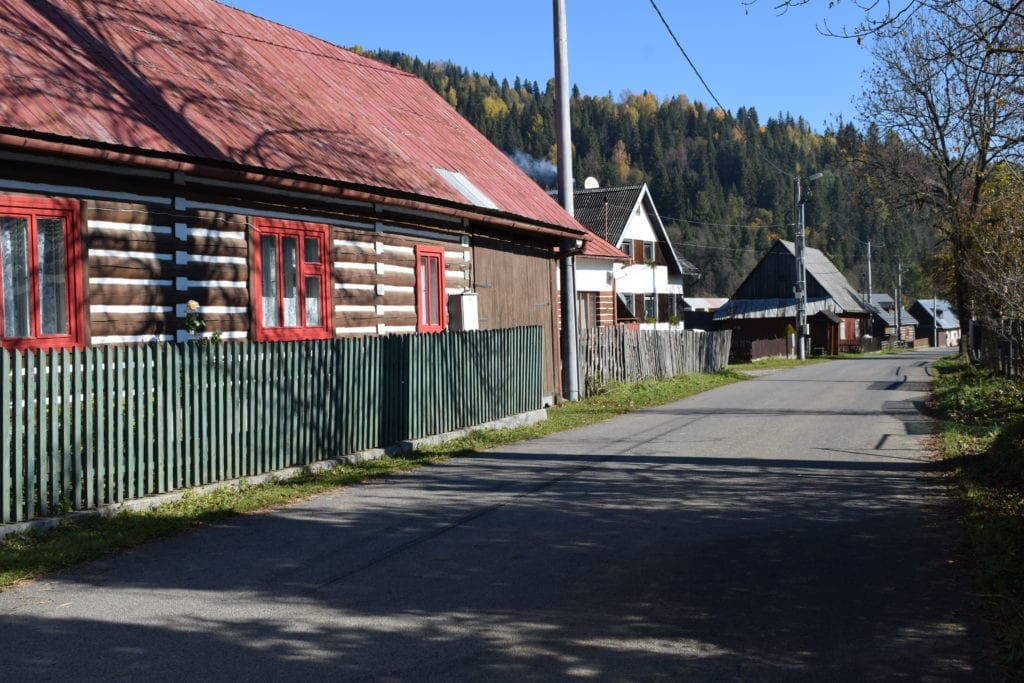
Osturna is a laid-back fairy-tale place with an interesting history and remaining sparkles of a unique culture, lying 700 meters above sea level amidst a gorgeous valley.
This nine-kilometer-long village is inhabited by about 390 people. Those people are Rusyns or Gorals, a diasporic ethnic minority group with a complex history (more about this later) and fascinating architecture.
They are the descendants of the Rusyns (Ruthenians, Lemkos), now an official national minority in Slovakia, but their distinct identity was never officially accepted by the countries they always lived in (Poland, Russia, Austro-Hungary, Ukraine).
157 of Osturna’s wooden structures are recognized as a national treasure.
Passing through Osturna is a 10km long jump in a parallel universe, but there are also reasons to stay overnight, and why not, making it your base to explore the Tatra Mountains, one of the most beautiful regions of Slovakia.
Rusyns, Goral, or Lemko? Ethnicity of Osturňa
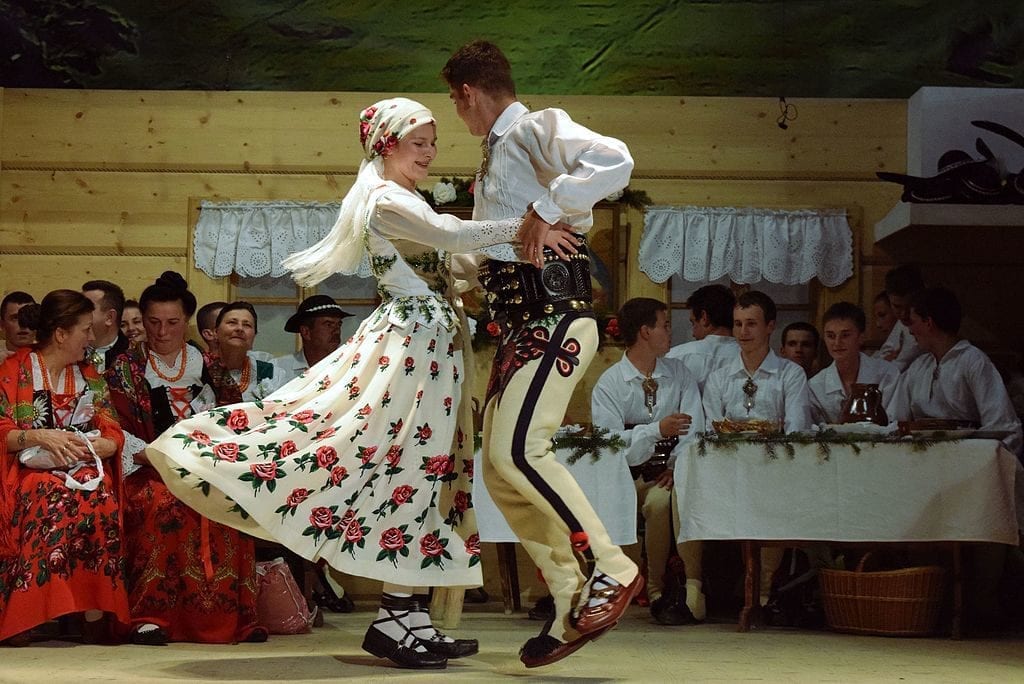
As far as we could figure out, the inhabitants of Osturňa are Lemkos, an ethnic subgroup of Gorals, who are sometimes confused with Rusyns.
The endonym Rusyn has frequently been unrecognized by various governments and, in other cases, prohibited.
Of the estimated 1.2 million people of Rusyn origins, as few as 90,000 people have been officially identified as such.
This is due, in part, to the refusal of some governments to count Rusyns and/or allow them to self-identify on census forms, especially in Ukraine.
The Gorals (literally “highlanders”) are an ethnic group primarily found in their traditional areas of southern Poland, northern Slovakia, and the Cieszyn Silesia region of the Czech Republic (Silesian Gorals).
There is also a significant Goral diaspora in the Bukovina region of western Ukraine and northern Romania, as well as in Chicago, the seat of the Polish Highlanders Alliance of North America.
What distinguishes the Lemko culture is its deep commitment to Eastern Christianity, introduced to the Eastern Slavs by Byzantium in the 9th century.
Most Lemkos today are Eastern Rite or Byzantine Rite Catholics. In Osturňa, they belong to the Eastern Orthodox Church.
Osturňa: History and Geography
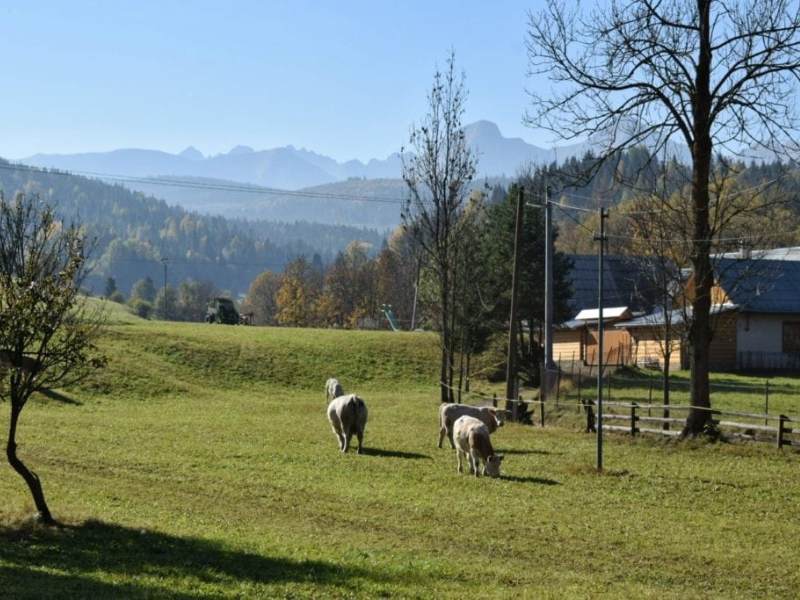
Osturňa lies on the Osturniansky Potok (Osturňa River) Valley, separated from the rest of Slovakia by mountain ridges.
Poland is just behind the smaller ridge up north; one of the most direct ways to get here is from the town of Kacwin.
Both villages belong to the same region – Spisz/Spiš that in 1918 was split between two newborn countries, Poland and Czechoslovakia.
Founded in 1313 on the estates of Niedzica Castle, the village of Osturna was originally settled by Ruthenians (Lithuanians) from the Lemko region of southern Poland. Osturna is first mentioned in historical records in 1593.
Rusyns had struggled for their independence for centuries; they formed two short-lived states after World War I: the Lemko-Rusyn Republic and the Komancza Republic. Some of the founders of the Lemko-Rusyn Republic were sentenced to death or imprisoned by the prosecuting attorney Kost Levytsky, future president of the West Ukrainian National Republic.
During World War II, Nazi Germany sought to Germanize the Gorals, along with the Estonians, Latvians, and Lithuanians, and include them in the resettlement plans.
Under Nazi racial laws, the White Russians, Gorals, and Ukrainians were viewed as “undesirable”, and thus subject to special statutes (labor and police law) in the occupied territories of Eastern Europe, although to a milder degree than other non-German ethnic groups.
About 130,000 to 140,000 Lemkos were living in the area in 1939. Sadly, after 1947, no Lemko villages survived north of the Carpathian Mountains (on both the Polish and Ukrainian sides, further east).
Those people were subject to forced resettlement, initially to the Soviet Union (about 90,000 people) and later to Poland’s newly acquired western lands (about 35,000); they were victims of Operation Vistula in the late 1940s.
This was a state-ordered removal of the civilian population in a counter-insurgency operation to remove potential support for the guerrilla war being waged by the Ukrainian Insurgent Army (UPA) in south-eastern Poland.
Its aim was to eliminate the partisan groups that kept fighting the Soviets after World War II by relocating and dividing them.
At least, in communist Poland, many of the Lemkos improved their life quality (by receiving post-German, generally bigger farms, brick houses, and running water) – contrary to what happened to the Lemkos within Soviet Ukraine, who, in the same period, were deported to Kazakhstan and Siberia and forced to extreme poverty.
While some 5,000 Lemko families returned between 1957 and 1958 (they were officially granted the right to return in 1956), the Lemko population in the area today numbers only around 10,000–15,000. 55,000 more Lemkos live in other areas of Slovakia.
A Peculiar Architecture
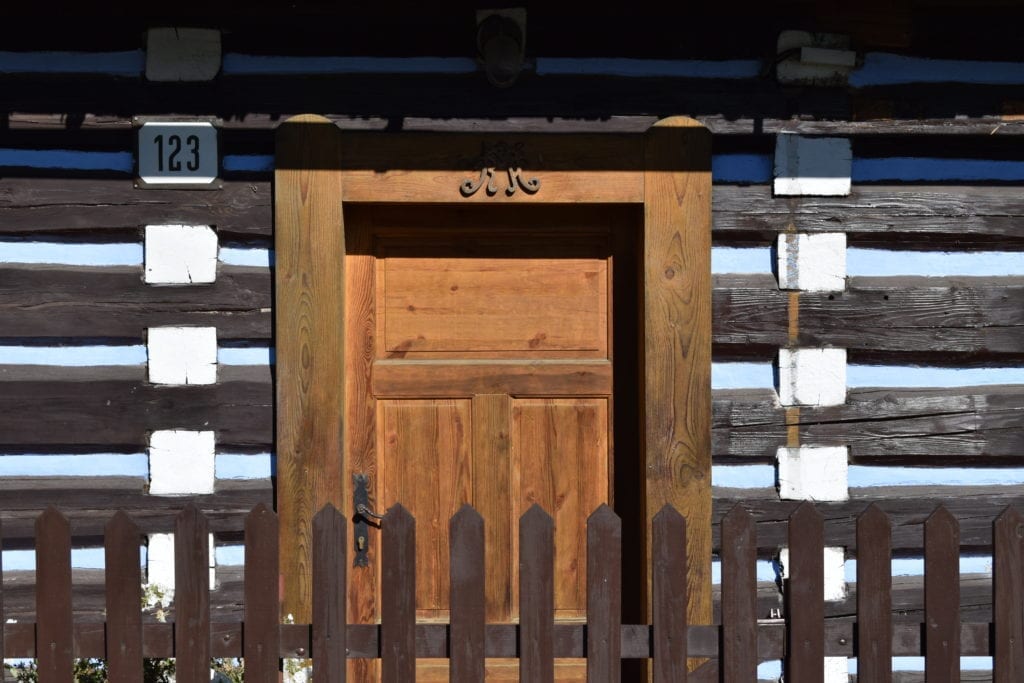
A fascinating enigma, Osturňa’s traditional vernacular architecture is nowadays protected by the Slovak government. The vernacular architecture of the Carpathians draws on environmental and cultural sources to create unique designs.
Vernacular architecture refers to non-professional, folk architecture, including that of the peasants. In the Carpathian Mountains and the surrounding foothills, wood and clay are the primary traditional building materials.
The Zakopane Style of architecture, established at the end of the 19th century, is held as a Goral tradition and is widespread in the Podhale region.
Details vary from locale to locale, but the majority of homes in this area have traditionally been a single-story rectangular plan; one or two rooms; a central chimney; a gable, hipped-gable, or hipped roof; and plastered and limewashed exteriors.
Materials are sourced locally: wood (usually oak), mud, straw, fieldstone, lime, and animal dung. Roofs are typically clad in wooden shakes or shingles, with occasional exceptions of rye straw.
Buildings in Osturna are made ofhorizontal logs notched to hold them together. The simple saddle notch is the easiest and, therefore, most common. Dovetailing is used by more experienced woodworkers.
Most homes are plastered inside and out to prevent moisture, improve insulation, hide construction imperfections, and enhance coziness.
Traditional plaster is made of clay, water, dung, and straw or chaff. Several coats may be applied to create a smooth finish, then lime and water are applied to produce a pleasing white color and protect the clay from rain.
Thatched roofs are traditional but have declined in popularity due to fire hazards. Dirt floors are common, though most houses now have wooden floors. The center of the home is dominated by a traditional clay oven.

157 of Osturna’s wooden structures are recognized as a national treasure by the Slovakian government. In the village, there is also one of the very few Orthodox churches in the area.
Where to stay in Osturňa
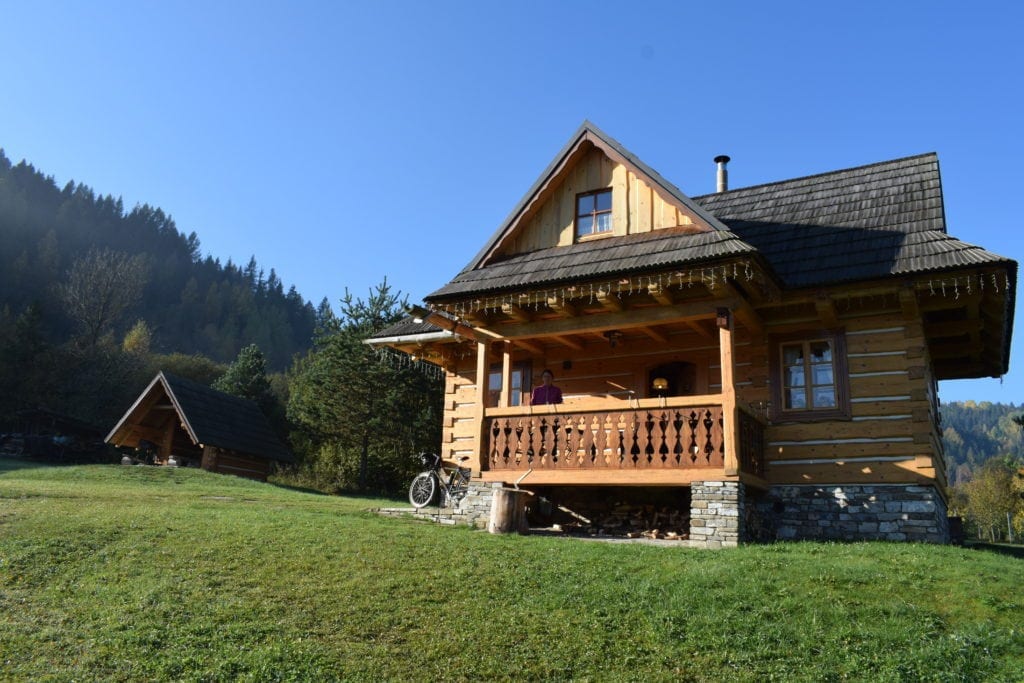
Luckily, there are no big hotels in Osturna; a few cozy and well-blended accommodation options are available. Most are traditional-style vernacular buildings, so you’ll get to admire Osturna’s architecture from the inside.
We stayed at the Goralska Drevenica, a very cozy cottage with 3 rooms, a very nice kitchen/living room, and a beautiful garden with a view.
There are no official campsites in Osturna, but wild camping is tolerated in Slovakia, though, so you might try to get to the forest or ask some locals to pitch your tent on their land.
There is a small supermarket in the village. Keep in mind that the village is very spread out, so it might be a bit far to walk to.
How to get to Osturňa
Getting to Osturna without one’s own means of transport is a serious task. There’s a train station in Vysoké Tatry where trains arrive from Poprad.
From there, there might be a few local buses a day. We saw the stops but never saw the buses, and we haven’t found any info online.
Your best bet is to ask the friendly tourist info office in Vysoké Tatry. If you’re an adventurous spirit, hitchhiking might be the quickest way to get there.
If you have a vehicle, you’ll easily make one memorable road trip out of getting here. The scenery along the road is one of the main reasons to come to Osturňa.
We arrived here by bicycle, coming from theDunajec River gorge, which lies at the border with Poland, very close to the High Tatras. This is really the perfect entry/exit point if you’re cycling to or from Poland.
There’s an unpaved but well-maintained cycling path (which is also a hiking trail), about 20km long, which actually lies mostly on the Polish side.
The gorge has stunning white limestone cliffs and is covered by vegetation that is truly mesmerizing when painted in the autumn colors.
The path ends at the southern tip of Lake Czorsztyn (Jezioro Czorsztynskie), a well-designed man-made reservoir.
From there, there are two ways to get to Osturna: one brings you back to Poland, and the other goes through a Slovakian valley. Both are nice, easy, and short, about 10/12km to get to the Osturna area.
The road goes uphill from here, heading south along a beautiful, solitary road towards the pass at 1,126 msl.
You’ll have the first glimpse of the massive High Tatras before finally watching the Ždiar Pass from above. This is a bit of a sweaty climb, especially at the end, with slopes up to 9%.
Learn more about cycling in Slovakia
What to see in Osturna
Besides strolling the whole length of the village (which will take most of a day), things to do in Osturna are mostly nature-lover activities.
There are several hiking trails accessible on foot, while for those with a means of transport (be it a car, van, motorbike, bicycle, or whatever), the options are endless, and the village could become the perfect base to explore the surroundings.
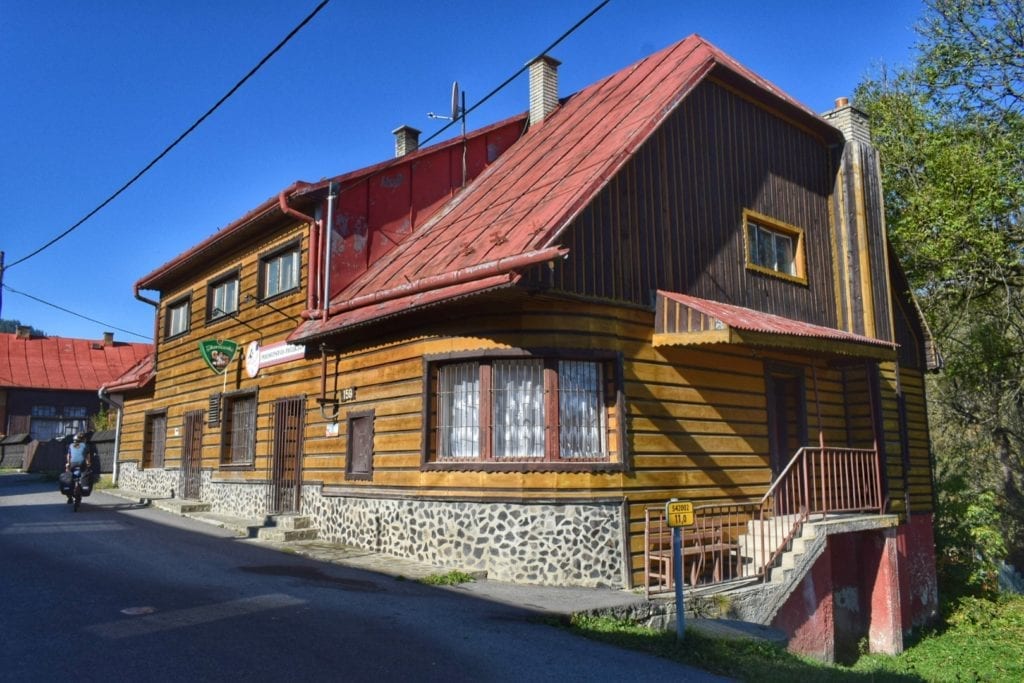
Foraging is for sure a cool thing to do here, in autumn, be ready for lots of mushrooms. Don’t miss a visit to the pub (nº 159, Jan Pavlik, Pri Mlyne). You’ll feel like you’re back in the Soviet 80s.