

Last Updated on 31 January 2026 by Cycloscope
A reportage from the Raw sakè festival in the Japanese Alps, Doburoku matsuri in Shirakawa-go
And so>, finally, we reached Shirakawa-go. With the forced detour we took yesterday because of a landslide, we were afraid we wouldn’t have made it in time. But here we are, perfectly punctual at 8 in the morning.
Disclosure: Some of our articles contain affiliate links. This comes at no additional cost for you and helps us keep this website up and running. (as Amazon Associates we earn commission from qualifying purchases)

A couple of kilometers before the town center, there is the information point facing the Shinto shrine where the festival will take place today.
Shirakawa-go is a very special place, one of the most beautiful villages in the Japanese Alps and perhaps in all of Japan. If you are more interested in the town than in the festival, just jump straight to this article about the village of Shirakawa.
Doburoku Matsuri
“Matsuri” is the Japanese word for festival; it’s mainly used to refer to religious ones, but sometimes even for more profane events. This festival takes place in October, and we arrived on the last day.
These days, people pray to the god of the mountain, offering him the doburoku sakè to ask for a good harvest. Different days, different shrines; today is the day of Lijima Hachiman Shrine.
At 9 am, the religious ceremony begins in the jinja (the Japanese word for Shinto shrine). There isn’t a big crowd right now; this morning’s celebration seems to be a matter for the “insiders”, the actual organizers, performers, and local religious authorities.
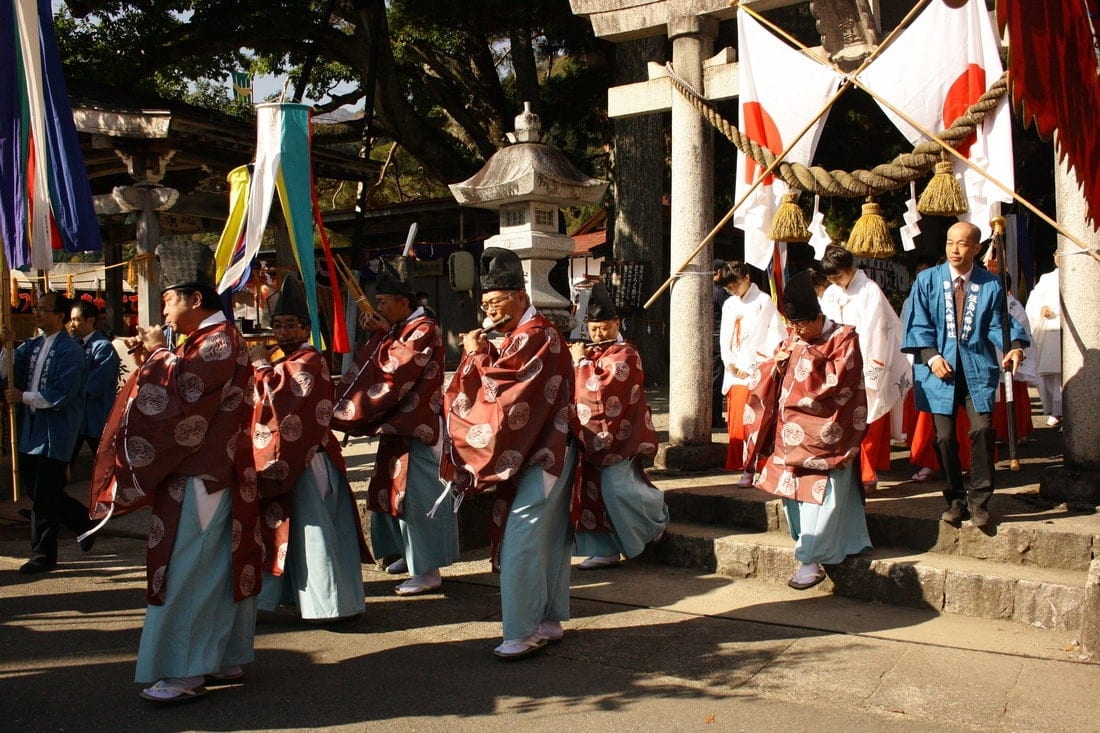
The first doburoku is brought to the altar, and some prayers are said; then it is poured for the people to drink.
But what is the doburoku sakè?
Doburoku sakè
The doburoku saké is a type of rice wine (we do know what we’re talking about when we say sakè, don’t we?). It is rough, not filtered, thick, dense, and white. In Japan, it is forbidden to brew saké at home, but people here have special permission to do so because of this tradition.
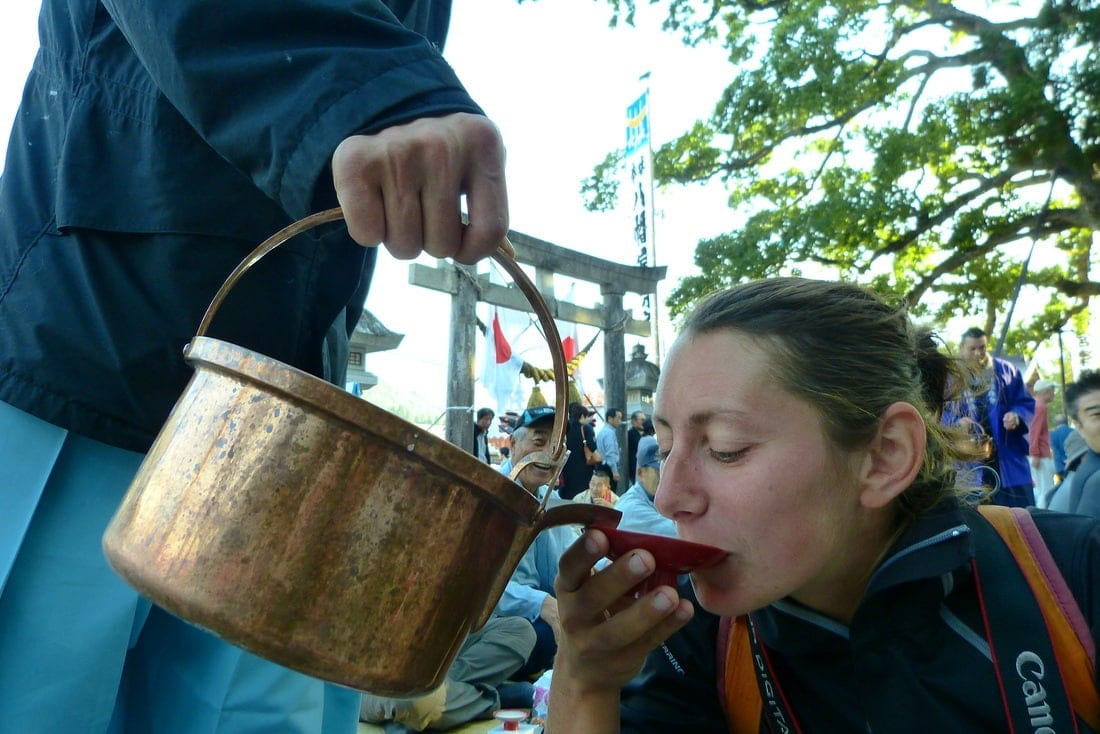
Despite the fact that the morning’s sake is meant for the insiders, as soon as the people become aware of our presence, we are immediately poured some. Sometimes being foreign is comfortable. And the party begins…
Shishimai, the Japanese lion dance
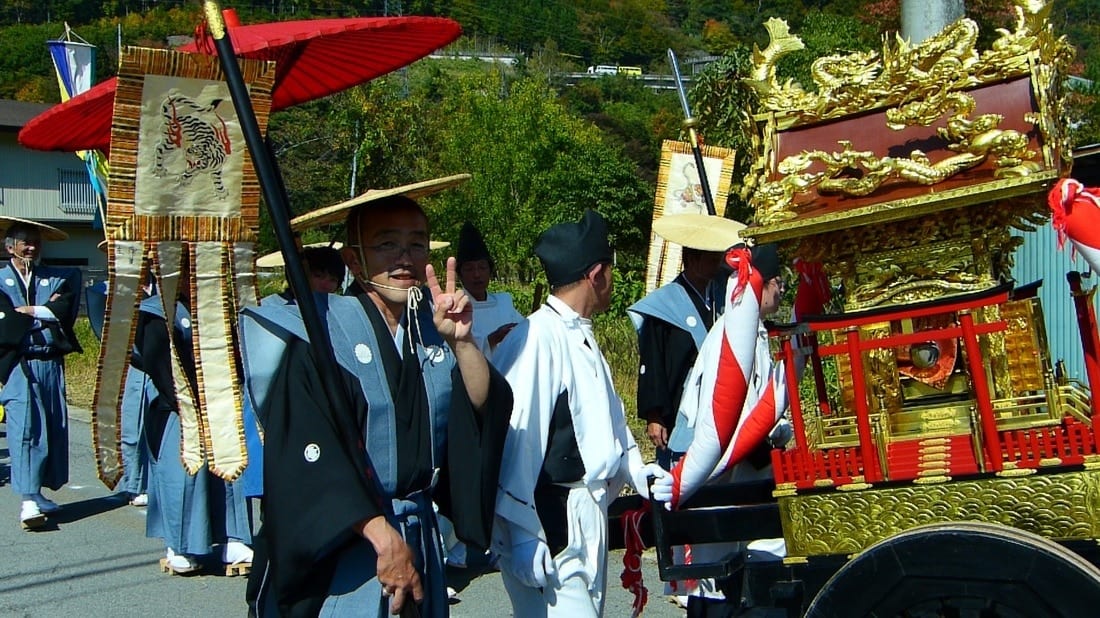
Around 10 am, the mikoshi (portable shrine) is pulled out of the jinja, and the procession starts. Traditionally dressed musicians play a hypnotic pattern of flutes, drums, and mouth organs.
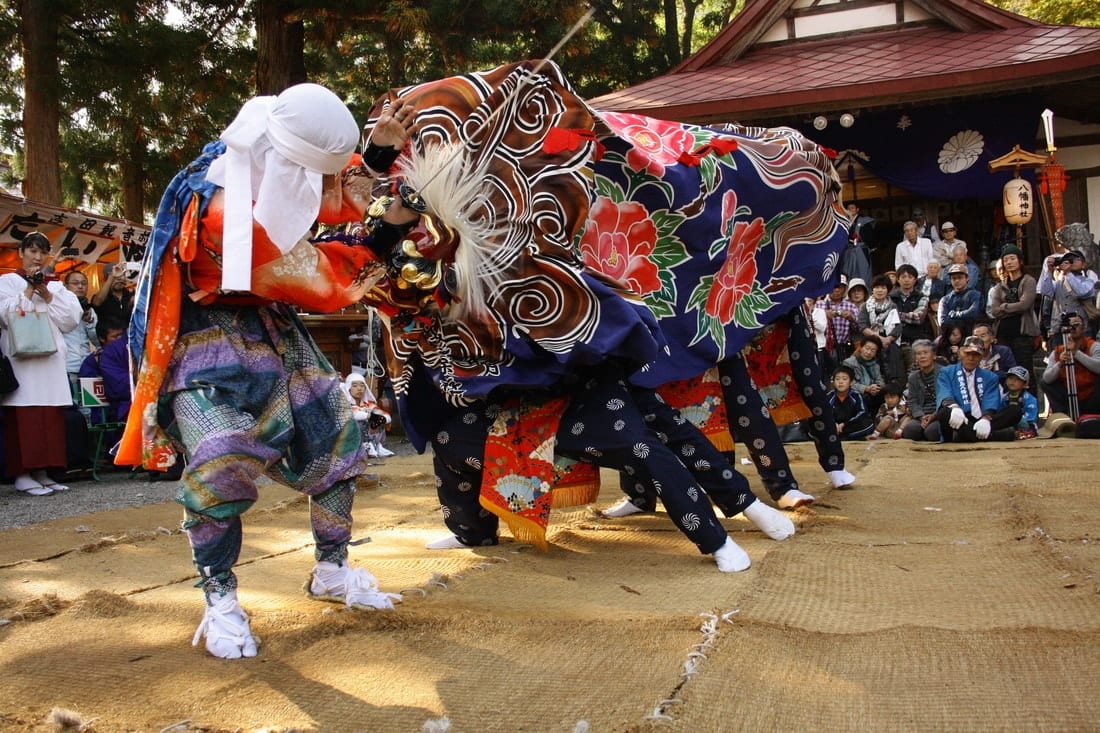
Three young men wear the lion costume. The first stop is in the square of the information point, just across the street. Here starts the lion dance, Shishimai.
Two kids, around 10 years old, I guess, fight the lion with various weapons. Their movements are swift and fluid, a show of very good skills for such young kids.
The dance seems to have been imported from China during the Tang Dynasty and was associated with the celebration of the Buddha’s birthday. The style varies from region to region. Apparently, there are up to 9000 variants.
From the Buddhist rites, the dance was borrowed to Shinto ceremonies, as here, and it’s also performed to celebrate the coming of the new year.
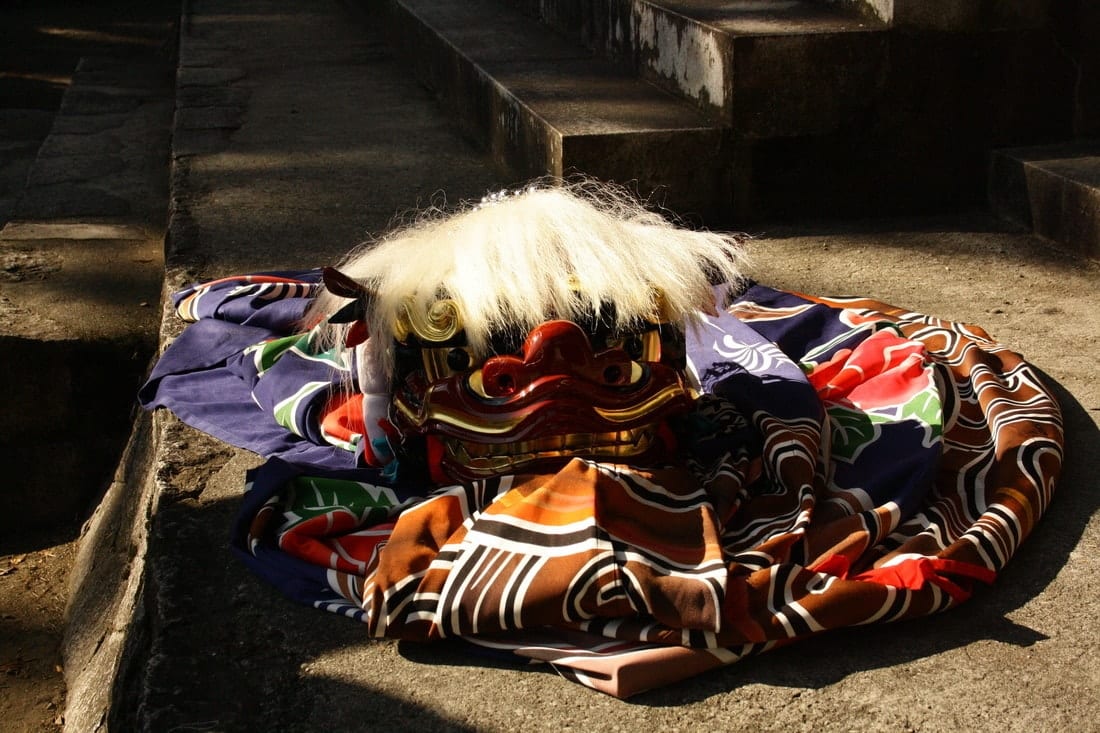
The wooden mask of the lion is called Shishi-gashira and is handled by a man who plays the lion’s head. The other two men behind him are the lion’s body; all are under a colorful cloth.
Meanwhile, a guy with a banana face, who looks like he’s coming straight from an 80’s anime, keeps on bringing us beer and sake.
The procession slips through the narrow alleys of the town’s outskirts, stopping a few times to redo the dance, first in front of another shrine and then in front of someone’s house. And banana face sticks to his mission to make us drunk. It is 11 am, and indeed, we are already sloshed.
Luckily, there is a two-hour lunch break, and we stuff some 7-Eleven shit into our stomachs, hoping to make it through the rest of the day. Back at the jinja, we witness the main ceremony of donating doburoku to the mountain god, and then all the spectators are pushed to sit on a long carpet.
The crowd is bigger now, but it’s still a small festival, mainly locals and people from nearby villages. Needless to say, we are the only foreigners, as usual.
Now,;the thing works like this: you pay 400 yen to buy a flat cup, and then you can drink as much sake as you want, or even more. We sit down, and some ladies go to serve the sake without a hitch. When they see an empty cup, they run to fill it.
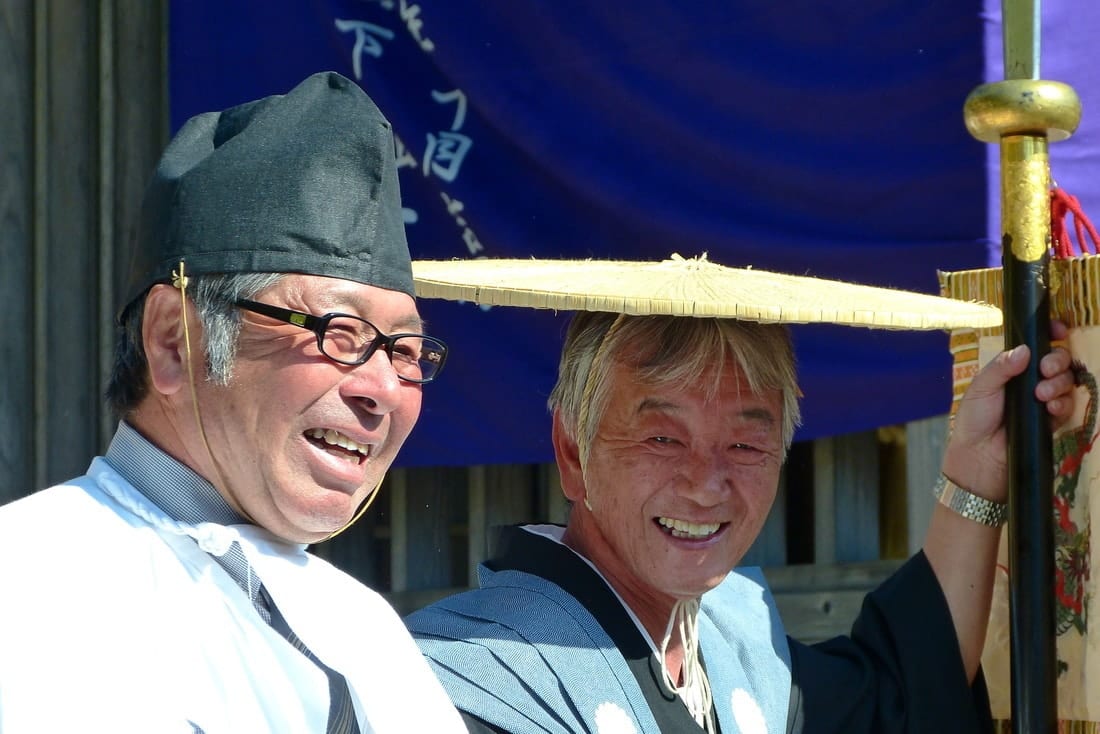
We meet Toru, a mechanic who used to live in Vancouver, and we chat. We are always interrupted by people who want to take pictures with us.
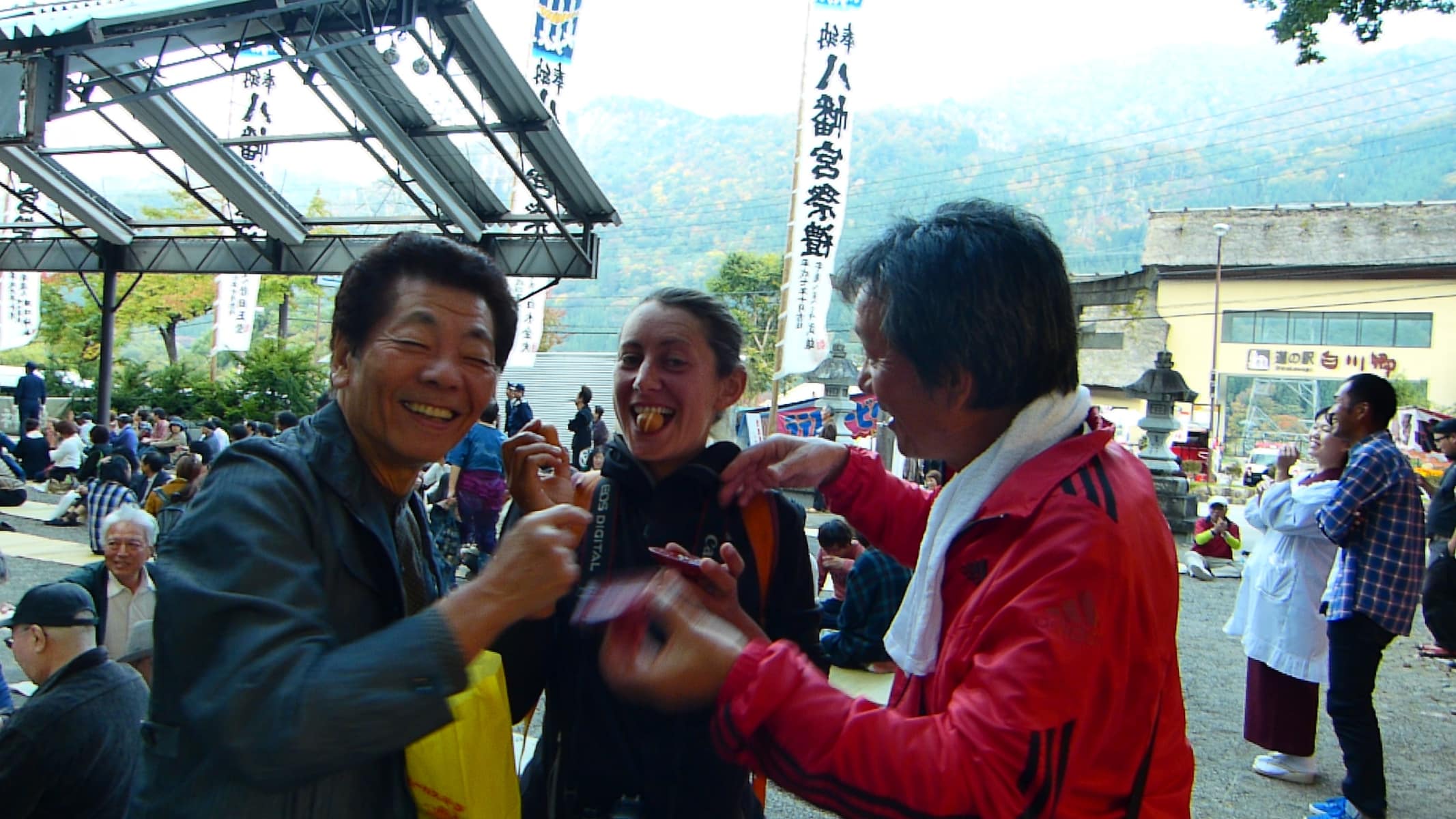
To give us a better welcome, they make us drink more than everybody else, in a way that, according to them, is “Japanese style”. You drink from the saucer (the flat cup) while a lady keeps on pouring sakè into it, non-stop.
On stage, there are singers and peasant dances, but nobody seems to care; everybody is too focused on drinking. The drunk Japanese do such things that they would never do when sober. A guy even hugs us! We’re offered some very nice sashimi, and everything seriously begins to blur.
Fortunately, there is a two-hour break before the evening ceremony, so we make use of that by napping on the information center’s benches. Before the sun sets, we set up our tent in a meadow back there. We meet another traveler then, Koji from Chiba, who is here by car and will sleep here too.
Because hotel prices are so high across Japan, many people sleep in their cars when traveling, not just the young and adventurous, but also families and older couples.
Indeed, the parking lot is full of people sleeping in their cars. That’s why we see so many abandoned hotels everywhere in Japan.
We go with Koji to see the lion dance in the evening, the long version this time. They perform on a big jute rug, and both dancers and musicians are visibly exhausted.
The kids keep on fighting the lion, adding new moves and techniques to the previously used ones, they may be slightly less tired than the older performers but sweat is clearly visible on their temples. This time, the dance lasts more than one hour.
At some point, some guys in funny costumes parody the dance, and the performers finally take a real breath (but not the musicians).
After the dance, there are some performances on stage by the villagers, between unlikely karaoke tunes and weird dances from some anime’s signature songs. Very fun, the nice atmosphere of a true village festival
Check also
We came to Shirakawa-Go as part of the Japanese three-month leg of our two-year Asian bicycle trip.
- For hints and trips about traveling in Japan on a very tight budget (less than 10 USD per day) read our guide here.
- To have a panoramic view of our Japanese bicycle touring project, check our itinerary in this other article.
- For Japanese destinations not covered by us, check this very comprehensive guide for Japan
Please comment, like, and share on social networks if you like!
Follow us