

Last Updated on 27 January 2026 by Cycloscope
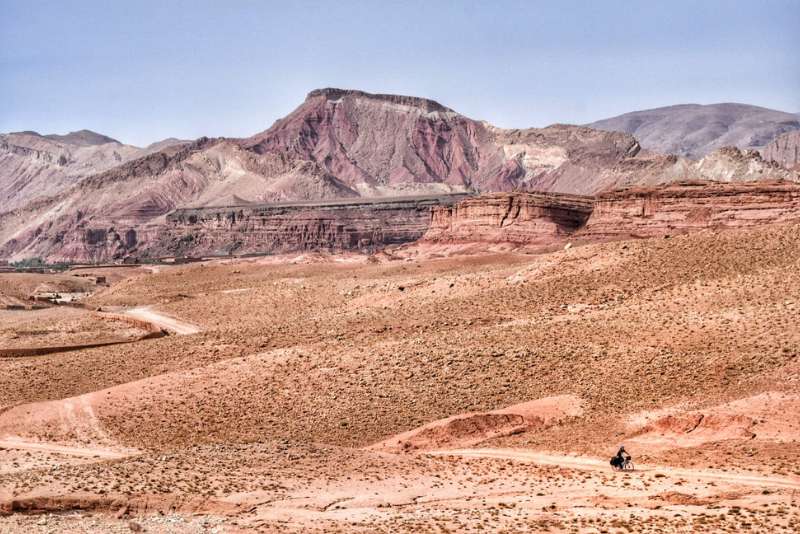
Cycling Morocco. A bikepacking and cycle touring guide to adventure travel Morocco on a bike
Itineraries, Atlas, Atlantic coast, Mediterranean Coast – A Moroccan bike trip
Are you thinking about cycle touring Morocco? Want to find out the best bikepacking itineraries and all the tips to make your bike trip an unforgettable adventure? Look no further, here’s our ultimate guide to biking in Morocco.
Disclosure: Some of our articles contain affiliate links. This comes at no additional cost for you and helps us keep this website up and running. (as Amazon Associates we earn commission from qualifying purchases)
After nearly two years of pause from cycle touring, we were itching for a bikepacking adventure, we didn’t want to leave Africa yet but we also needed a change of vibe, so cycling Morocco was the perfect compromise and a choice we’ll never regret.
Morocco is a gorgeous country, very diverse and full of natural and cultural attractions. The Atlantic coast with its waves and cliffs, the Mediterranean with its secluded coves, the High Atlas with its wild peaks, the Anti Atlas with its alien landscapes… and then the desert, the imperial cities, the hills covered in olive and argan trees…
There’s so much to see and do that you could come cycle touring Morocco every year and always find new routes and bikepacking itineraries.
Cycling in Morocco though, requires a minimum level of fitness, the country is very hilly almost everywhere and the heat can be disheartening even in the middle of winter.
In this long blog article, you’ll find our Moroccan biking itinerary and a few variations of it, plus all the hints and tips you might need to prepare for your bike trip in Morocco.
Keep reading and let us know about your Morocco cycling adventure in the comment section!
Bikepacking / Cycle Touring Itineraries in Morocco
Our bikepacking itinerary in Morocco was a month-long, about 1800km, with a total elevation gain of 27,950 m – beginning in Essaouira and finishing in Ceuta (that little portion of Spain in Africa).
It touches both Moroccan coasts (Mediterranean and Atlantic) and crosses the Atlas three times, starting with the easiest crossing and finishing with the hardest. It touches three of the four imperial cities, cuts through the off-the-beaten-path countryside of the north, and the desert plateau between the two Atlas chains.
Spectacular cliffs, ancient cob architecture, monumental mountains, intricate mosaics, desert life, majestic beaches, forests of olive trees, and the laidback lifestyle of Moroccan people; these are just a few of the marvels you’ll cycle through with this cycle touring itinerary.
If you’re cycling from Spain towards West Africa, you could easily follow this route in the opposite direction, ending up in Essaouira and then proceeding further south towards Western Sahara and Mauritania.
Although this route sticks mostly to tarmac roads, with only about 20% dirt, it’s still quite challenging and definitely not suited for a beginners’ bikepacking trip.
Of course, you’re welcome to use only portions of this route for a shorter bike trip, or take it as a blueprint to plot your own bikepacking route in Morocco – we welcome alternative GPX tracks in the comments, let’s build community!
Check Also
> Cycling Andalucia and the Spanish Southern Coast
> Bike Touring Northern Spain – Miranda to Miño
> Bikepacking Pyrenees Coast to Coast – Bikepacking w. P. Baumeister
Bikepacking Morocco route highlights [Map of our route]
- Essouira
- Imsouane
- Tizi’n Test
- Tinmel
- Marrakesh
- Tighedouine
- Tizi’n Tichka
- Telouet
- Ait Benhaddou
- Skoura
- Valley of Roses
- Dades Gorge
- Msemrir
- Lac d’Isil
- Sidi Yahya Ou Saad
- Khenifra
- Meknes
- Fez
- Chefchouane
- Mediterranean Coast
Chapter 1 – The Atlantic Coast of Morocco: From Essaouira to Agadir
200km / 85% gravel / 2900m elevation gain
(Day 1 to Day 4 on the route map)
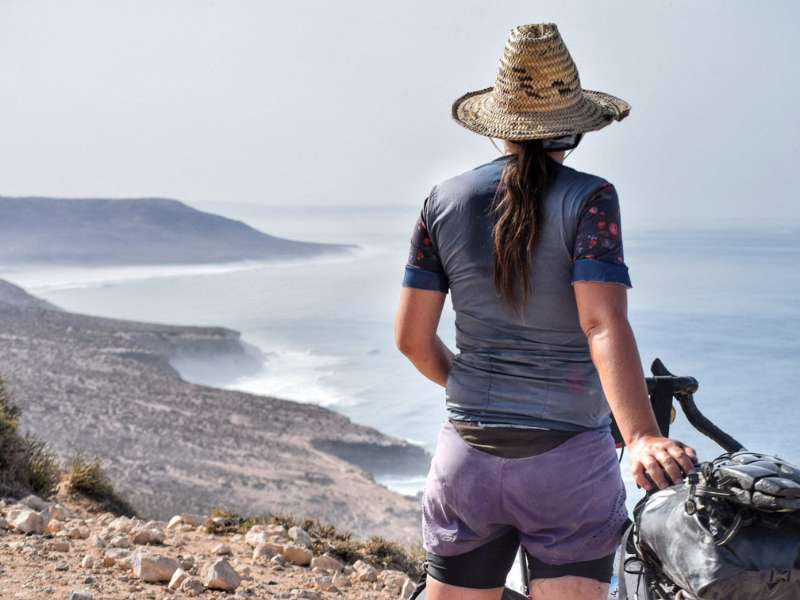
This seemingly short stretch of the Atlantic Coast features some of Morocco’s best oceanic landscapes.
Most of the 730+ km-long coastline from Tangier to Essaouira is flat, highly urbanized, and, unfortunately, a bit dirty. Although cities like Casablanca and El Jadida are pretty cool, we recommend starting your bikepacking journey in Essaouira.
Scenic cliffs and secluded beaches battered by waves straight out of a surfer’s dream, vibey fishermen’s towns, and sleepy farmers’ villages, this 200km route is one of the highlights of our bike trip in Morocco.
The surfaces are 85% dirt, with some very rocky sections, so it’s better to have wide tires to tackle this. This road can be quite a challenge: lots of steep ups and downs on uneven surfaces, and with the heat of the coast.
Camping in this area is very easy, while accommodation is available in Tafedna, Imsouane, Taghazout, and, of course, Essaouira and Agadir.
Chapter 2 – The First Atlas Crossing: From Agadir to Marrakesh via Tizi’n Test
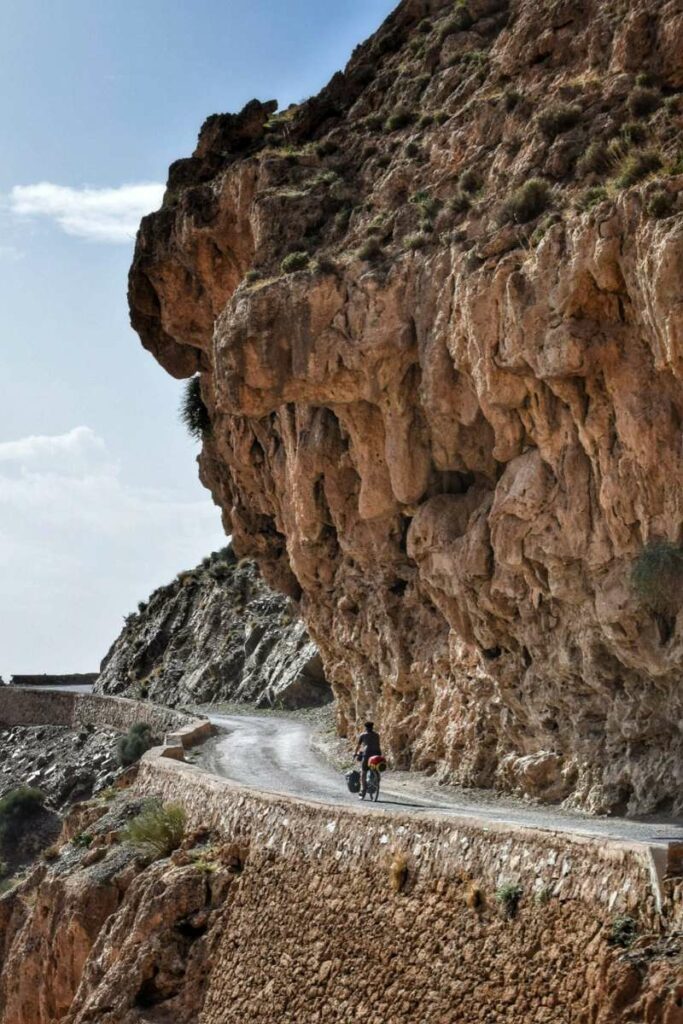
386km / 90% tarmac / 5740m elevation gain
(Day 5 to Day 12 on the route map)
Starting from Agadir, you have two options: staying on one of the three main roads towards Taroudant or climbing some hills to Azrarag (or even a detour to Paradise Valley, if in wet seasons).
The main roads are flat and quite dull, so the hill seems a more interesting option, but you’ll climb quite a lot in Morocco, so you might consider skipping this. A bus to Taroudant is also an option if you want to save a couple of days.
Taroudant itself is a lovely walled city worth a stop. The last commercial settlement before the climb up the 2,093 meters of the Tizi ‘n Test is Oulad Berhil, where you can stock up on some food for the climb, although that’s not really necessary.
Cycling up Tizi’n Test starts with a somewhat mild slope but quickly turns into a steep but spectacular climb (850m in 20km, a 5% average). Past halfway through the pass, you’ll meet several small restaurants, most of which also offer cheap accommodation or basic camping opportunities.
We slept at Le Belle Vue, close to the top – tasty Tajin, fantastic breakfast, and super friendly staff – great value for money; but I think all of the auberges up there have similar characteristics.
Getting down from the pass is even more jaw-dropping: a long descent among earthen kasbahs and rural villages, finally meeting a river with some water and greener landscapes – a great bike touring day.
72km from Tizi’n Test top is the town of Ouirgane, with its beautiful reservoir, which unfortunately was almost dried up due to the 3-year-long (as at the end of 2022) drought in the region.
Past there is the busy town of Asn, where you can have a glimpse of Morocco’s highest peak, the Toubkal. If you want to climb the Toubkal, you can detour only about 20km to the town of Imlil, where you can arrange a mandatory guide.
Proceeding towards Marrakesh, there’s a last beautiful landscape to pass, the Gorges of Tahanout. From there to Marrakesh is flat and relatively uninteresting.
Cycling in Marrakesh
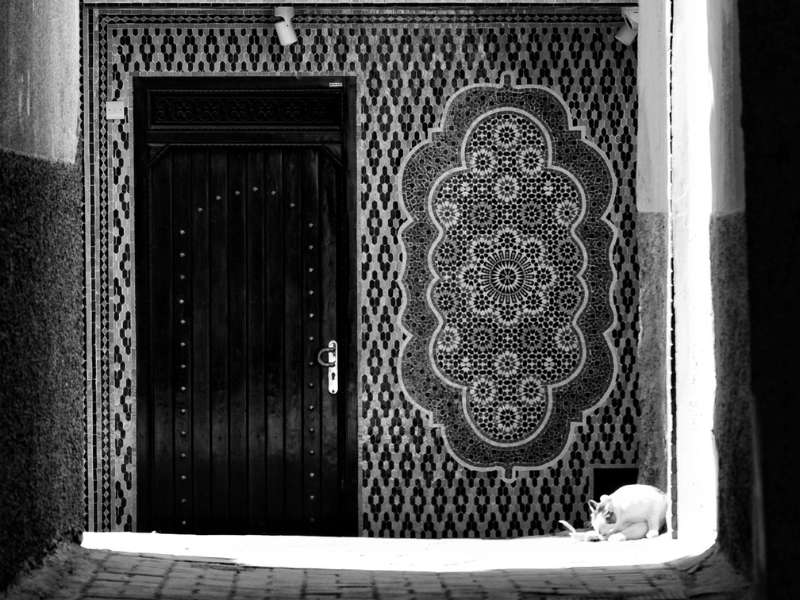
Marrakesh is undoubtedly an iconic city worth visiting at least once in your lifetime. Having been forced to spend 5 days here by my toothache, we had the chance to see it thoroughly, and in our humble opinion, two days are more than enough to enjoy the city.
Marrakesh is one of the most chaotic places I’ve ever seen, and that’s undoubtedly what fascinates me about it, but it gets tiring quite quickly.
Cycling there, though, is not as bad as it might seem, just be sure to avoid the flocks as you’ll get stuck in the walking crowds of tourists – staying at the edge of the medina is the best choice.
Chapter 3 – The 2nd Atlas Crossing: From Marrakesh to Ouarzazate via Tizi’n Tichka
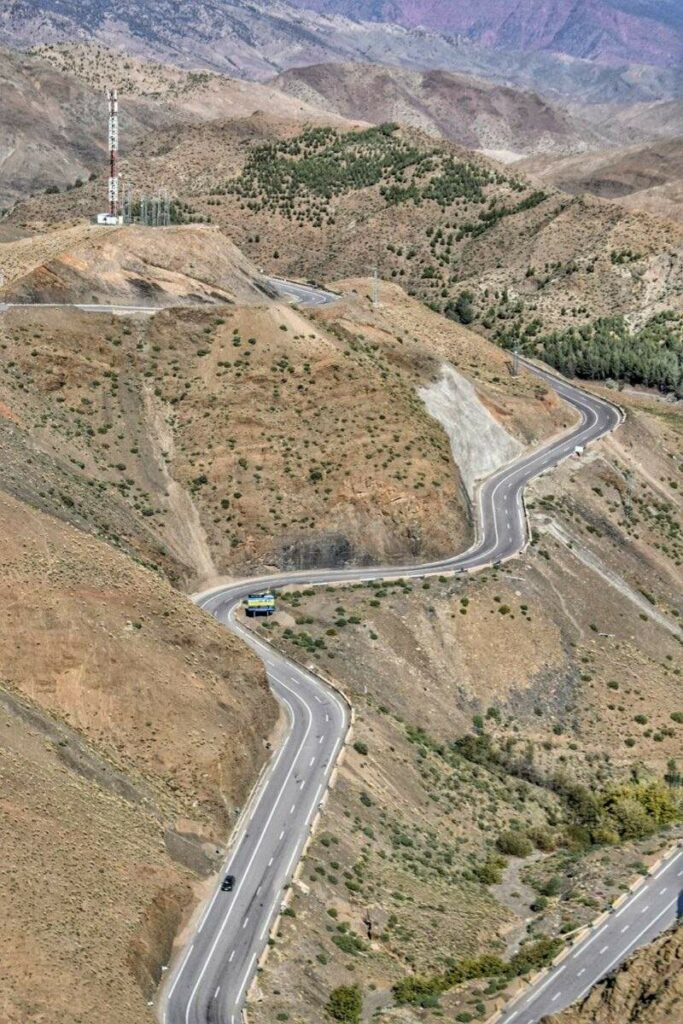
200km / 85% tarmac / 3150m elevation gain
(Day 13 to Day 16 on the route map)
Leaving Marrakesh, you’ll have a flat and smooth road up to Ait Ourir, from where you’ll leave the busy main highway to get towards Tighdouine. A gorgeous countryside path is mostly tarred except for a short but rocky 12km dirt section that will lead you back to the main road halfway up the pass.
The road up the Tizi’N Tichka pass is not the most beautiful you’ll ride. A large and relatively busy highway that’s the primary connection between Marrakesh and Ouarzazate, this road is literally cut through the mountains. Near the top, though, the view of the numerous switchbacks is quite rewarding; you know that feeling of “wow, did I really cycle up this?!”
Camping is possible behind some of these cutout rocks, but it’s not the safest nor the most spectacular of the camping spots. As temperatures can get quite chilly in winter up here, and wind is not a joke, you should know that the last available accommodation before the pass is the Gite Associative de Taddart – cheap, friendly, and equipped with the best hot shower in Morocco.
After reaching the pass, our route turns left on the road to Telouet and Ait Ben Addou – a gorgeous bike ride. Starting with colorful mountains intertwined with green pine forests you’ll easily reach Telouet, a small village famous for its incredibly rich Kasbah, very few people visit it but we highly recommend a stop, accommodation options are plenty in town.
After Telouet, the itinerary goes through a seamless series of traditional earthen villages and old Kasbahs, starting with Anmiter, which might even be a better choice for spending the night than Telouet.
From Anmiter to Ait Ben Addou, you’ll bikepack along a river winding down a fantastic canyon that gets deeper and deeper as you go – I stopped to take pictures at least one hundred times along this section.
Ait Benhaddou is the most famous Kasbah in Morocco, having served as a filming location for many masterpieces, including Lawrence of Arabia and Game of Thrones. It’s an imposing cob construction, but a bit too touristic for my taste. If you had the chance to visit other, less famous kasbahs along this cycle touring route, you might as well skip it.
The last section to Ouarzazate is relatively easy (just a few little hills) and mostly featureless.
Chapter 4 – The Desert and the Valley of Roses: From Ouarzazate to Msemrir
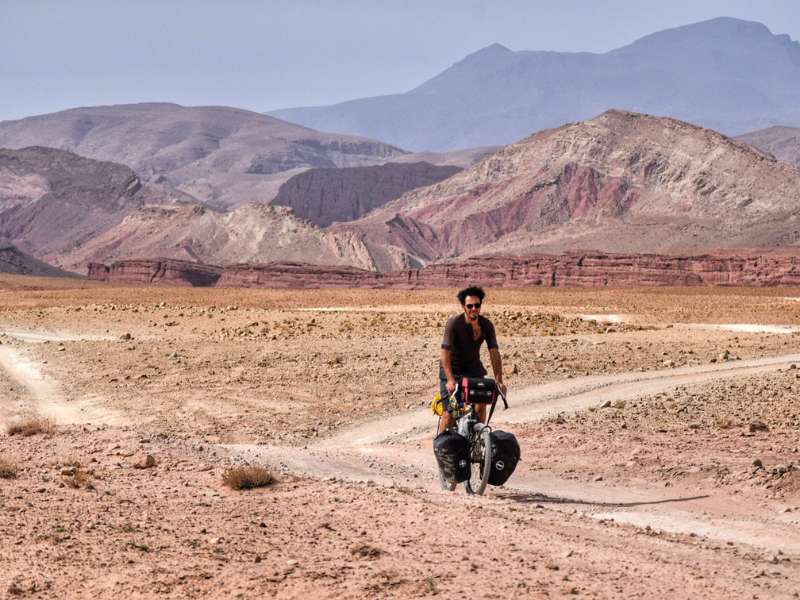
193km / 85% tarmac / 2560m elevation gain
(Day 16 to Day 20 on the route map)
The mostly flat N10 rolls eastwards from Ouarzazate through a lunar landscape made even more surreal by the light beam cast on the north horizon by the world’s biggest concentrated solar power plant (CSP) – it reminded us of some parts of Namibia.
The city of Ouarzazate was not particularly special to our taste, while Skoura is much more interesting: a green oasis complete with date palms and majestic mud architecture in the middle of a bare desert.
After reaching Kalaat M’Gouna, our cycle touring itinerary in Morocco turns north to the Valley of Roses.
This road is a little overdeveloped at first, with plenty of hotels and well-established settlements, but it soon winds through one of the most unbelievable landscapes we’ve ever seen.
Bright red, rugged mountains shaped by the elements over millions of years, and some unbelievable rock formations that we’ll never forget.
At the village of Bou Tharar, the route leaves the tar and goes through a plateau and a valley that made us feel like we were literally in the middle of nowhere – what a memorable ride!
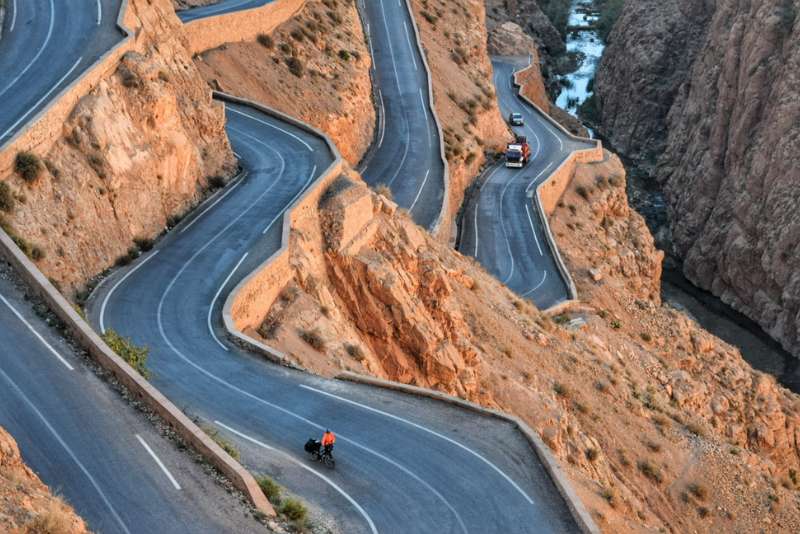
Reconnecting with the R704, the landscape changes but remains dreamlike: first, you’ll pass through the narrow Dades Gorge, then climb a series of narrow, iconic switchbacks.
From here, the road starts climbing, with steeper gradients, amid beautiful mountains sculpted by the wind, before reaching the village of M’semrir.
Along this whole route, there are loads of accommodation options (except between Ouarzazate and M’semrir). Wild camping is possible, but with the usual caution (read the paragraph dedicated to wild camping).
Chapter 5 – The highest Atlas crossing: From Msemrir to Khenifra
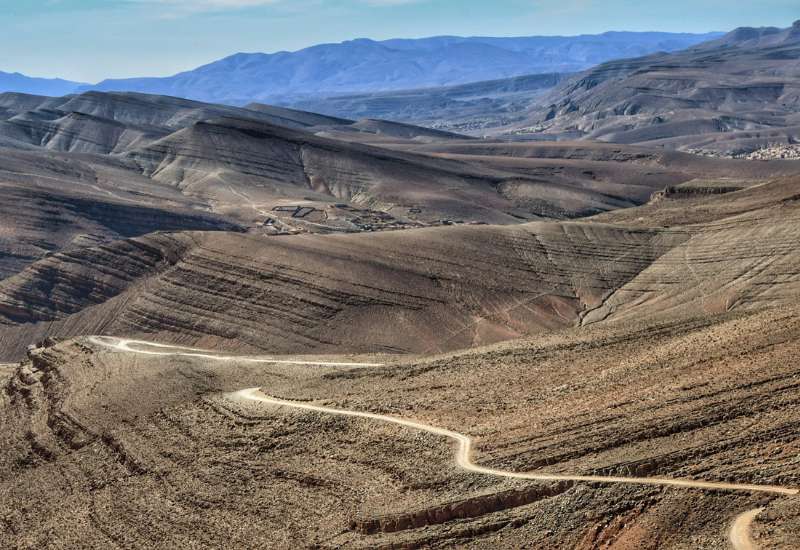
230km / 85% tarmac / 4530m elevation gain
(Day 21 to Day 25 on the route map)
We are now familiar with the Atlas and ready to tackle the highest pass on our itinerary, at 2800+m.
Starting from M’semrir, we cross some of the highest villages in Morocco, above 2000 msl. The road is almost flat for about 25km, then it enters a small gorge and turns into a dirt track, where the pass starts. Right here is the last accommodation option, we recommend tackling the pass in the morning as it can take several hours to reach the top.
The pass is at its worst at the beginning, with very steep, rocky slopes and quite annoying resident kids. As a quick note, this is the only area of Morocco where we felt less safe, people around here are more rude and I recommend more caution, especially for female bikepackers.
After the first switchbacks, the road flattens out a little, and the surface improves; it’s still challenging and likely to get quite windy – I had a tailwind for once, yay!
The landscape along this pass is pretty and wild, but honestly not as unmissable as other places.
At the top, the road is tarred again, and I’ll bet they’ll probably also pave the pass within a couple of years if not earlier. Down, and then a little hill, and then down again to the village of Agoudal – with more accommodation and more annoying kids.
From Agoudal to Inilchil is a short and almost flat ride, but wind and cold can make it challenging. Lac D’Tislit is small but pretty and a great camping spot.
Another short hill and we enter a new valley and a completely different landscape through a very steep and spectacular descent – from now on it’s scattered pine trees and rare settlements, no accommodation but loads of wild camping opportunities.
The first lodge is Mourik Farm, right before the turn to Aghbala – cheap and really recommended.
Aghbala is a steep and ugly village with nothing to offer but a few grocery stores. A little more climbing before reaching the plateau, quite lovely and pleasant to ride.
Getting down from the plateau is spectacular and great fun until you reach the main road to Khenifra (N8), which is quite busy.
Chapter 6 – The Imperial Cities: From Khenifra, through Meknes, to Fez (or maybe not?)
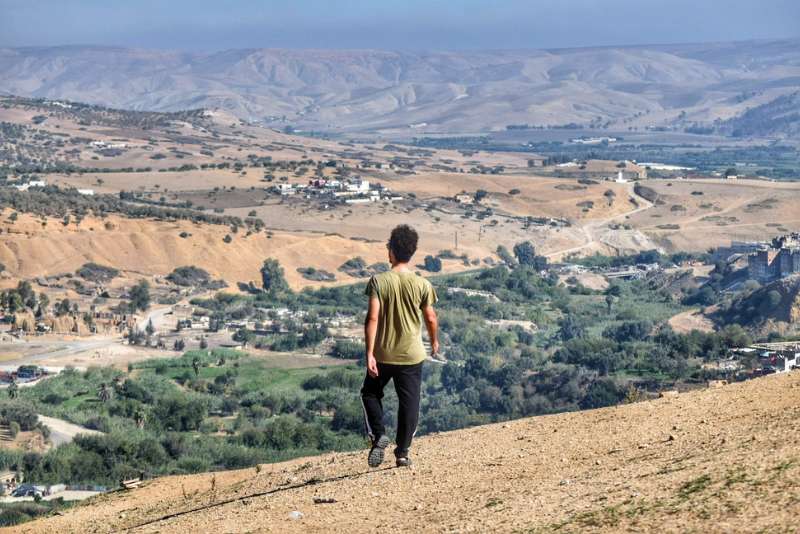
220km / 90% tarmac / 3000m elevation gain
(Day 25 to Day 30 on the route map)
You might think you’re out of the Atlas now, that you’ll be done with mountains… but Morocco still has some challenges for you.
The whole of northern/central Morocco is very hilly and sparsely populated, with loads of ups and downs, pine forests, and giant olive and argan plantations.
From Khenifra, our bikepacking itinerary takes the most obvious road, north towards M’Rit. Beautiful views on a rolling road winding through dense pine forests, up again above 1000msl with some more lunar mountainous landscapes – less busy than I expected.
The Zaouia d’Ifrane is in a valley that’s totally worth visiting. Head here if you’re looking for some more off-road cycle touring and don’t mind steep gradients and loads of elevation gain and loss.
Otherwise, please stick to the main road to Meknes, which is our favourite city in Morocco. As the smallest of the four Moroccan imperial cities, Meknes is the perfect place to soak up the atmosphere of an authentic Moroccan medina, without too much tourism spoiling the experience.
From Meknes, we went to Fez, which is the only place in Morocco we didn’t like. The second-largest city in Morocco is rife with scammers because it attracts tourists. Several people fucked us off for no reason in the medina – overall, we would suggest avoiding it.
Chapter 7 – To Chefchouane and the Mediterranean Coast: From Fez (or Meknes) to Ceuta
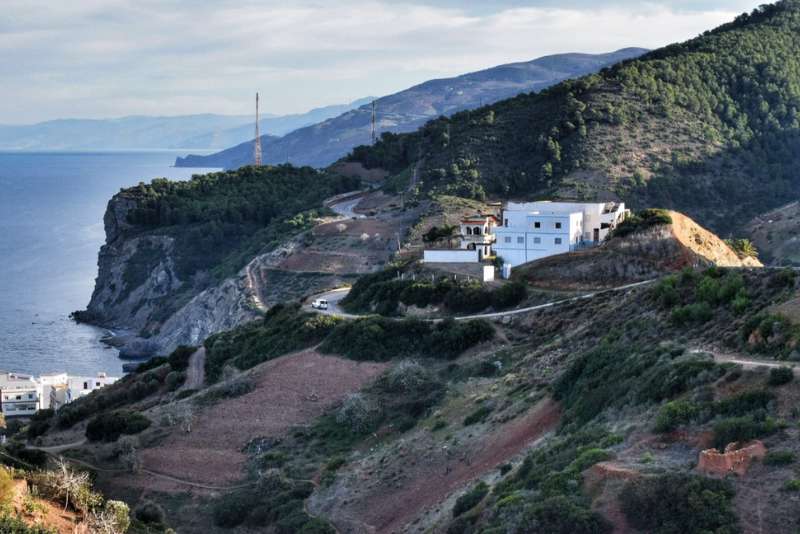
335km / 100% tarmac / 6800m elevation gain
(Day 31 to Day 37 on the route map)
The central areas of northern Morocco are really out of the tourism industry, but that doesn’t make them less interesting, actually quite the contrary.
Rolling hills full of olive trees, laid-back country life, constant ups and downs with stunning views… with only one downside: very few accommodation options all the way from Fez to Chefchouane.
From Fez or Meknes, there are several similar roads north toward Chefchouane, all of which pass through Ouezzane, the only place with accommodation I could find in this area. Interesting detours would be Moulay Boucht from Fez – with its ancient fortress – or Moulay Idriss Zerhoun, with the Roman ruins just 20km north of Meknes.
All of these roads are relatively pleasant to ride, although not as spectacular as others; all have lots of hills. From Ouezzane to Chefchoune, the landscape is gorgeous again, much greener than in the south.
Chefchoune, also known as the Blue City, is very touristy, but it’s got a cool vibe and is definitely pretty. The mountainous, lush surroundings offer nice hiking opportunities around Jebel El-Kelaa.
From the blue city, we absolutely recommend spending the last (or first) days of your Moroccan bike trip on the Mediterranean coast. Two equally beautiful roads lead to Oued Laou, passing by the umpteenth incredible canyon.
The Mediterranean coast can be busy in summer and the middle seasons, but it’s very quiet in winter. Ups and downs between scenic cliffs and grey-sand beaches, with a few towns in between before arriving at the beautiful city of Tetouan, which is worth a stop to explore its medina.
From Tetouan, it’s a short urban ride to Ceuta, where you’ll cross the border into Spain and take a ferry to Europe.
More ferry connections are available from the Tanger Med port, which is also nearby – about 40km east of the city of Tangier.
Best season for Bikepacking Morocco
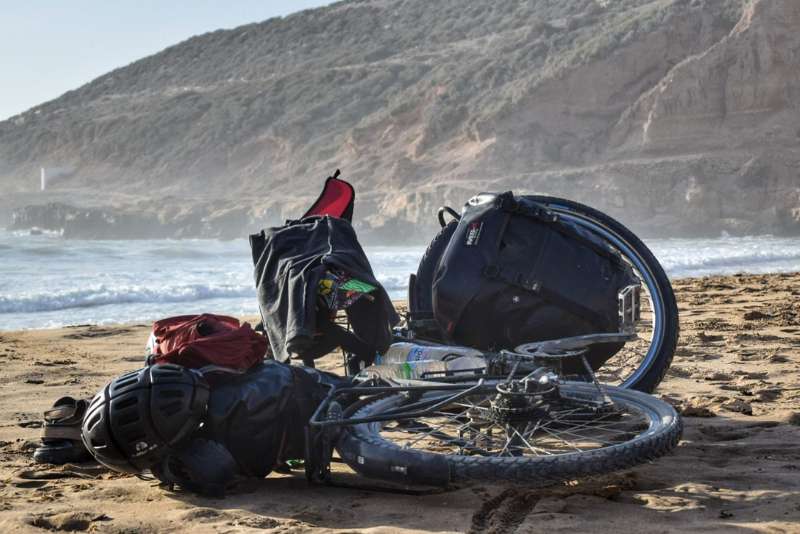
Morocco is extremely hot in the summer months. In June, July, August, and even September, temperatures can easily get above 40 °C (104 °F), especially in the desert and along the coast. Therefore, cycling in Morocco in the summer is not advisable.
Winter, on the other hand, is relatively mild at low elevations but can get cold in the Atlas Mountains, with strong winds and snow. If you’re well-equipped for cold weather and/or plan on staying primarily in the lowlands, maybe cross the Atlas only once. Then even December, January, and February are viable months for a bikepacking trip in Morocco.
But the best times of the year to bike in Morocco are definitely spring and autumn. In Spring, from late March to late May, the flower season is in full blossom, turning the landscapes into colorful impressionist paintings.
Autumn is also great, our bike adventure in Morocco started in late October and ended in early December. On the coast and lowlands, the temperatures were perfect, even a bit too warm sometimes, while the Atlas was chill at high altitudes, but overall, it was easily doable with the right gear.
Morocco is an arid country; except in the north, rain is quite rare. The wet season should be from October to April, but we didn’t see a single drop of rain, only clear blue skies.
What to Bring for a Bike Trip in Morocco
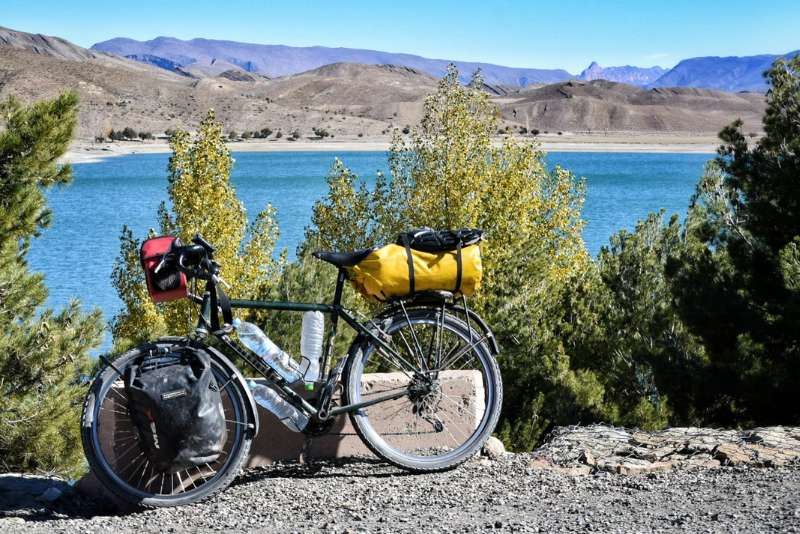
If you’re going to follow our advice and cycle Morocco in autumn, spring, or winter – and you want to include the High Atlas in your trip (you should) – then you should expect wide temperature excursions during your trip.
While you’ll most likely be in your summer cycling attire when along the coast, possibly even in the middle of winter, on the Atlas, you can easily find yourself coping with below 5C (41F).
So, pack some mild winter gear, especially a warm sleeping bag, since temperatures drop overnight.
If you want a complete packing list, have a look at our Bikepacking Gear List article and/or our Essential Gear for Cycle Touring.
If you don’t wanna click further, add to your standard kit:
- Leg warmers
- A good cycling jacket
- Merino base layer: 1 sleeveless 1 long-sleeved
- Wool hat
- Warm socks
- Neck warmer
What is the budget for a bikepacking trip in Morocco?
As we mention in all our cycle touring guides, the budget for a bikepacking trip varies greatly depending on the cyclist’s needs, wants, and availability.
If you’re planning for a totally self-supported bikepacking trip in Morocco – wild camping and cooking – then you could easily make it with a budget of less than 10$ per day, which will be spent on groceries and teas/coffees for your breaks. If you don’t care about hot drinks, even 5$ per day would do.
If you want to have a roof above your head every night, and a cooked meal per day, a realistic budget would be $30/35$ x day.
Our trip was a mix of the two options, we camped and cooked, but also slept in auberges and dined out often, on a budget of $20/25$ per day per person, we had a relatively luxurious experience.
Is it allowed to do wild camping in Morocco?
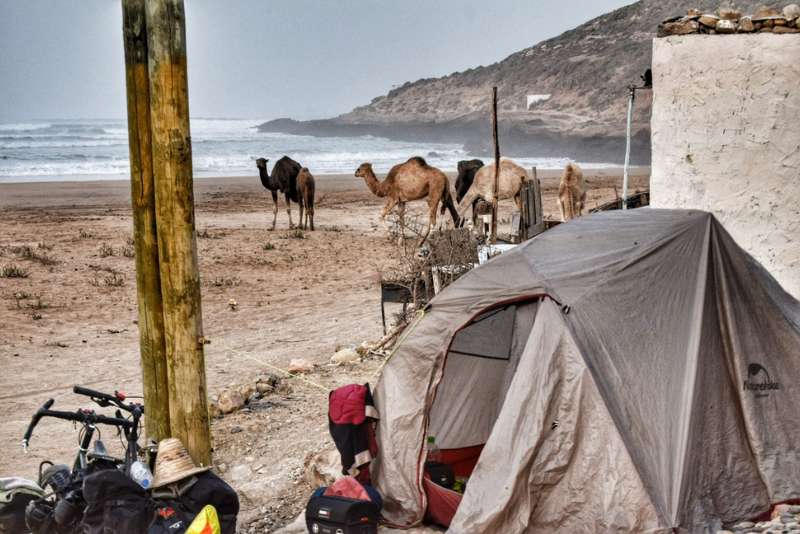
Wild camping is quite tricky in Morocco. Once widely tolerated, after the isolated but terrible episode of the murder of two Scandinavian tourists in 2018, the government has taken a strong stance against wild camping.
In most areas of the country, a citizen witnessing a tourist setting up camp is very likely to notify the police. Police will later show up, forcing the camper to leave, always offering an alternative solution… a nearby auberge or a free stay at the closest police station.
There are still ways to camp for free in Morocco:
- In coastal areas, wild camping is more common and somehow tolerated.
- Asking a villager to pitch the tent near their house is likely to have a successful outcome; an invitation to the house for tea or even dinner is not rare.
- Hiding very well after sunset, ensuring no one sees you, is another option for those who really want to camp in the wild. Anyway, headers often pop out of nowhere near that time, and you’re still likely to be seen and asked to leave.
Accommodation options when cycle touring Morocco
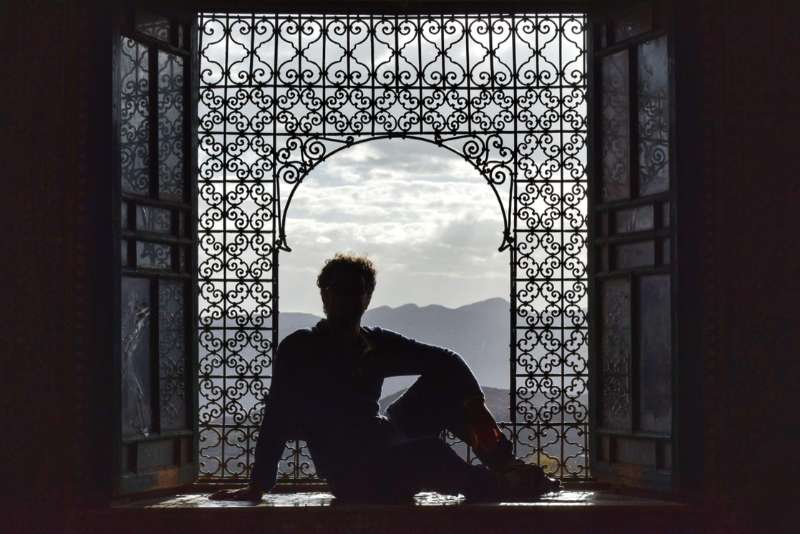
Budget accommodation options in Morocco are no longer what they used to be. After the tourism blockade of 2020 and 2021, prices of guesthouses and auberges have increased considerably.
Going from an average of $10/15$ with breakfast to something around the $20/30$ mark, they are still relatively affordable but definitely not for everyone. Especially solo bike tourers will end up spending more on accommodation.
Some areas of Morocco, especially between Fez and Chefchouane, completely lack accommodation options. Here, you’ll have to plan the stages of your itinerary accurately and sometimes end up cycling less or more than what you’d have liked if you want to have a roof above your head every night.
Campsites are found in the most touristic areas, but they are usually luxury desert camps (quite pricey) or catered towards campervans – they often lack shade and lounge areas. Prices are around $50 per person, per night.
Getting water when cycling in Morocco
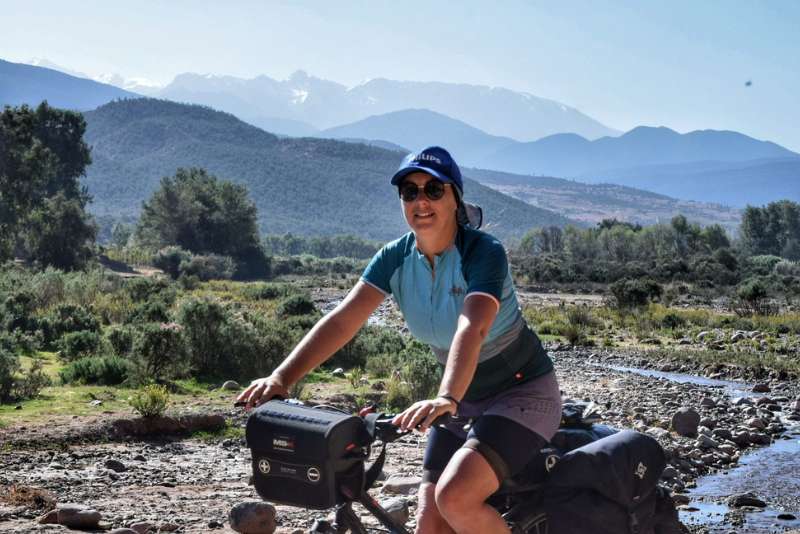
Except in a few major cities (namely Casablanca and Rabat), tap water in Morocco is drinkable, though not always of the best quality.
Drinking water is widely available along most Moroccan roads, sourced from underground wells. You’ll often encounter public taps to refill your bottles. So no need to carry too much or buy bottled water.
In the desert and other remote areas, taps might be rarer, so pack a few excess liters.
Food in Morocco
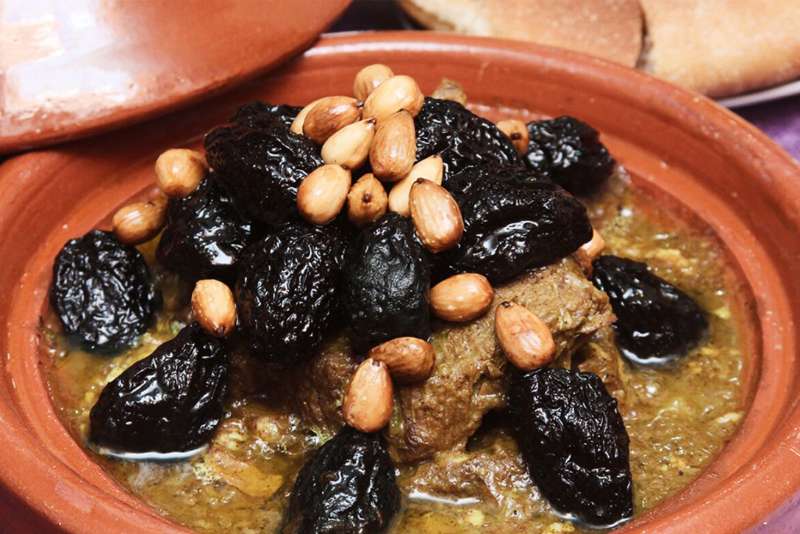
Moroccan food is tasty and very healthy, but not so varied. Although along the coast you could treat yourself every day with fresh, delicious, and relatively cheap fish, outside the cities of the interiors you’ll mostly eat tajin, tajin, and tajin… and Berber Omelette.
The tajin is a terracotta pot used to slow-cook meat (chicken, beef, rarely goat) with an abundance of fresh vegetables. Fully vegetarian tajines are always available; they are often vegan or might include an egg.
Omelette Berber is also cooked in tajines, it’s a large omelet with tomatoes, spring onions, olives, and sometimes cheese.
Bread is everywhere in Morocco, making it perfect for lunch on the go.
Supermarkets are found only in cities, in towns and villages, though there are shops where to buy groceries for camp cooking. Pasta, rice, olives, sauces, basic cheese, and all the basics you might want are almost always available at low prices.
Morocco is the country of dry fruit; there’s a vast choice of figs, dates, peaches, nuts, and whatnot. Those make for great road snacks – natural supplements are the best!
Language and People
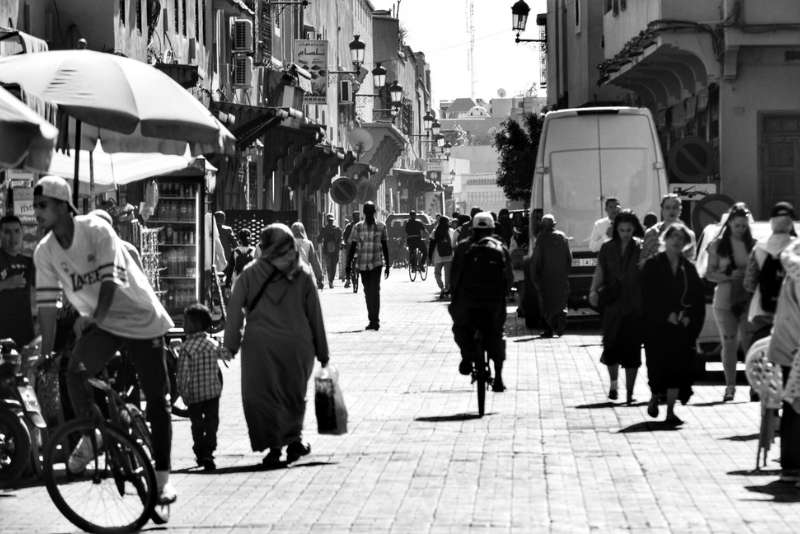
The official languages of Morocco are Arab and Berber. Most Moroccans also speak good French, especially in the center and south, and decent Spanish (only in the north and some major tourist cities).
English is not common outside tourist areas, so learn a few basic French words to communicate.
In rural areas, while you can still meet French-speaking men, most women will only speak Arabic, as unfortunately, many of them don’t go to school.
The people of Morocco are among the friendliest we’ve ever met during our many years of roaming the world. Smiling and very polite.
Of course, there are exceptions, so you should always exercise caution when dealing with people. The most touristic cities are home to scams, and Fez had a rather unpleasant atmosphere for us, with widespread drug addiction and annoying flycatchers at every corner.
While we loved most of the mountain people, the area at high elevation near the town of Imlilchil was less pleasurable. Elena was getting creepy stares, kids were overstepping personal space in a sketchy way, and, in general, people were less welcoming and smiling. It doesn’t mean it was an unsafe area, but I will advise a bit more caution, especially for ladies.
Biking in Morocco: Roads, traffic, and drivers
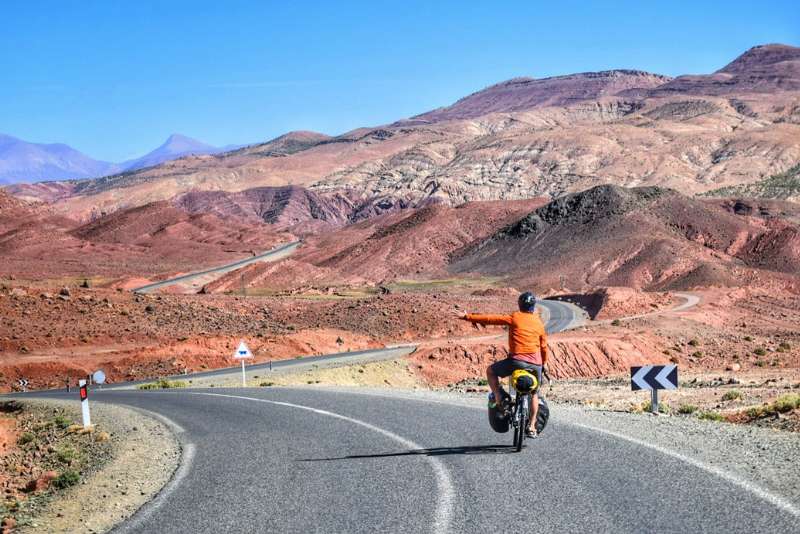
The road network in Morocco is quite extensive, and the government is working quickly to pave most of the unpaved roads.
There are so many roads that the possible bike touring routes in Morocco are practically infinite. You can experience the Atlas Mountains and the desert without ever leaving the smooth tarmac, plan a mixed-surface bikepacking itinerary, or stay forever on rough, unpaved trails.
For the last option, though, you’ll have to go there soon. As I said, most roads are being paved, and it’s getting increasingly more challenging to find unpaved marked roads – donkey trails are endless though, but often not marked on maps.
Traffic gets intense only near the cities or on the main arteries, but drivers are generally considerate and friendly, giving the cyclist a feeling of safety.
Biking in the cities can be a little hectic, but nothing compared to Italy or Southeast Asia.
Safety and Crime: is Morocco safe to travel by bike?
Having cycled extensively in more than 50 countries in the last 10 years, we developed a sixth sense for danger, and it was never activated in Morocco, except maybe twice.
We felt really safe in most of Morocco; people were kind and friendly, if not helpful.
The only time we really didn’t like was our evening in Fez, when people gave us a very different vibe – although Fez is a beautiful city, I would recommend skipping it.
The other place where our sense of danger was awakened is the high mountains near Agoudal and Imilchil, where kids were disturbing and adults were somehow rude – I won’t say it was a dangerous area anyway, the worst that could have happened is probably some stones from kids.
Bike Touring Morocco as a solo female cyclist
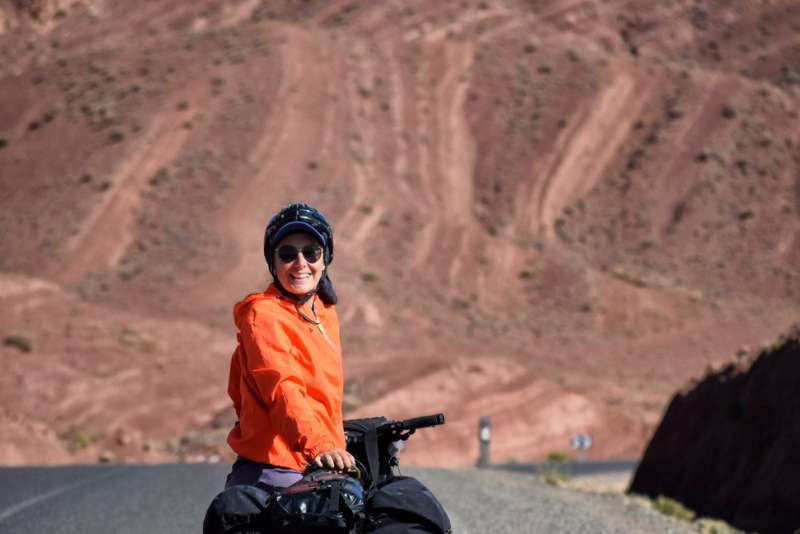
During our bike adventure in Morocco, we split up several times and cycled independently. Elena rode alone in many areas of the country, and her impression was of overall safety.
The coast, especially, was quite friendly to a solo-woman-cyclist, maybe because of the surf culture, perhaps because of the long history of cultural mixes, making this part of the country absolutely fine.
On the mountains, where Berber people live, the situation is a little different. We recommend long sleeves and long trousers in this area of Morocco, which is much more conservative than the big cities and coastal regions.
A few recommendations:
- Ask households if you can pitch the tent, instead of just going wild camping
- always be sure there’s at least a woman in the household you’re sleeping at
- dress conservatively
- Don’t get in cars with men alone, unless they’re a taxi
- Don’t take drugs
- Politely decline if a man offers to show you around
Taking a bike on local transport while cycling Morocco
Railways in Morocco are not very extensive. An Atlantic line connects Tanger to Casablanca, finishing in El Jadida on the coast and extending to Marrakech inland. Fez is also connected, as it’s near the impassable border with Algeria, in Oujda.
Taking a bike on trains is not very easy; the bike must be packed and partially dismantled, so the best way to skip boring sections is by coach or collective taxi.
Coaches connect most cities and towns in Morocco; every city has a few long-distance bus stations, while in the village, you’ll have to ask where the stop is.
Bikes are super straightforward to carry on long-distance buses; they’ll mostly go upright in the luggage compartment, and you don’t even need to take your panniers or bikepacking bags out.
You don’t need to pre-book a space for your bike; just show up with it, and there should be no problems – maybe arrive a few minutes in advance if your bus is starting from your location (otherwise, if you’re by a stop on the way, it will make no difference).
You’ll be asked for a small fee by the person who takes care of the luggage; the cost is negotiable (we paid the equivalent of $5 per bike from Casablanca to Essaouira, and our Moroccan warmshower said it was fair; shorter routes might be a bit more expensive in comparison).
In more remote areas, there might not be coaches; in that case, you can resort to collective taxis. Those are large cars picking up people on the way; they always have a luggage carrier on top, and you should be able to load your bike and gear there.
Surprisingly, hitchhiking with a bike is not that easy in Morocco. Elena tried a few times without success.
ATMs and card payments – getting cash in Morocco
ATMs are scarce in Morocco; they can be found only in major cities, even though not at every corner, as you might be used to – just imagine, in Marrakesh, there’s only one ATM in the whole of the city center.
So, get cash when you can – and don’t forget to store it safely. Morocco is safe, but you’ll never know.
Card payments are also not as widespread. Some hotels might accept it, but it’s pretty unusual in small shops or restaurants.
Mountain Biking in Morocco
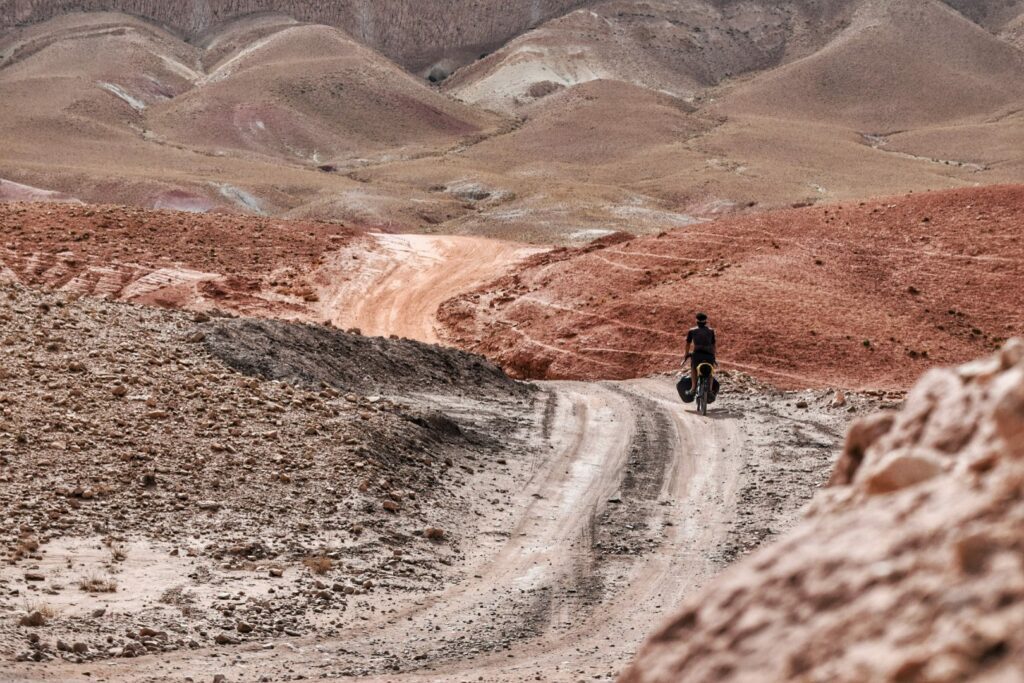
As a large, mountainous country, Morocco offers plentiful opportunities for mountain biking. Unfortunately, though, the trails aren’t marked, and there’s not much information online.
Dirt roads are found in the remotest areas of the Atlas, often connecting two tarmac roads. A great MTB itinerary in Morocco, for example, goes through the valleys connecting Tizi’n Test with Tizi’n Tichka.
My advice when looking for MTB trails or singletrack is to use Google Maps satellite view and Google Earth to spot them; more often than not, they are not marked as roads, but they are visible on satellite pictures.
Another option would be to join an organized mountain bike tour in Morocco. There are many agencies you can find online, from easy e-bike tours to self-guided singletrack itineraries.
FAQs about biking in Morocco
Is Morocco good for cycling?
Morocco is one of the best countries in the world for experienced cyclists. It has gorgeous and varied landscapes, healthy food, low prices, and great people.
Morocco is, though, a very hilly country, so it’s not really recommended for cycling novices.
Where can I bike in Morocco?
The best areas to bike in Morocco are:
The Mediterranean coast from Tatouan,
The Atlantic coast from Essaouria to Agadir,
The whole of the High and Lesser Atlas,
The desert coast towards Western Sahara and Mauritania.
Is Moroccan water safe to drink?
Yes, tap water in Morocco is safe to drink – notable exceptions are Casablanca and Rabat, whose water quality is low (although still claimed safe by the government). In the High Atlas, you can also drink from streams and natural springs.