

Last Updated on 14 January 2026 by Cycloscope
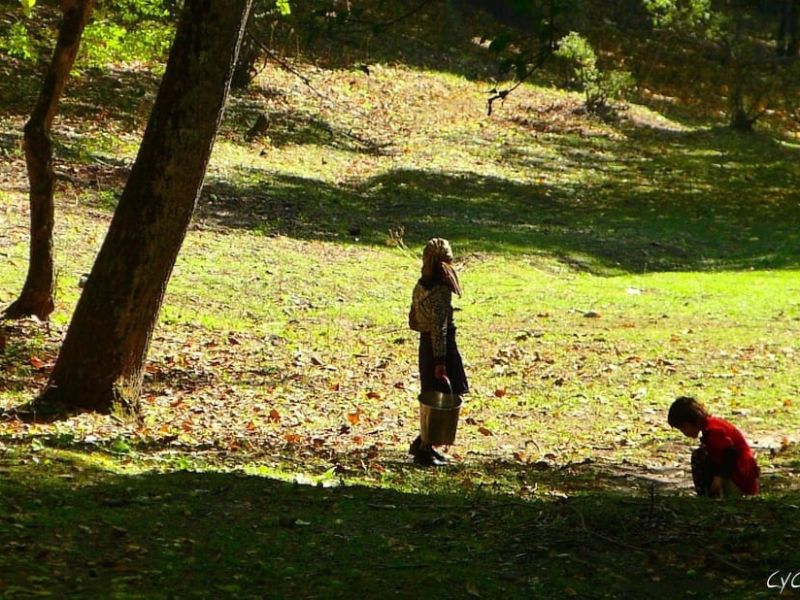
It only takes a watchful heart to perceive how the entire Kyrgyzstan is immersed in a magical, almost supernatural halo. With its peaks caressing the sky under a skin of eternal ice, the crystal waters of its alpine lakes, and its tough and determined people.
Disclosure: Some of our articles contain affiliate links. This comes at no additional cost for you and helps us keep this website up and running. (as Amazon Associates we earn commission from qualifying purchases)
But there is a place that maybe more than any other carries the soul into a fairy-tale kingdom, a place named after a hero. This place and this hero are called Arslanbob.
The legend of Arslanbob
Arslanbob was a man of faith, a disciple of the Prophet Mohammed, who left his homeland in search of an earthly paradise. Among these valleys of Central Asia, he found it, but something was missing for it to be perfect: fruit trees.
So when Arslanbob Ata, “the son of the lion’s gate, returned to his master asking for advice, he gave him walnut seeds, “go and spread,” he told him, and so he did, creating the world’s largest walnut tree forest.
A beautiful story, but just a story, as the forest was already here when Alexander the Great, around 330 BC, conquered these lands (then called Sogdiana), winning the tenacious resistance of the Veneti with matrimonial diplomacy and thus introducing nuts into Europe.
Arslanbob and the nuts’ harvest
The village of Arslanbob is located in the province of Jalal-Abad, 1,700 meters above sea level, in southern Kyrgyzstan, just a few kilometers from the border with Uzbekistan. And Uzbek is 95% of its 13,000 inhabitants, of whom, anyway, there is almost no trace in the village itself for two months a year.
September and October are the months of the nuts, the harvest season. “If you are looking for someone, it is better to look in the woods than in the village,” says Hayat, Alpine Guide and Coordinator of the Community-Based Tourism Bureau (CBT). In fact, from the second half of September and throughout October, the whole village leaves the houses made of mud and straw and moves to the forest.
A surreal world of tents warmed by wood stoves, clay ovens built in a few hours, and then swings and even volleyball nets. But most of all, people: women and men, elderly people scoffing and small kids on donkeys’ backs, an authentic village, in short, but in the woods.
The season is officially opened by a rite in which every family offers a sacrifice (it is unclear to whom; strong pagan influences contaminate Islam here): a sheep, or, if they can’t afford it, seven loaves.
Into the forest: how to harvest walnuts
The magic unfolds gradually: first, at the edge of the forest, lush orchards of beautiful apples, pears, and plums, with sheep and cows grazing around them.
Then the first walnuts, some old giants, centuries-old, majestic, and the lazy collectors who take the walnuts that fall from the ground. The children are playing, throwing rotten nuts at each other.
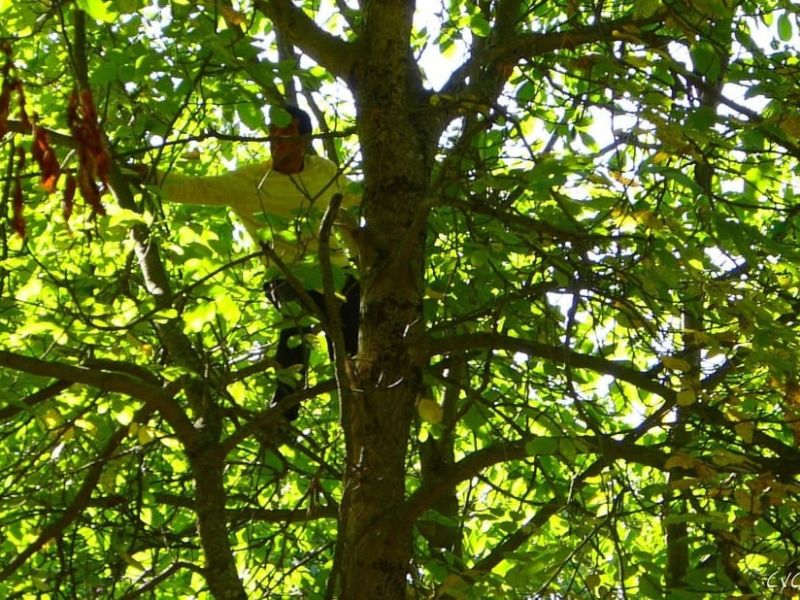
But it is by going deeper, into the heart of the forest, that the real harvest is witnessed. Men climb on the trees, almost always barefooted, without the help of ropes or stairs, and passing from branch to branch, shake vigorously the walnut tree, causing a hailstorm of fruit. Women and children down there, hurry to pick them up, careful not to be hit by the volley of nuts.
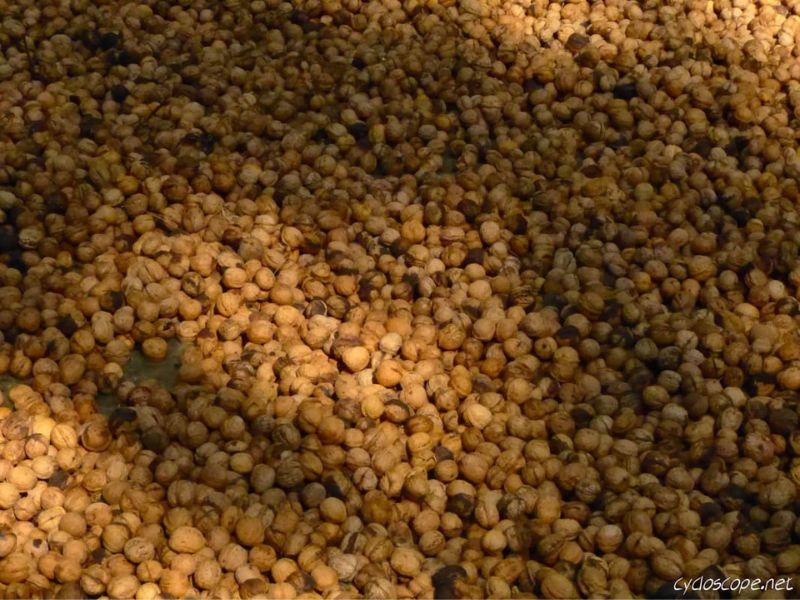
The walnuts are then separated from the husks (once again, the task is assigned to the children; many here do not attend school, at least during this time of year) and left to dry in the sun on large plastic or cloth canvases.
Some figures
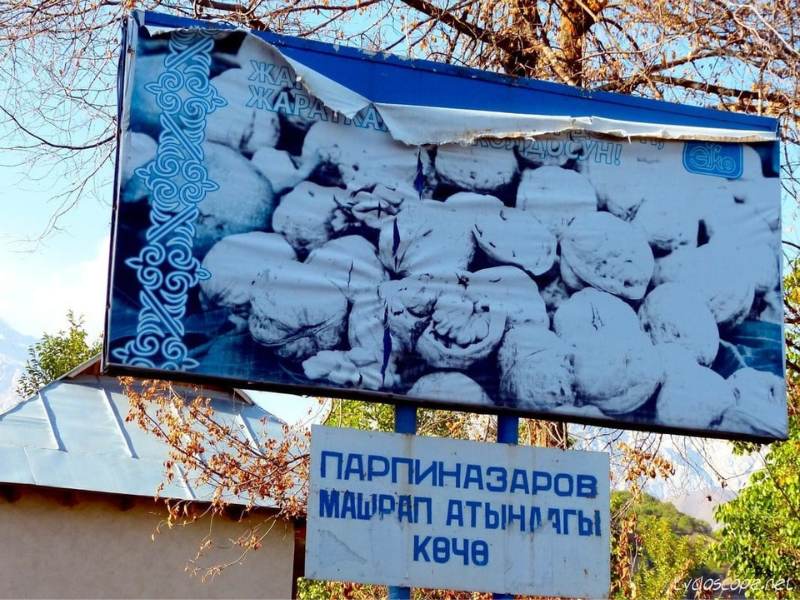
Every year, from the 16,000 hectares on which the Arslanbob forest extends, about 1,500/2,000 tons of nuts are introduced into the local and global market, most of them exported to Turkey and China as the main buyers.
The price of one kilogram of nuts on the domestic market goes from about 70 som (about € 1) for raw product to 300 s (more than € 4) for peeled and clean walnuts. On paper, not so bad, but how much do the collectors’ families earn?
Not much, given that the prices here are those to the final consumer. According to Hayat, a family collects between 500 and 1000kg of nuts per season, which are mostly purchased on the spot by the most affluent, who, in turn, deal with distributors; often, the steps between producer and consumer are at least four or five.
Tourism as a sustainable resource
During the Soviet era, Arslanbob was a popular tourist destination. Still, today, it is possible to see abandoned “resort” ruins, with many swimming pools and children’s rides, now covered by tentacular vines.
In fact, with the collapse of the USSR, Arslanbob has been in a dark tunnel for more than 15 years. But for a few years, thanks to the commitment of people like Hayat, this dream village has experienced a small revival of the tourist economy.
The numbers are certainly not daunting, but Hayat’s satisfaction is evident when he tells us that visitors were around double the previous year… figures that make an Italian smile, accustomed to the astronomical numbers of places such as Venice or Florence, but which the local CBT is right to be happy about.
In fact, mass tourism, Hayat argues, would have a destructive impact on the village’s culture and ecology. At the same time, a gradual increase in visitors year by year can boost the economy and stimulate the town’s cultural growth, in an optic of mutual exchange between locals and visitors. Because “in each of us there is evil and good, and it is the latter that we must learn from each other.”
After harvest, winter will come, burying Arslanbob and its forest under a white blanket, wrapping them in the muffled silence this season brings. But Hayat will not stop, volcanoes of ideas, he has already invented a new way of skiing… driven by a horse! So perfectly Kyrgyz…
Getting from Bishkek to Arslanbob
Tonight we slept at a guesthouse (gastiniza) near Bishkek’s Osh bazaar. Taxis for Osh leave from here, and we want to leave early in the morning (Arslanbob is located near Jalal-Abad, on the road to Osh). The neighborhood does not seem “well attended” at night; the road linking the market to the bus station is full of motels.
When Daniele goes to the mini-market a woman “offers her services” to him, those motels are all Love Gastiniza. But who cares, we found a very cheap one, 500 som for a double room (7 EUR), not the cleanest in the world, the standard toilet is filthy, and on the wall, there is a poster with the word LOVE and many little hearts drawn. Suspicious spots dot the blankets.
When we wake up, we go to the taxi parking, ready to be “attacked” by all the drivers. And that’s what happens, we are discussing with six taxi drivers simultaneously.
Most of them want to take us to Jalal-Abad; they don’t want to go up to Arslanbob, which is about 50 kilometers from the main road. They would leave us where the road splits, and then we would have to find another way to get up there.
At a certain point, two guys take us away from the crowd, asking for 1000 som per person, the price is more than fair. And it seems they’ll take us to the final destination.
The car is tiny, and the driver doesn’t seem to be a taxi driver; the trunk is full of stuff. It seems the two boys are just going back home, and perhaps they were looking for someone to share the petrol with.
The mountains and the Naryn River valley
Before Kara-Balta, we take the road south that begins to climb into the mountains until reaching the pass (3000 msl), through the infamous tunnel, at least infamous among cyclists because it is very narrow and long. We had heard it was without lights, but the lights are there, dim but present.
Anyway, there is a sidewalk so you can walk without risking death. But this has created many legends, and most cyclists load their bikes onto trucks to cross.
It’s starting to snow, and we are surprised to see that there are still yurts up here. The driver drives quietly, not like a psychopath, and we are happy. We stop to eat along the way, and the two guys pay us for lunch. Then we can confirm they are not taxi drivers.
The road is beautiful and not so tough, it goes along the Naryn River, a placid and greenish stream winding through stunning gorges, we think it should be a perfect canoeing trip going down this stream. We regret not being able to cycle here, but our gear isn’t suited to the cold season, too bad.
Our guesthouse in Arslanbob
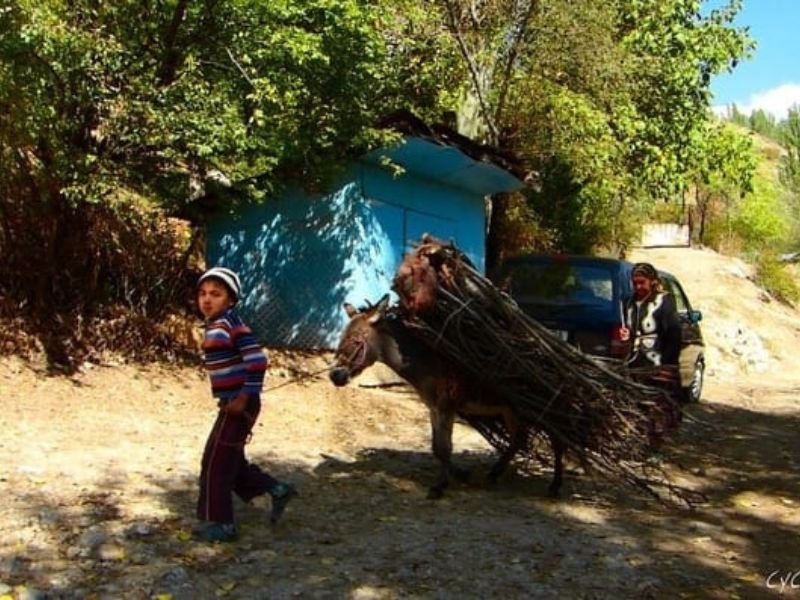
We arrive at the junction with the road to Arslanbob when it’s almost dark. At about 8 pm, we arrived at the village, and we saw virtually nothing of this part of the road. The guys leave us in the town center, everything is closed and dark. Quite strange, usually in Kyrgyzstan, everything remains open 24/24.
Let’s knock on the gate of the CBT (Community-based tourism, a Kyrgyz tourist agency) as we were advised to do. They welcome us with tea, nuts, and apples and find us a guest house, the number 18, a boy comes to pick us up by car and takes us there.
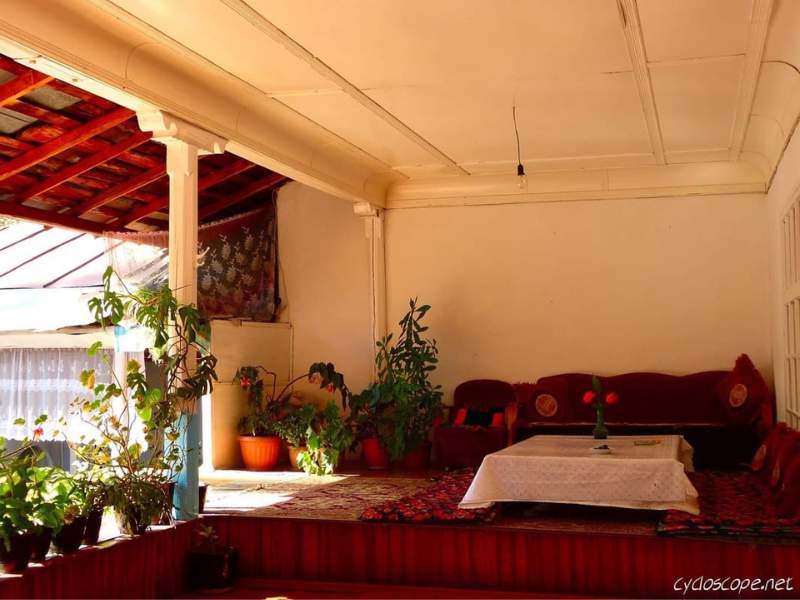
The house is lovely, apparently in traditional Uzbek style. There is a huge veranda with so many plants, all in wood, and a large low table surrounded by carpets on which to sit and eat and drink tea.
Our room is nice, although with kitsch wallpaper and a glittering pink rod to hold the curtains—mattresses on the floor, the typical Central Asian ones, similar to thick blankets.
There’s a girl with a long braid who speaks a few words of English. The custom for young women is not to cut their hair until marriage. She brings us emmer and tomatoes as a snack. Here, women don’t attend school much; they don’t even speak Russian, unlike men.
Breakfast is fried potatoes and eggs. We go out and begin to explore the village and its surroundings. Everything is very bucolic. Here, the inhabitants are mostly (90%) Uzbeks and are pretty religious. Or, more than anything else, quite literally follow the tradition.
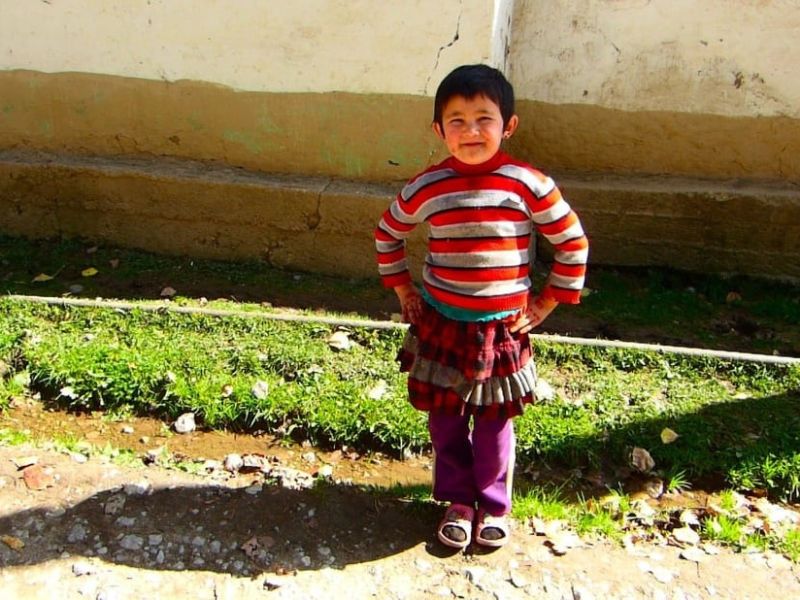
The clothes are traditional. Women wear long skirts or long trousers and a headscarf, with only the neck visible. This is common in Kyrgyzstan, but here all of them are dressed this way, without exception. The men are wearing Uzbek hats (Taqiyah), more sober than the Kyrgyz ones (Kalpak). There’s no beer or alcoholic drinks anywhere.
Women do not study much; most get married at eighteen, braid cut, and the end of the free ride.
The role of women is typically to take care of the house, fields, and animals. But another activity typical of this resort is the nuts gathering. Around here, it is indeed the largest walnut forest in the world, and this is precisely the harvest time. And that’s why we are here.
The big waterfall (bol’shoy vodapad)
In the CBT office, there’s a map with some places we could walk to. We are moving towards what the map indicates as a “big waterfall”.
To reach it, we cross the village and see that the houses are built differently here (doors and windows are straight, a simple thing the Kyrgyz find hard to do), and the gardens are well-kept with flowers, various plants, and many fruit trees. But the town is almost deserted; we will soon understand why.
Past the town, we follow the road along the river and meet Hayat, the leader of the local CBT, whom we have heard about from Chad. It’s going in the mountains with a group of tourists, and they’ll be back tomorrow. We greet them and move towards the waterfall, obviously taking the wrong path, which is steep and rocky, but it does not last long.
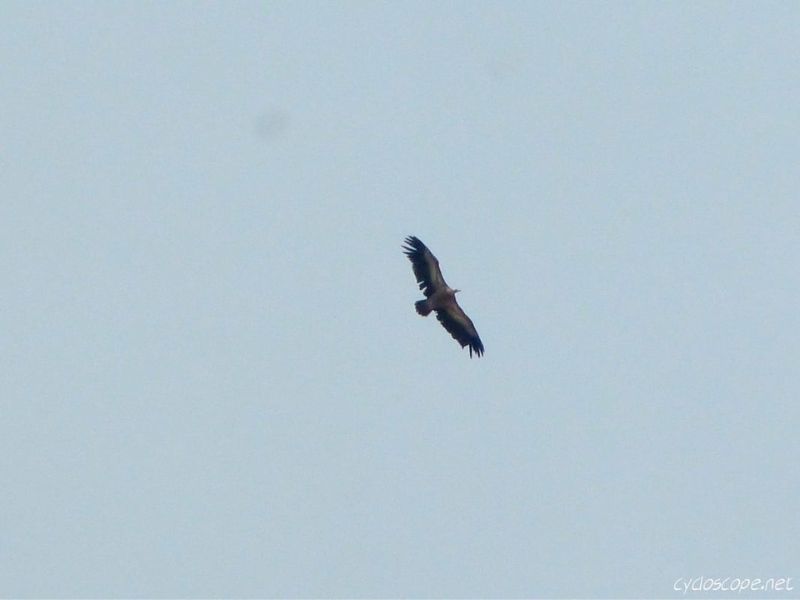
The waterfall is about 80 meters high, but actually, the most fascinating thing is that the overhead is full of eagles, at least five. And they are huge. We think of the time the conductor of the Kazakh train showed us a video of an eagle spotting a mountain goat at the edge of a ravine, grabbing it, and then letting it fall into the abyss… We move a little more inside…
We return to the village, following a charming path along the calm river, then take the road to the walnut forest. We begin to see the first trees.
They are huge, especially considering how long it takes a walnut tree to grow. There is a lovely path to follow, but the trees are fenced. We wonder whether someone owns them; we will ask Hayat tomorrow.
We see a few tents between the trees, but no one is collecting nuts. We want to get “deep inside” the forest, but we can’t figure out which path to follow, and it’s late. We’ll try again tomorrow.
We have to go to town to buy some groceries before everything closes, which takes place around 18:30! And we arrive late, and at the end, we eat bread, butter, and bananas. Tomorrow we will get dinner prepared by the women at the guesthouse.
The small waterfall (malenki vodapad)
We wash ourselves, on the other side of the courtyard, there is a small house with a shower and a sauna. The landlady heats water with a wood fire.
At the CBT, Hayat has not yet returned from the mountain trip. Better check the map on the wall to reach the depths of the forest.
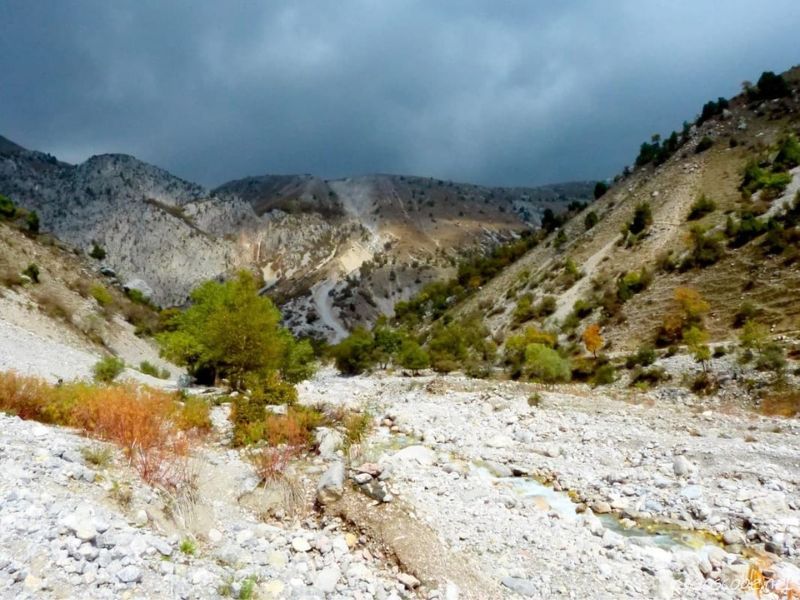
The trails are not marked, and there are no proper maps. We first reach the small waterfall and ask for directions to the Malenki Vodopad (“small waterfall” in Russian).
This small waterfall is nicer than the big one, maybe because we are much closer. An “improvised” bridge (basically a piece of iron, recycled from what is unclear) leaning on the two banks of the river leads us to another improvised iron staircase that climbs the mountain on the other side. It gets to a cafe! Closed.
Entering the biggest walnut forest in the world
From there begins a path, which goes into the forest. The forest is a maze, not in the sense that you can imagine, though.
There are just walnuts and it’s not dense, the problem is that there are a lot of fences, probably for the animals, and when you enter a gate it’s not clear where to get out. However, with the help of our Garmin GPS, which at least tells us which direction we are going, it’s not that complicated.
In the future, we will start to see more and more people in the woods. They live there with the whole family and the animals, at least for the harvest season. That’s why we haven’t seen many people in the village. Again, nobody is collecting nuts.
They all seem to be napping. Finally, we come to a part of the forest that is not fenced. And we see a man in a tree. He is shaking the branches to drop nuts.
Arslanbob, a village in the woods
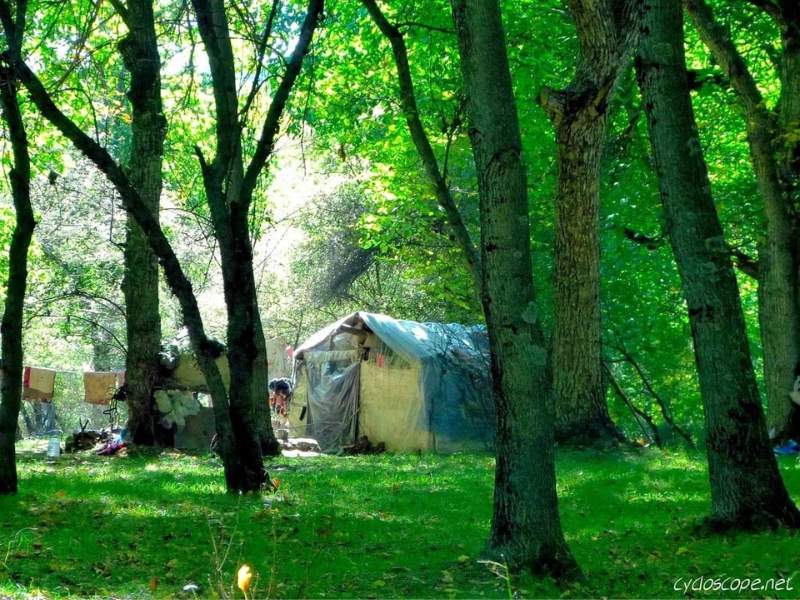
This part of the forest looks like a village in the woods, full of tents, and even a family has a fenced garden with a watchdog. There are a lot of people walking, sleeping, cooking, and children playing. We see other binders.
One has a ladder up to a certain point of the trunk and then climbs. The others are not even that. They climb all the way barehanded. Cavort on these high branches to drop the nuts and then descend along the trunk, clinging arms and legs to it. It seems a bit dangerous.
We walk a dozen kilometers immersed in the atmosphere of Miyazaki’s films. The day is beautiful, full of sun. At home, there is another guest who eats with us. Dinner arrives, and it’s enormous!
Everything is in one dish: a pepper stuffed with rice, at least five boiled potatoes, plenty of other vegetables, and even meat for Daniele. Oh, I forgot, also a cob. None of us can finish the dish.
We chat a bit with the other guest, Nathan, who’s also a blogger, and go to sleep happy. Tomorrow we will leave Arslanbob. A little sorry. With a little more money, this would have been a place to spend more time.
Out of Arslanbob: the ugly Bazar Korgan
This morning it rained, and we finally managed to meet Hayat and interview him. He is doing a good job promoting this place and seems to have many ideas. He’s developing winter tourism.
And when we tell him that the Naryn River would be a nice little place to go canoeing, he agrees and offers to let us stay there, room and board paid for, to help him organize this sort of tour. Sure, it would be nice, but first we should do some more practice with the canoe.
To understand the problem, there are no teachers for skiing, canoeing, etc… As long as it comes to horse riding, there are no problems. We greet this very nice guy, and we get on the minibus that takes us to Bazar Korgan. Along the way we see more and more Kyrgyz hats, we are back.
Bazar Korgan is a really ugly place. At the bus station, we are assaulted by taxi drivers and chauffeurs, and not even knowing where to go, it’s hard to think.
Hayat had recommended a couple of beautiful places, one to the south, near Sary Tash, from where you can see the Lenin Peak (7,000 meters), and another to the northwest, Lake Sary Chelek. But in both cases, those destinations are too expensive for us.
After a walk in the bazaar, the only thing that is here, as the village name suggests, and a stop at a cafe that has no food (they wonder why I ask for sugar for tea and do not have it), we return to the station and decide to take a bus to Jalal Abad. We will see the city, then go to Osh tomorrow, and then return to Bishkek.
Jalal-Abad: a cute Silk Road town
The bus is cheap, and in just over an hour, we arrive. Jalal-Abad seems like a lovely city; there are many people around. Let’s find a gastiniza. There’s one for 500 som, dush iest, and that tualet iest.
And it’s true, there are showers and bathrooms, too bad those are out of order. In the bathroom, you cannot flush the toilet, the water heater does not work, and the shower has no handset; instead, a rusty pipe dangles over the shower tray (I guess they do not use it often).
The mattress was white when Kyrgyzstan was still a Soviet republic. We do not even try to lift the blanket. We’ll sleep wrapped in sleeping bags. Left the backpacks, we went for a ride through the city.
Of course, not one of those “must go at least once in a lifetime” places, but Jalal-Abad is definitely a cute little town and probably nice to live in; there are many outdoor cafes, and it seems to be less expensive than the north of Kyrgyzstan.
But in a few hours, we have seen pretty much everything, and we go back to the fetid guesthouse. We spent the evening playingcachiera (a dice game, pretty stupid), compelling… We forgot the playing cards in Bishkek.
Disappointed by Osh
As each night spent in a respectable gastiniza, we wake up with scattered itches. We get to the bus station, and from there, we go to Osh, a boring trip. The Kyrgyz are very quiet and do not make “a big mess” on the bus as we Italians do…
In Osh, the bus station is located in the middle of the market. We go down there and go in search of the usual bad place to sleep. This part of town is an enormous bazaar. We roam a bit; it seems nice.
But it rains and we have to find a place to leave our things, we ask a few hotels along the way but the prices are high (by our standards). In the end, we find a guesthouse, without any sign, behind, or rather inside, the mosque. OpenStreetMap signaled it on our Garmin GPS.
Two guys at the entrance show us the room. The mosque is pretty, and there are large rugs. They bring us mattresses and blankets. Everything is clean! Hooray. It only cost 400 som (5,50 Euros), a great deal!
Let’s walk through the market. There’s a storm, but many parts of the market are sheltered. The only problem is that there is mud on the ground, and sometimes you have to wade through a pond formed between the stalls.
The market is vast but not very “quaint”. They sell what we call cinesate (Chinese low-quality stuff). The food part is smaller than that in Bishkek, and nobody yells to attract customers. Sometimes they say things when you come, so quietly, like they are drug dealers.
Back to our guesthouse, through a park full of karaoke, which is pretty popular, but these are practically the size of a shower stall, outdoor, with a stereo, a monitor, and the pirate CDs sold everywhere (I think the originals do not exist). Unfortunately, the weather is bad, and we can’t see any performance.
In the end, we’re pretty disappointed by Osh. We probably didn’t see its eternal beauty, but believe us, we’ve looked for it and haven’t found it anywhere. What many say is the “quintessential Silk Road city of Central Asia” just looked dull and ugly to us. But maybe we got it all wrong…