
Last Updated on 16 January 2026 by Cycloscope
Things to do in Urumqi and facts to know
about the capital of Xinjiang
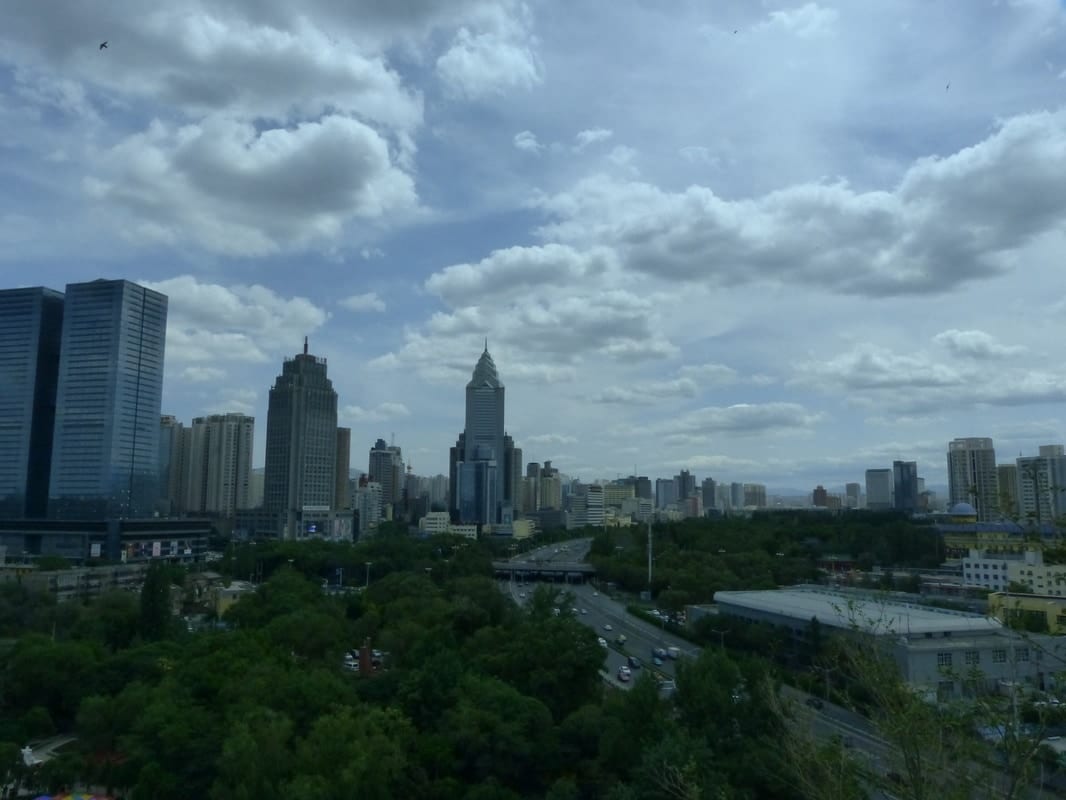
Urumqi, the capital of the Xinjiang Uyghur Autonomous Region, is known for its geographical isolation, being the furthest city in the world from any sea.
Disclosure: Some of our articles contain affiliate links. This comes at no additional cost for you and helps us keep this website up and running. (as Amazon Associates we earn commission from qualifying purchases)
With over 3 million residents, Urumqi offers a unique blend of urban life, history, and the complex socio-political landscape of the Uyghur region.
Although often overshadowed by its political tensions, Urumqi remains an intriguing destination for those seeking to experience a side of China that’s rarely seen by international tourists.
The city has charm, under the thick veil of pollution that envelopes it.
Here, we had the chance to witness the activities in Chinese city parks: group dances, calligraphy competitions, and a wide variety of weird sports. We also witnessed firsthand the militarization of the region and the repression of the Uyghur people.
Bicycle touring to Urumqi from Kazakhstan was pretty cool for the first 5 days. After a very beautiful ride around Sayram Lake, though, we had no choice but to follow the highway G30, where we got caught in a sort of toxic storm.
Nuclear wind and bus to Urumqi
Good morning highway G30. There’s a crazy wind, of course, against us; we can’t do more than about 7 km/h, even though we are in the flats.
After a while, the wind picks up, raising nasty clouds of dust. We consider the hitchhiking option, but we should get on the highway to try it. Now we are on a side road that runs just beside, a couple of meters below.
It is not an easy task; we have to find a break in the barbed wire, climb the steep road, and jump the fences. This part of the road along the desert is really boring and also quite impractical with this wind. We would like to spend our few days in the visa period seeing something more interesting.
So we begin to hitch-hike, but this is not Kazakhstan, and it takes longer. In the end, there is a bus to Urumqi that costs 300 yuan (two people + two bikes). We agreed and got on board, and we do not regret it at all!
The wind gets stronger and stronger, bringing with it a hugeyellowish cloud that envelops everything, so you no longer discern what’s land from what should be the sky.
A sort of nuclear winter, or at least as one could imagine it. The stench is felt through the closed windows. We are in a great desert with huge towering factories, and the road is full of sand. Honestly, I don’t see the point of cycling this hell.
Hostel in Urumqi
We get to Urumqi, and it’s raining. We find the hostel very cute. It costs 40 yuan per person in a dorm, not so cheap, but most hotels here don’t accept foreigners. In China, it is pretty common, especially in big cities and sensitive areas.
To host a foreign customer, a hotel must have some sort of special permit, which I think could be quite pricey, probably not worth it in a non-touristic area like this. After a nice shower, we go to eat at a nearby restaurant.
A customer who speaks a bit of English orders from us. We eat noodles in broth with quail eggs, Daniele takes mini shashlik, and I take what looks like beans, which later turn out to be peanuts, in a huge quantity.
Life in the city parks of Urumqi
The next morning, Daniele has a stomachache, so we stay in Urumqi one more day to take the opportunity to see the city. Actually, it is prettier than the first impression we had on the bus.
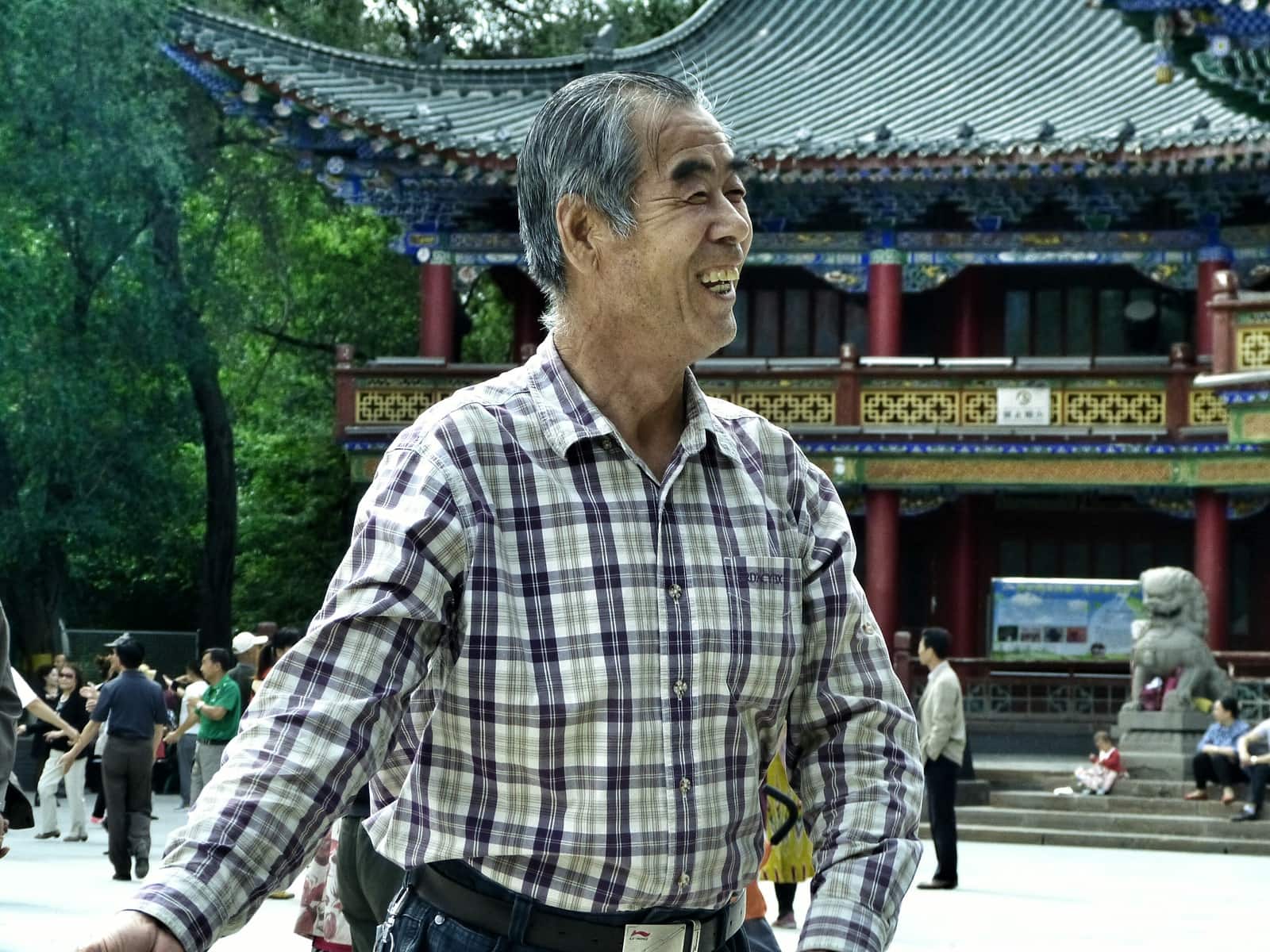
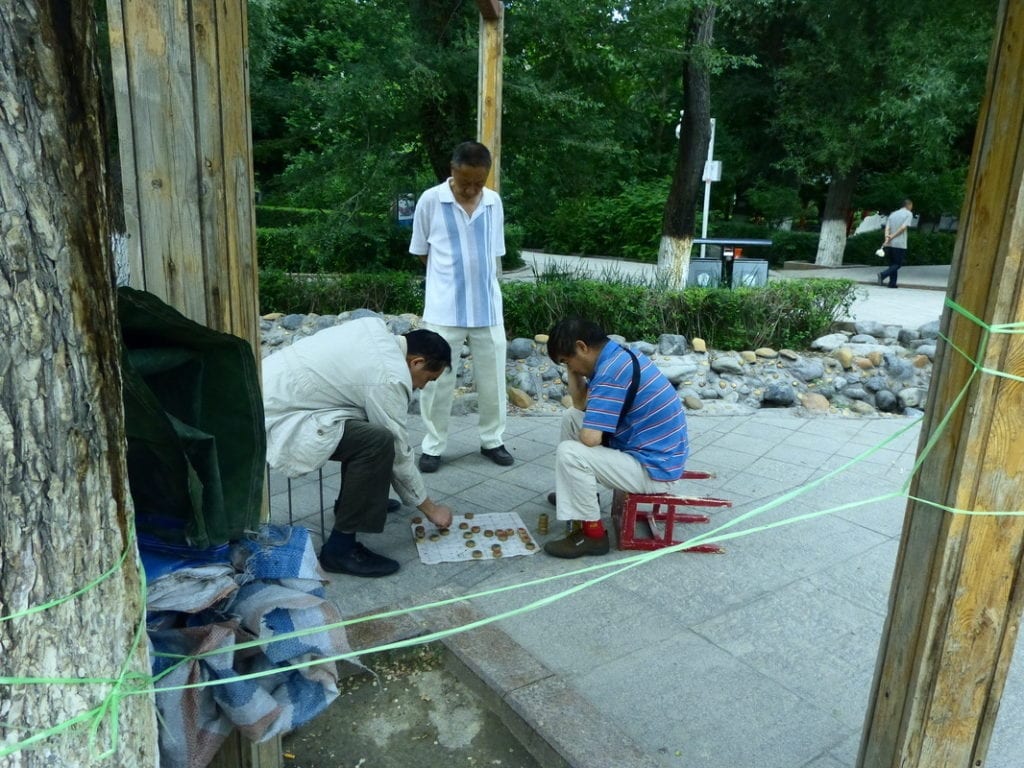
We cross a few parks in the city, People’s Park, Hongshan (Red Hill) Park, Nanhu Park, and Culture Park. Here, for the first time, we get to see what Chinese people do in the parks:
1. Group dancing to Turkish music, attended by all ethnic groups together (under the “vigilant” eyes of heavy-armed military anyway).
2. Preposterous gymnastics (some walk backward, others scratch their back against some special tool, or their butt against concrete columns).
3. Then, there is an area where old men practice calligraphy, writing on the ground with brush and water.
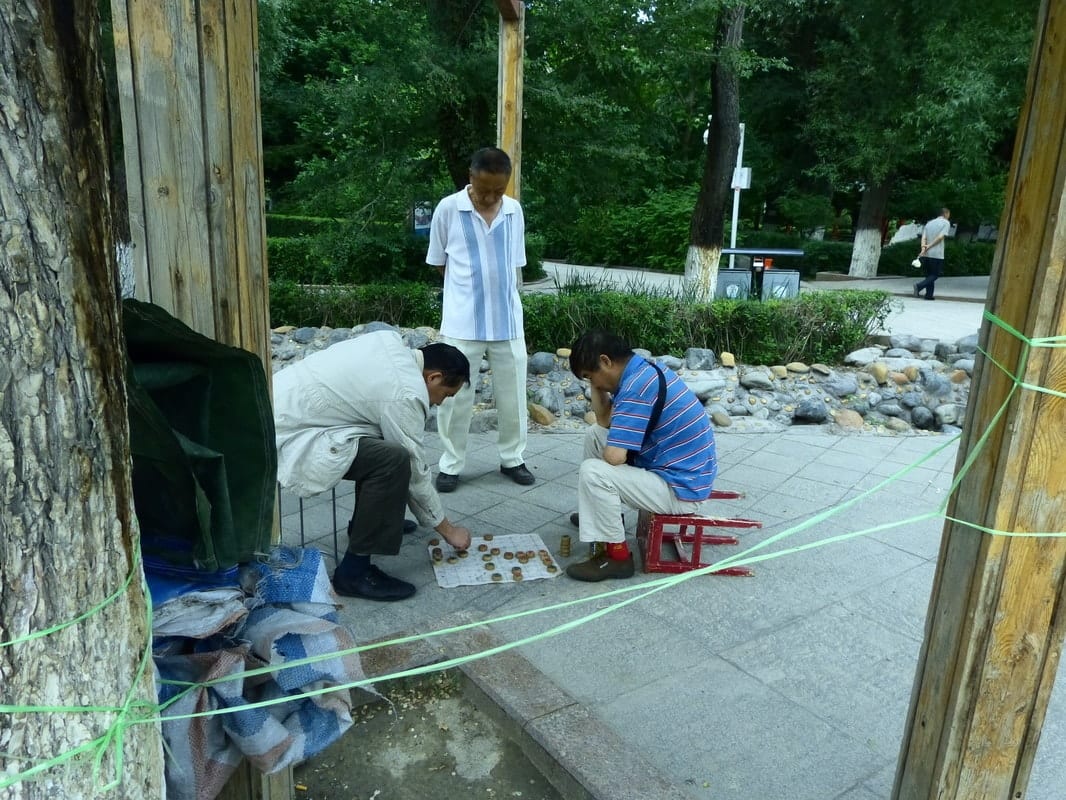
4. Other people play Xiangqi (Chinese chess)
5. While some play tennis with a ball tied to the racket by a string (?).
6. And then obviously some table tennis monsters (every Chinese is such, according to our European standards).
The Ethnic Unrest Between Uyghur and Han
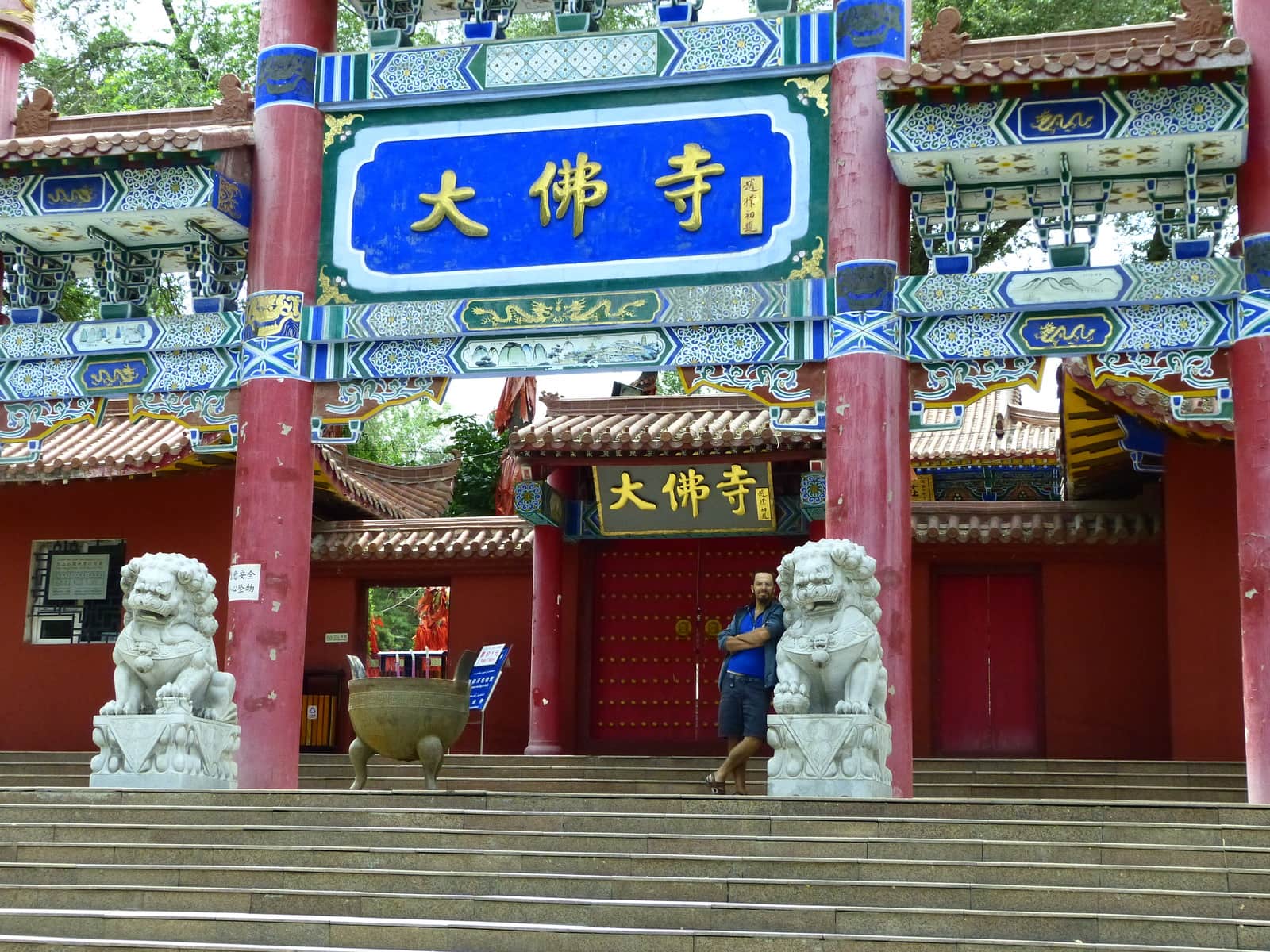
While strolling the streets of Urumqi, it’s easy to see how this is considered a “hot zone”.
There are soldiers everywhere, even some tanks, and all the parks and shopping malls have metal detectors that everybody has to go through.
Here, unlike the countryside of Xinjiang, the majority of the population is Han Chinese (the dominant Chinese ethnic group). To reach this demographic goal, the Chinese Communist Party encouraged the migration of Han people to traditional minority areas, offering convenient tax conditions and other incentives.
This situation, together with the justified feeling by the Uyghur people of not being Chinese, the repression of religious expressions, and the lack of decision-making power (among many other factors), brought the city to a breakdown and a subsequent situation of perpetual unrest.
July 2009 riots and subsequent unrest
See also: July 2009 Ürümqi riots and September 2009 Xinjiang unrest
From Wikipedia: “In the largest eruption of ethnic violence in China in decades, major rioting broke out in July 2009 between ethnic Han Chinese and Uyghurs. The New York Times reporter covering the riot described the violence as “clashes with riot police and Uighurs rampaging through the city and killing Han civilians.
Then, for at least three days, bands of Han vigilantes roamed Urumqi, attacking and killing Uighurs.” Before the riot broke out, young Uighurs had marched through the city “to protest a case of judicial discrimination”. According to official figures, most of the 197 killed in the riot were Han, a statement disputed by Uighurs.”
Staying one more day in Urumqi was interesting, and we’re glad we came to see this city we’d heard so much about.
Tomorrow we leave for Turpan, an oasis town along the Silk Road, and also the hottest and lowest place in China.