

Last Updated on 16 January 2026 by Cycloscope
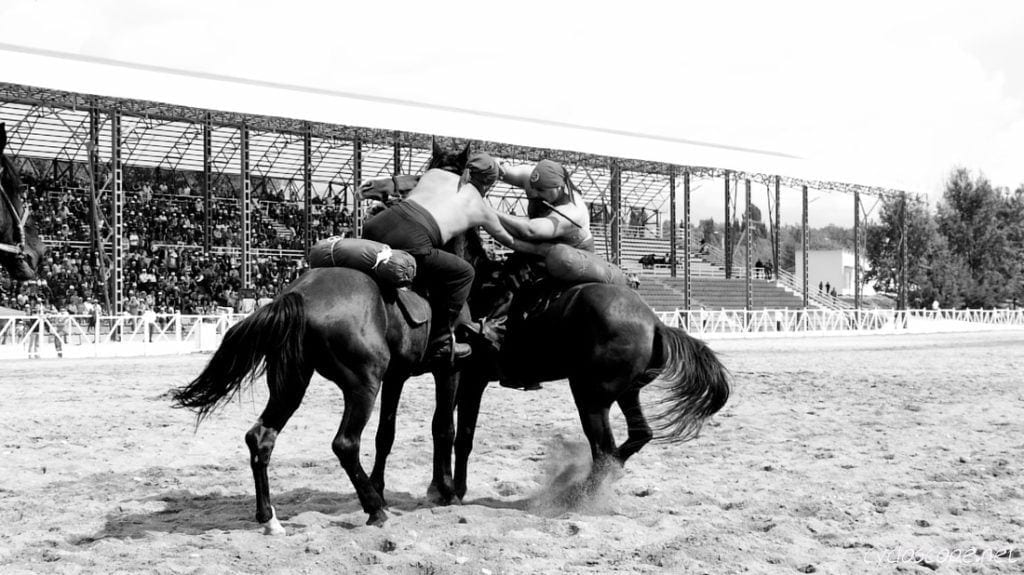
Kyrgyzstan, Issyk Kul Lake, Cholpon Ata town, First World Nomad Games. Play polo with a dead goat (Kok Boru or Buzkashi), throw your opponent from his horse in a tense Enish fight, or grab your bride (or slap your groom) in a Kyz Kuu race!
So here we are, Kyrgyzstan, Issyk Kul Lake, Cholpon Ata town, First World Nomad Games, history takes place before our eyes! But wait a moment, what’s this Nomad Games thing?
The historical and political background (in pills)
Disclosure: Some of our articles contain affiliate links. This comes at no additional cost for you and helps us keep this website up and running. (as Amazon Associates we earn commission from qualifying purchases)
Let’s start from the beginning: Central Asian nations share a common history that dates back to Soviet times.
Nomad tribes wandered these wide and tough lands for centuries, unified under the Genghis Khan empire and then again by Tamerlan in the 14th century.
The troops of both conquerors mostly spoke Turkic Languages, which were spread all over Asia to the edges of Europe.
Kyrgyz, Kazakh, Azeri, and Uzbek are all part of the Turkic language family and are almost mutually intelligible. Along with the language comes the culture and the games that go with it.
Then came Soviet times, and so did Russification. But with the fall of the Union, Turkic identity resurfaced. And in modern geopolitics, this could play an important role.
The idea of the Games first appeared during the 2011 visit of Turkish Prime Minister Recep Tayyip Erdoğan to Kyrgyzstan (cit), as a way to improve relations among Turkic-speaking countries and extend Turkish political influence in countries still strongly influenced by Russia.
A messy start
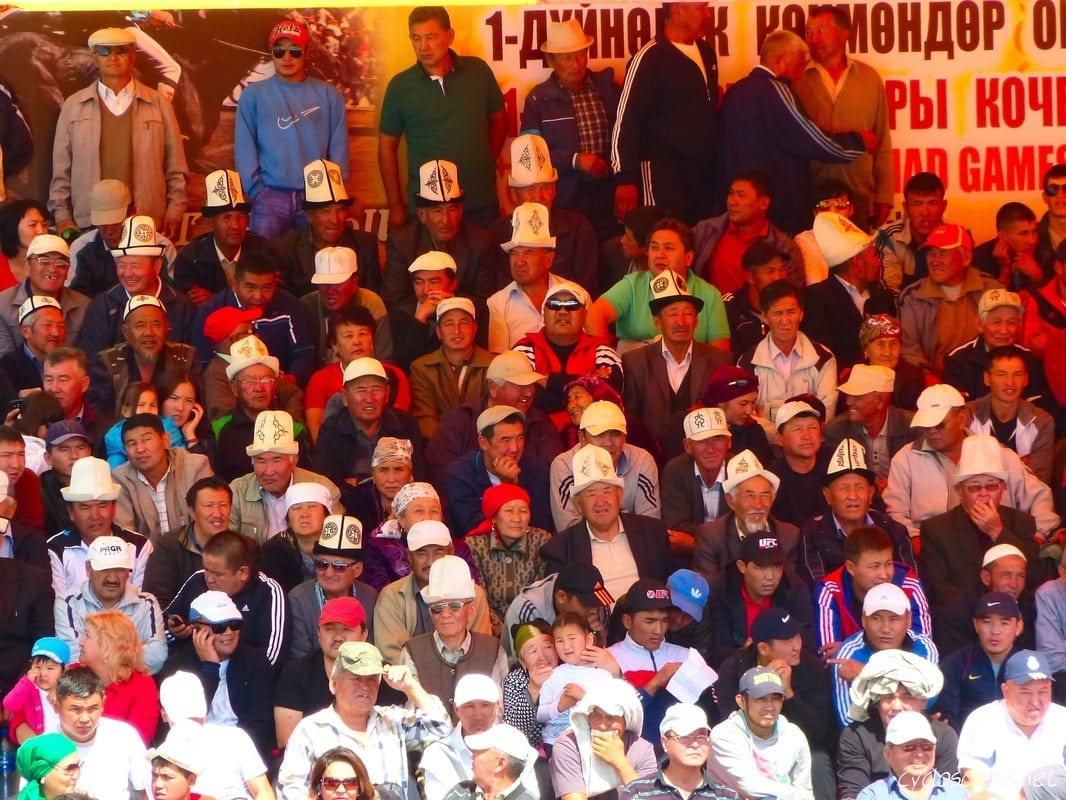
Yesterday, the racecourse’s press office told us to show up this morning at 8 am to get our accreditation. We wake up at dawn and go, but we are confronted by an array of soldiers who prevent our passage. We tried to explain that we had an appointment, but no way.
Besides, we were told this morning that there will be an opening ceremony of the games. At the end, one of the soldiers tells us it will open at 9 am, and a little while later, he comes back and says it will open at 10.
Not a bad beginning. Let’s go have breakfast at the cafe across the street. When we get back, we are told everything will begin at 7 pm tonight!
Nobody knows anything about the program, so we go for a walk around town and visit all the guesthouses looking for a cheaper place, and we find it right next to yesterday’s one, half the price, with a beautiful garden, a kitchen, and wi-fi that works.
The opening ceremony
We go to the beach, which is very crowded and full of tourists, unlike the other places we’ve seen around Issyk Kul. Daniele also manages to take a bath.
Back from the beach, we meet a journalist. He tells us that the games had already begun somewhere in town, and he saw some “wrestling” matches.
But how is it possible that they began, and no one knew it in the press office? And then, shall not the games begin after the inauguration ceremony? Here, it seems like they wake up in the morning and decide what to do. Kafka again.
We go back to the Hippodrome to attend the ceremony, which looks like trying to get to a Madonna concert, except that here it’s free.
I argue with everybody because they keep pushing from all sides, which doesn’t make sense given that the “gate” (soldiers trying to clear the crowd) is closed.
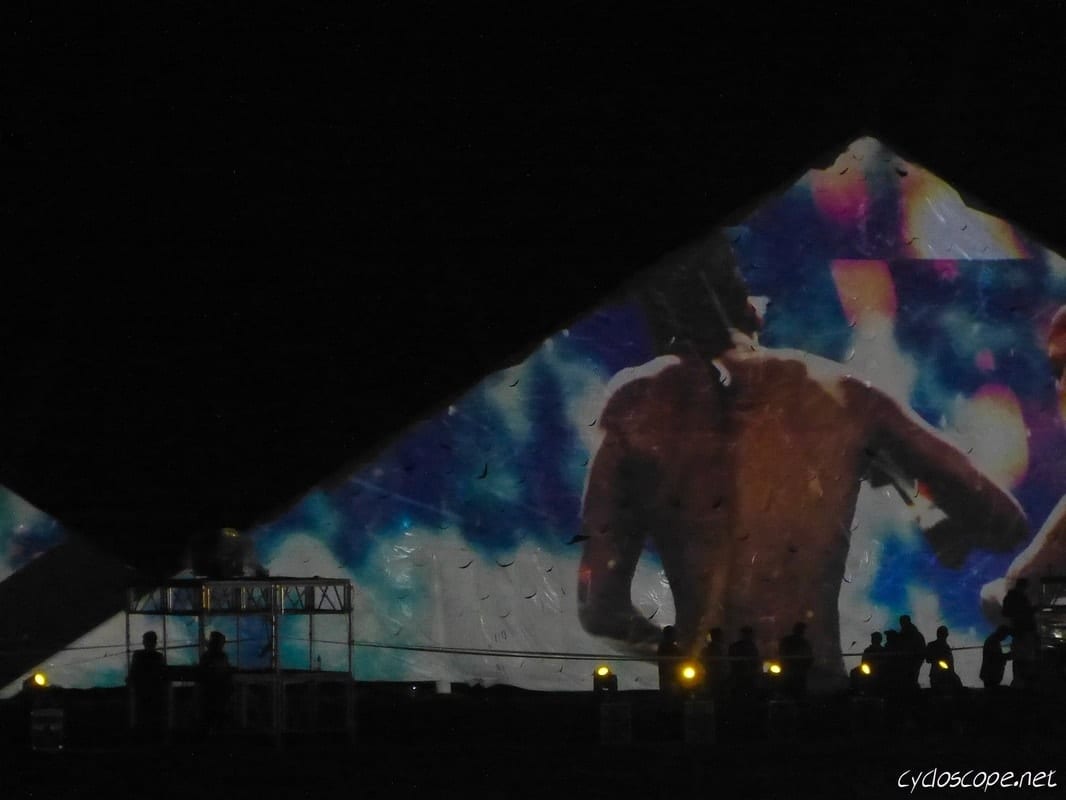
The ceremony is nothing special. But one thing strikes us at once: there are some pyramid structures with projections on them and a play of light. How could the press office think the ceremony could be held at 10 am? Mystery…
There is some group choreography, playback singing, and horses on fire with guys on their backs, also on fire. The procedure takes about an hour and a half, plus another hour and a half of waiting.
Of course, there was also the usual teams’ parade, with flags and everything, but it was completely out of sync. As the announcer called Azerbaijan (the first country in alphabetical order), the Kazakhstan team was already parading.
There are also countries we would never have expected, such as France, Germany, Sweden, the USA, and Austria, whose delegations are composed of only one member. They will probably participate in the Toguz Korgool tournament (a Mancala-style board game).
The Turkish team is indeed the biggest after Kyrgyzstan; everybody in the audience has a small Turkish flag, which they got for free at the entrance, another smart political move.
After all the 19 flags and 400 athletes (source CNN) had done their parade, we went back ruefully to the village, hoping to see something tomorrow.
We had a beer with Misha and Julius (the German giants we met months ago on the ferry to Georgia, they are here too, small world) that reached us here before going to Karakol.
Kok Boru – polo with a dead goat
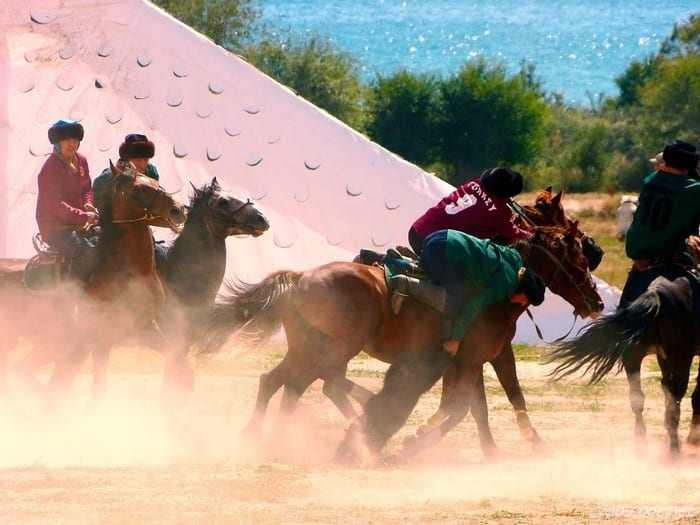
We get to the Hippodrome around 10 in the morning. According to unconfirmed sources, we understand that the Kok Boru tournament should begin. Kok Boru is the Kyrgyz version of Afghan Buzkashi.
Two teams of 4 horses and 4 horsemen get into a struggle trying to conquer a dead goat (the ball) to throw it in a big concrete basket and score a point.
The team consists of 10 players who can take over at any time during the match. Each player carries a whip that is used to flog his horse, an opponent’s one, a fellow rider, or even himself.
The goat is headless, with its paws cut short; it is disemboweled and filled with sand to restore its weight. Easy, isn’t it?
The game starts, of course, at one o’clock, with us there are Misha and Julius, with freshly arrived girlfriends from Germany, and even Claudia and Bettina (the cycling couple we met in Bishkek).
Today, contending for the goat and the glory are Uzbeks and Turks, a rip-roaring victory for Turkey.
From the gallery, we can’t see much because the field is sandy and the horses raise a lot of it, enveloping the contenders in an impenetrable cloud.
Up to the jailoo – the Nomad Games’ yurt camp
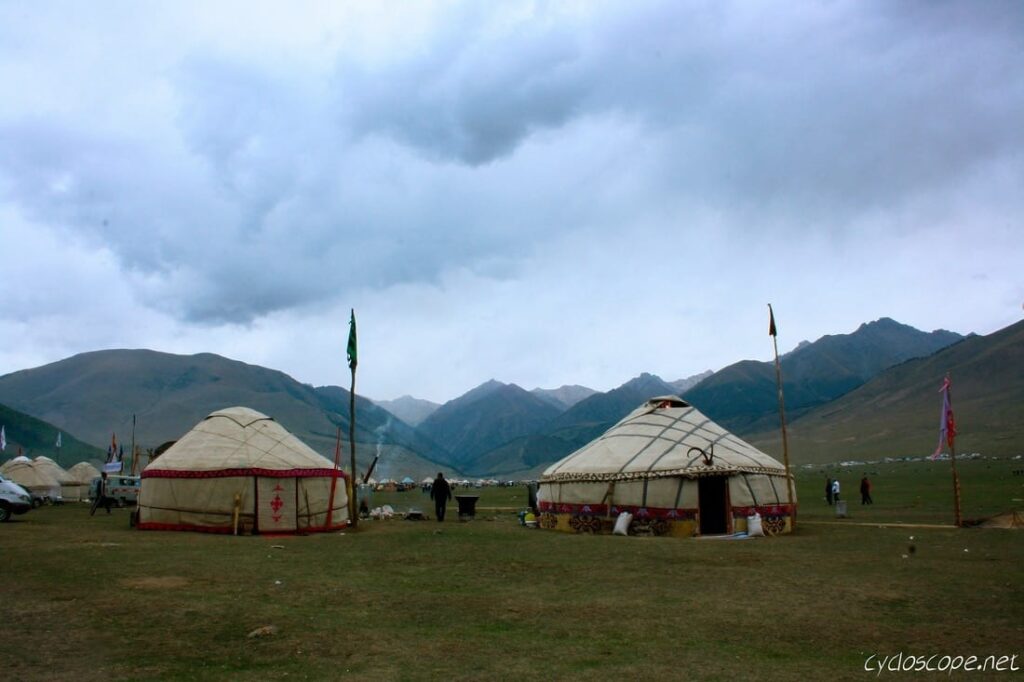
We go to Kyrchyn Jailoo, a nice place in the mountains where the cultural part of the festival will be held.
A Jailoo is indeed a summer yurt camp usually placed high in the mountains. Today, there should be an eagle hunting show and even a concert.
We go with Emile, Claudia, and Bettina after a long negotiation with taxi drivers. In theory, there must have been shuttles, but in practice, there are not. In the cab: a fashion designer from Narin, another guy who seems to be his boyfriend, an unidentified lady, and us.
The driver ends up with 4 gay persons in the car and appears, so to speak, in subjection. He does not say a word the whole trip.
In Kyrchyn, there are a hundred yurts, divided into sectors representing the different regions: the Jal-Alabad ones, the ones from Osh and Bishkek, etc. All of them are beautiful and decorated “to the nines” with colorful shirdak felts.
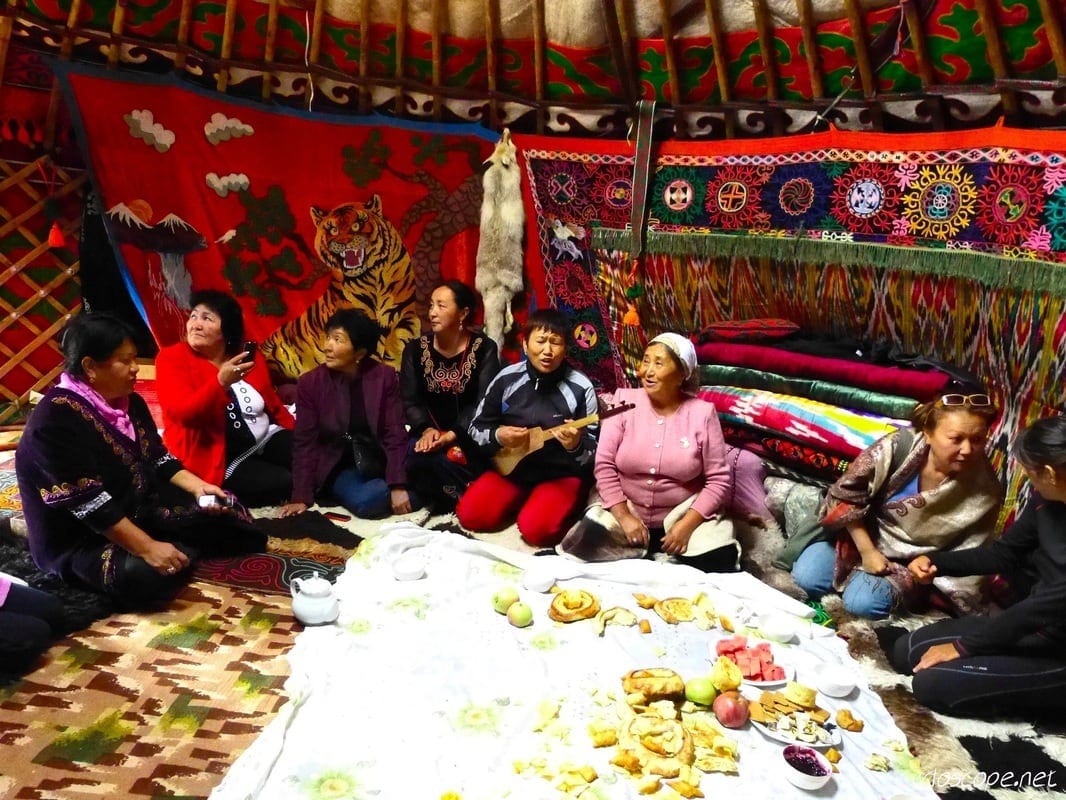
Our fellow couple from Narin invited us to tea at a friend’s Yurt, and we went; it was chilly there. In addition to tea, we get cakes, bread, and jams. There are some singing ladies, playing a komuz, the traditional string instrument of Kyrgyzstan.
Then came another elderly lady in traditional clothes, who even sang and recited a blessing for us. Another one shows us a wolf skin, with fur, head, and everything. Mostly women are here in the yurt, a women’s world.
The lady with us in the taxi loudly says in English that “those two girls” (Claudia and Bettina) look like men. Delicate and classy…
Kyrgyz performing arts
When we finally got out of the yurt, the eagle hunting was over. We saw nothing, but we had a pretty good time in the yurt.
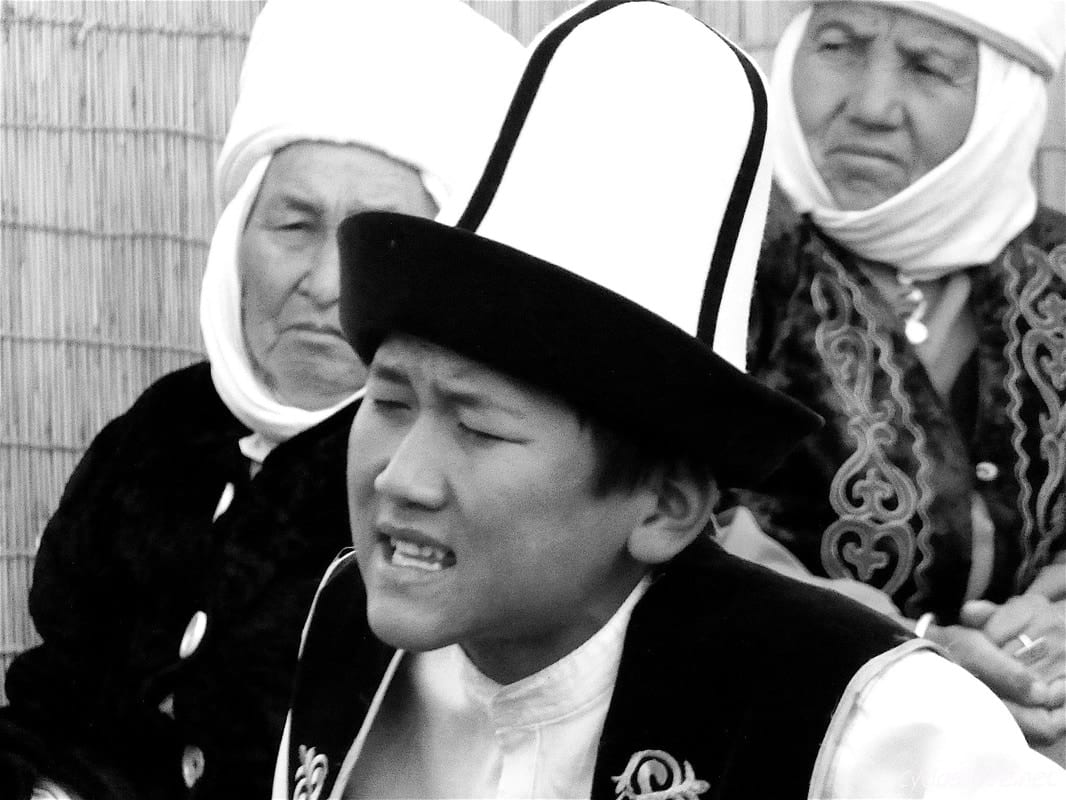
We bump into a child reciting the Manas, a Kyrgyz epic poem passed down orally.
The Manas is an important national treasure in Kyrgyzstan, twenty times longer than the Odyssey and Iliad together. The recitation is intense and quite hypnotic, even if we, of course, don’t understand a word.
Then begins a concert so bad that everyone plays to a backing track. There comes a multi-instrumentalist who can’t play any instrument, and then another band is kicked off the stage in the middle of the song by the announcer. We don’t understand why. He could at least let them finish the song; they were neither worse nor better than the others…
Finally, a guy plays the komuz, and he’s really good! Indeed, the audience asks for an encore (so do we). The announcer doesn’t approve; he is a bit of a weird guy.
In the end, there’s a riot in the audience, and we win. But then comes a sandstorm, and it all ends, so we go look for a bus to Cholpon Ata, we’re going to see the wrestling.
Central Asia wrestling
The fighting sports (horseless) are held at Ruk Hordo, an open-air cultural center on the west side of Cholpon Ata.
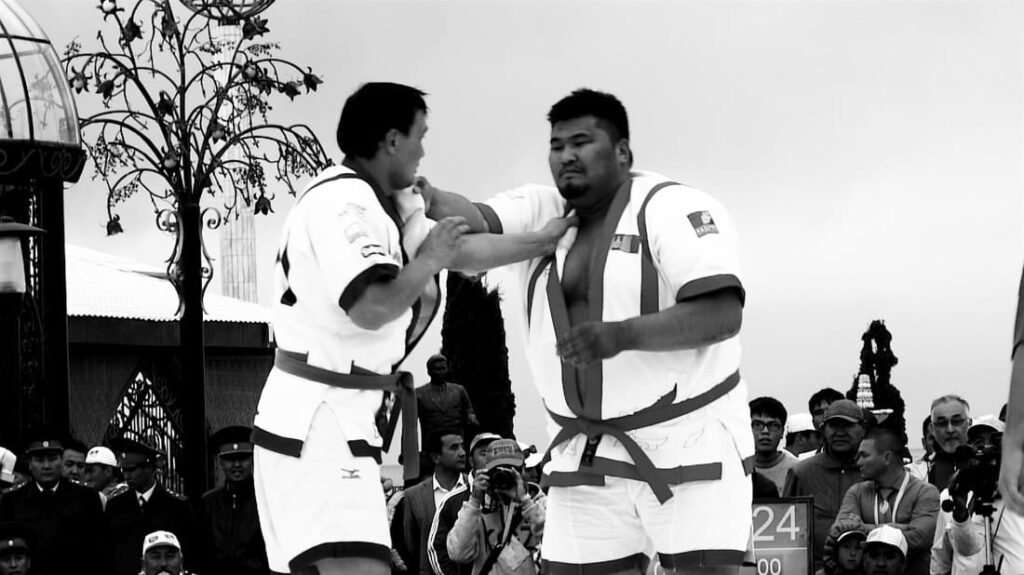
First, we see some matches of Alysh, a Central Asian belt wrestling style. The athletes can’t let go of the opponent’s belt and must try to pin him to the ground.
Rux Hordo Cultural Day
Again, Rux Ordo today, for our joy, it’s just in front of our guesthouse. The program of the day should be demonstrations of crafts and traditional games from other countries, not better defined.
There are a lot of stands with crafts from several countries, Uighur musical instruments, Ukrainian wood carving, some beautiful Tuvan jews harps, and a lutist making stunning carved Komuz.
Everything begins with everybody on stage singing a nationalistic song, then the Azeris go on stage dressed in strange outfits, with colorful pajama pants and large, heavy wooden clubs.
They begin a dreadful dance; for most of the time, hopping, they say “Ale Ale” and “Allah, Allah”. Behind those troglodyte dancers, there is an equally primitive drummer with a bronze instrument; he also sings, quite out of tune.
Kyrgyz’s audience is horrified. But the Azerbaijani traditional displays are not finished yet. After the dance, the game demonstration proceeds as follows: two men sit on the floor, facing each other. Both are holding the same wooden stick, and they must keep their feet on a plank of wood.
The purpose of the game is to pull the stick out of the opponent’s hand. Exciting. Given that there isn’t a league for this game, Azeris defy anyone who wants to try their hand. We are tempted…The funny thing is that the Kyrgyz challengers from the audience won all the matches!
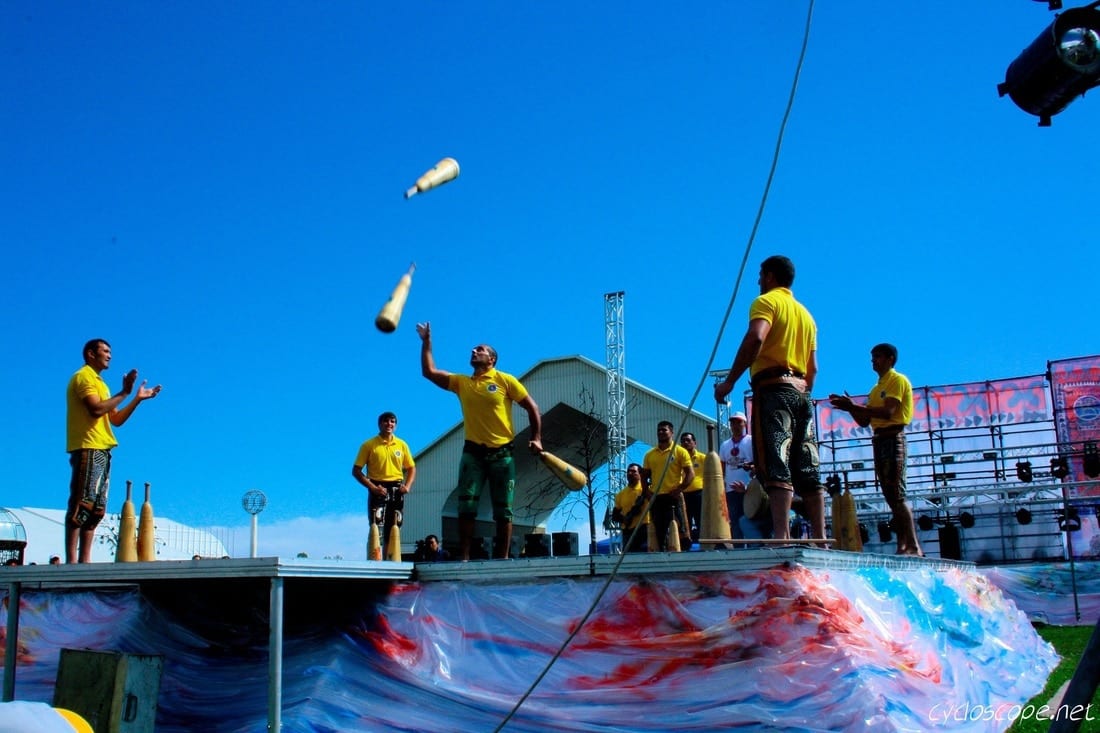
Finally, the Azerbaijan show is over. On stage, some Koreans perform cool Taekwondo moves, and then a little old man dances the Kyrgyz Kara Jorgo, a typical dance.
He knows how to dance. With him, there is what seems to be his niece, a girl of about 7. At some point, people in the audience began approaching and putting money into the old man’s hat. Funny.
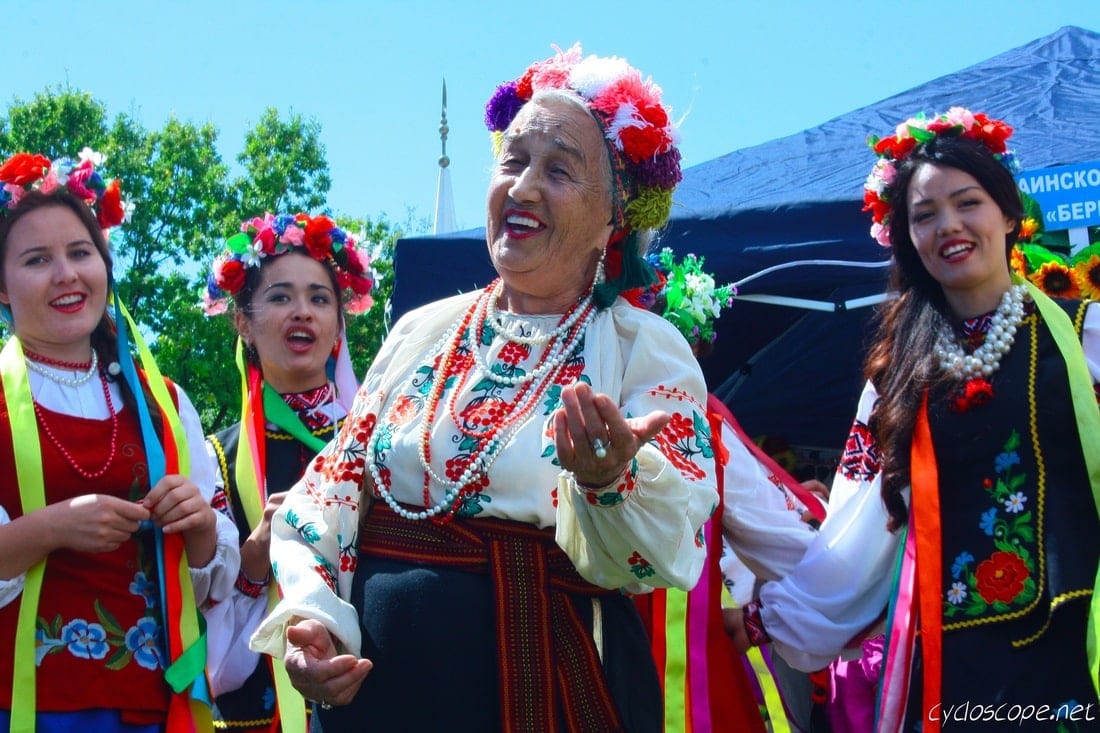
There was also a Ukrainian folk group of musicians/dancers with an old female singer whom we loved. Too bad we did not understand a word of what they said; people laughed a lot.
We go home and come back after dinner to see the fashion show, during which (or before or after) there should be a concert.
It’s a display of traditional clothes reimagined in a modern style, but the show is pretty boring to us (not much into fashion). It’s cold, and after an hour, we go back home. There is no concert.
Inside the Hippodrome – Kok Boru, Er-Enish and Kyz Kuu
We finally got our Press Pass, and now we can wander with a more professional look between horses and wrestlers. We go immediately to the hippodrome, where we can finally enter the field. Indeed, we are really inside the playground, a few meters from the horses.
Er-Enish: wrestling on horses
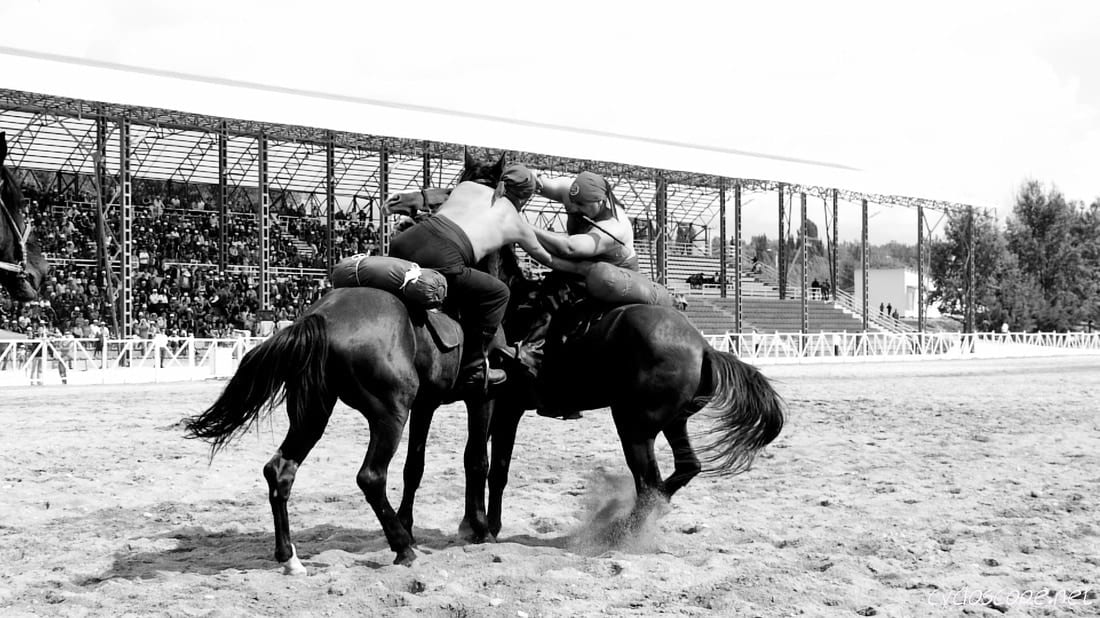
We are quite excited to see Er-Enish, a sort of horseback wrestling. It works like this: inside a circle drawn in the sand, there are two horses and two riders; the aim is to beat each other and try to knock your opponent off his horse.
The Afghan team consists of dudes with tough, rude faces, probably Pashtuns. One gets very upset and says, “I won’t play anymore.” Of course, we do not know why.
They go to talk to the referee, and then the Afghan beats the opposing player with the flagstick of his Afghanistan flag. And then the whole team leaves.
So, Kazakhstan, the opposing team, won the subsequent matches without playing. The sport is quite exciting anyway, especially from so close. But the horses do not look like they are having fun; sometimes they bite each other and bleed a lot.
Turkish nomad games
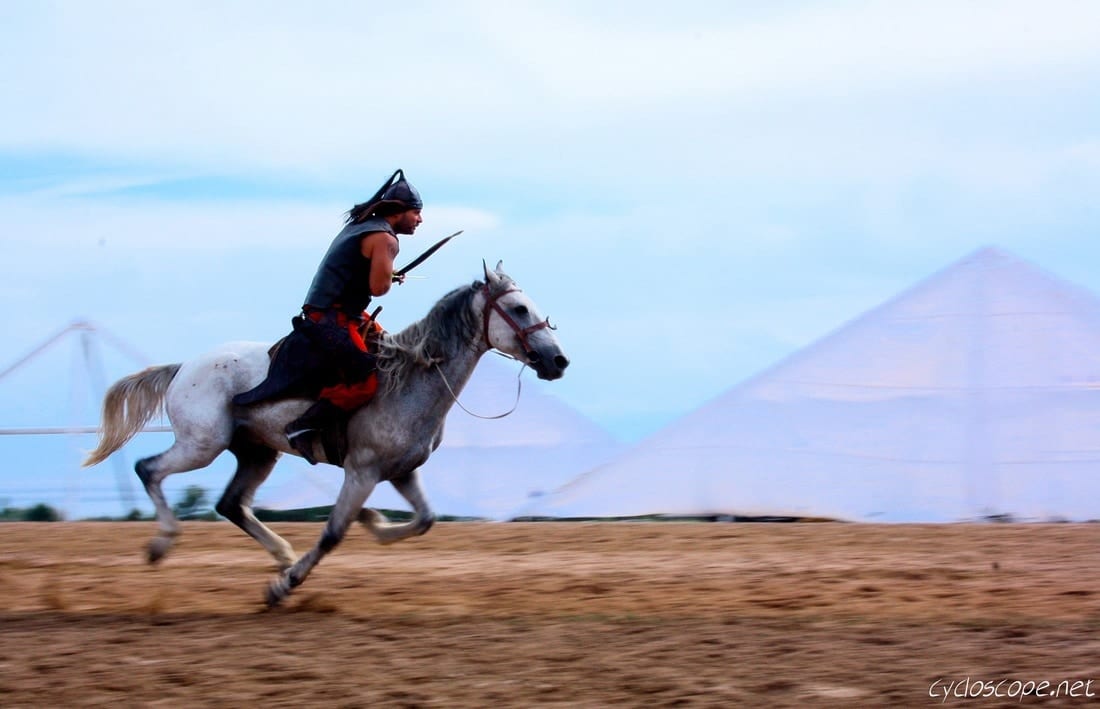
In the afternoon, there is a demonstration of some Turkish games. The first is a kind of horseback archery where you have to shoot arrows at a target while the horse gallops as fast as it can. There is a Turkish guy dressed as a gladiator (or so it seems to us) who’s very good.
Then there is another team game, the Jereed, of which we have no clear understanding of the rules. To play, you need guys, horses, and broomsticks.
These are rolled at the opponents if they hit one point, the opponents score if they grab it on the fly. However, for those who always wanted to try.
It’s the last day of the games. At 10 o’clock, we are at our beloved hippodrome to witness the Kok Boru final, this time directly inside the playground.
The teams vying for the title and dinghy (money in Russian) are, guess who: Kyrgyzstan vs Kyrgyzstan! Who knows who will be the winner!
Seeing this game from inside the field makes it appear to us, let’s say, from another perspective. And this perspective can be a bit dangerous at times.
The horses run fast, and many times we have to run away so as not to be trampled. A journalist, intent on looking into the camera, was unaware of the horses’ proximity and was brought down.
We thought he was going to die, but he got lucky, or more precisely, the horses were smart enough not to step on him. The match is tense and quite exciting. It goes to overtime, and after a long struggle, Kyrgyzstan wins!
Kyz kuu: a flirt horse race
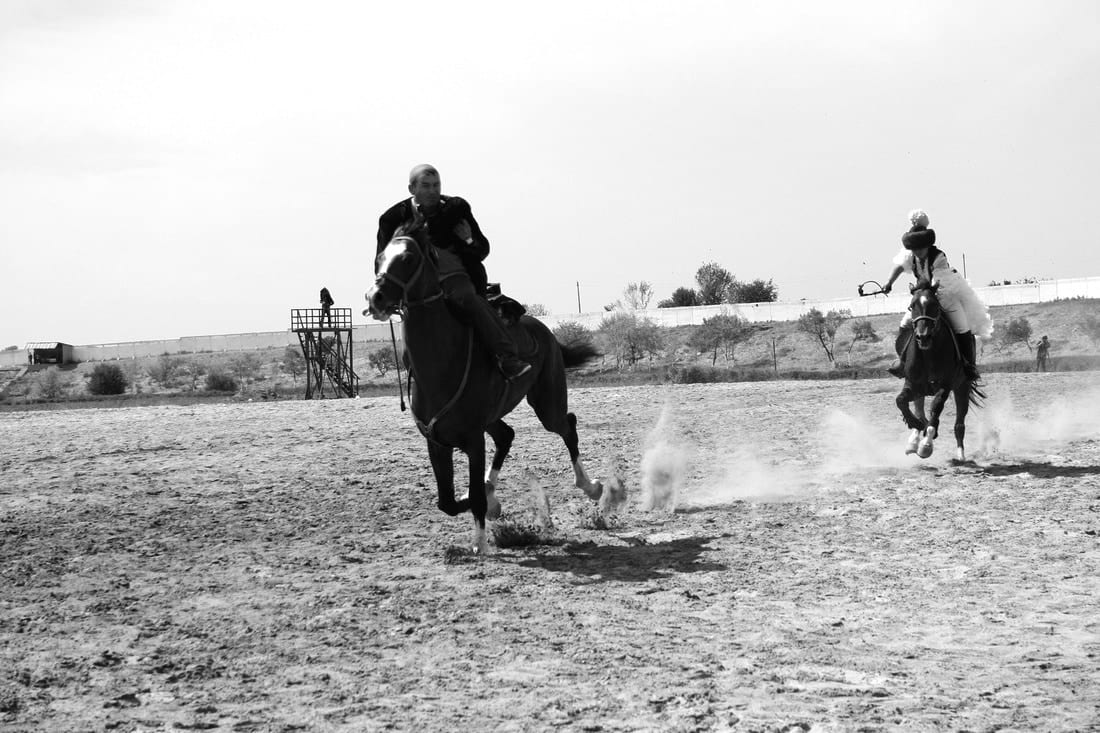
After the game, some youths dance their favorite dance, the Kara Jorgo. And then another demonstration of another game of the Kyrgyz tradition, in which a man and a woman race (on horseback, what else?).
If the man wins, he can kiss the woman, but if the woman makes him bite the sand, then she can whip the man. The name of this game is Kyz Kuu.
Leaving Cholpon Ata
So it’s over, at least for us; we will not attend the closing ceremony. Back to the Guest House, we take our bikes and hit the road again. The road after Cholpon Ata, fortunately, is paved in much better condition.
We did not get far; we left at 4 pm and stopped to sleep on a nice little beach on our beloved Issyk Kul Lake, which we’ll abandon tomorrow to reach another lake, the Song-Kul, which is 3000 meters above sea level.
Follow us while we get lost