

Last Updated on 11 March 2026 by Cycloscope
Scuba Diving in Pemba & Zanzibar. All you need to know about fish, coral conservation, prices, best dive sites, PADI dive centers & courses. An honest guide
Sadly, the world’s coral reefs are not doing very well, but the Zanzibar Archipelago in Tanzania (Unguja, Pemba) still has the best diving spots in East Africa.
Disclosure: Some of our articles contain affiliate links. This comes at no additional cost for you and helps us keep this website up and running. (as Amazon Associates we earn commission from qualifying purchases)

Vast and majestic coral reefs are still healthy, and marine life is thriving – diving in Zanzibar is still an incredible experience.
If it’s true that there has been some coral bleaching in recent years, it mostly affected the shallowest reefs. Snorkeling in Zanzibar, thus, is not what it used to be, but for divers, it’s still a paradise worth exploring, especially Pemba, which is one of the best diving destinations in the world.
Check Also
- Diving Lake Malawi – A Complete Guide to the Unexpected
- Backpacking in Malawi – The Best Online Resource
- A Safari in South Luangwa NP – Zambia
- Cycling in South Africa – a great cross-country trip
The Zanzibar Archipelago

There’s some misunderstanding among tourists about what Zanzibar really is; some even think it’s a province in mainland Tanzania, some are convinced it’s an independent country, and those a bit more informed know it’s an island off the coast of Tanzania.
As many of you know, all of this is wrong – Zanzibar is an archipelago comprising the two main islands of Unguja and Pemba, plus hundreds of other islets, some of which have world-class diving sites.
The Zanzibar Archipelago is an autonomous province of Tanzania; thus, it is often confused with an independent country, and its culture and some laws differ from the rest of the country.
Unguja

The island of Unguja is what people usually call Zanzibar; the region’s capital is here, and it’s indeed called Zanzibar City (which comprises the old colonial neighborhood of Stone Town). Unguja is separated from the mainland by a channel, about 36.5 km wide at its narrowest point.
The island is not big, about 85 km (53 mi) long and 39 km (24 mi) wide, with a total area of 1,464 km2 (565 sq mi). Zanzibar/Unguja is completely flat, with no hills.
It’s almost completely surrounded by beautiful sand beaches, intermingled with bustling mangrove areas. Coral reefs are located about 1/2km offshore or near the islets.
Unguja/Zanzibar is one of the most popular tourist destinations in Africa, attracting more than 400,000 travelers each year. Diving is the most common sports activity in Zanzibar, recently challenged by the rise of Kitesurfing.
Pemba Island

Pemba is a totally different story. Despite being easily reachable from Zanzibar, the island still sees very little tourism.
Pemba is much more pristine than Unguja, both in its natural and cultural aspects. It’s a very conservative island where 98% of the population follows strict Islamic customs.
Pemba doesn’t have many beaches, being mostly surrounded by thick mangrove forests. The landscape, though, is much more interesting with rolling hills, huge trees, swamps, and densely forested areas.
Its offshore islets, though, are pure uncontaminated tropical paradises, and the surrounding coral reefs are among the top 10 in the world. Pemba is probably the best diving spot in East Africa.
Diving in Zanzibar/Unguja
Let’s start by saying that, in Zanzibar, the ocean temperature is almost constant at 26 °C all year round, and the average visibility is about 30/40 meters on a sunny day – not bad.
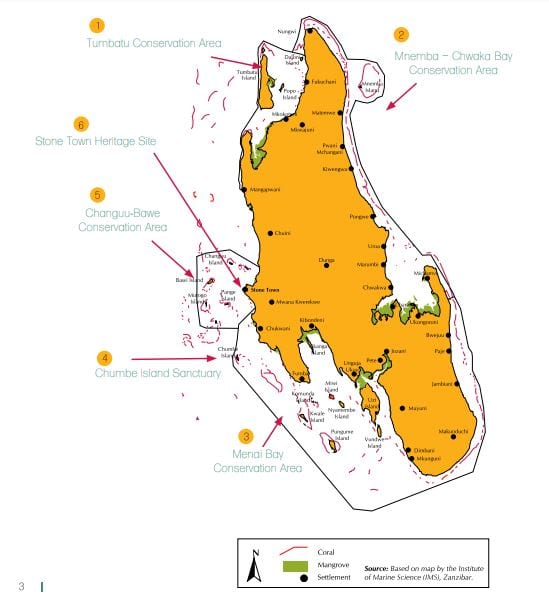
The Zanzibar Archipelago has six marine conservation areas: five around Unguja and the Pemba Channel, which cover the whole West coast of Pemba Island.
- Tumbatu Conservation Area (offshore Tumbatu Island, in the northwest)
- Mnemba/Chwaka Bay Conservation Area (Northeast)
- Changuu-Bawe Conservation Area (offshore islets of Stone Town)
- Chumbe Island Sanctuary (South of Stone Town)
- Menai Bay Conservation Area (South-West)
- Pemba Channel (West Pemba)
Another great diving area in Zanzibar, which we recommend, is the reef offshore Jambiani in the southeast. This reef is not yet protected by a conservation area, but it is probably the best dive site on Unguja.
Jambiani is still an offbeat area for scuba, with only two diving operators operating there, so you’ll likely have a much more private diving experience compared to other locations.
So, there are 3 main areas for diving in Zanzibar/Unguja: the North tip, the South-East coast, and the Menai Bay Conservation area (famous for dolphins). The rest of the spots are mostly snorkeling. We recommend exploring them all if you have time.
PADI Diving Schools/Centers in Zanzibar
There are plenty of diving centers in Unguja, some of which are very busy, especially in the north. In high season, you might expect boats full of up to 10/12 divers.
If you want a more relaxed, quiet experience, we absolutely recommend Pole Divers, which operates with only a few divers at a time, keeping the same prices as most competitors (70€ per dive), which is even cheaper than some.
Stefano and Abdallah, the two dive masters, are super-experienced and relaxed guys. Their school is located in Jambiani, on the stunning and less crowded southeastern coast of Zanzibar.
Here, they know of gorgeous, unexplored diving spots with abundant coral and thriving marine life. You can contact them at [email protected]
A few PADI schools have a base in Stone Town (notably One Ocean Dive, one of the largest), but most PADI dive centers in Zanzibar (Unguja) are located along the northeastern and southeastern coasts.
Regarding safety, there’s only one decompression chamber on Zanzibar-Unguja. In case of accidents, your dive center will escort you there.
PADI Diving in Pemba
As far as I could find out (and I did a lot of research and asked everyone), there’s only one certified diving center with a foothold in Pemba, Swahili Divers (located in the far northeast of the Island).
Anyway, most resorts will be able to arrange your dives, usually by calling up someone from Zanzibar – this is best arranged in advance.
Lala Lodge, a budget lodge with great food near the port of Mkoani (where the ferries arrive and depart) is able to arrange diving even at short notice.
The Best Diving Sites in Pemba
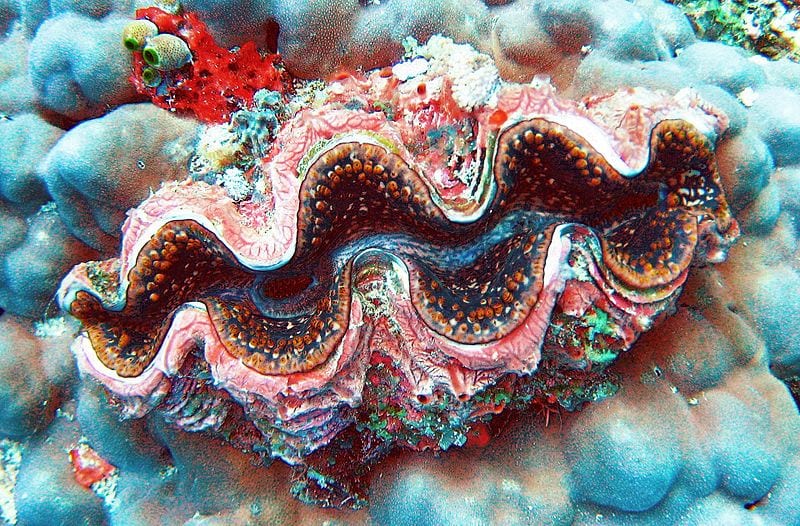
World-class diving spots are plentiful in Pemba, with a huge part of the reef still unexplored. If you only have one day to dedicate to diving in Pemba, though, we absolutely recommend Misali Island.
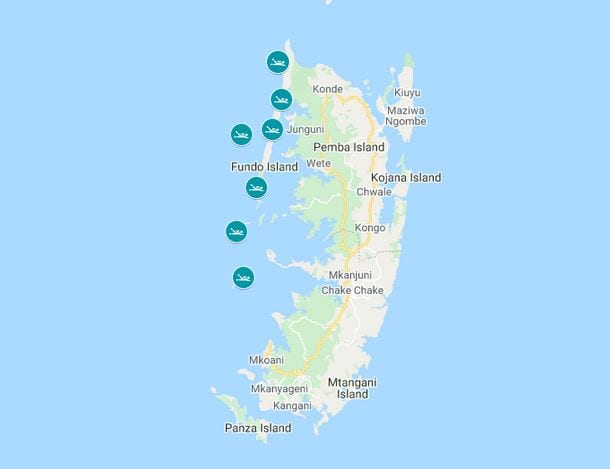
Misali has both walls and coral mountains (the biggest is called Kilimanjaro), which are accessible to beginners since the depth doesn’t exceed 18 meters.
For those looking for more challenging dives, the Fundo Island gaps have vertical walls that go pretty deep and strong currents. Dolphins can be spotted near Kokota Island.
How to get to Pemba – Ferry Schedules and Prices from Zanzibar
Pemba has its own airport, which receives daily flights from Zanzibar Airport. They cost about 100$ one way.
The ferry connection to Zanzibar City runs 4 times per week (Wednesday, Thursday, Saturday, and Sunday, 8 am – 6 hours), while there’s also a weekly ferry to Tanga (Sunday 3 pm – 3 hours) on the Tanzanian Mainland.
Fares are 30/35/40 USD, respectively, for Economy (outdoor deck), 1st Class (indoor deck, faint AC), and VIP (comfortable chairs, cool AC). Fares are the same for Zanzibar-Pemba and Pemba-Tanga.
There are also two ferry connections per week from Zanzibar City to Wete, in the north of the island (near the major diving sites). Thursday 7:30 am and Sunday 10:30 am – this is though a very long journey, about 10/12 hours.
Best Season to go Diving in Zanzibar
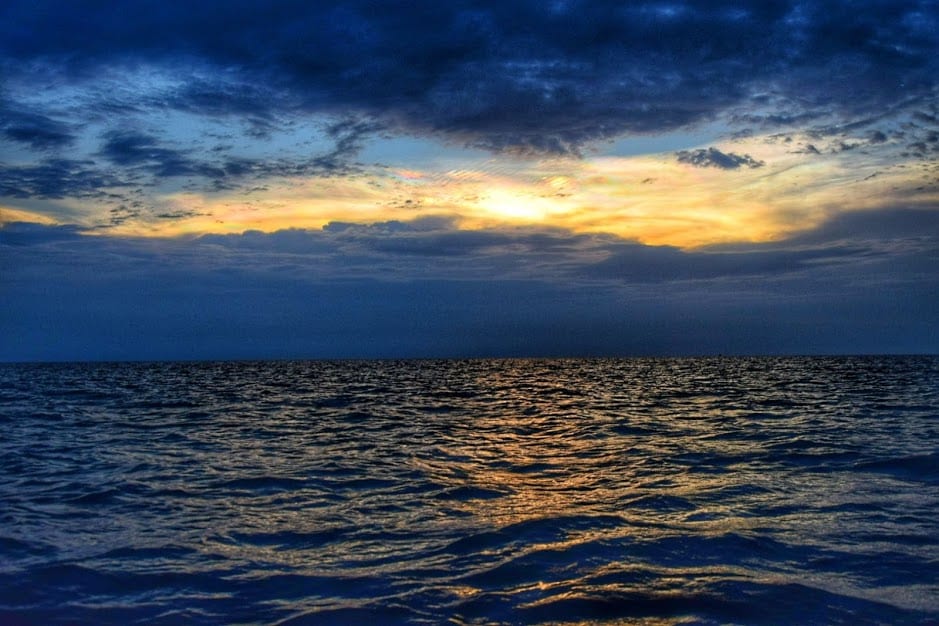
The best time to dive in the Zanzibar Archipelago is certainly from August to October/November, when the weather is windless, skies are clear, and visibility is incredible.
Humpback whales and sperm whales pass through Zanzibar waters around August and September, so that’s another point.
From December through to February, the winds are strong (kitesurfing season), resulting in bumpy boat rides and reduced visibility. It’s still a good season for diving if you have a lucky day.
The monsoon season usually starts in March and lasts throughout April and May. During this season, diving in Zanzibar is basically impossible.
Marine Life in Zanzibar
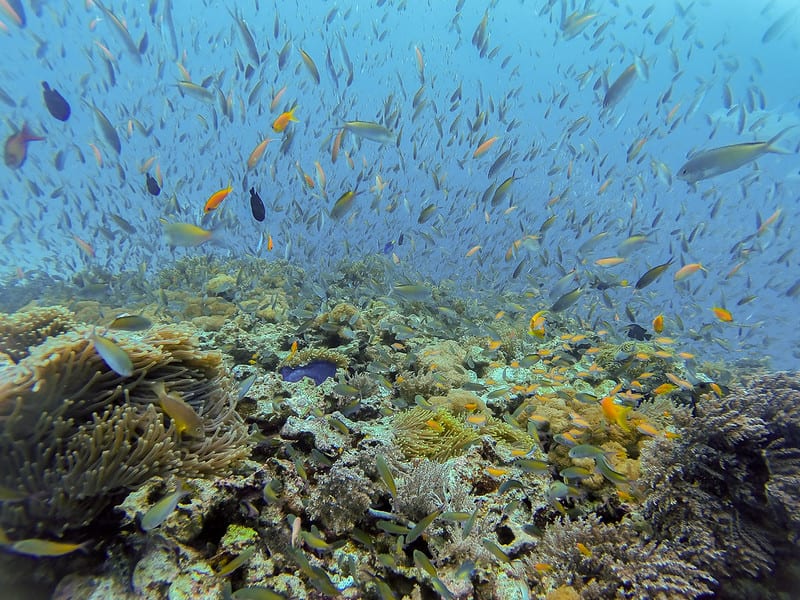
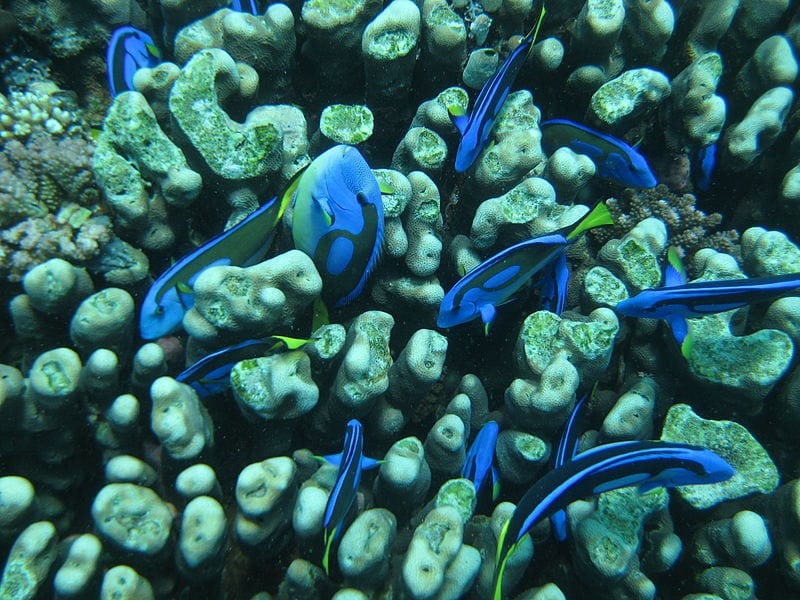
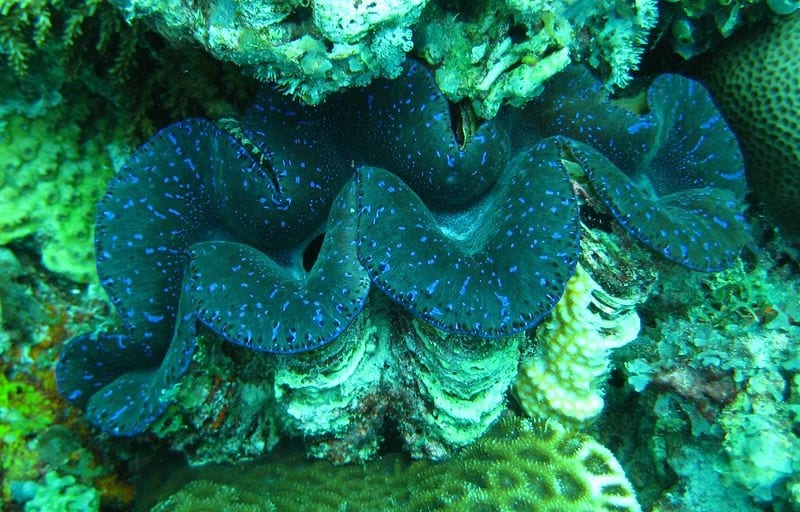
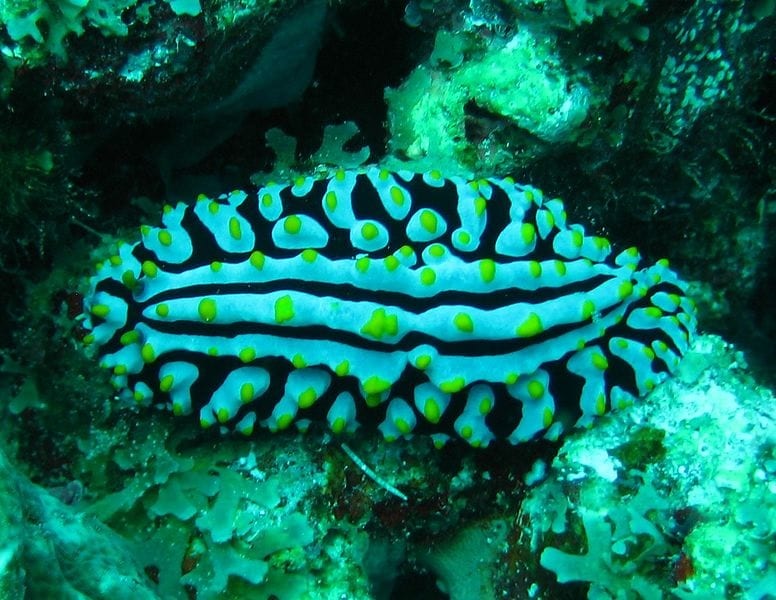
The Zanzibar Archipelago is famous for its abundance of reef fish and a large variety of small marine life. Sea creatures such as nudibranchs (a type of sea slug), leafy sea dragons, frogfish, giant clams, crocodilefish, seahorses, mantis shrimps, octopuses, and huge specimens of Napoleon fish are very common to spot.
There are many species of clown or anemone fish, a big population of lobsters, eels, schools of trumpetfish, lionfish, scorpion fish, and a lot more!
Dolphins are very common in Menai Bay, and turtles are frequently spotted there as well. Humpback and sperm whales pass near the Mnemba/Chwaka Bay Conservation Area in August/September.
Zanzibar, though, is not a diving destination for big pelagic species such as whale sharks, oceanic mantas, or great white sharks; those are very rare or absent. Large tunas, though, are everywhere.
Coral species are plentiful and diverse, from cabbage coral to anemone. Live cover (including all sessile organisms) is predominant at Mnemba (North) and Changuu (West).
Hard coral cover ranges are scarce in Kichwanito and plentiful at Pange. Soft corals comprise the dominant taxa in the northeastern region but are almost absent at the western sites.
Algal cover is high at Kendawi (39%) in the northwestern part of the island, where 30% of the reef is covered with turf algae.
Overall, the northwestern and northeastern regions have the highest diversity, while western reefs are dominated by extensive mono-stands of branching corals. “Mountains” of coral are impressive on the southwest reefs.
Source: researchgate.
Accommodation in Pemba
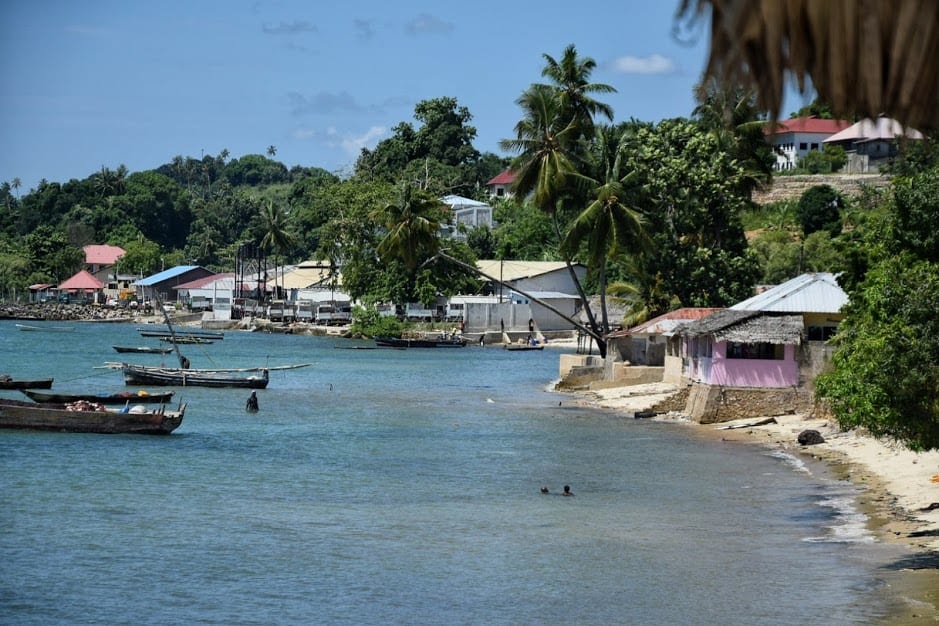
Being still a very untouristy island, accommodation choices in Pemba are pretty limited (especially when compared to Unguja.
The only resort with a dive center is Gecko Nature Lodge, which hosts Swahili Divers; their prices are higher than Zanzibar standards at 130/200$ for two dives in nearby/far-away reefs.
In the same area is another cool, quiet, upmarket lodge called The Manta Resort. They can also provide PADI courses (540$ for PADI Open Water certification) and certified dive masters (min 4 dives at 52$ per dive).
Our recommendation, though, especially for those on a budget, is certainly Lala Lodge in Mkoane – a slingshot from the ferry terminal. It might not have the fanciest rooms, but the food is absolutely great and much cheaper than its competitors, while its beach location is very nice.
The real value of this lodge, though, is its owner, Denis, who will solve any problem and fulfill any request (including diving) in an affordable, friendly manner.
Accommodation in Paje/Bajaawa – South East Zanzibar
The whole length of the coast is an infinite (20km long) white sand beach, almost entirely lined by hotels, guesthouses, and resorts of all price ranges.
We stayed in a few places during our 10-day stay in the area and checked out many others. Here are some recommendations:
Our absolute favorite is Mustapha’s Place, a mid-range accommodation in Paje. The place is really worth more than the 40$ they charge for a double room.
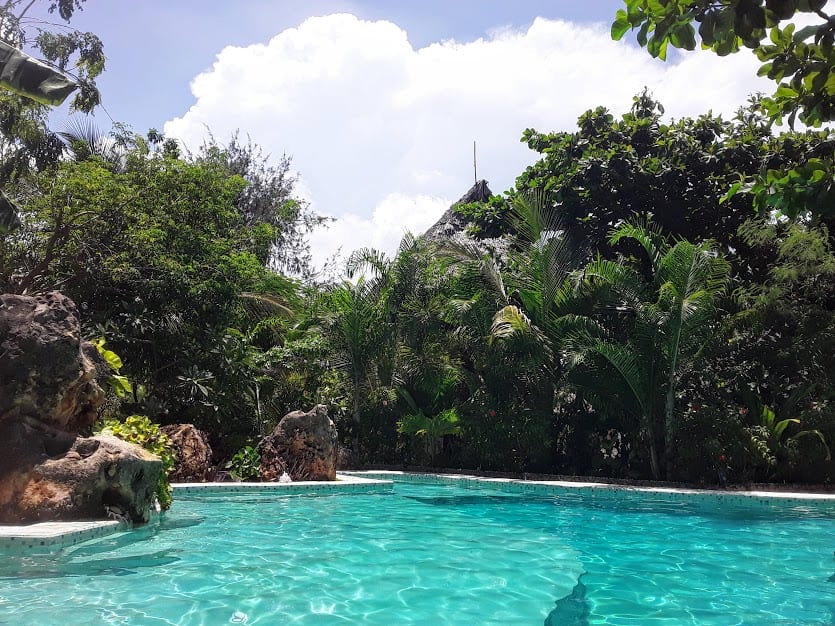
The garden is stunning, and the pool is one of the best I’ve seen on the island – big and shaded. The rooms are made with local materials; some are really pretty, some a bit less so.
There’s a huge restaurant terrace, but the food is a bit overpriced, and the quality depends a bit on luck”.
Where to Stay in Nungwi – North Unguja (Zanzibar)
Nungwi is the busiest part of Zanzibar. We recommend staying here if you’re a party-seeker, enjoy nightlife, or love all-inclusive resorts. We’ll add some of our favorite options once we get the time.