

Last Updated on 31 January 2026 by Cycloscope
Kagoshima & Sakurajima Volcano Travel Guide
Kagoshima is the capital city of Japan’s southernmost prefecture, which also bears the same name. It’s set in southeastern Kyushu. We arrived here from Fukuoka, as one of the first destinations of our bicycle trip in Japan.
Disclosure: Some of our articles contain affiliate links. This comes at no additional cost for you and helps us keep this website up and running. (as Amazon Associates we earn commission from qualifying purchases)

At the bottom of this page, you’ll find the map of our route from Fukuoka to Kirishima. Click on the red path to get the elevation profile.
For hints and tips about traveling in Japan on a very tight budget (less than 10USD per day), read our guide here. To have a panoramic view of our Japanese bicycle touring project, check our itinerary in this other article.
Sakurajima volcano
A Japanese Bicycle Touring Story
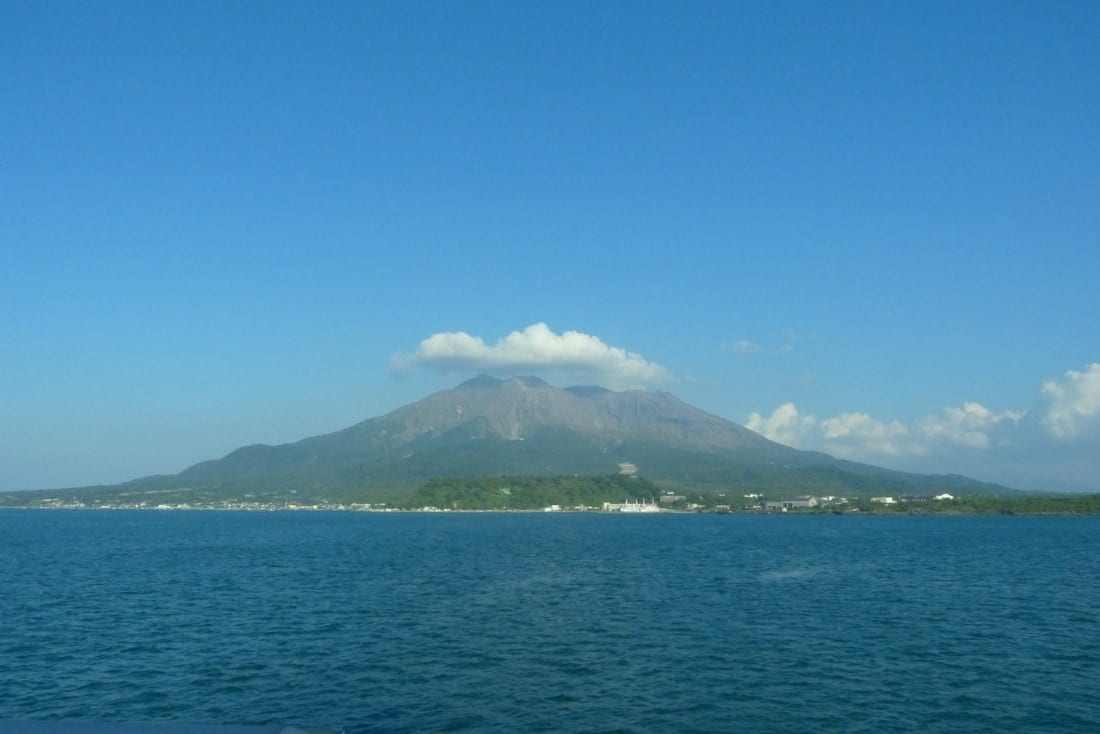
We arrive in beautiful Kagoshima, the Naples of Japan. Not meaning pizza and espresso, but a seaside town lying at the feet of a volcano, the Sakurajima. The volcano is on the other side of the Bay of Kinko. Not really interested in the city itself, we hop on the first ferry across the bay.
There’s one boat every 30 minutes or so. The price should be low, but we don’t precisely know; we didn’t pay, and nobody asked for tickets.
The Sakurajima volcano is just in front of us, beautiful in its 1117 meters of cooled lava.
It used to be an island, but during the eruption of 1914, one of the most violent, it joined the island of Kyushu in the Osumi Peninsula. The volcano is apparently one of the most active in the world.
Arriving at the volcano’s foothills, we went to the information center, where we met a Japanese person who spoke English for the first time. We see a documentary about the city’s history and its relationship with the volcano, and we notice the first significant difference with Naples: here, they are prepared for an eruption.
They built large concrete canals that led lava and mudslides to the sea, saving the city, shelters on the streets for the citizens, and, of course, an evacuation plan.
In addition, not less importantly, they proudly display the Guinness Book of World Records: Kagoshima has produced the largest turnip in the world, well, 31,5 kg. There is a photo of the proud farmer holding the super-tuber.
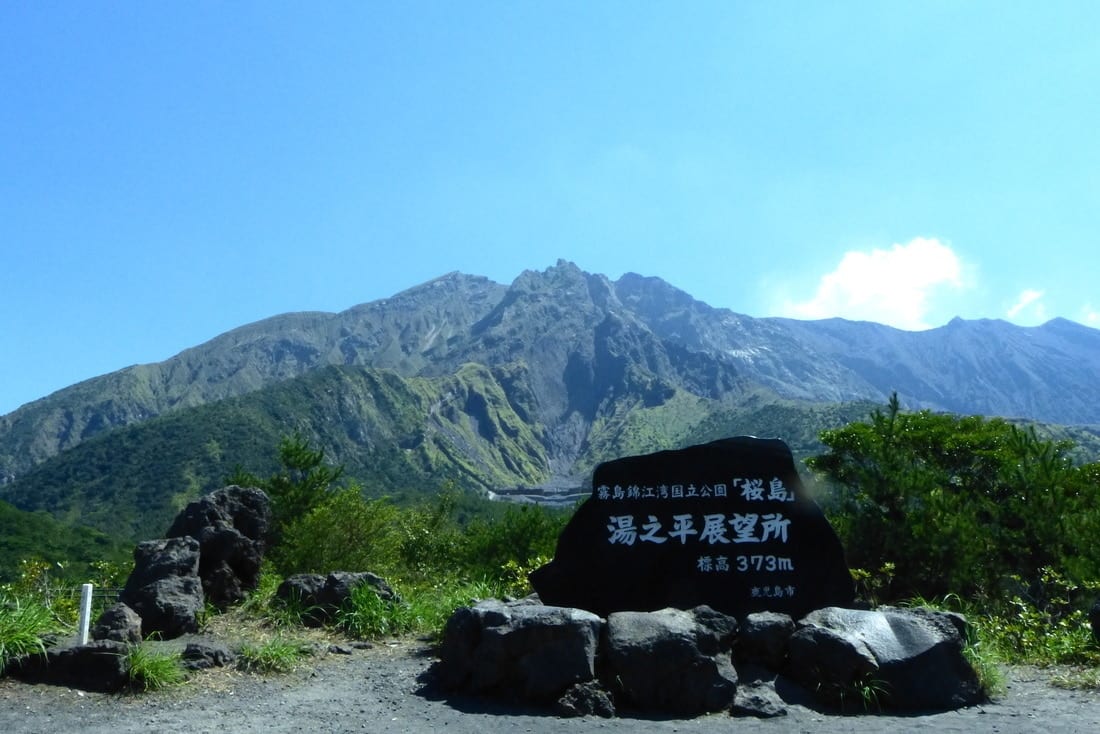
It is not possible to reach the top (of the volcano, not the turnip), but we cycle to the observation point, just 373 msl, from where we see the north peak, the oldest, and the southern one, newer and active.
The lava park
Going back down there’s a lava park, made by the 1914 eruption. Pines are already growing here; it’s beside the sea, and the shapes created by the cooling magma are impressive. The smell of vegetation and seawater reminds me of my hometown, Catania.
There’s a path through the park that we follow until we find the statue of a screaming singer and a flying V guitar; it’s a memorial for an epic concert attended by 70,000 people.
We try to bathe, but it is not easy; there are many algae, the rocks are sharp, and the nearby port makes the water uninviting.
We sleep in a wooden gazebo overlooking the volcano. In the morning, we bathe our feet in the thermal stream near the info center; it’s called a “foot onsen.” There are many of those in Japan, especially in Kyushu, and they are always free.
Foot onsen and getting out
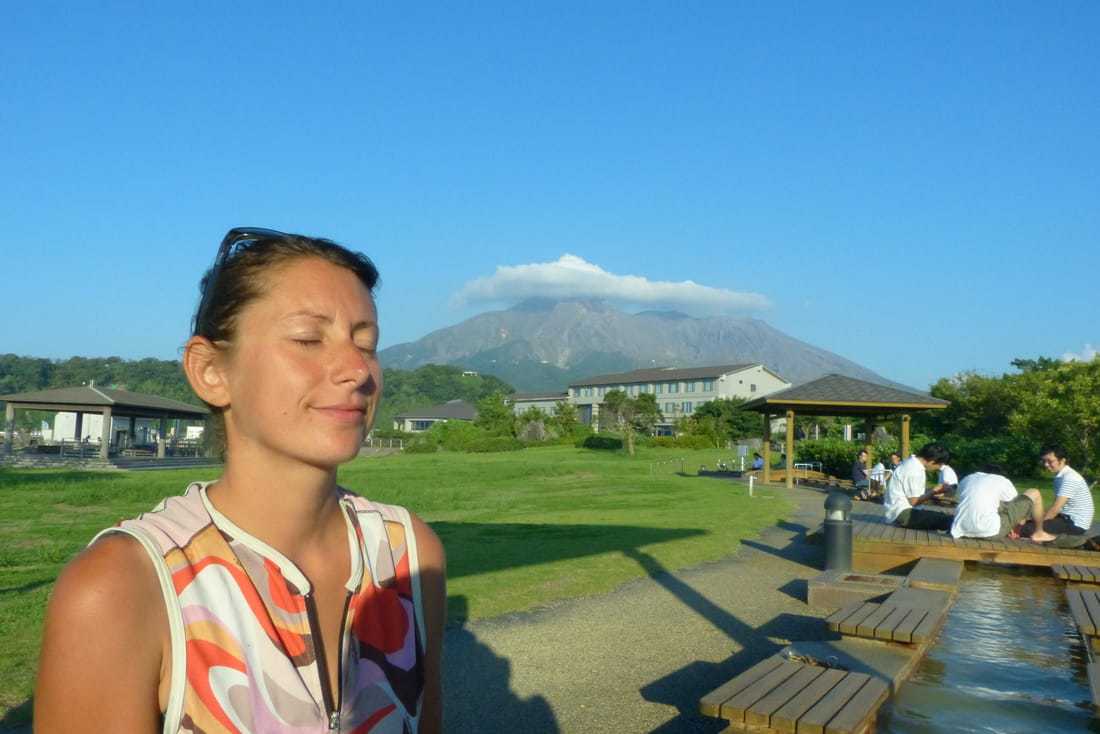
Along the coast, we see the volcano from all sides; it smokes. We stop next to the umpteenth “information point”, where there are also free “feet hot springs”. We put the tent under a tree in the nearby car park as recommended by an old hippie with a van, here to paint and sell paintings to tourists.
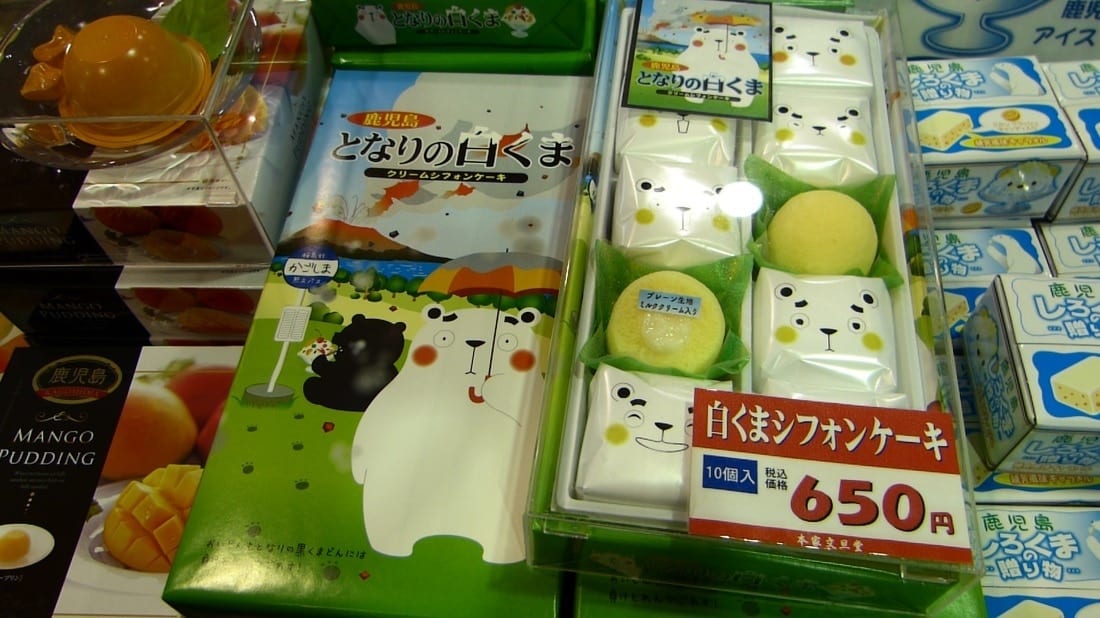
We eat with our feet in warm water and poke around in the tourist shop that sells local products. Everything is kawaii (cute) and cartoonish, like only Japan can be. Biscuits with a smiley face, in the shape of drunken samurai, animals, samurai animals, and so on.
Just before sunset, the volcano erupts. The huge cloud gets iridescent. There have been 700 eruptions this year.
Here’s the map of the route we first cycled in Kyushu, from Fukuoka to Nobeoka through Kagoshima.
Please comment, like, and share on social networks if you like!
Follow us