

Last Updated on 31 January 2026 by Cycloscope
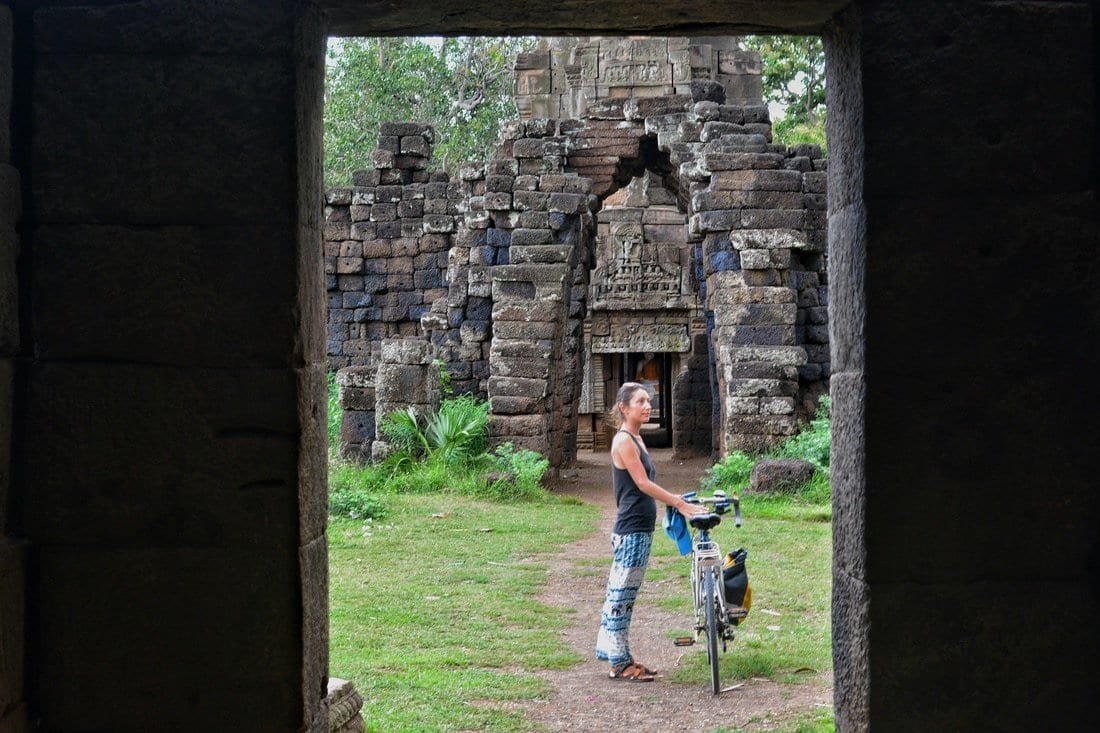
Cycle from Phnom Penh through Cambodia’s countryside, exploring Kratie, Kampong Cham, and Stung Treng with tips for a memorable bike adventure.
This is the third part of a detailed description of Cambodia’s bike tour. Coming from Thailand in August, we crossed this beautiful and deeply emotional country, heading to the only border with Laos. Here’s the description of the last 439km, from Phnom Penh to the Lao border.
Click here for part1: from Koh Khong Thai border to Kampot
Click here for part2: from Kampot to Phnom Penh
Disclosure: Some of our articles contain affiliate links. This comes at no additional cost for you and helps us keep this website up and running. (as Amazon Associates we earn commission from qualifying purchases)
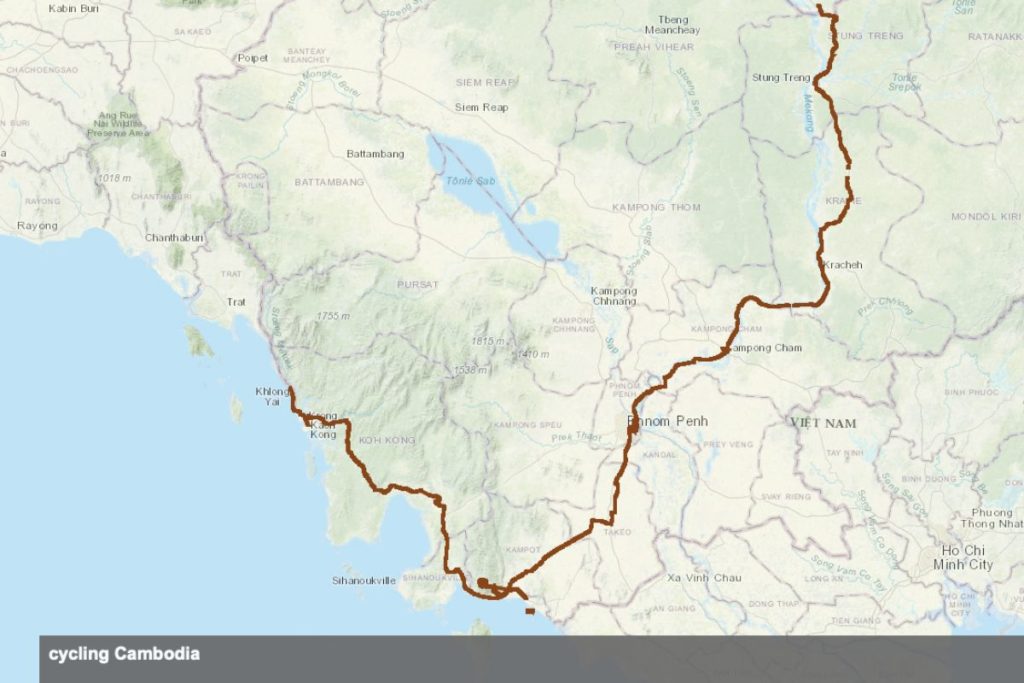
At the bottom of the article is the map of the whole Cambodian tour. Click on the track to get the elevation profile.
For general hints and tricks to keep your budget extremely low while traveling in Cambodia, check out this article.
From Phnom Penh to Kampong Cham – 112km
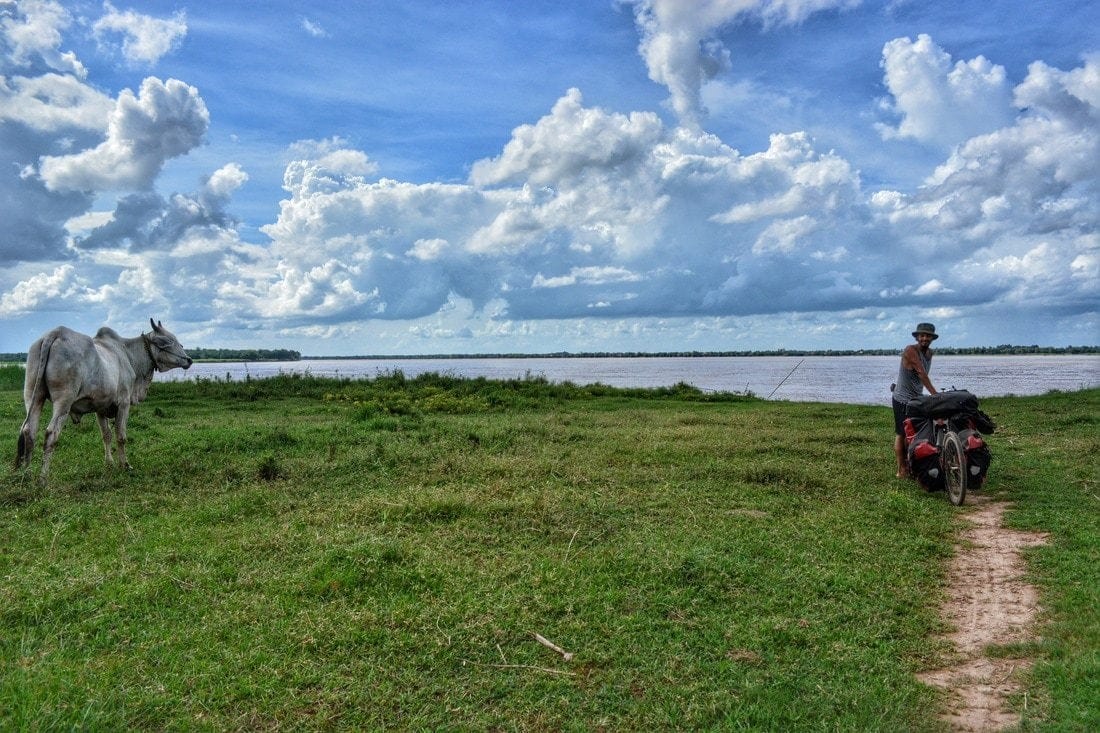
Leaving Phnom Penh northward is no big deal compared to getting in from the South. Get to the Mekong and follow it; there’s the main road, Highway 6, not beautiful but wide, with plenty of overpriced accommodations.
For a long stretch, it has a much nicer side road that runs parallel to the very shores of the Mekong; follow that as far as you can. Many villages and restaurants.
At KM40, there’s the first bridge across the Mekong, which leads to the town of Khsach Kandal (ខ្សាច់កណ្ដាល), where there’s a love-motel-style guesthouse with no WiFi.
From here, we followed Road 381 and then turned right because locals said the road was messy (check the map).
So from here began a 43km unpaved leg, the road was a little tricky sometimes but still rideable, even though it rained the night before, keep in mind however that taking unpaved roads in Cambodia is always a gamble, and don’t blame us if you find yourself in a river of mud.
This stretch of road, however, is really beautiful, especially the last 20km along the river, a glimpse of the Mekong lifestyle. These kinds of roads are the reason why we love bicycle travel.
Near the village of Oleng, there’s a ferry crossing and a slow barge that goes approximately every hour (coordinates 11°55’25.1″N 105°16’07.7″ E) to Kang Maes, at the crossroads of roads 70 and 223. The latter brings you to Kampong Cham in 25 super-easy kilometers.
However, just beside the pier, visible from the boat, there’s a very nice guesthouse with a view of the river (7 USD), we loved that, and WiFi was available.
It’s possible to reach Kampong Cham without crossing the river by ferry, but it’s a long, tricky route through the countryside. My advice is to attempt this only in the dry season.
Kampong Cham
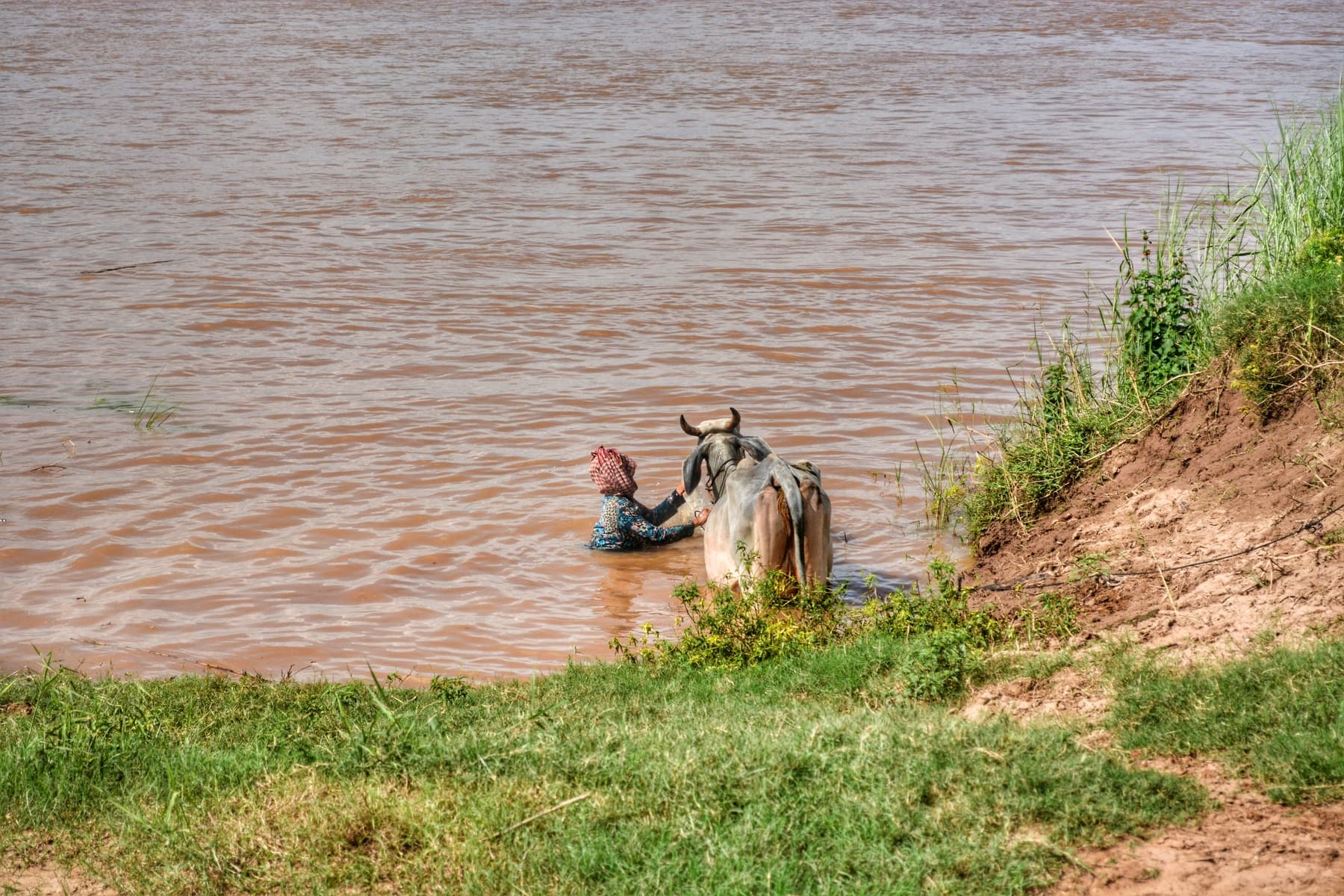
Cham is the name of a Cambodian ethnic minority, mostly Muslim, which indeed concentrates most of the 217,000 individuals in this province.
The area also played a key role during the Khmer Rouge uprising and seizure of power: from here, the Cambodian communists launched their assault on Phnom Penh.
The city was for a long while a stronghold of Pol Pot’s army, and the local Muslim community suffered even more than the rest of the Cambodians, not because of some racial issue but mainly because of the reluctance of the Chams to abandon their traditions and rites.
Kampong Cham is nowadays one of the most beautiful Cambodian cities; it ranks 6th for population in Cambodia, with just 118.000 inhabitants.
The town is a model to follow for neatness and decorum, with a splendid riverside lined with restaurants and guesthouses, it aims to become a major tourist center in the next decade.
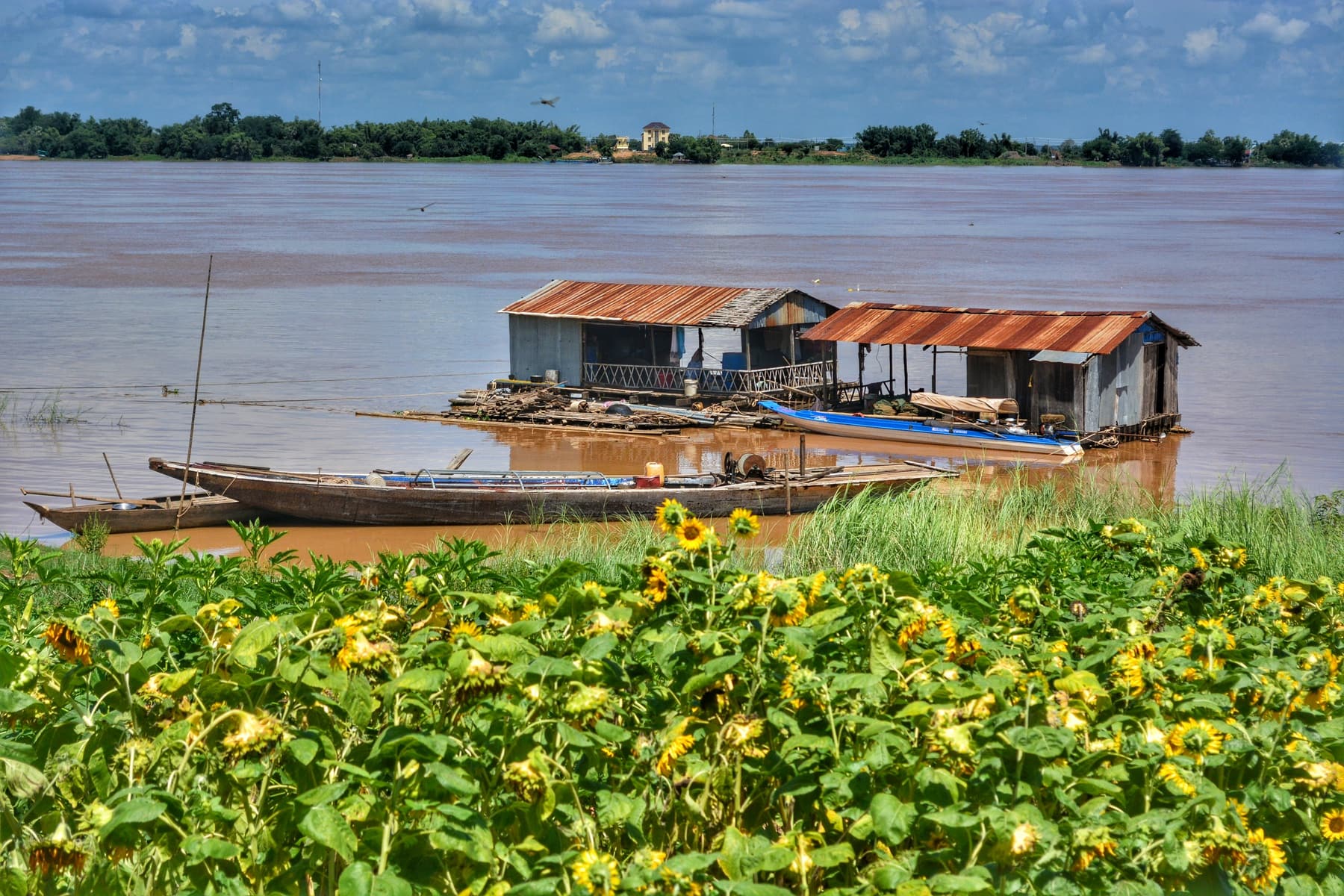
Besides the laid-back riverside atmosphere, there are a few things to see in the area, the best being the famous bamboo bridge to Koh Paen, an island in the Mekong.
This is in the southern part of town, not far from the main bridge. However, we missed that, since it’s washed away during the wet season and rebuilt every year.
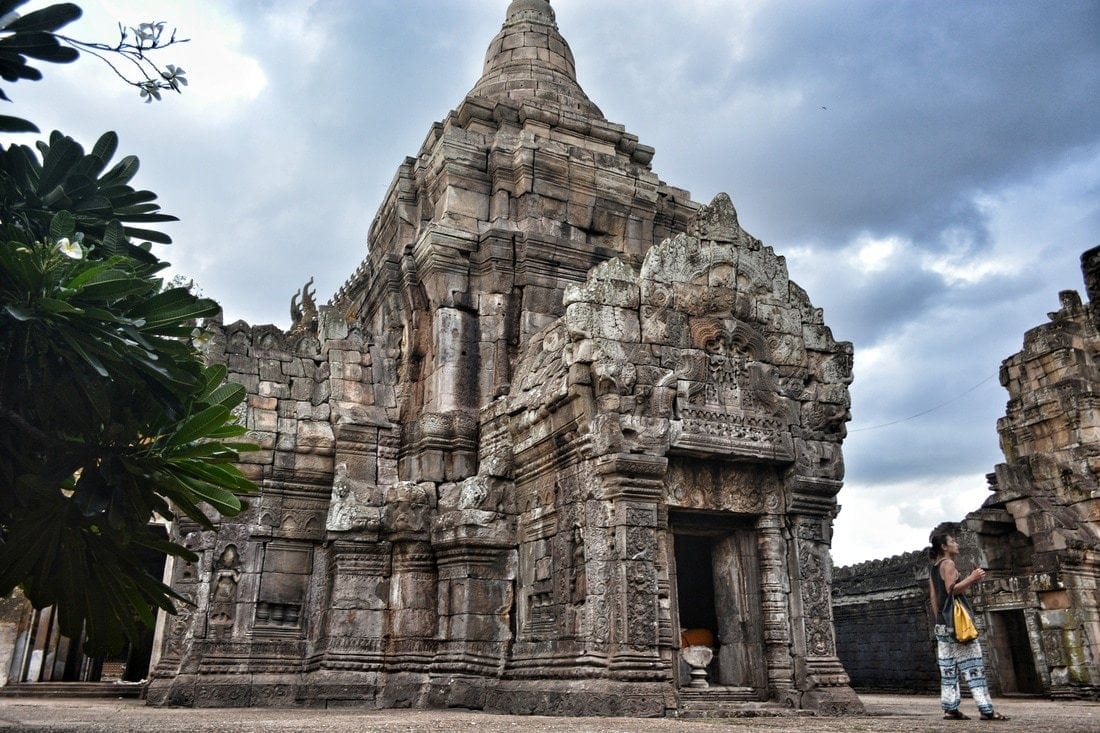
What we really enjoyed was Nokor Wat (coordinates 12°00’00.3″N 105°26’20.6″E, less than 5km from the city center), an 11th-century Angkorian temple lying in disrepair but completely tourist-free.
On the same site, there’s an NGO, named BSDA that trains disadvantaged kids in Apsara Traditional Dances, performances are on request so maybe contact them before.
When we were here the kids had just finished their daily training, we booked a performance for the day after (just for us! Based on the donation) but unfortunately, there was a biblical downpour, and since the place is open air…
Kampong Cham to Kratie – 124km
Cycling (or riding or walking or whatever you like) along National Road 222, past the real Cham villages, is a very interesting ride, a good chance to cast a glimpse at this minority’s lifestyle. A mosque on stilts above the water is surely a unique sight.
An easy 36km lead to Phumi Prek Kak (or Stueng Trang or Stung Trong), a sleepy village with a muddy riverside boardwalk, a crappy guesthouse, and nothing more, from here there’s a car ferry to cross the river, road 222 takes a turn west so to keep following the river one must cross to the east bank and hit road 308.
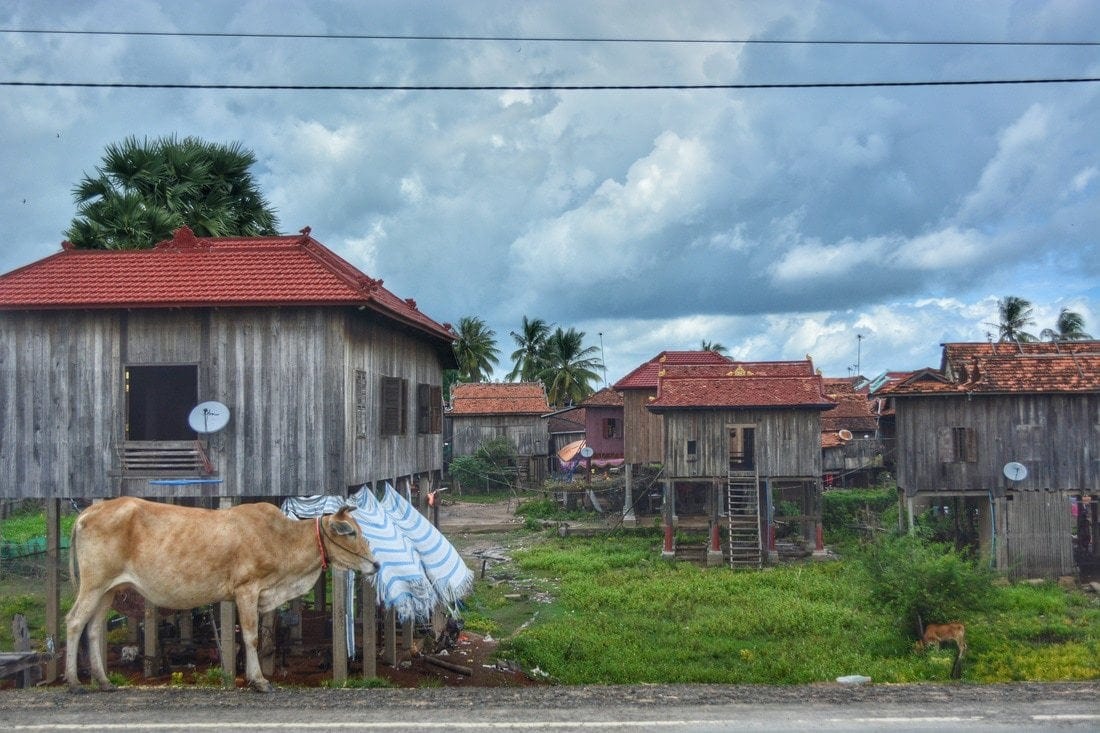
From there, there is a very nice 53km to the next guesthouse in Chhlong, and 35km more to the slightly touristic town of Kratie. This part is beautiful and very tranquil, with the Mekong mostly in view. Traditional stilted Khmer houses, as usual, are tall and made of wood.
Kratie
Kratie (Krong Kracheh) is mostly famous for being one of the few places in the world where the endangered Irrawaddy dolphins live. The view spot itself is actually in the village of Kampi, around 20 kilometers north, on a mixed concrete/dirt road.
The town of Kratie itself is basically all about guesthouses and tourist restaurants, serving a mix of Western/Cambodian favorites. Cute colonial architecture, nice for a stroll on the riverside, and a hamburger or tofu-burger, for the greenies.
Apparently, the small island facing the town is lovely and has a cycling path that goes around it, but since either this or the dolphin view requires a fee, needless to say, we didn’t do it, cash shortage being a classic for the poor cycloscopicos.
Kratie to Stung Treng – 140km
Past Kampi, the last settlement for miles and miles, is Sangkum, after which we find ourselves in one of the poorest areas of the world we’ve ever been.
Houses are rotten; some miss walls, some miss roofs; some are made of scrap-metal sheets; kids’ clothes are torn; people look lazier than ever, and sometimes even desperate. Many landmines left from the Khmer Rouge era make rice growing a deadly business here.
Just 19km, and the road joins Highway 7, from now on, there’s nothing, I mean really nothing, until Stung Treng, 120km past Sangkum.
Small signs warn of the presence of mines, few bomb craters are visible. No food, no water, no accommodation, no houses, nothing at all (18-01-2017 Update: it seems we’re wrong about that, check the comments).
A wide flat road with few cars heading to Lao, that’s it.
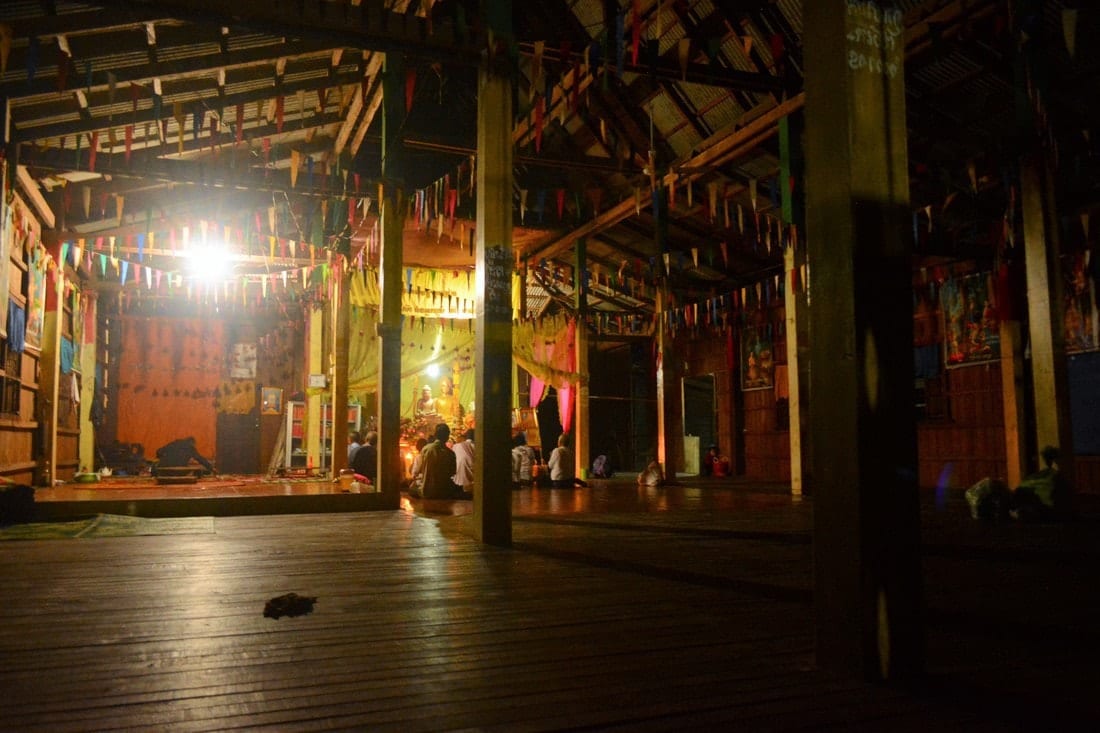
Here’s when we found shelter in a Buddhist temple, we asked the oldest monk and he agreed. In exchange for a 4 USD compulsory donation, we could sleep inside the praying hall, which was not a great idea, since we had been woken up one hour before by the prayer’s preparation before the deafening drum began shaking the wooden structure, a few meters from our ears.
Stung Treng
Stung Treng could be beautiful, but it is not. A quite big town by Cambodian standards, it has a decadent atmosphere and a lazy way of being.
Being mainly a stopover for tourists traveling from Laos to Siem Reap or other destinations in Cambodia, it doesn’t aim at being much more, a pity.
Guesthouses are plenty, just don’t go where all the backpackers go, the one in the muddy minibus parking lot with the restaurant inside, that really is the worst.
Can make use of the restaurant tough, since there are only two serving a few Western-style stuff (the other one being in front of the ATM, slightly better IMHO).
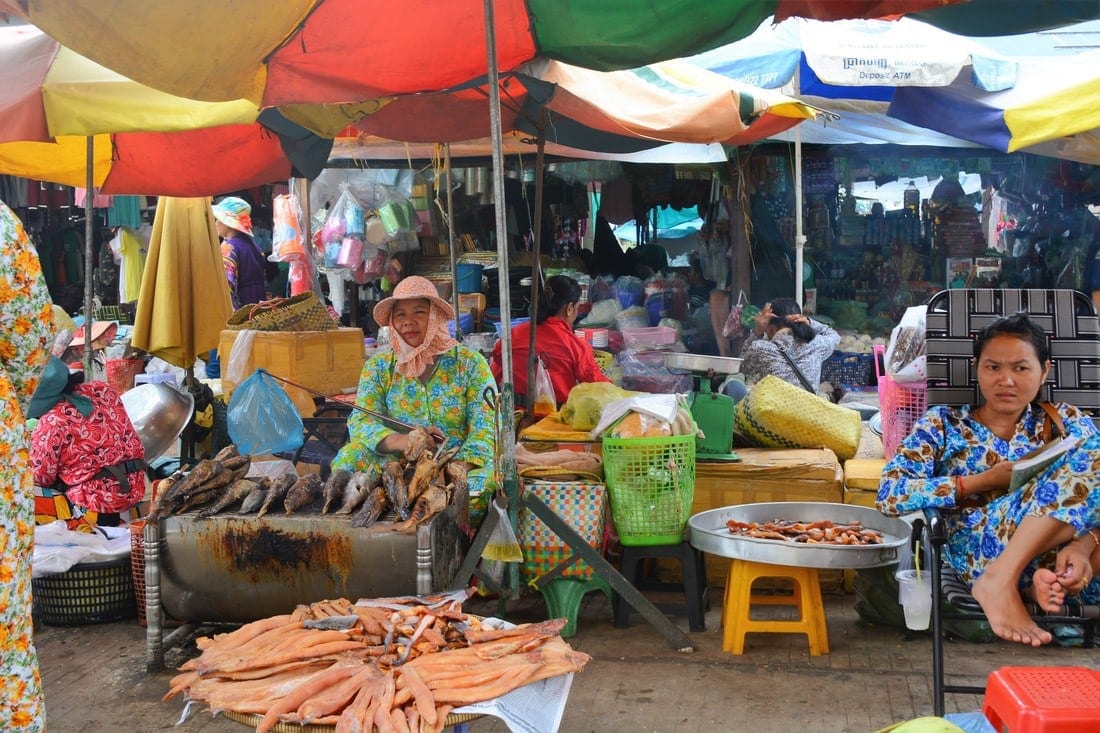
The highlight of Stung Treng is no doubt the big market, plentiful fruit, clothes, and dubious food stalls (visit them in the morning, when the food has just been cooked).
This is the only place we saw wild animals sold illegally as meat: turtles, monitor lizards, monkeys, a weird rodent, and more, whose identities were hard to figure out.
From Stung Treng to Lao border crossing – 63km
From Stung Treng to the Lao border are 63 more lazy kilometers of nothingness, the only small settlement being less than 10km from Laos, where the road takes a bend west and follows the border until the frontier checkpoint.
Being the only crossing between Cambodia and Laos, the border is surprisingly quiet; if you’re unlucky, you could meet one of the few big buses that could slow the thing down.
Anyway, visa on arrival procedure is smooth, pay the fee, depending on your country, 30 or 35USD for most countries, plus 2$ for the stamp fee, plus a 1 or 2 dollars bribe… yes bribe, but this time there really was no choice, pay or stay in Cambodia. Anyway, if they ask more, try to bargain, though I don’t see much chance here.
There are also some more shady, but official, fees if you cross after 4 p.m. or on weekends. The chance of being scammed is greater for tourists in groups than it is for bicycle tourers, as always.
If you found this article useful, please don’t forget to follow us on
Facebook, Instagram, and youtube
If you have more information, please feel free to contribute in the comments!
Our Itinerary
Follow us