

Last Updated on 6 September 2026 by Cycloscope
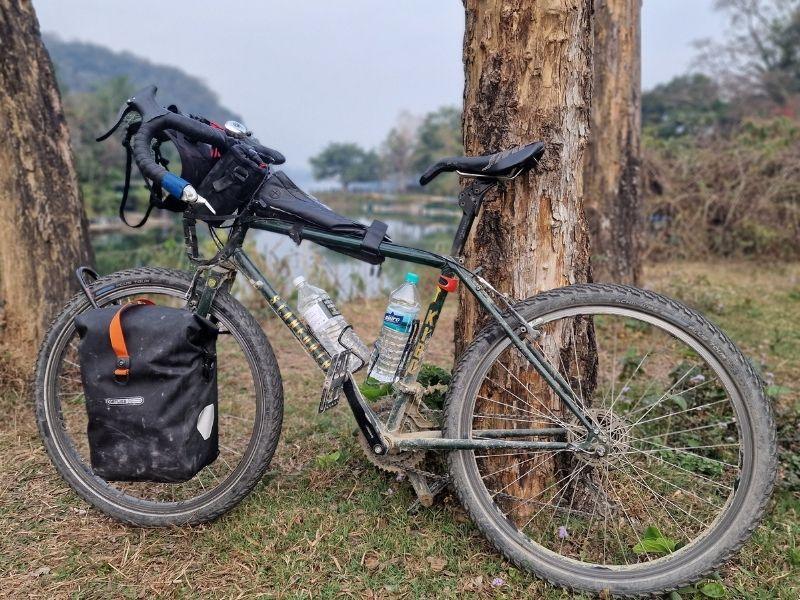
We review SMP saddles after long-distance bicycle touring in Albania, North Macedonia, and Nepal. Comfort, fit, models, customization, pros and cons.
A bicycle saddle is one of those pieces of equipment that is easy to underestimate. A saddle can feel perfectly comfortable on a short ride and become a completely different story after six or seven hours in the saddle, particularly when you repeat the same thing day after day with a loaded touring bicycle.
Disclosure: Some of our articles contain affiliate links. This comes at no additional cost for you and helps us keep this website up and running. (as Amazon Associates we earn commission from qualifying purchases)
We’ve spent a long time riding with Selle SMP saddles, including extended trips through Albania, North Macedonia and Nepal. We have tested two different models, used by a male and a female rider, respectively, and have had the opportunity to use them in the kinds of conditions where a touring saddle really has to prove itself: long days, mountain roads, rough surfaces, heavy luggage, and consecutive days of cycling.
Our experience has been very positive, but there is an important qualification. Selle SMP saddles are highly individual. The distinctive shape that makes them exceptionally comfortable for some cyclists can feel strange to others, and choosing the correct model is much more important than simply choosing a saddle with plenty of padding.
SMP saddles are available on Amazon, Sellesmp.com, and Backcountry.
A very different-looking bicycle saddle
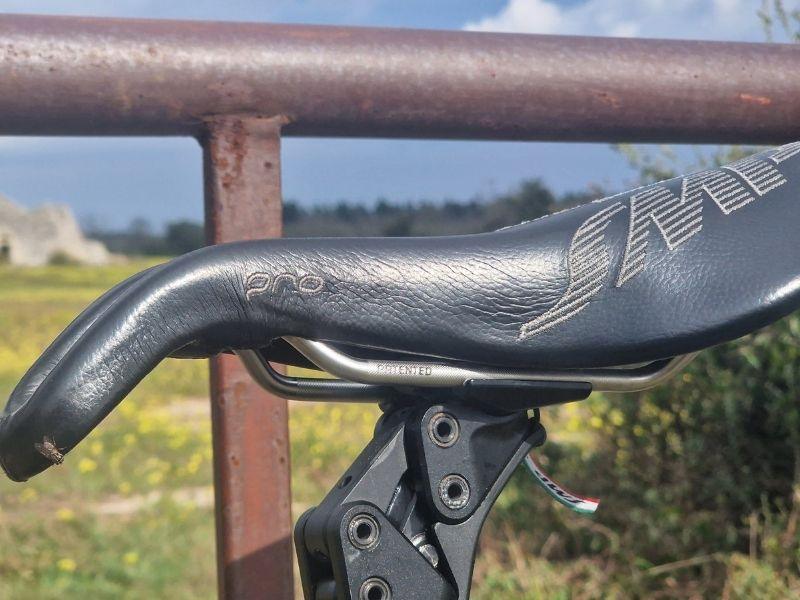
The first thing you notice about a Selle SMP saddle is its shape.
The large central channel is impossible to miss, but the whole saddle is different from a conventional touring saddle. The rear section is curved and supportive, the sides rise toward the centre, and the nose drops sharply downward in what Selle SMP calls its characteristic “eagle-beak” shape.
It looks unusual because it is designed around a different idea of how a cyclist should be supported.
Rather than spreading pressure more or less uniformly across a padded saddle, Selle SMP’s ergonomic design is intended to support the rider primarily around the sit bones while reducing pressure on the soft tissues in the centre. The central channel extends along the saddle, while the shape of the nose is designed to reduce pressure in the front part of the saddle.
According to Selle SMP, the correct saddle should allow the sit bones to rest securely on the rear support area while the central section remains relatively free of pressure. The company also stresses that saddle width alone isn’t enough: the profile, shape, riding position and adjustment all influence the final result.
This is something we came to appreciate particularly during long days.
The saddle doesn’t necessarily feel immediately luxurious. Instead, it feels as though it is putting support in very specific places and deliberately removing it from others.
And the longer you ride, the more that distinction matters.
Two riders, two different Selle SMP saddles
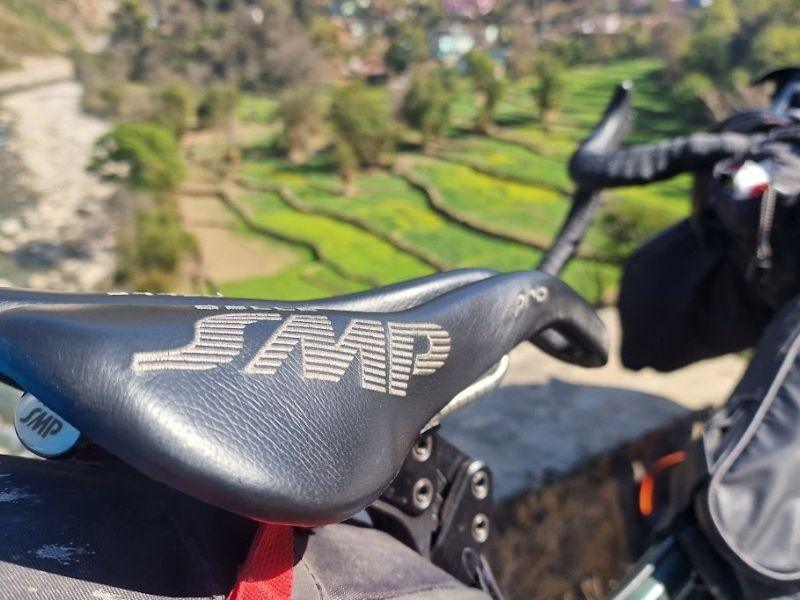
For this review we used two different Selle SMP saddles, one for a male rider and one for a female rider.
It would be easy to describe these as a “men’s” and a “women’s” saddle, but that isn’t really how Selle SMP approaches its range. The company explicitly states that it does not divide its saddles by gender. Both men and women can use the same models; the important variables are individual anatomy, sit-bone width, riding position, intended use, and personal preference.
This actually makes more sense once you have ridden the saddles.
The two riders have different bodies and different requirements, so the saddles were selected accordingly. The difference isn’t simply that one saddle is designed for a man and the other for a woman. It is that each rider needs a different relationship between their pelvis and the saddle.
This is one of the things we like about the Selle SMP approach. Rather than assuming that everyone of a particular sex or body type needs the same saddle, the company offers a wide range of shapes and sizes.
That also means that you shouldn’t necessarily buy the same Selle SMP saddle simply because another cyclist tells you it is fantastic.
Choosing the right Selle SMP
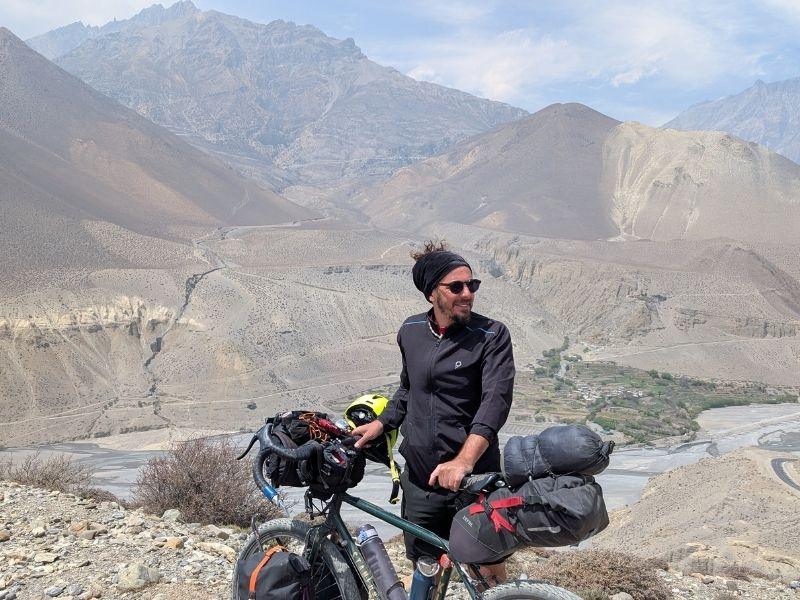
This is probably the most important part of the whole review.
Selle SMP’s range can initially be confusing because there are so many models. However, the choice is not simply about finding the widest saddle or the one with the most padding.
The starting point is the distance between your sit bones. Selle SMP recommends measuring this with its S-Tool at an authorised retailer, while its Saddle Finder also takes into account the type of bicycle, riding discipline, frequency of use, riding position and desired level of padding.
This is important because saddle width and sit-bone width are not the same thing.
A saddle that is too narrow may fail to provide proper support underneath the sit bones, while one that is excessively wide can interfere with the thighs and become uncomfortable in a different way. The shape of the support area is just as important as the measurement printed in the specifications.
And then there is the question of padding.
More padding doesn’t automatically mean more comfort. Selle SMP itself distinguishes between firmer models, which provide more direct and stable support, and more padded models, which offer a softer initial sensation.
After spending thousands of kilometres on these saddles, we’d agree with that distinction.
Selle SMP models and specifications
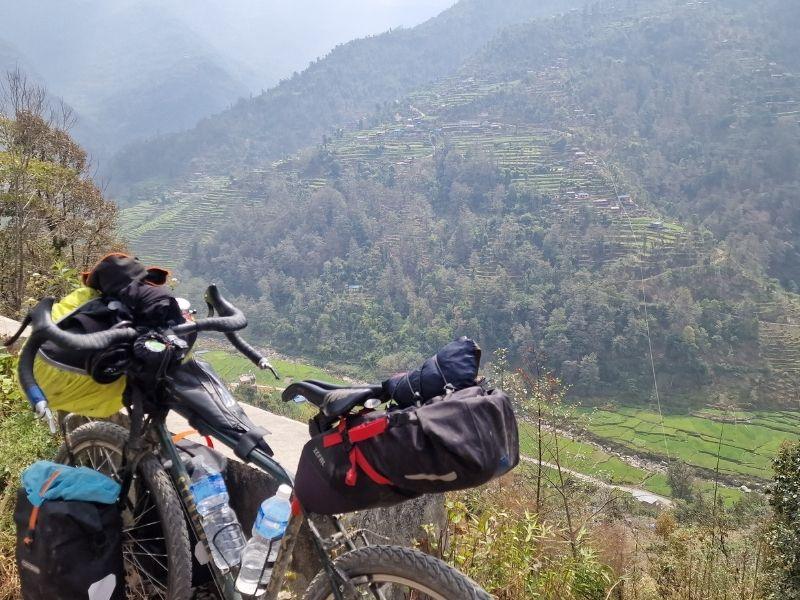
For touring and trekking, the TRK and Martin Touring families are the most relevant parts of the current Selle SMP range. The TRK models are considerably more compact, while the Martin Touring models are much wider and more heavily padded. Selle SMP currently lists both ranges under its Trekking/City category.
| Model | Recommended sit-bone width | Width | Length | Weight | Padding |
|---|---|---|---|---|---|
| TRK Medium | 90–124 mm | 160 mm | 280 mm | 405 g | Polyurethane |
| TRK Medium Gel | 90–124 mm | 160 mm | 280 mm | 485 g | Polyurethane + Gel |
| TRK Large | 125–150 mm | 177 mm | 272 mm | 410 g | Polyurethane |
| TRK Large Gel | 125–150 mm | 177 mm | 272 mm | 500 g | Polyurethane + Gel |
| Martin Touring Medium | 90–140 mm | 218 mm | 255 mm | 560 g | Polyurethane |
| Martin Touring Medium Gel | 90–140 mm | 218 mm | 255 mm | 655 g | Polyurethane + Gel |
| Martin Touring Large | 141–150 mm | 263 mm | 256 mm | 615 g | Polyurethane |
| Martin Touring Large Gel | 141–150 mm | 263 mm | 256 mm | 710 g | Polyurethane + Gel |
Specifications are from Selle SMP’s current product pages.
The table also illustrates how much customization is possible without the need to think in terms of male and female versions. For example, the TRK Medium and TRK Large have different recommended sit-bone ranges, while the Gel versions add a self-moulding gel insert and around 80–90 g of additional weight.
The Martin Touring models take the concept of a wide, padded saddle considerably further. At 218 mm wide, the Martin Touring Medium is already substantially wider than the TRK Medium, while the Martin Touring Large reaches 263 mm. The latter is clearly aimed at cyclists looking for a particularly broad support area rather than riders concerned with keeping weight and dimensions to a minimum.
For a loaded touring bicycle, we’d generally be more interested in getting the correct shape and support than saving a few hundred grams.
What is the difference between the standard and Gel versions?
The Gel versions are not simply a softer version of exactly the same saddle.
They retain the same overall SMP ergonomic concept, but add a self-moulding gel insert to the polyurethane padding. Selle SMP says that the gel is designed to adapt to the rider and reduce pressure at anatomical pressure points.
There is also a noticeable weight penalty.
For example, the TRK Medium weighs 405 g, compared with 485 g for the TRK Medium Gel. The TRK Large increases from 410 g to 500 g when moving to the Gel version.
For an everyday touring bicycle, that extra weight is unlikely to matter much. For an ultralight bikepacking setup, it might.
The more important question is whether you prefer the feel of the gel. For some riders, the additional softness is worth it; for others, the firmer and more direct support of the standard version may actually feel better over long distances.
How does the Selle SMP feel on a long-distance tour?
This is where our experience with the saddles becomes more interesting than the specifications.
We’ve used them in Albania and North Macedonia, where touring can alternate between good asphalt, rough secondary roads, steep climbs and long descents. We’ve also ridden with them in Nepal, where the combination of rough surfaces, climbing, altitude and loaded bicycles creates a considerably more demanding test.
On a long-distance tour, saddle comfort is cumulative.
The question isn’t whether the saddle feels good when you first sit down at 8 a.m. The real question is what it feels like at 3 or 4 p.m., and then what happens when you climb back onto the same saddle the following morning.
This is where we found the SMP design particularly convincing.
The saddle provides a very defined area of support beneath the pelvis. At the same time, the large central channel means that the middle of the saddle isn’t continually pressing into the perineal area.
After several hours, that becomes much more significant than whether the saddle initially feels soft.
We wouldn’t describe our SMP saddles as “sofa comfortable”. They don’t make a long day in the saddle disappear.
What they do is provide stable, predictable support without making the centre of the saddle carry more pressure than necessary.
For us, that is a much more useful definition of comfort.
Touring in Albania and North Macedonia
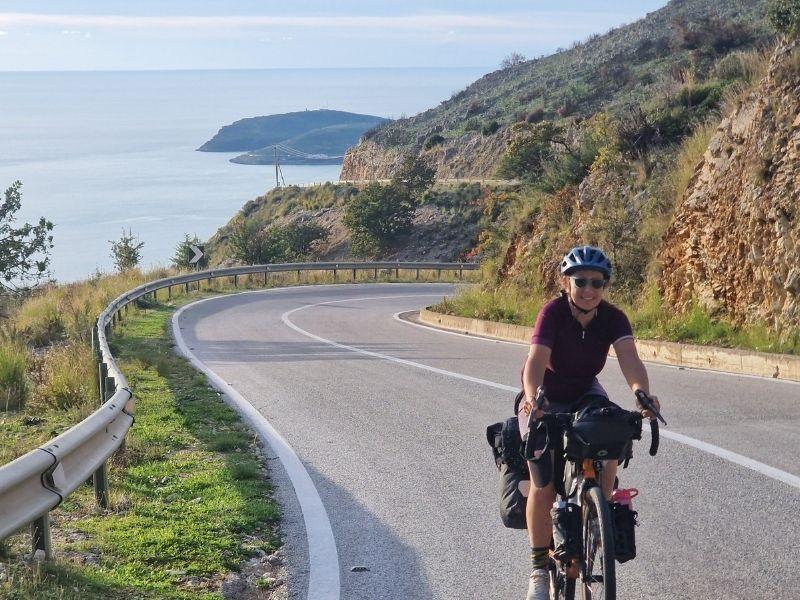
The Balkan trips were particularly useful because they exposed the saddles to a wide variety of riding.
There were days of relatively smooth roads and days when the surface became much rougher. There were long climbs where the position on the saddle changed repeatedly and descents where the bicycle was moving over rough surfaces at speed.
With luggage on the bicycle, the saddle becomes even more important.
A loaded touring bicycle puts more demand on the rider’s contact points, and the saddle needs to remain stable rather than forcing the rider to constantly move around looking for a comfortable position.
This is one of the characteristics we appreciated about the SMP.
Once properly adjusted, the saddle gives you a fairly clear place to sit. The pelvis feels supported rather than floating on a thick layer of soft padding.
That isn’t something that necessarily impresses you during a ten-minute test ride.
After several consecutive touring days, however, it becomes much more noticeable.
Nepal was the real test
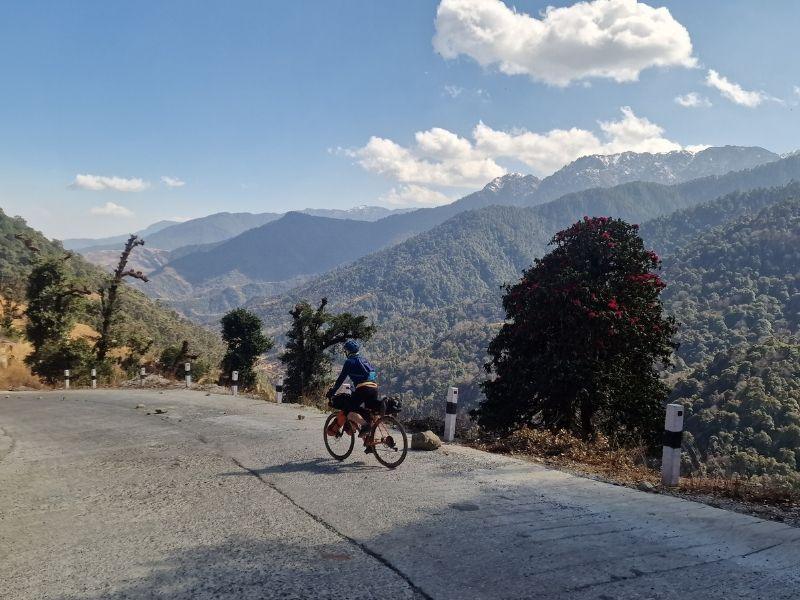
Nepal provided an even more demanding environment.
Long climbs, rough roads, and heavily loaded bicycles can make every contact point on the bike more noticeable. When you’re spending hours climbing and descending, small problems that you can ignore on a short ride become much harder to ignore.
The SMP saddles continued to work well in those conditions.
What stood out most was not a particular moment of extraordinary comfort, but the lack of a progressive increase in saddle discomfort as the riding day went on.
There is an important difference.
No saddle is going to make an eight-hour day in the Himalayas painless. Your legs will get tired, your back will get tired and your whole body will know that you’ve spent the day cycling.
But the saddle shouldn’t be the thing that makes you want to stop.
For us, the SMP performed well in exactly that respect.
The central cut-out isn’t a gimmick
The large central channel is probably the feature that makes the SMP look most unusual, and it’s also the feature that requires the least imagination to understand once you’ve ridden one for a long time.
On a conventional saddle, a significant amount of the rider’s body can be supported across the central area. SMP instead leaves this section open.
The idea is to allow the sit bones to provide the primary support while reducing pressure on the soft tissues in the centre.
Selle SMP’s current ergonomic guidance describes the central channel and downward-sloping nose as key parts of its pressure-management system. It also stresses that the saddle still has to be correctly sized and positioned; the cut-out cannot compensate for an unsuitable saddle.
This last point is important.
A cut-out doesn’t automatically make a saddle comfortable.
If the saddle is the wrong width, the wrong shape or incorrectly adjusted, you can still have problems.
Getting the position right
This is perhaps the biggest warning we’d give someone buying an SMP.
Don’t judge the saddle until you’ve spent some time getting the position right.
Selle SMP recommends making adjustments in small increments, particularly with saddle height and fore-and-aft position. The company also notes that its longer rail design gives a substantial range of adjustment.
We would follow that philosophy.
Install the saddle, start from a sensible position and ride it. If something doesn’t feel right, change one thing by a few millimetres and ride again.
Don’t simultaneously change the height, tilt and setback and then try to work out what happened.
The shape of an SMP is sufficiently distinctive that small positional changes can noticeably alter the way your weight is distributed.
And don’t necessarily make a final judgement after your first 20-minute ride.
Your body needs to understand the saddle as well.
Comfort versus softness
One of the most useful things we’ve learned from riding these saddles is that comfort and softness aren’t the same thing.
A very soft saddle can feel wonderful when you sit on it in a bicycle shop.
But once you start pedalling for hours, the foam compresses, your pelvis moves and the distribution of pressure changes.
The SMP approach is different. Even the more heavily padded models are built around the same basic ergonomic concept: support the pelvis in the right place and keep unnecessary pressure away from the centre.
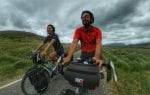
The standard models are firmer and more direct, while the Gel versions add another layer of cushioning and pressure distribution. Selle SMP says its Gel inserts are self-moulding and intended to reduce pressure at the main anatomical contact points.
Which is better?
There isn’t a universal answer.
Some riders will prefer the direct support of the standard model. Others will appreciate the softer feel of the Gel version, especially for recreational or touring use.
Again, this is where testing becomes more useful than specifications.
Durability and construction
Touring equipment gets abused.
A saddle on a long bicycle trip has to deal with rain, dust, mud, sweat, sunlight, accidental knocks and the occasional moment when you lean the bicycle against something that is considerably less forgiving than a bicycle stand.
Our SMP saddles have accumulated the inevitable signs of travel, but they’ve held up well through the conditions we’ve subjected them to.
The current TRK and Martin Touring models use polypropylene bodies, steel rails and polyurethane padding, with the Gel versions adding the gel insert. The saddles use Selle SMP’s vacuum-applied SVT cover system.
They’re not designed to be the lightest possible saddles on the market, particularly in the Martin Touring range.
For expedition-style touring, we don’t see that as a major disadvantage.
A few hundred grams matters much less to us than having a saddle that continues to work after several hours on a rough road.
What we like about Selle SMP
The biggest strength is the ergonomic concept.
The central channel is large, the support area is clearly defined and the distinctive nose gives the saddle a shape that is genuinely different from most alternatives.
We also like the fact that Selle SMP offers such a broad range of shapes and dimensions. It makes the buying process more complicated, but it also means that there is a much better chance of finding a saddle that actually fits your body rather than simply accepting whatever happens to be available in one generic “touring” size.
The saddles have also proved themselves in the environment that matters most to us: long-distance bicycle touring.
Albania, North Macedonia and Nepal aren’t identical cycling environments, but all three provided plenty of opportunities to discover whether the saddle worked after the novelty had worn off.
It did.
What we don’t like
The main disadvantage is the complexity of choosing one.
If you walk into a shop looking for a Selle SMP, you don’t simply have a choice between a small, medium and large saddle. There are different models, widths, padding levels and intended uses.
That is good from a fitting perspective but potentially frustrating for someone who just wants to buy a saddle and get on with cycling.
The other disadvantage is price. Selle SMP saddles aren’t bargain-basement components, and some of the more elaborate models are considerably more expensive than generic touring saddles.
Finally, the shape won’t suit everyone.
That’s not something we would try to hide. A Selle SMP feels different, and some riders will prefer a more traditional saddle shape.
This is exactly why Selle SMP recommends testing the saddle before buying where possible. The company has its SMP4TEST system through participating retailers, allowing cyclists to try a model on their own bicycle.
So, is a Selle SMP good for bicycle touring?
In our experience, yes.
But we’d phrase the recommendation carefully.
We wouldn’t say that Selle SMP makes the best bicycle touring saddle. There is no such thing as a universally best saddle.
We would say that Selle SMP makes some of the most interesting saddles for cyclists who spend long periods in the saddle, particularly if conventional saddles create pressure in the central area or if you appreciate a more structured form of pelvic support.
Our experience in Albania, North Macedonia and Nepal has convinced us that the design works particularly well for long-distance touring.
The saddles don’t make the bicycle magically more comfortable. They don’t eliminate fatigue and they don’t compensate for a poor bike fit.
But with the right model and the correct setup, they can make the saddle itself much less of a limiting factor during a long day.
Final verdict
After using two Selle SMP saddles over long-distance trips in the Balkans and Nepal, we would happily recommend trying one to anyone planning serious bicycle touring.
The unusual appearance isn’t just a marketing gimmick. The large central channel, curved support area and dropped nose all form part of a coherent ergonomic design intended to distribute the rider’s weight differently.
The biggest lesson, however, is that you shouldn’t choose an SMP based on somebody else’s favourite model.
Measure your sit bones, consider your riding position and the type of cycling you do, look at the available models and, if possible, test the saddle on your own bicycle. Selle SMP’s current Saddle Finder follows essentially this approach, using anatomy and riding characteristics rather than gender alone to identify suitable models.
For us, the real test was not how the saddles felt during the first ride.
It was how they felt after riding all day, then getting back on the bicycle the next morning, and doing it again.
After Albania, North Macedonia and Nepal, we’re still using them.
Cycloscope verdict: Highly recommended for long-distance touring, provided you take the time to find the right model and set it up correctly.
Selle SMP Saddle Review — Pros and Cons
| Pros | Cons |
|---|---|
| Excellent pressure relief | Unusual shape takes some getting used to |
| Very good for long days in the saddle | Choosing the right model can be complicated |
| Excellent range of sizes and shapes | More expensive than many conventional saddles |
| Stable pelvic support | Not every rider will like the ergonomic shape |
| Standard and Gel options | Correct setup is particularly important |
| Proven on long-distance touring | Some models are relatively heavy |
Specifications note: Selle SMP’s specifications and product range can change, so the model table above reflects the manufacturer’s current information available in 2026.