

Last Updated on 4 September 2026 by Cycloscope

From trail to e-MTB, the best MTB saddles of 2026 reviewed — WTB, SQlab, Specialized, and Ergon, with specs and buying advice for every riding style.
Finding the right MTB saddle is one of the more personal equipment decisions in cycling — what works for one rider can be actively uncomfortable for another.
Disclosure: Some of our articles contain affiliate links. This comes at no additional cost for you and helps us keep this website up and running. (as Amazon Associates we earn commission from qualifying purchases)

That said, the market has moved meaningfully in the last couple of years: Fusion Form bases from WTB, 3D-printed padding from Specialized, and ergonomic-first designs from SQlab and Ergon have collectively raised the floor on what counts as a good saddle.
Here are the models worth considering in 2026, across different riding styles and budgets.
WTB Volt Fusion Form Titanium
Best all-round MTB saddle
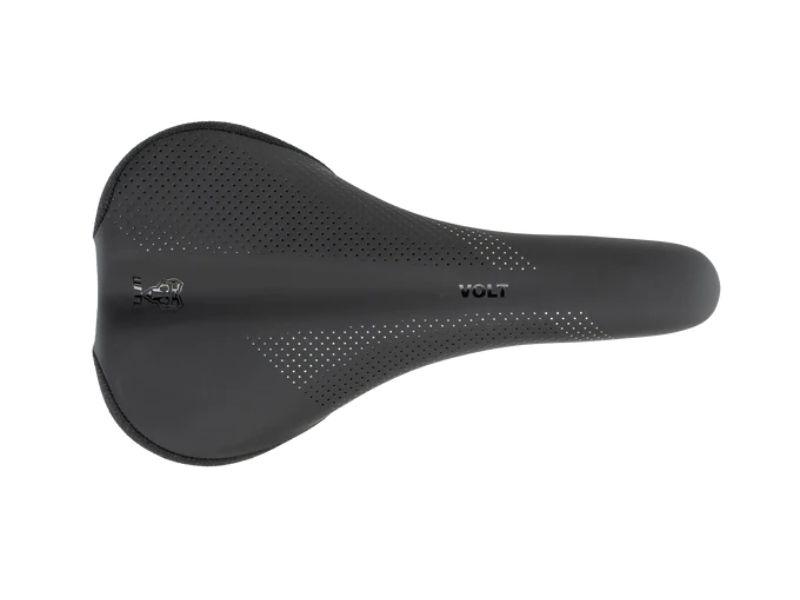
The Volt has been WTB’s most popular mountain saddle for years, and the Fusion Form update gives it a legitimate refresh rather than just a new colorway. The key change is in the base construction: instead of the standard injection-molded nylon, the Fusion Form uses carbon-fiber-infused nylon with a precisely tuned fiber content for each model, creating a specific flex profile that balances bump absorption with pedaling efficiency. The microfiber cover is vacuum-sealed directly onto the base rather than stapled — a cleaner finish that also allows the shell to flex more naturally.
The shape itself is unchanged: a slightly cradled profile with a gentle drop to the nose, shallow Comfort Zone cut-out along the center, and WTB’s Love Channel for soft tissue relief. It works across disciplines — trail, XC, gravel, light bikepacking — which is probably why it’s on more bikes than any other saddle in this list.
Available in 135mm (Narrow), 142mm (Medium), and 150mm (Wide), with Chromoly, Stainless, Titanium, and Carbon rail options.
Specs:
- Length: 265mm
- Widths: 135 / 142 / 150mm
- Rails: Titanium (7 × 7mm)
- Shell: Fusion Form carbon-fiber-infused nylon
- Padding: DNA
- Cover: Microfiber (vacuum-sealed)
- Weight: 225g (Medium, Titanium)
- Rail options: Chromoly / Stainless / Titanium / Carbon
WTB Rocket Fusion Form
Best for enduro and e-MTB riders
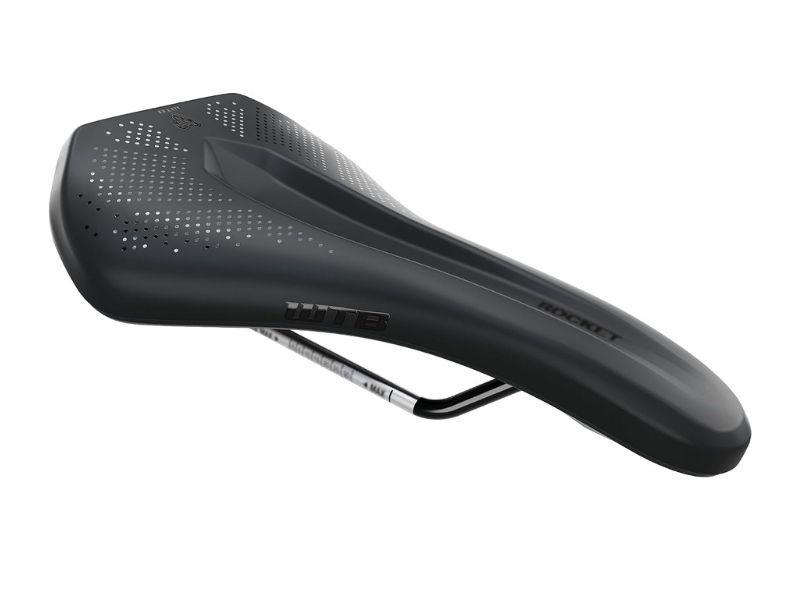
The WTB Rocket is a complete redesign — same name, different saddle. WTB repositioned it squarely at enduro and e-MTB use, with thicker padding than the Volt, a pronounced swooped tail (the “Backstop”) that locks the pelvis into position on steep seated climbs, and a contoured profile that keeps you anchored in one riding position rather than encouraging movement along the saddle. For riders who spend a lot of time seated on technical climbs, this is the functional difference that matters.
The most distinctive new feature is a hidden integrated handle recessed into the underside of the rear — useful for hike-a-bike sections and lifting heavier e-MTBs onto stands or racks. The Fusion Form base on the Rocket is tuned softer than the Volt, consistent with its comfort-first positioning. The ABR corner protection and Love Channel carry over from the wider WTB range.
At ~330g in the steel rail version, it’s not a gram-counter’s saddle — but that’s not what it’s for.
Specs:
- Length: 265mm
- Widths: 142 / 150mm
- Rails: Steel / Titanium (options vary by level)
- Shell: Fusion Form flex-tuned base
- Padding: Thick DNA
- Cover: Microfiber
- Weight: approx. 330g (Steel, Wide)
- Features: Backstop rear ramp, integrated hike-a-bike handle, Love Channel, ABR corner protection
SQlab 611 Ergowave MTB Carbon
Best for ergonomics and pressure relief
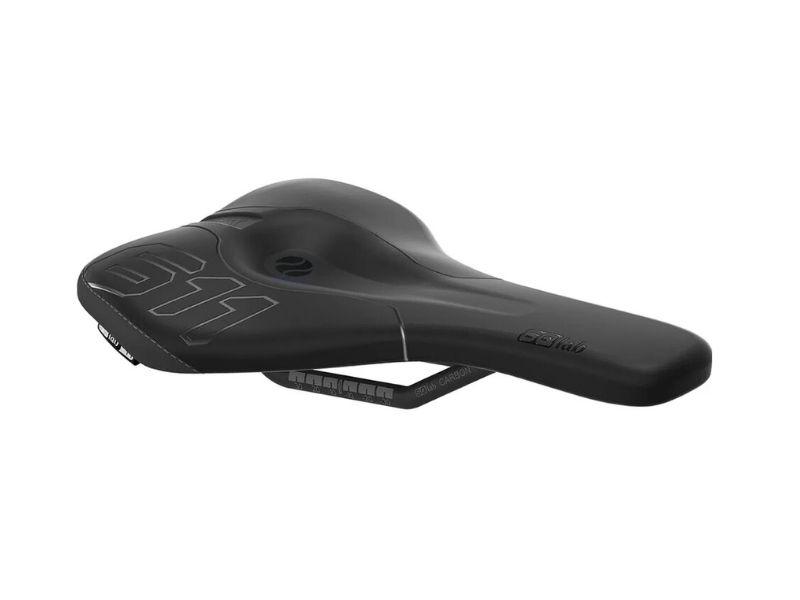
SQlab takes a fundamentally different approach to saddle design: instead of adding padding, they engineer the shell geometry to transfer weight directly onto the sit bones and eliminate pressure on soft tissue. The Ergowave profile — a wave-shaped shell with a raised rear and a lowered nose — does this mechanically, without requiring the rider to compress through a foam layer to find support.
The result is a saddle that feels unlike anything else. Firm to the touch, but genuinely comfortable on long technical rides once the geometry is doing its job. The 611 is the MTB-specific variant, with a slightly wider nose than the road-oriented 612 (4mm wider) and padding tuned for off-road vibration damping. Carbon rails and a carbon-fiber-reinforced shell bring the weight to 150g. Kevlar reinforcement on exposed areas adds durability on rough terrain.
The critical detail with SQlab is width selection: the 611 comes in five widths (13–17cm) based on sit bone measurement, and fit matters more here than with conventional saddles. SQlab provides a home measurement kit. Do not guess the width.
Specs:
- Widths: 13 / 14 / 15 / 16 / 17cm (sit bone width 9–13cm recommended range)
- Rails: Carbon
- Shell: Carbon-fiber-reinforced
- Padding: Marathon foam (MTB-tuned damping)
- Cover: K18 synthetic with Kevlar side reinforcement
- Nose width: 44mm
- Weight: 150g
- Features: Ergowave profile, lowered nose, raised rear, Kevlar side protection
Specialized Power Pro with Mirror
Best 3D-printed saddle for trail use
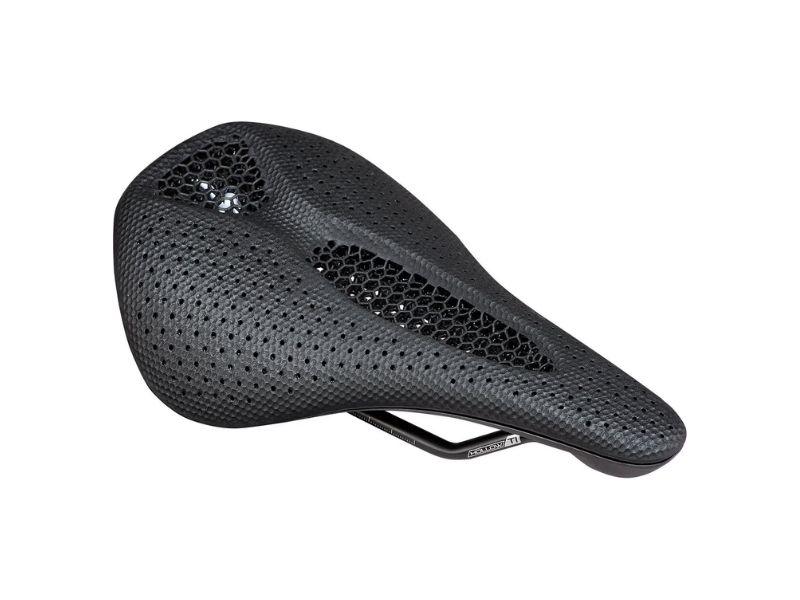
Specialized’s Mirror technology has been available at S-Works level for a while, but the Power Pro brings the same 3D-printed EPU lattice — the same 14,000 struts and 7,799 individually tunable nodes — to a saddle with titanium rails and a reclaimed carbon fiber base, at a significantly more accessible price than the S-Works.
The Power shape itself is short-nosed, flat in profile, and uses the wide elongated Body Geometry channel to eliminate soft tissue pressure. What Mirror adds is sit bone support that adapts to load in a way foam cannot: it compresses under pressure and rebounds immediately, removing the hot-spot buildup that makes foam saddles uncomfortable on longer rides. Specialized explicitly positions the 2026 Power Pro as trail-ready — the titanium rails are more durable than carbon for the impacts MTB riding produces, and the lattice is now stiff enough to handle drops and rough terrain.
Available in 143mm and 155mm widths. SWAT-compatible mount integrated into the base.
Specs:
- Length: 155mm (short-nose)
- Widths: 143 / 155mm
- Rails: Hollow titanium (7 × 7mm)
- Shell: Reclaimed carbon fiber + injected nylon
- Padding: Mirror 3D-printed EPU lattice (14,000 struts / 7,799 nodes)
- Weight: approx. 215g
- Features: Body Geometry channel, SWAT mount, trail-rated Mirror lattice
Ergon SM E-MTB Sport
Best saddle for e-MTB riders
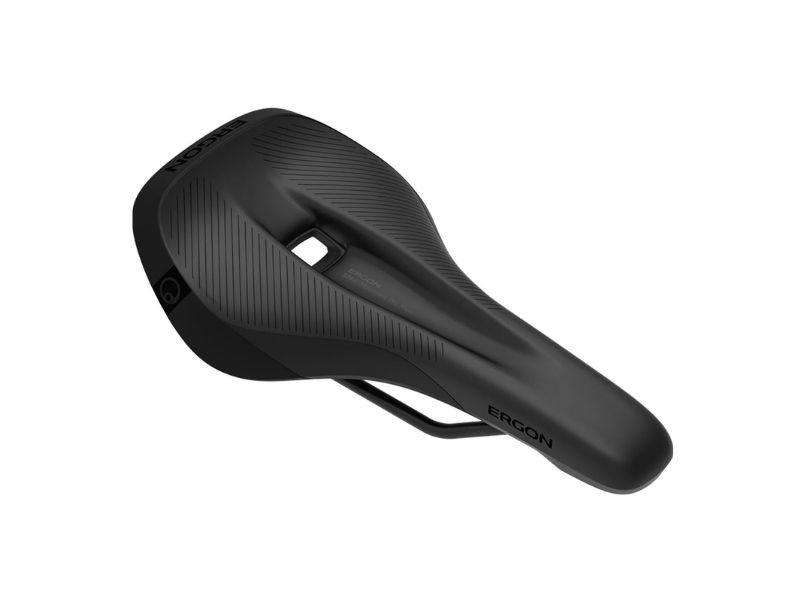
E-MTBs fundamentally change how riders sit: the motor allows (and often requires) sustained seated climbing on terrain where most riders would stand. Ergon built the SM E-MTB Sport specifically around this reality, with a geometry that doesn’t just borrow from a conventional MTB saddle.

The steep, high rear ramp stabilizes the rider’s position on sustained steep climbs. The nose is wider than average — important because the pelvis often shifts forward under maximum effort on very steep gradients. The V-shape profile gives freedom of movement for descending transitions.
OrthoCell inlays in the seating area provide better pressure distribution than gel while being lighter and more durable. The antifriction side flanks reduce thigh friction during rapid pedaling cadences, which becomes relevant when a motor is keeping your cadence high.
Available in men’s and women’s versions with anatomically specific relief channel positions. Two sizes: S/M (fits 9–12cm sit bones) and M/L (fits 12–16cm).
Specs:
- Length: 265mm (approx.)
- Widths: 144mm (S/M) / 160mm (M/L)
- Rails: CroMo (7mm round)
- Shell: Nylon Composite
- Padding: Orthopedic Comfort Foam with OrthoCell inlays
- Cover: Microfiber
- Weight: approx. 335g (men’s, S/M)
- Features: Rear ramp, wide nose, V-shape profile, anti-friction flanks, QuickClick Topeak mount, gender-specific versions
How to Choose an MTB Saddle
Measure your sit bones first. Most saddle discomfort comes from incorrect width. Most brands (Ergon, SQlab, WTB) offer free home measurement kits or printable tools. Match the saddle width to your sit bone measurement, not your hip width.
Padding is not the same as comfort. Thicker foam compresses and pinches soft tissue on longer rides. Firmer saddles with good shell geometry — like the SQlab 611 — often outperform cushioned saddles on multi-hour efforts.
Match the saddle to your position. A flat saddle (Volt, Power Pro) suits riders who move around along the saddle’s length. A contoured saddle (Rocket, SQlab 611) keeps you in one position — better for sustained climbing, less good for varied terrain riding styles.
Rail material matters for weight and compliance. Titanium (Volt, Power Pro) damps vibration and is trail-durable. Carbon (SQlab 611) is lightest but less tolerant of side impacts. Steel/CroMo (Ergon SM, Rocket base level) is the most durable and cheapest, with more vertical flex.
E-MTB riders need a different saddle. The Ergon SM E-MTB Sport and WTB Rocket are the purpose-designed options. Conventional saddles work but miss the rear-ramp geometry that becomes important during sustained motor-assisted climbing.
Read also: