

Last Updated on 27 August 2026 by Cycloscope
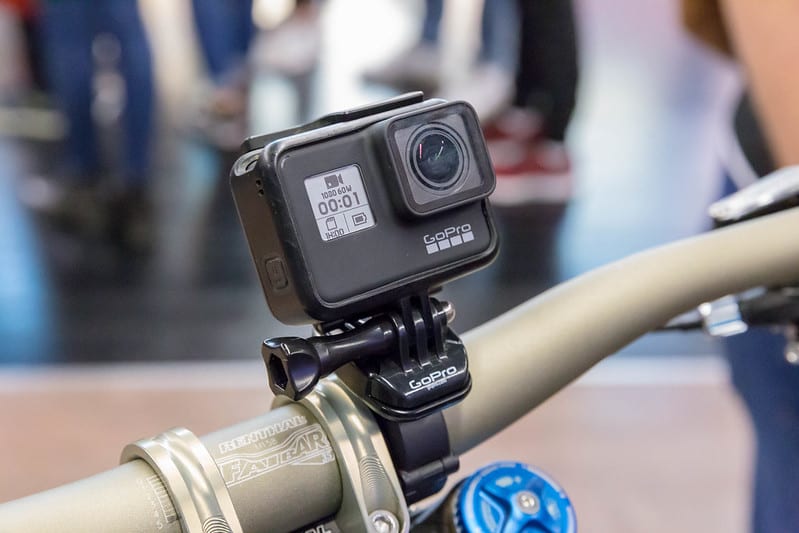
The Best Cameras for Cycling Compared: from cheap to top. Where to mount a bike cam (handlebar, helmet, & more…), how to choose an action cam, and some 360 models.
So what is the best camera for cycling in 2026? Is there a product that can claim to be the best bike action cam? The landscape has shifted considerably since we last updated this guide — GoPro has a new flagship, DJI replaced the Osmo Action 4, Garmin exited the action camera market entirely, and the 360-camera category has leapfrogged to 8K. Here’s where things stand.
Recently action cameras have turned into the staple of mountain biking, many bicycle tourers and bikepackers went intensively into vlogging, and even road cyclists are starting to use action cams, especially cycling safety cams.
Due to this huge and ever-growing demand, many manufacturers have introduced new action cameras on the market. GoPro remains the reference point, but DJI and Insta360 are now serious competitors in every category — budget, flagship, and 360.
We put together this updated list of the best action cameras for cycling. Several of these we tried ourselves in our numerous touring and bikepacking trips, while for others we relied on reviews from friends and online.
How we compile our gear guides: during more than 10 years of cycloscope.net our team personally tested dozens of similar pieces of gear. For what we can’t test personally, we involve other people in the cycling community to give their feedback and opinion about gear they have used. Our decade-long experience in bicycle touring enables us to find the key cons and pros of every product we mention.
11 Best Cycling Cameras in a Nutshell
2 Cheap Action Cameras for Biking
- AKASO V50 Elite – Best Budget Helmet Cam
- COOAU 4K 20MP WiFi – Best Bikepacking Cam for a Number of Mounts
5 Top Cameras for Cycling – The Very Best
- GoPro Hero 13 Black – Best GoPro for Cycling
- GoPro Hero (2024) – Best GoPro for the Money
- Sony FDRX3000 – Best Cam for Cycling in the Rain
- Insta360 Ace Pro 2 – Best Bike Camera for Vlogging
- DJI Osmo Action 5 Pro – Best MTB Camera
2 Best Cycling Safety Cams
- Olympus TG-Tracker Camera – Best Cam to Track Your Bike Rides
- Fly12 CYCLIQ Action Camera – Best Cycling Safety Camera
2 Best 360 Cameras for Cycling
- Insta360 X5 – Best 360 Bike Cam
- GoPro MAX 2 – Best for Live Streaming
Best Bike Cams – Comparison Chart
Product Megapixels Max Resolution Sensors Waterproof Depth Price Tag AKASO V50 Elite 20 4K/60fps WiFi, no GPS 40m (with case) $ COOAU 4K 20MP WiFi 24 4K/60fps WiFi, no GPS 40m (with case) $ GoPro Hero 13 Black 27 5.3K/60fps, 1080p/240fps WiFi 6, GPS 10m (no case) $$$ GoPro Hero (2024) 12 4K/30fps, 2.7K/60fps WiFi 5m (no case) $ Sony FDRX3000 12 4K, HD/120fps WiFi, BT, NFC, GPS 60m (with case) $$$ Insta360 Ace Pro 2 50 8K/30fps, 4K/60fps WiFi, BT 10m (no case) $$$ DJI Osmo Action 5 Pro 40 4K/120fps WiFi 6, BT 20m (no case) $$$ Olympus TG-Tracker 7.2 4K/30fps WiFi, GPS, Compass, Altimeter 30m (no case) $$ Fly12 CYCLIQ Safety Cam 12 1080p/60fps WiFi, BT 1m $$$ Insta360 X5 72 8K/30fps (360°) WiFi, BT 15m (no case) $$$ GoPro MAX 2 29 8K/30fps (360°) WiFi, BT, GPS 5m (no case) $$$
2 Cheap Action Cameras for Biking
1. AKASO V50 Elite
Best Budget Helmet Cam
AKASO started as one of many Chinese action cam brands, but while many have failed, they managed to keep it up and quickly became one of the best brands for budget action cams, with their V50 and Brave series.
If you’re a bike rider looking for the best helmet camera to record your trips without spending a fortune, the AKASO V50 Elite is our recommendation — still one of the best budget cameras for cycling for the specs: 20MP, 4K/60fps, waterproof case included down to 40m.
The Akaso V50 Elite is an affordable action camera packed with impressive features. Compact and lightweight, with voice control, a remote, and intuitive touchscreen controls, it serves as a great entry point into the world of action cameras.
Minor drawbacks include occasional touchscreen responsiveness issues and a laggy companion app, but at this price those are easy trade-offs.
Pros: 4K/60fps video and 20MP stills · Compact and lightweight · Two batteries included · Voice control and remote · Great value
Cons: Requires case for waterproofing · Akaso app can be slow · Touchscreen occasionally unresponsive
Key Specs:
- Video: 4K/60fps
- Photo: 20MP, 8x digital zoom
- Weight: 78g
- Waterproof: with case, up to 40m
- WiFi: Yes | Bluetooth: No | GPS: No
2. COOAU 4K 20MP WiFi
Best Bikepacking Cam for Number of Mounts
For those seeking an affordable action camera with reliable performance, the COOAU Cool Series stands out for one specific reason: the accessory bundle is extraordinary. Bike mount, helmet mount, chest harness, external microphone, two batteries — it comes with more mounting options than most cameras costing three times the price.
Powered by a Sony sensor, it records 4K/60fps with 170° wide angle, EIS stabilization, and Wi-Fi remote control. Battery life is the main weakness — plan around 60–70 minutes per charge — but the dual-battery kit helps.
Pros: Exceptional accessory and mount bundle · External microphone included · 24MP, Sony sensor · 170° wide angle · Wi-Fi remote
Cons: No touchscreen · SD card sold separately · Requires case for waterproofing
Key Specs:
- Video: 4K/60fps, 1080p/120fps
- Photo: 24MP
- Waterproof: with case, up to 40m
- WiFi: Yes | Bluetooth: No | GPS: No
5 Top Cameras for Cycling – The Very Best
1. GoPro Hero 13 Black
Best GoPro for Cycling
You can’t mention action cameras without thinking about GoPro, and the Hero 13 Black is their current flagship — and one of the most capable cycling cameras ever made.
Building on the Hero 12’s already-excellent 8:7 sensor and GP2 processor, the Hero 13 adds meaningful upgrades: HyperSmooth 6.0 is now the reference standard for in-camera stabilization, WiFi 6 dramatically speeds up media transfer, and the new HB-Series interchangeable lens system opens up creative options that didn’t exist before — macro, ultra-wide, anamorphic, and ND filters all attach magnetically.
Resolution tops out at 5.3K/60fps (4K/120fps, 1080p/240fps slow-motion), with 27MP stills. The Hero 13 is also waterproof to 10m without a case — no muffled audio trade-off — and the larger 1900mAh Enduro battery outperforms the Hero 12, especially in warm conditions.
For cycling vloggers, the Bluetooth headphones integration (record directly via AirPods or similar) is a genuinely new feature. The burst slow-motion function captures up to 13x slo-mo with a single tap — useful for capturing technical riding moments.
Pros: HyperSmooth 6.0 — best stabilization in class · 5.3K/60fps · Interchangeable HB-Series lenses · Waterproof without case · WiFi 6 transfer · Bluetooth audio recording · Built-in GPS
Cons: Expensive · HB-Series lenses sold separately · Battery life still limited at max settings
Key Specs:
- Video: 5.3K/60fps, 4K/120fps, 1080p/240fps
- Photo: 27MP
- Processor: GP2
- Sensor: 1/1.9″ CMOS
- Waterproof: 10m (no case)
- WiFi: 6 | Bluetooth: Yes | GPS: Yes
- Weight: 154g
- Battery: 1900mAh Enduro
2. GoPro Hero (2024)
Best GoPro for the Money
The GoPro Hero (2024) is exactly what it sounds like: a no-frills action camera that does what most cyclists actually need, at roughly half the price of the Hero 13.
It shoots 4K/30fps and 2.7K/60fps, captures 12MP stills, and is waterproof to 5m without a case. Controls are stripped back to the essentials — there’s no front screen, no GPS, no voice control — but that simplicity is precisely the point. If you want to strap a reliable camera to your helmet and press record, this is the least complicated way to do it with a name you can trust.
At around $199, it sits at the very top of the budget tier but brings genuine GoPro build quality and mount ecosystem compatibility. For tourers who want a camera primarily for documentation rather than content creation, it’s a smart buy.
Pros: Simple and reliable · GoPro mount ecosystem · 4K · Waterproof without case · Compact
Cons: No stabilization · No front screen · No GPS or voice control · Limited frame rate options
Key Specs:
- Video: 4K/30fps, 2.7K/60fps
- Photo: 12MP
- Waterproof: 5m (no case)
- WiFi: Yes | GPS: No
- Weight: approx. 86g
3. Sony FDRX3000
Best Cam for Cycling in the Rain
We used the FDRX3000 ourselves and were impressed — particularly with the audio and optical image stabilization. It remains our pick for cyclists who prioritize audio quality above everything else, thanks to its stereo microphone with noise reduction. No other action cam in this list records audio this well out of the box.
The camera features a Zeiss lens with 3x optical zoom, is waterproof to 60m with the included case, and supports GPS, NFC, Bluetooth, and Wi-Fi. The main weakness remains the lack of a built-in display — Sony’s Live-View Remote fixes this but adds cost.
The Sony FDRX3000 is aging compared to the GoPro and DJI competition, and new units are increasingly hard to find. If audio fidelity is your top priority on touring or vlogging rides, it’s still worth tracking down. Otherwise, the Insta360 Ace Pro 2 has largely taken its crown as the best-sounding cycling camera.
Pros: Best-in-class stereo audio · Optical image stabilization · Zeiss lens · GPS · Waterproof to 60m with case
Cons: No built-in display (LiveView Remote sold separately) · Aging resolution (12MP, 4K/10fps) · Short battery life · Not compatible with GoPro mounts
Key Specs:
- Video: 4K, HD/120fps
- Photo: 12MP
- Lens: Zeiss, f/2.8, 3x optical zoom
- Waterproof: 60m with case
- WiFi, NFC, Bluetooth, GPS
- Weight: 114g (with battery)
4. Insta360 Ace Pro 2
Best Bike Camera for Vlogging
The Insta360 Ace Pro 2 fills the slot vacated by the discontinued Garmin VIRB in one sense — it’s the camera for cyclists who want data-rich, content-creator-quality footage — but it does it completely differently, and considerably better.
Co-engineered with Leica, the Ace Pro 2 carries a 1/1.3″ sensor capable of 8K/30fps and 4K/60fps video, with 50MP stills. Low-light performance is outstanding. The standout hardware feature for cycling specifically is the 2.5″ flip-up touchscreen, which makes helmet-mounted vlogging genuinely practical — you can actually see yourself framing without stopping or guessing.
FlowState stabilization handles vibration well enough for gravel and light off-road. The magnetic mounting system makes swapping between handlebar, helmet, and chest rigs fast. AI highlights — the camera automatically compiles a short edit from your ride footage — are a nice bonus for those who don’t want to spend hours in post.
Audio has been improved significantly over the original Ace Pro, with a multi-microphone array and AI noise reduction. The DJI Osmo Action 5 Pro still edges it for stabilization on rough MTB terrain, but for road cycling, bikepacking vlogs, and touring content, the Ace Pro 2 is our top pick.
Pros: 8K video · Leica lens · 2.5″ flip screen — ideal for vlogging · Outstanding low light · AI highlights and editing · Magnetic mount system · Replaceable lens guard
Cons: No GPS · Waterproof to 10m only (no case) — less than DJI · Premium price · App required for activation
Key Specs:
- Video: 8K/30fps, 4K/60fps
- Photo: 50MP
- Sensor: 1/1.3″ CMOS
- Waterproof: 10m (no case)
- Flip screen: 2.5″ + 0.7″ front display
- WiFi, Bluetooth
- Battery: 3 hours
5. DJI Osmo Action 5 Pro
Best MTB Camera / Best for Stabilization
DJI’s Osmo Action 5 Pro is the most versatile action camera in this list and, in our view, the overall best cycling camera of 2026 for those who don’t need 8K video.
The headline spec is battery life: up to 4 hours of recording on a single charge, with the Adventure Combo bundling three batteries for up to 12 hours total. For long bikepacking days, this changes the calculus entirely — most cameras need a mid-ride battery swap.
The 1/1.3″ CMOS sensor handles low-light well. RockSteady 3.0+ and HorizonSteady stabilization together produce impressively smooth footage on rough gravel and technical trail riding — the HorizonSteady mode locks the horizon completely even when the camera tilts significantly. The dual OLED touchscreens (1.46″ front, 2.5″ rear) make framing intuitive in both directions. Waterproofing reaches 20m without a case, the deepest in this category.
The magnetic quick-release mount system is excellent — switching between mounting positions takes seconds. Direct wireless connection to DJI Mic 2/Mic mini transmitters (no receiver required) makes it compelling for cycling podcasters and vloggers who want professional audio without the cable clutter.
Pros: 4-hour battery (best in class) · 20m waterproof without case · RockSteady + HorizonSteady stabilization · Dual OLED screens · Magnetic quick-release mount · DJI Mic wireless support · 47GB built-in storage
Cons: Tops out at 4K (no 5.3K or 8K like some rivals) · No GPS · DJI ecosystem vs GoPro’s wider mount range
Key Specs:
- Video: 4K/120fps, 1080p/240fps
- Photo: 40MP
- Sensor: 1/1.3″ CMOS
- Waterproof: 20m (no case), 60m (with case)
- Dual OLED screens (front + rear)
- WiFi 6, Bluetooth
- Battery: 4 hours
- Built-in storage: 47GB usable
2 Best Cycling Safety Cams
1. Olympus TG-Tracker Camera
Best Cam to Track Your Bike Rides
The Olympus TG-Tracker is a rugged, bulky action camera with a feature set that nothing else in this list can replicate: five built-in sensors that record GPS, accelerometer, e-compass, temperature, and barometric pressure data simultaneously with video. All data can be viewed in the companion app independently from the footage.
It has a foldable 1.5-inch tilt-out LCD screen, records 4K/30fps video, is waterproof to 30m without a case, and includes a 204° ultra-wide field of view (switchable to 157°). Heavy and bulky compared to modern action cams, but if you want a cycling computer and a camera in one unit, nothing else competes.
Pros: Unmatched sensor suite (GPS, altimeter, compass, temperature, accelerometer) · Tilt-out screen · 30m waterproof without case · Built-in 60-lumen light · Excellent electronic image stabilization
Cons: Heavy and bulky · Limited mounting options · 204° FoV can be too wide · Discontinued but still available
Key Specs:
- Video: 4K/30fps, 720p/240fps
- Photo: 7.2MP
- FOV: 204°/157°
- Waterproof: 30m (no case)
- Sensors: GPS, GLONASS, QZSS, barometric pressure, temperature, acceleration, orientation
2. Fly12 CYCLIQ Cycling Dash Cam
Best Cycling Safety Camera
The Cycliq Fly12 Sport, now in its third generation, is the only purpose-built cycling dashcam in this list. It sits on your handlebars and records continuously, locking incident footage automatically when it detects a collision or when you manually trigger it.
At 150g and with a compact form factor, it pairs neatly with the Fly6 rear dashcam to give you front-and-rear coverage — something no other camera in this guide can do. The front light is integrated. Recording options up to 2880×2160 at 24fps, with electronic stabilization and a 64GB card included.
If your primary use case is safety documentation rather than content creation, the Fly12 is the only honest recommendation.
Pros: Purpose-built for incident capture · Incident detection and file locking · Front light integrated · 64GB card included · Robust and weatherproof
Cons: Not an action camera — limited creative use · Light output reduced vs previous gen · Footage quality in low light is limited
Key Specs:
- Video: 2880×2160@24fps, 1080p/60fps, 720p/120fps
- Connectivity: WiFi, Bluetooth
- Waterproof: IP65
- Weight: 150g
2 Best 360 Cameras for Cycling
1. Insta360 X5
Best 360 Bike Cam
The Insta360 X5 is the definitive 360 camera for cycling in 2026. It records 8K/30fps spherical video using dual 1/1.28-inch sensors (larger than any previous 360 cam at this price point), with a triple AI chip stack for processing. The result is dramatically better low-light footage than the X4, and real-world 360 video quality that now holds up at reframed 4K.
For cycling use, the key advantages of 360 video are well established: you mount the camera on an invisible selfie stick below the frame (the stick disappears in post), and after the ride you choose your framing — any angle, any perspective, without having committed to a direction while riding. It’s the most flexible format for documenting bikepacking routes.
The X5 adds replaceable lenses (a first for Insta360’s X series) — a practical feature that matters if you’re riding gravel and kicking up stones. Battery life reaches 3 hours. It’s waterproof to 15m without a case, the deepest of any 360 cam in this list.
At $549, it’s expensive, but it’s also the best all-round 360 option for cyclists by a clear margin.
Pros: 8K/30fps 360° · Dual 1/1.28″ sensors — best low-light in class · Replaceable lenses · 15m waterproof without case · 3-hour battery · FlowState stabilization · 72MP photos
Cons: Expensive · Stitching occasionally visible in challenging lighting · Requires editing to reframe — not plug-and-play
Key Specs:
- Video: 8K/30fps (360°), 4K at various frame rates
- Photo: 72MP
- Sensors: Dual 1/1.28″ CMOS
- Waterproof: 15m (no case), 60m (with Dive Case)
- Battery: 3 hours
- WiFi, Bluetooth
- Replaceable lenses: Yes
2. GoPro MAX 2
Best for Live Streaming
Released in September 2025, the GoPro MAX 2 is the long-awaited successor to the original 2019 MAX, and it brings the GoPro 360 format up to speed with its competition: 8K/30fps 360° capture, larger sensors, a bigger battery, a six-microphone array, and a larger touchscreen.
Unlike the Insta360 X5, the MAX 2 leans into its dual personality — it functions as both a 360 camera and a traditional GoPro-style action camera. In single-lens Hero mode, it shoots 4K/60fps with 100fps slow-motion and GoPro’s HyperSmooth 360 stabilization. For cyclists who want one camera that covers both perspectives, this versatility is the main argument in its favour.
Live streaming is genuinely excellent. The six-mic system with wind-balancing is the best audio in any 360 camera currently available. GPS is built in — useful for overlaying speed and elevation data on footage via GoPro’s Quik app.
The Insta360 X5 outperforms it in low-light and has deeper waterproofing, but if you’re already in the GoPro ecosystem and want 360 capability, the MAX 2 is a seamless addition.
Pros: 8K/30fps 360° · Dual-mode (360 + standard action cam) · 6-mic array — best audio in 360 category · HyperSmooth 360 stabilization · GPS · Live streaming · Replaceable lenses
Cons: Waterproof to 5m only (no case) — significantly less than X5 · Lower sensor quality than X5 in low light · $499 — expensive for casual use
Key Specs:
- Video: 8K/30fps (360°), 4K/60fps (single lens), 100fps slow-motion
- Photo: 29MP (360°)
- Waterproof: 5m (no case)
- Audio: 6-microphone array
- GPS: Yes
- WiFi, Bluetooth
Things to Consider When Buying a Cam for Cycling
Image Stabilization
Stabilization is the single most important spec for a cycling camera. A 4K clip with bad stabilization looks worse than a 1080p clip with good stabilization. HyperSmooth 6.0 (GoPro), RockSteady/HorizonSteady (DJI), and FlowState (Insta360) are all excellent in 2026 — any of the flagships will handle road and gravel well. For aggressive MTB, DJI’s HorizonSteady has the edge.
Size and Weight
The best action camera for cycling needs to be lightweight. No matter how you mount it, a lighter camera creates less aerodynamic drag, puts less stress on mounts, and is less likely to affect your balance in crash situations. Most modern action cameras sit in the 120–160g range — acceptable for all mounting positions.
Video and Photo Quality
The minimum resolution on a modern action cam is 1080p but you should go for 4K if professional-looking quality is your goal. The top cameras in 2026 can record 5.3K and 8K, but consider whether you have the hardware to edit that footage. 8K files are very large, drain batteries faster, and most viewing platforms cap out at 4K. For most touring and bikepacking use, 4K is the sweet spot.
Where to Mount a Bike Cam
Primarily, there are two main mounts you can use: handlebar and helmet.
With the helmet mount, you get a more immersive experience. The angle changes as you turn your head, making video more engaging — but also disorienting if you move your head too much.
The handlebar mount is less engaging but more stable. It’s also easy to turn toward yourself for vlogging, though you need good audio for that.
Very popular among mountain bikers is the chest strap camera mount, which shows the front of the bike and terrain in detail. Great for trail footage.
360 cameras largely resolve the mounting dilemma: mount anywhere and choose your framing in post.
Does a Cycling Cam Need to be Waterproof?
For bike touring, yes — rain is a question of when, not if. All cameras in this list handle rain and splashes. The DJI Osmo Action 5 Pro (20m without case) and Insta360 X5 (15m without case) lead on waterproofing. The GoPro Hero 13 Black (10m) and Insta360 Ace Pro 2 (10m) are also adequate for all but underwater conditions.
Battery Life
Battery technology remains the constraint in action camera design. Most flagships last 60–90 minutes at maximum resolution settings. The DJI Osmo Action 5 Pro is the exception at 4 hours — a significant advantage for full-day rides. Always carry at least one spare battery.
GPS
If you like to map new horizons, built-in GPS adds a geotag to each shot and makes it easy to create photo maps with apps like Komoot or Strava. Of the cameras in this guide, the GoPro Hero 13 Black, Sony FDRX3000, Olympus TG-Tracker, and GoPro MAX 2 have built-in GPS.
Connectivity
High-end cameras now offer WiFi 6 (GoPro Hero 13, DJI Osmo Action 5 Pro) for faster media transfer. Most support Bluetooth for remote controls and wireless microphones. The DJI Osmo Action 5 Pro supports direct wireless DJI Mic connection — no receiver required — which is a meaningful upgrade for vlogging cyclists.
Check Also:
- Bike Helmets: The Safest on the Market (rated by science)
- The Best Cycling Sunglasses
- 13 Top Headphones for Biking
- The 12 Very Best Bike GPS Computers
Conclusions
It’s hard to name a single winner — the best bike camera depends on your intended use and budget.
- If you want the top GoPro: GoPro Hero 13 Black — best stabilization ecosystem, interchangeable lenses, GPS
- If you want the best overall camera: DJI Osmo Action 5 Pro — longest battery, deepest waterproofing, best MTB performance
- If you want to vlog seriously: Insta360 Ace Pro 2 — Leica lens, flip screen, 8K, best low light
- If you want something cheap and reliable: AKASO V50 Elite
- If you want 360 footage: Insta360 X5 — the clear 360 leader
- If you want safety-first: Fly12 CYCLIQ — the only purpose-built cycling dashcam
Frequently Asked Questions
How an action camera is different from other rugged or traditional cameras?
Action cameras are specifically built for sports. A very sturdy construction, small size, and lightweight are the most important characteristics. Most of them can shoot slow-motion videos at a high framerate and have wide lens angles. Action cameras are built for action and to be used in action. The controls on these cameras are straightforward to access and in some cases, you can use them completely hands-free too. The rugged or traditional cameras are larger and more delicate, they are not designed to be used in action situations.
Where should I mount my cycling camera?
Disclosure: Some of our articles contain affiliate links. This comes at no additional cost for you and helps us keep this website up and running. (as Amazon Associates we earn commission from qualifying purchases)
How we compile our gear guides: during the almost 10 years of cycloscope.net our team personally tested dozens of similar pieces of gear. For what we can't test personally, we involve other people in the cycling community to give their feedback and opinion about gear they have used. Our decade-long experience in bicycle touring enables us to find the key cons and pros of every product we mention.
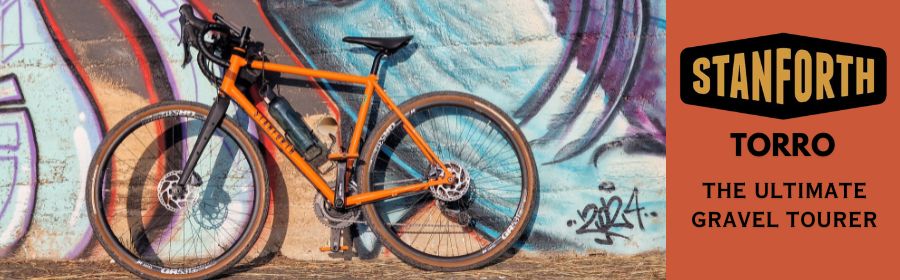
Primarily, there are two main mounts that you can use for your action camera on a bike: handlebar and helmet.
With the helmet mount, you will get a more immersive experience. The angle will change as you turn your head and the video will be a lot more engaging, but also a bit confusing if you move your head too much.
The video from the handlebar mount is not very engaging but the view will be a lot more stable. You will have to compromise on the shock absorption feature, cause the handlebar gets all the bumps.
On the other hand, you can easily turn a handlebar camera on yourself, and even talk into it while you’re cycling – cycle-vlogging – pretty trendy… but you’ll need good audio features for that (more about audio later).
Very popular among mountain bikers is the chest strap camera mount, which shows the front of the bike and the terrain in detail. Cool angle for tricks and action footage.
There are many other ways to mount an action cam on a bike: using selfie sticks (tied with zip-ties or such), or movable clamps – just to mention a couple.
Read more on our full article!
Box style, cube style, bullet style: what’s the difference, and which one is the best?
A majority of the cameras for cycling fall into the category of Box style. They also come in a vast range of resolutions. On average their FoV is around 160-degree.
The cube style is compact and you can mount it in a small area. These are extremely lightweight and there is only one button on them to start and stop the recording. The average FoV here is around 140-degree. You might not find many resolution options though.
These action cameras are very sleek and long in design but there are no major brands on the market that specialize in this style of action camera. There are some Chinese models available but the quality is going to be slightly off.
Should I go for FHD, UHD, 4K, or 5k?
It is totally up to you, which resolution you should consider for your rides. The best in class is 4K and the video quality is going to be exceptional. This is again the case with UHD as well but both these formats also consume a lot of battery.
FHD and HD are good choices for you if you go on long rides because they are good with picture quality and also don’t consume much battery.
Read more in our full article!