

Last Updated on 14 January 2026 by Cycloscope

In 1924, Alfonsina entered the Giro d’Italia. Disguised as a man, she became the only woman ever to compete in the most prestigious men’s cycling race.
In early-20th-century Italy, the use of bicycles was strongly discouraged. According to the anthropologist Cesare Lombroso, in his essay “Cycling and Crime,” bicycles were associated with delinquency.
Disclosure: Some of our articles contain affiliate links. This comes at no additional cost for you and helps us keep this website up and running. (as Amazon Associates we earn commission from qualifying purchases)
The Catholic Curia forbade priests from riding them, and in cities such as Rome and Milan, cycling was banned after sunset. For a woman to ride a bicycle was guaranteed scandal.
Alfonsina Morini was born in 1891 in Castelfranco Emilia, a rural village in the province of Bologna. Italy had been unified for only thirty years. She was the second of nine children, born to illiterate parents.
A few years later, the family moved to Fossamarcia, near Castenaso. In 1901, her father, Carlo, received an old bicycle donated by the local doctor. At the time, very few people owned bicycles. For Alfonsina, cycling became her only form of entertainment.
Italy was not like France, where the bicycle had already become a symbol of women’s emancipation. In 1896, in Ostend, Belgium, the first women’s cycling world championship was held, won by Belgian rider Hélène Dutrieux).
In Italy, by contrast, a woman on a bicycle was literally seen by the Church as a manifestation of the devil.
Despite this cultural environment, in Bologna, there were 7,000 bicycles of the 100,000 in the nation.
On Sundays, Alfonsina told her parents she was going to church, but she actually participated in bicycle races in neighboring villages, often winning against male competitors.
Once she won a pig, which, given the family’s financial constraints, was not too bad. Despite this, the family was labeled “crazy” by the villagers. It was unfortunate to have a daughter like that.
She began training regularly and, in 1907, went to Turin, where the “Unione Velocipedistica Italiana” had just been founded.
The club included several women, arousing less scandal than in the countryside. Here, Alfonsina rides on both road and track.
Despite those early openings, public opinion, fueled by the press, maintained a pessimistic view that fully reflected the chauvinist mentality of the time.
In 1910, “La Stampa Sportiva” wrote, “We don’t have any sympathy for the virago, the woman who makes 200 km cycling, who rows as a professional.
This exercise is not suitable for women’s potential and health. They are feminine acrobatic routines that we have to perform with great force. “
Meanwhile, in 1911, Alfonsina set the women’s world Hour Record at 37.192 kilometers per hour, 300 meters faster than the French Louise Roger had achieved eight years earlier.
In 1915, she legalized her marriage with Luigi Strada, thus changing her name to Alfonsina Strada.
In 1917, a few days after the defeat of Caporetto, due to the lack of participants, Alfonsina’s application to Giro di Lombardia was accepted; she then could ride with champions like Girardengo, Pellissier, Thys, and Belloni.
However, the chance of a lifetime came in 1924, a special year for the Giro d’Italia, which was born in 1909. In response to economic issues, the most prestigious houses decided to boycott the race, not registering the subscriptions of the most famous champions of the time, such as Girardengo and Brunero.
La Gazzetta dello Sport, the race’s organizer, was compelled to include amateurs alongside professionals.
Courgnet and Colombo, leaders of the pink newspaper, hold hands to compensate for the setback. From this perspective, Alfonsina’s should be considered. It was just a publicity stunt.
Many went to see the Giro pass by and to observe this strange woman who rode a bicycle. She could wash only after all the male cyclists had washed. She begins in Milan despite the criticism. The “Guerin Sportivo” dedicated a song, The Girina:
Alfonsina, don’t despair,
If you get a flat, we are a thousand,
ready to fill your hole
After the first stages, Alfonsina surprised even herself; she isn’t the last (54 of 57), 32 men have already retired.
Moreover, the Giro is arduous, 3618 km of arduous riding. The roads in many parts of the country are little more than strips of mud. If you fall, you will lose hours due to punctures (or multiple punctures).
The 304 km between Foggia and L’Aquila, the Giro reaches the sharp peaks of the Abruzzi, with the dreadful Macerone.
After a disastrous fall, Alfonsina replaced her broken handlebars with a broomstick borrowed from a housewife along the road.
Towards Perugia, the surprising flood. She arrives out of regular time. But the jury allows her to continue the race. She is now an attraction.
In Rijeka, at the end of the longest stage of the Giro, 415 km from Bologna to Istria, Alfonsina declares to the press that she has finally stopped being defined as a frivolous “devil in a skirt”, appreciating the courage of the woman.
“But what could I do? The whore? I have a husband in the asylum that I have to help, and I have a child in school that costs me 10 Lire per day.
I have good legs, and the fans in Italy (especially women and mothers) treat me with enthusiasm. I’ve had some disappointments, some mocked me, but I’m satisfied, and I know I did well.”
The tour ends with the victory of Giuseppe Enrici after the duel with Federico Gay. Only 30 of the original 90 riders arrived in Milan. Alfonsina is among them.
In the following years, the opportunity to enroll in the Giro was denied to Alfonsina.
But she participates anyway for long stretches, as she had during her debut period, earning the friendship, esteem, and admiration of many journalists, riders, and cycling enthusiasts who continue to follow her exploits with curiosity.
Left widowed by Luigi Strada, Alfonsina remarried in Milan on December 9, 1950, to an ex-cyclist, Carlo Messori, with whom she continued her sporting activities until she decided to withdraw from competition.
However, her passion for cycling is not diminished. She opens, in fact, a bicycle shop in Milan, on Via Varesina, with a small workshop for repairs. Widowed again in 1957, she continues to run the store on her own.
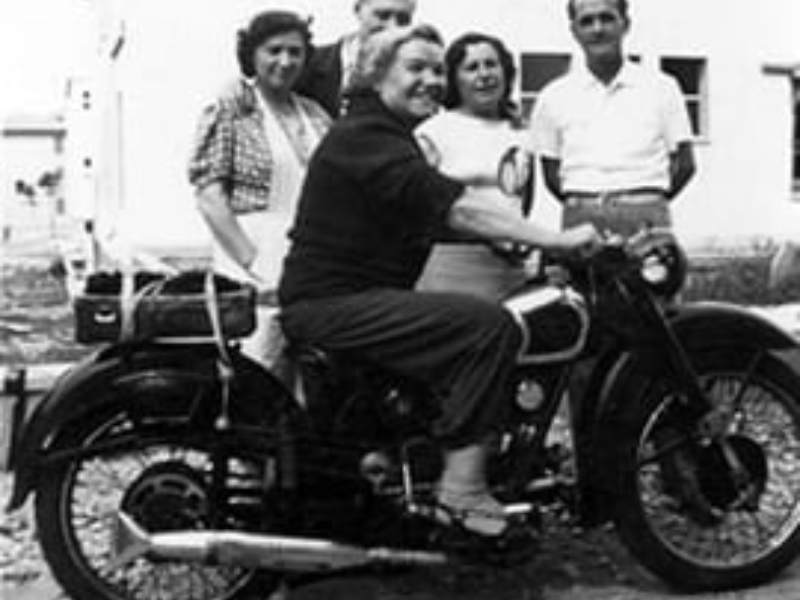
She rides her last race in 1956, at age 65, a veteran who won. She died in 1957, left alone with her cats, falling on the ground while trying to start her Guzzi 500 motorcycle.
The women’s Giro d’Italia was born in 1988. Today, the highest peak of the Giro d’Italia Women is the Cima Alfonsina Strada. In France, the first female edition of the Tour de France was in 2022.
For more complete documentation about Alfonsina check out the book “Het roerige leven van Alfonsina Strada: de enige vrouw die ooit de Giro reed” by Paolo Facchinetti. This book is only available in Italian and Dutch.