

Last Updated on 16 January 2026 by Cycloscope
The history of Georgian wine, the oldest wine in the world
Traditional winemaking in Georgia and the future of Georgian wine
Georgian wine has recently been rediscovered as one of the best wines in the world, but few know it’s also considered the oldest. Before exploring the region ourselves and meeting the Georgian winemakers, we did some research on wine and Georgia.
Disclosure: Some of our articles contain affiliate links. This comes at no additional cost for you and helps us keep this website up and running. (as Amazon Associates we earn commission from qualifying purchases)

Check our full Georgian travel journal to learn more about this beautiful country.
The origins of the oldest wine in the world
Wine comes from the Latin “vinum”. The wine was produced for the first time, perhaps by chance, between 9 and 10,000 years ago in the area of the Caucasus. It appears that the first wine was produced entirely accidentally from the fermentation of a forgotten grape in a container.
One of the oldest quotes about wineries in the Caucasus belongs to Apollonius of Rhodes (295 B.C. -215 B.C.), the Argonauts found a fountain of wine in the palace of Aieti in Colchis.
They rested in the shade of a grapevine. Colchis is the current western Georgia, the oldest place for wine production. Even Homer in the Odyssey told of the fragrant and sparkling wines of Colchis.
David Magradze, an expert at the Institute of Horticulture, Viticulture, and Enology in Tbilisi, told the magazine Observatory Balkans and Caucasus:
It is in this region that the world’s oldest winery was discovered, dating back about 6,000 years.
“according to studies of archaeobotanists, the domestication of the grapevine began in the South Caucasus between the sixth and the fourth millennium BC, at the same time that would have started in Mesopotamia. It is in this era that the developing of Shulaveri-Shomu culture in the central part of the Transcaucasus region began, the oldest Neolithic culture to take place in the Caucasus. And from this period are some seeds of grapevine found in Georgia.“
Some Georgian grape varieties
This small region contains dozens of native grape varieties whose history is lost in the mists of time.
The varieties Saperavi, Vanis chkhaveri, otskhanuri sapere, and dzelshavi yield excellent red wine, while white wine is made from grapes rkatsiteli, tsiska, tsolikouri, krakhuna, mtsvane kakhuri, and mtsvane khikhvi.
Traditional winemaking techniques in Georgia: Kakhetian and Imeretian
The two conventional methods of wine production are the Kakhetian and Imeretian, named after two Georgian regions. The difference between the methods used in Europe is not only the use of buried clay pots.
According to the Kakhetian method for making white wines, the vinasse is left in the fermentation with the must in clay pots.
The difference from European wines is that these are only the must fermentation without the skins. The result of the Khaketian method is a yellow, dark, tannic wine with an alcohol content of 13-14 degrees.
In the Imeretian method, which uses only 5-10% of the stems, seeds, and grape skins, the wine is slightly more colorful and acidic, with an alcohol content of 11-12 degrees.
Georgian wine in Qvevri
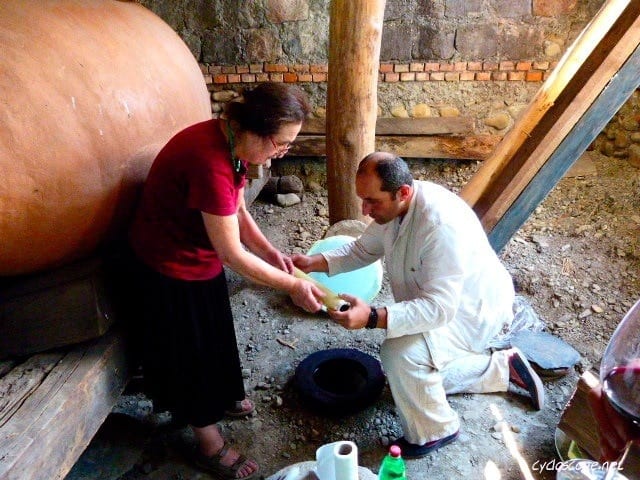
Qvevri (amphorae) are particular vases for winemaking. The stages of production and consumption have been developed over a thousand years. Many Georgian families have their own traditions.
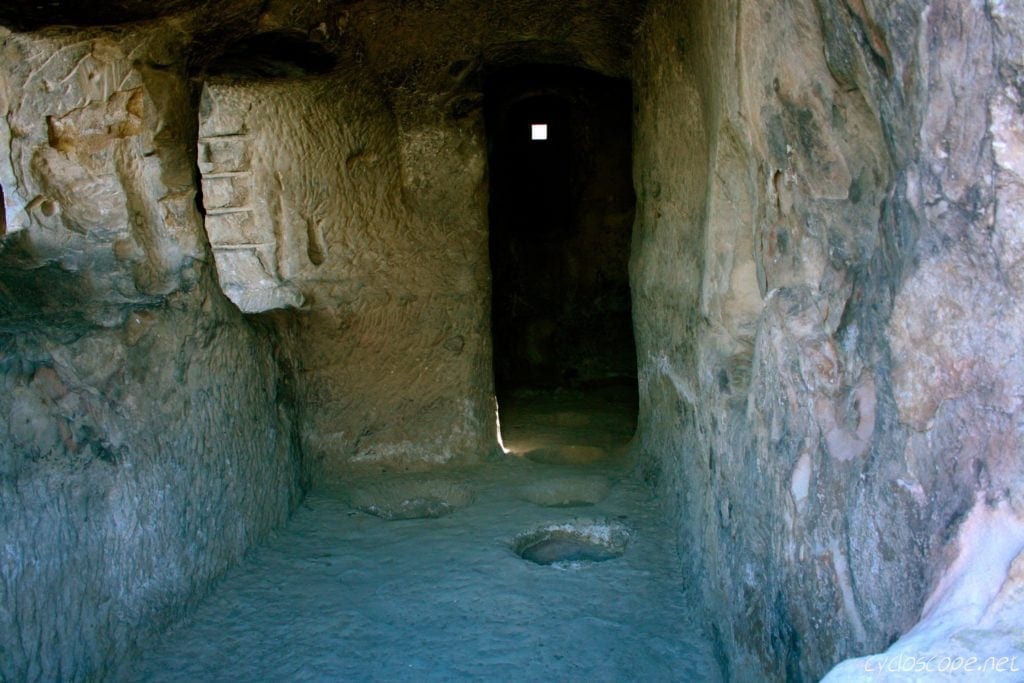
Many have specific places behind their homes, where the qvevri are buried. The qvevri came in various sizes and were hand-molded jars by skilled potters.
“Even in ancient Egypt and Assyria, this type of amphora was used, with the difference that only half was placed underground. The fact that the jars are completely underground,” says the Georgian winemaker, “keeps the wine at a constant temperature of about 13-14 degrees.
So the winemaking is done without any temperature changes. Modern technology has replaced this ‘natural’ method with steel tanks, allowing the temperature to be adjusted.
The particularity of these vinification methods lies in the fact that fermentation takes place with stems present, and maceration can last up to six months.
The Georgian wines produced according to traditional methods, therefore, are different in that they contain all the features of the place where they are made.
According to tradition, after the birth of a child, a qvevri is filled with wine, which will then be opened only on the day of his/her wedding.
Marani, Georgian traditional wine cellars
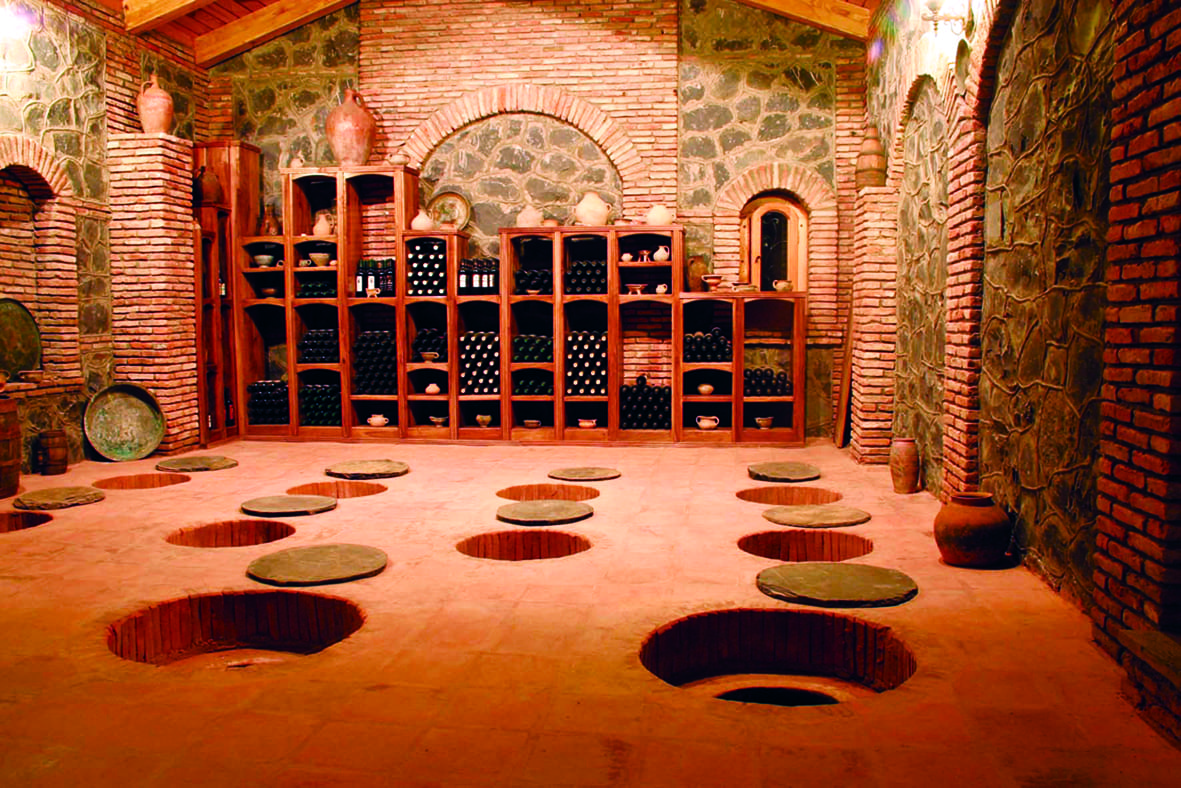
Each of the two winemaking methods used in Georgia has its own type of cellar (Marani in Georgian).
“In the region of Kakheti,” says Magradze, “the cellar is usually made of stone, and the qvevri are kept there. In the region of Imereti, however, the basement is made of wood, and large clay pots are placed underground, outdoors rather than in the cellar.
How an embargo can save a tradition: the Russian ban on Georgian products
But also in Georgia, the use of modern imported technology in winemaking is becoming more widespread. Traditional production, like everywhere else, is at risk of extinction.
The primary wine cooperatives, created in Soviet times when Georgia was the wine tank of the Russian republics, survived the collapse of the Union and adopted modern technologies, favoring more productive varieties and conventional farming practices.
Moreover, the large clay jars are produced by local craftsmen following practices dating back to the dawn of winemaking, and their number is shrinking rapidly because young people are unwilling to undertake the demanding apprenticeship and accept an unsatisfactory return.
The Russian embargo on Georgian wine importation, introduced in 2006, has led to profound changes in the country’s wine market.
The increased attention to the quality and maintenance of traditional methods led to the first international recognition and the establishment of a Slow Food Presidium for Georgian Wine in Jars.
Today, Ukraine is the leading importer of Georgian wine, followed by Kazakhstan and Belarus. Other countries that buy wine from Georgia are the United States, China, the Baltic countries, and Azerbaijan.
The Russian ban has led to both positive and negative changes in the Georgian wine market. As a result of the embargo, the producers had to improve the quality of their wines to sell in other markets.
In the same opinion, Renato, a winemaker from Trentino, a long-term resident of Georgia, said: “Once, any wine used to be produced. After the embargo, Georgian manufacturers faced the world market and had to start thinking about quality. “

But the embargo was also very damaging to some wineries, which had to close due to bankruptcy.
Slow Food Presidium and the rebirth of Georgian traditional wines
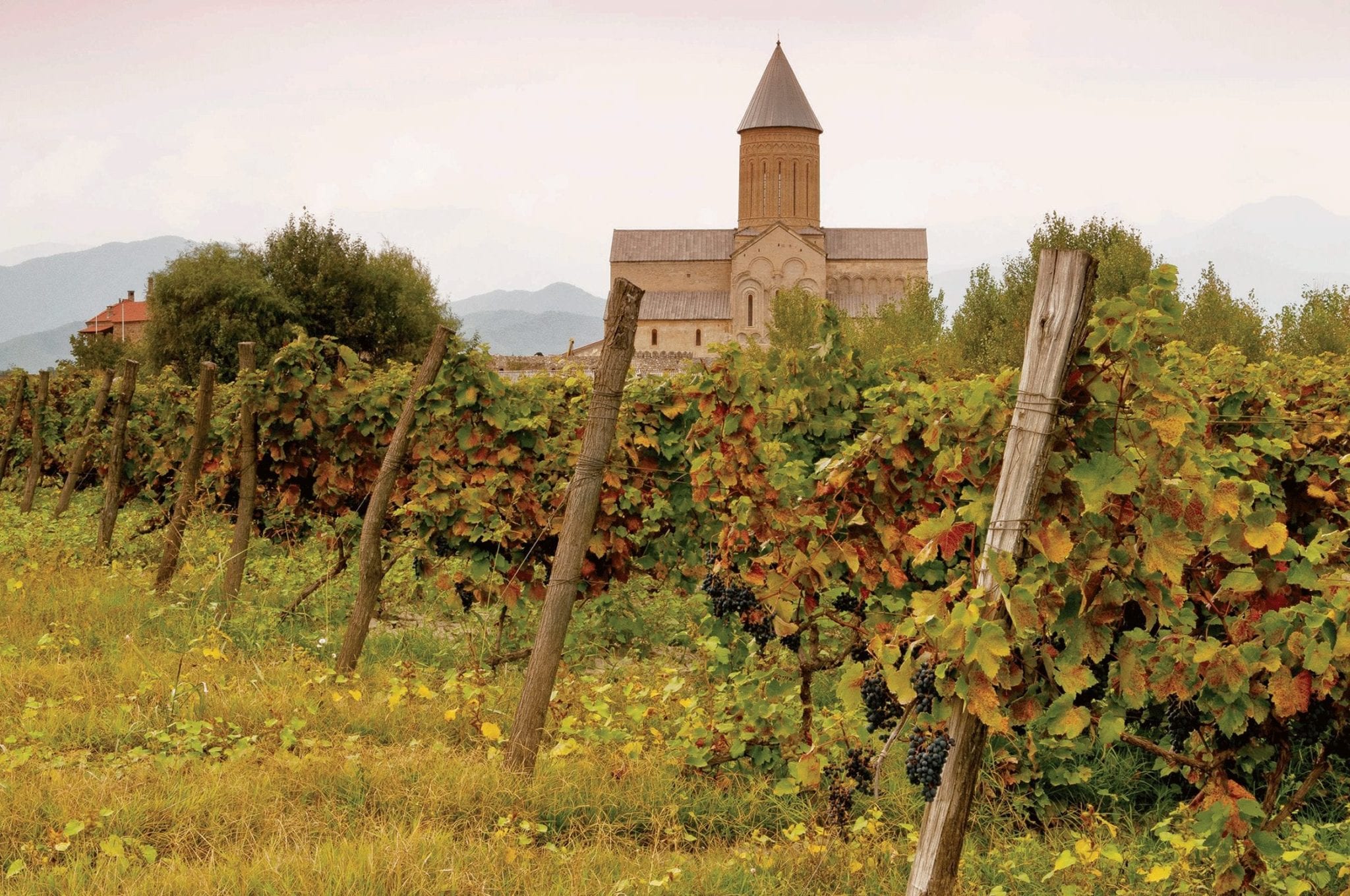
Slow Food, with its presidium, started in 2008, and met with producers from different geographical areas. They identified two main ones. The first, Khakheti, is the most traditional and has the best facilities.
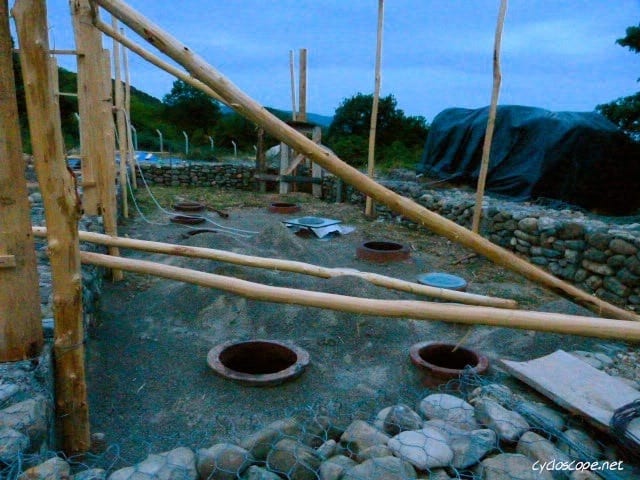
The second, Imereti, lies to the east and is entirely different. Here, the wine is produced mainly for family consumption, and the facilities are limited: the jars are buried beneath outdoor canopies.
In 2011, the region of Kartli, bordering Kakheti and famous for its wines, joined the Presidium. In addition, manufacturers have joined the Qvevri Wine Association to promote and enhance Georgian Wine in Jars.
The presidium mission also aims to help producers produce marketable wine, providing them with basic winemaking and storage equipment.
With the advice of a local enologist and through professional training, manufacturers have improved wine quality and adopted sustainable techniques.
Today, presidium producers are expanding their businesses and recovering abandoned vineyards. In addition, to increase the project’s sustainability, the production of chacha, a local distillate made from the skins of grapes of different varieties, was started.
Is the embargo on Georgian wine lifted?
On February 4, 2013, in Moscow, a meeting took place between the head of Rospotrebnadzor (the Russian Agency for the Protection of Consumer Rights), Gennady Onishenko, and the Georgian delegation regarding the restoration of supplies of Georgian wine and water to the Russian market.
The official reason for the embargo on Georgian wine and mineral water in Russia was the low quality of production. Now, if Georgian supervision is recognized as suitable for testing the quality of the supplies, importation could resume.
However, as noted by the President of the Rospotrebnadzor, Onishenko, Russia will maintain the embargo on the supply of wine material (must, half-ready wine), thus placing Georgia, according to experts, at a disadvantage compared to Western Europe and Latin American countries exporting wine materials to Russia, therefore significantly reducing the cost of production.
Before the embargo, Georgian wines accounted for about 10 percent of the Russian market. During the period when the ban was in force, South American wines occupied the market, and it wouldn’t be easy for Georgian wines to regain their former position.
Is Georgia really the birthplace of wine?
Yes — archaeological evidence shows wine was being made in what is now Georgia as early as 6000–5800 BC, making it the oldest known winemaking region in the world. Scientists identified wine residues in ancient pottery from the Neolithic sites of Gadachrili Gora and Shulaveri Gora, about 50 km south of Tbilisi.
How do researchers know the ancient pottery held wine?
Researchers found tartaric acid and other organic acids in clay vessels. Tartaric acid is a chemical marker tied closely to the Eurasian grape (Vitis vinifera) and wine fermentation, which confirms that the jars once held fermented grape wine rather than other beverages.
How old is the oldest evidence of wine?
The chemical evidence dates back roughly 8,000 years (6000–5800 BC), predating previously known early wines by several centuries.
Is Georgian wine still made using ancient techniques?
Many Georgian winemakers still use traditional qvevri fermentation and aging methods, carrying forward practices that date back millennia while also blending modern techniques in contemporary wineries.