

Last Updated on 2 January 2026 by Cycloscope
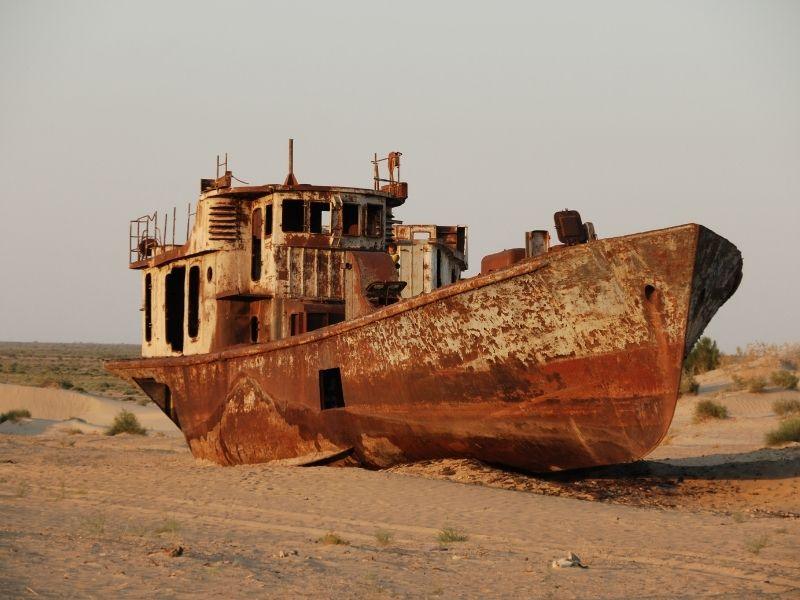
Once the 4th-largest lake on Earth, the Aral Sea has mostly vanished. Discover the story behind its disappearance and the lasting effects on the land, wildlife, and people.
Do you remember Aral Lake?
Disclosure: Some of our articles contain affiliate links. This comes at no additional cost for you and helps us keep this website up and running. (as Amazon Associates we earn commission from qualifying purchases)

That massive pool of water just on the east side of the Caspian Sea? Don’t you? Maybe you’re too young, ’cause if you looked at that after the year 2000, that doesn’t look so impressive.
Aral Lake used to be the 4th-largest lake in the world by surface area (68,000 square kilometers), after the Caspian Sea, Lake Superior (North America), and Lake Victoria (Africa). Now it’s almost a pond.
We went to Aralsk to find out in person. We didn’t focus too much on the ‘Instagrammable’ photos of the shipwrecks now resting on the bare sand, but mainly on the people who still live in what was once the most vibrant port of the Aral Sea, Aralsk.
Why did the Aral Sea dry up
In the 1940s, the Soviet government decided to divert the Aral Sea’s main tributaries, the Amu Darya and the Syr Darya, to irrigate the desert region surrounding the Aral Sea, in an attempt to grow rice, cereals, and cotton.
Many of the canals were poorly built, allowing water to leak or evaporate. From the Qaraqum Canal, the largest in Central Asia, perhaps 30-75% of the water went to waste. Today, only 12% of Uzbekistan’s irrigation canals are waterproofed (Wikipedia).
By 1960, between 20 and 60 cubic kilometers of water were going each year to the land instead of into the Aral. With most of its water supply gone, the Aral Sea began to shrink.
From 1961 to 1970, the Aral Sea’s sea level fell by an average of 20 cm per year; in the 1970s, the average rate nearly tripled to 50–60 cm per year, and by the 1980s it continued to drop, with a mean of 80–90 cm per year.
By 2007, the Aral Sea had declined to 10% of its original size.
Levels of salinity
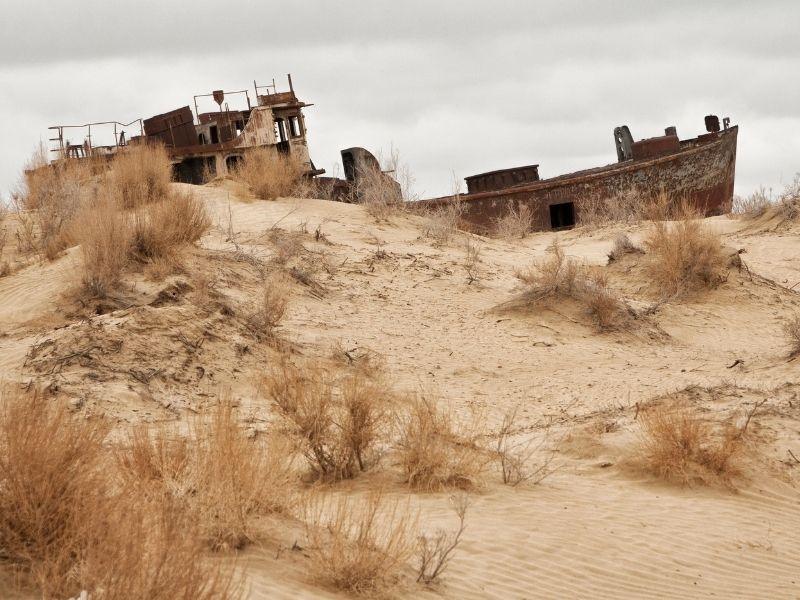
The level of salinity rose from approximately 10g/l to more than 100g/l in the remaining Southern Aral. The salinity of the rivers varies by place, time, and season.
When traveling through the desert, rivers often pick up salt residue from the ground, increasing salinity, but this may be lowered again after passing through irrigated lands.
Dams also affect salinity, notably by reducing its seasonal variability.
Smaller lakes in the Aral Sea area that no longer receive river flows tend to have higher salinity due to evaporation, causing some or all of the fish that either survived or were reintroduced in the 1990s to die.
Even re-watering those lakes does not compensate for the increased salinity over the years. In 1998, the water level was down by 20m, with a total volume of 210 km3, compared to 1,060 km3 in 1960.
Toxic sand, toxic air, toxic water
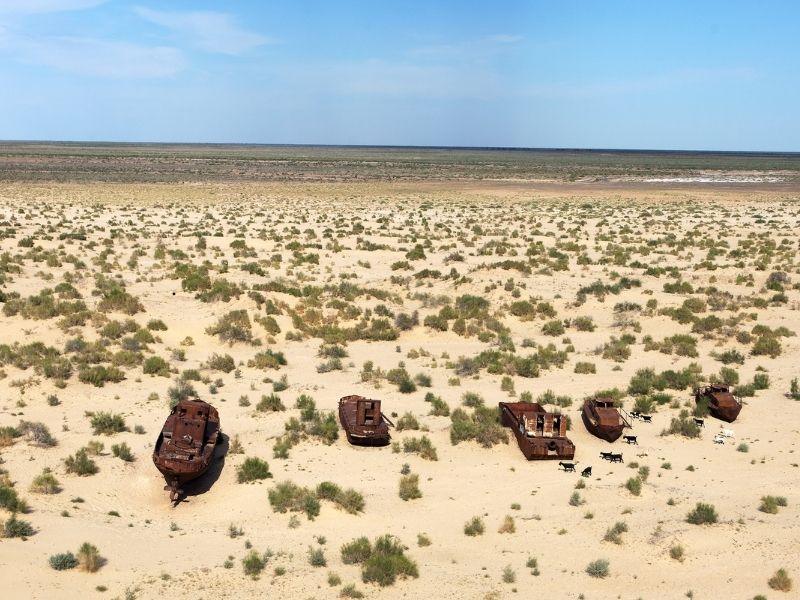
This imprudent land modification caused unexpected climate feedback, public health issues, and the devastation of the region’s once-robust fishing economy, affecting the lives of millions of people in and out of the area.
Winds are now the lords of the region, blowing highly salted and toxic sand (contaminated by chemical residuals of weapon testing, industrial projects, and so on) as far away as Scandinavia and Japan. Of course, it is a plague, especially for the locals.
The ecosystems of the Aral Sea and the river deltas feeding into it have been nearly destroyed. Crops in the region are destroyed by salt being deposited onto the land. Vast salt plains exposed by the shrinking Aral have produced dust storms, making regional winters colder and summers hotter.
During a visit in 2010, the UN Secretary General Ban Ki-moon declared
“It is clearly one of the worst environmental disasters in the world. I was so shocked”.
In the meantime, tensions are growing between the governments of Uzbekistan and Tajikistan.
Competition for water could become increasingly heated, as global warming and rising populations further reduce the amount of water available per capita.