

Last Updated on 19 January 2026 by Cycloscope
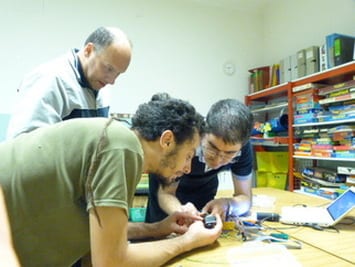
Working with RaspiBo
The “automatic road sampler” system is one of the most interesting, innovative, and challenging aspects of our project.
Disclosure: Some of our articles contain affiliate links. This comes at no additional cost for you and helps us keep this website up and running. (as Amazon Associates we earn commission from qualifying purchases)
Thanks to the fundamental contribution of RaspiBo, we’ve developed a system that can automatically take a picture every 500 meters along the entire route of the journey.
The images are geo-referenced and will compose an interactive map of the entire route, as well as video sequences in the form that we call “space Lapse” to mark the differences from the classic time-lapse.
A time-lapse video sequence is composed of frames taken at a fixed time interval, such as 1 second, united to create a video whose effect is “accelerated” (for example, a flower unfolding in seconds).
In our case, the fixed parameter is the distance, so all images will be equally spaced, creating a sort of “street view” effect when composed on a map.
How does our Automatic Road Sampler work?
After a thorough analysis of the various possibilities, we chose to use, for this version of the system, a GoPro Hero1 action cam. Almost all GoPro models have a 30-pin connector, which is used, for instance, to attach the LCD unit or other accessories.
Each of the 30 pins has a different function (audio output, video output, power supply…). This allocation lends itself to countless delicious possibilities for “hacking” and unofficial uses, of which you can find lots of tasty examples on the net.
Among these, there is one pin (n°12) that is connected to ground and turns the camera on or off. GoPro cameras have a very useful feature called OneButtonMode, in this mode, the machine is activated immediately when turned on, taking photos, or filming, depending on how we decide to set it.
In this way, it is sufficient to send the ignition signal, and the cam will immediately take a picture, then go off automatically by sending a new signal to pin 12. Fatherhood of this system is not ours; we report the source, where you can find many other interesting “hacks” for GoPro and other devices.
Who sends these on-and off signals is a circuit (a trigger), composed of a magnetic sensor applied to the bicycle fork, whose task is to detect the passage of a magnet placed between the spokes (as a classic cycle speedometer), and a chip, that counts the steps of the magnet up to the number that corresponds to 500 meters of the road (about 235 steps with a 26″ wheel), and then sending the signal that closes the pin 12 to ground, turning on the GoPro that, thanks to the OneButtonMode, immediately takes a picture.
Then the chip sends a signal to turn off the cam after a preset time, so the cam remains off when not necessary, resulting in significant battery savings (essential for the project’s success).
For those who wish to deepen the argument, here is the project’s wiki (in Italian) and a brief explanatory video.
Geo-Tagging
During the journey, a GPS receiver, in our case a Garmin Oregon 400t, continuously records the location referenced by date and time. This is a basic function of each GPS logger: to record the path traveled.
Using Viking, an open-source software, we can import a GPS track (GPX format) that will be displayed in the software on OpenStreetMap maps.
Thanks to Viking, we can assign GPS coordinates to any picture by matching the time and date metadata in the photos to those of the GPX track. The result is a map showing the photos arranged at the exact points where they were taken.
To share it all online, we now use EveryTrail, though in the long term we would like to develop our own platform to create an open community for sharing photos taken with this system.
Automatic Road Sampler – 2nd test
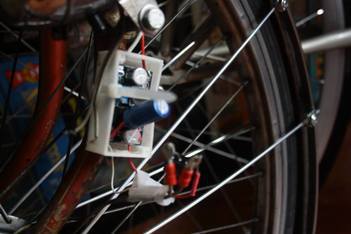
USB dynamo charger’s first prototype
Hub Dynamo battery charger. To ensure we never run out of energy, we have developed this simple circuit to rectify and stabilize the output voltage of the archaic Sturmey Archer Dynohub (1936), providing 5V via a USB port.
With this system, we can charge a USB battery by pedaling. The battery can thus increase the GoPro’s battery life, offering the added benefit of charging mobile phones and other devices in case of emergency. Diagrams and descriptions of the circuit are also available on the Cycloscope wiki.