

From Thomas Stevens on a penny-farthing to Lorenzo Barone in Siberia, meet the cycling travellers heroes who redefined what is possible on two wheels — and why distance alone never made anyone a hero.
Riding a bicycle across a country, or even across a continent, doesn’t make you a hero. Plenty of people have done it, including us, and more do every year, which is a wonderful thing. The road is open to everyone, and some notion of heroic exceptionalism should never gatekeep long-distance cycling.
But every so often, across the 140-year history of cycling travel, someone comes along whose journey isn’t just long or difficult — it’s genuinely transformative. For themselves, yes, but also for everyone who comes after them.
Disclosure: Some of our articles contain affiliate links. This comes at no additional cost for you and helps us keep this website up and running. (as Amazon Associates we earn commission from qualifying purchases)
They cross a frontier that wasn’t just geographical: the first woman to circle the globe by bike, in an era when women weren’t supposed to leave the house alone. The first person ever to ride a bicycle around the world, on a machine with no gears and no brakes, when nobody knew if it was even possible.
The man who spent five decades on the road, not chasing records, but simply because the road had become his life. The young Italian sleeping in a tent at -55°C in Siberia, carrying the same restless curiosity as his predecessors but now sharing it in real time with the world.
These are the cycling travellers heroes — not because they rode far, but because of what their riding meant.
Thomas Stevens — The First Around the World (1884–1886)
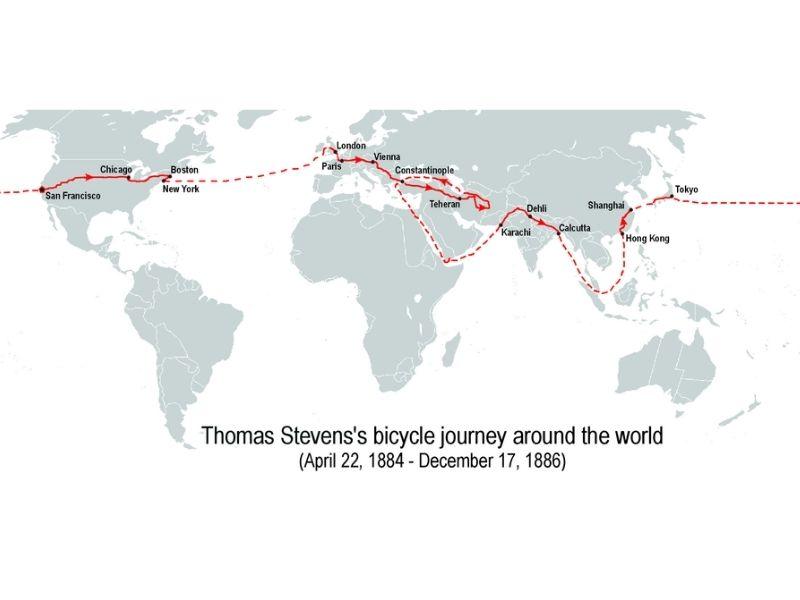
The story of the cycling adventure really begins with Thomas Stevens. Born on Christmas Eve 1854 in Berkhamsted, Hertfordshire, England, Stevens emigrated to the United States at 17 and worked his way through various jobs in the American West before settling in San Francisco, where he discovered the bicycle.
In April 1884, he departed San Francisco on a 50-inch Columbia penny-farthing, carrying little more than a spare shirt, a raincoat that doubled as both tent and bedroll, and a pocket revolver. He crossed the American continent in 103 days, reaching Boston after roughly 3,700 miles — the first transcontinental bicycle ride in history. He then shipped his bike to Liverpool and pressed on: through Britain, Europe, the Middle East, Persia, India, China, and Japan, completing his circumnavigation in December 1886.
His travels were serialised in Outing magazine and later published as Around the World on a Bicycle. This two-volume work captured the public imagination and planted the seed of long-distance cycling adventure in countless minds. Stevens wasn’t just a cyclist — he was a storyteller, and his detailed, accessible prose created a template that every cycling travel writer since has followed.
John Foster Fraser — Round the World on a Wheel (1896–1898)
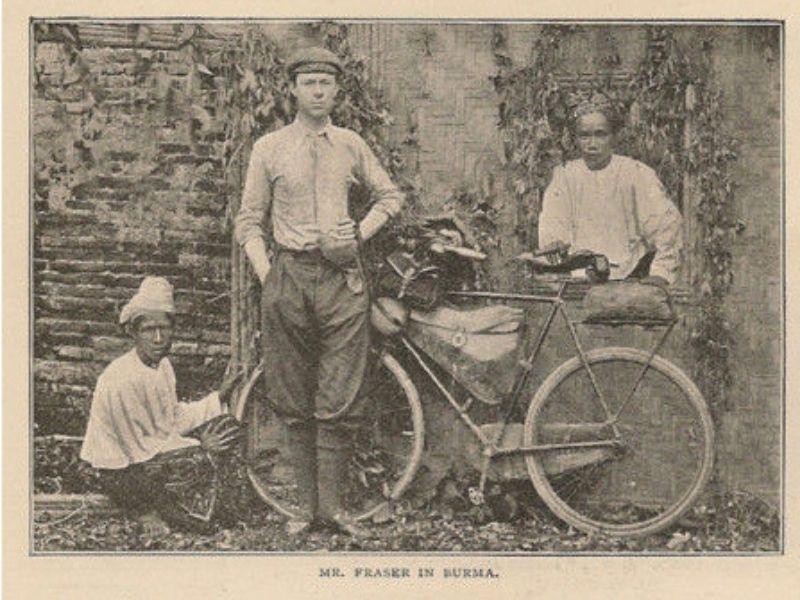
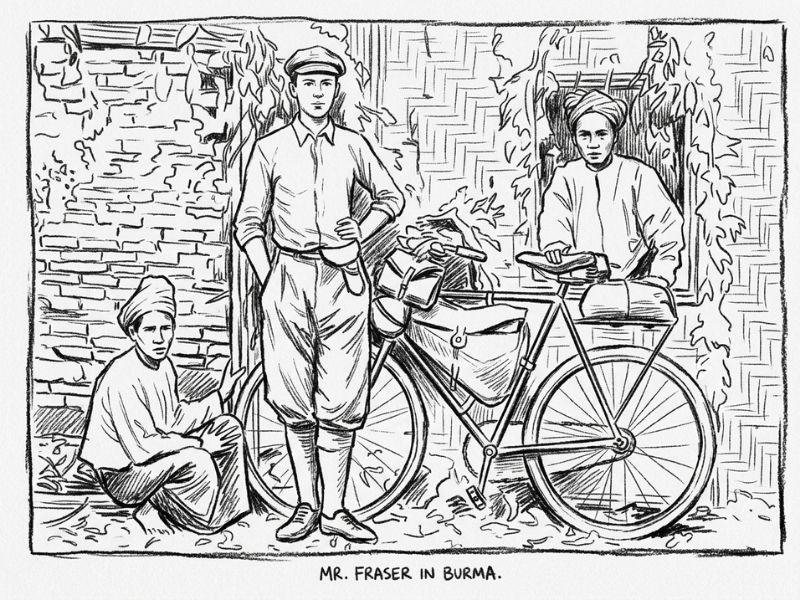
A decade after Stevens completed his solo ride, British journalist and travel writer John Foster Fraser upped the ante by setting off in 1896 with two companions — Lenz and Lunn — on a global cycling tour that covered over 19,000 miles across four continents.
Their journey took them through Europe, Asia, Australia, and the Americas, enduring roads that were often little more than dirt tracks, hostile border crossings, and the relentless grind of human-powered travel across hostile geography.
Fraser documented the adventure in Round the World on a Wheel, which became one of the defining cycling travelogues of the Victorian era. His writing offered readers a vivid panorama of landscapes and cultures at a time when most people would never leave their home country, helping to establish the idea that the bicycle was not merely a vehicle but a passport to the world.
Annie Londonderry — The Woman Who Proved It Could Be Done (1894–1895)
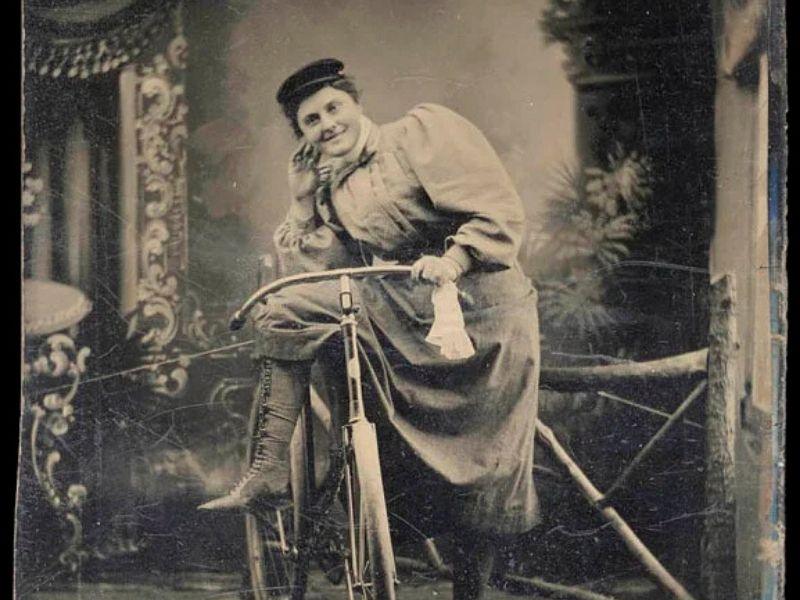
If Thomas Stevens proved that a man could circle the globe on a bicycle, Annie Londonderry proved that gender was no barrier to the attempt. Born Annie Cohen Kopchovsky, a Latvian Jewish immigrant to the United States and mother of three young children, she set off from Boston in June 1894 to become the first woman to cycle around the world.
Her journey was as much a performance as an expedition — she carried advertising banners for sponsors (including the Londonderry Lithia Spring Water Company, whose name she adopted), gave lectures along the way, and turned her adventure into a media event. She completed her circumnavigation in 15 months, arriving back in Chicago in September 1895.
Londonderry’s ride was groundbreaking on multiple levels. In an era when women’s participation in sport was widely discouraged, and long-distance cycling was considered a purely male pursuit, she crossed continents, navigated foreign bureaucracies, and returned home famous. Her story is one of the great acts of determination in the history of cycling — and of women’s rights more broadly.
Dervla Murphy — Ireland to India, and Everywhere After (1931–2022)
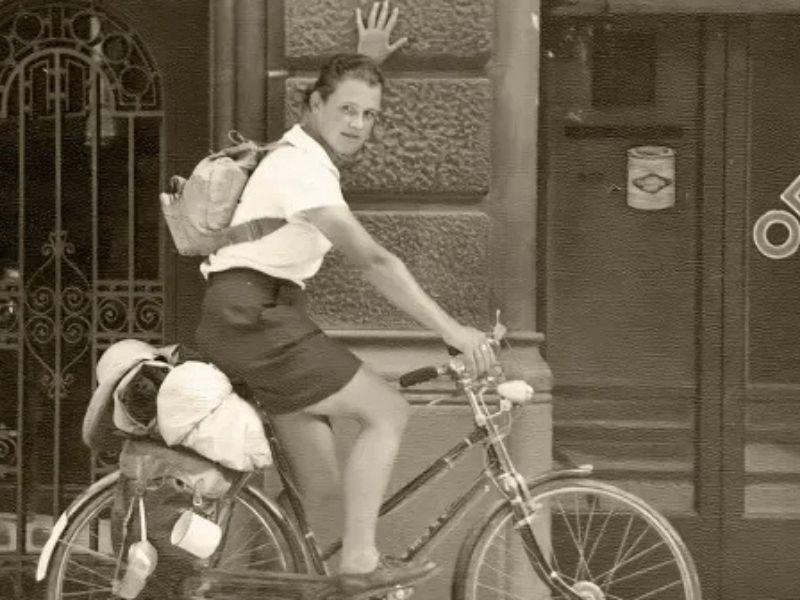
The dream began on a steep hill near Lismore, County Waterford, when a ten-year-old girl looked down at her legs slowly pushing the pedals and thought: If I kept doing this long enough, I could get to India. That girl was Dervla Murphy, and she spent the next eight decades making good on that thought.
Murphy was born in 1931 and received a second-hand bicycle and an atlas as birthday gifts that same year. She had her revelation. The atlas and the bike became her twin obsessions — but life intervened. She spent sixteen years caring for her mother, who developed rheumatoid arthritis early in Dervla’s life, and it was only after her mother died in 1962 that she was finally free to go. She was 31 years old. She had already waited long enough.
In January 1963, Murphy set off from Dunkirk on her Armstrong Cadet men’s bicycle — named Rozinante, after Don Quixote’s horse — with a pistol among her supplies and a refusal to be deterred by weather, bureaucracy, or common sense.
She cycled through Europe, Iran, Afghanistan, Pakistan, and arrived in India. She fought off a wolf attack in Yugoslavia. She survived snowdrifts in the Turkish highlands. She pushed through heat and illness across the subcontinent.
What followed was one of the most prolific careers in travel writing history: more than 26 books over 50 years, covering Ethiopia, Nepal, Cameroon, South Africa, Cuba, Palestine, Laos, and beyond. She travelled with her young daughter Rachel from the age of five, by bicycle, on foot, and by mule.
She won the Christopher Ewart-Biggs Memorial Prize, the Edward Stanford Award for Outstanding Contribution to Travel Writing, and the Royal Geographical Society award. She never learned to drive.
Murphy died in May 2022 in Lismore, aged 90, having never really stopped moving. She remains one of the great cycling traveller heroes — not only for the miles she covered, but for the clarity, honesty, and political intelligence she brought to the page.
Her book “Full Tilt: Ireland to India with a Bicycle” is the first bicycle touring book I have read, and we have included it in our article The Best Bicycle Touring Books I Have Read and Loved.
Lucien Péraire — Esperanto, Rails, and 30,000 km Across Eurasia (1928–1932)
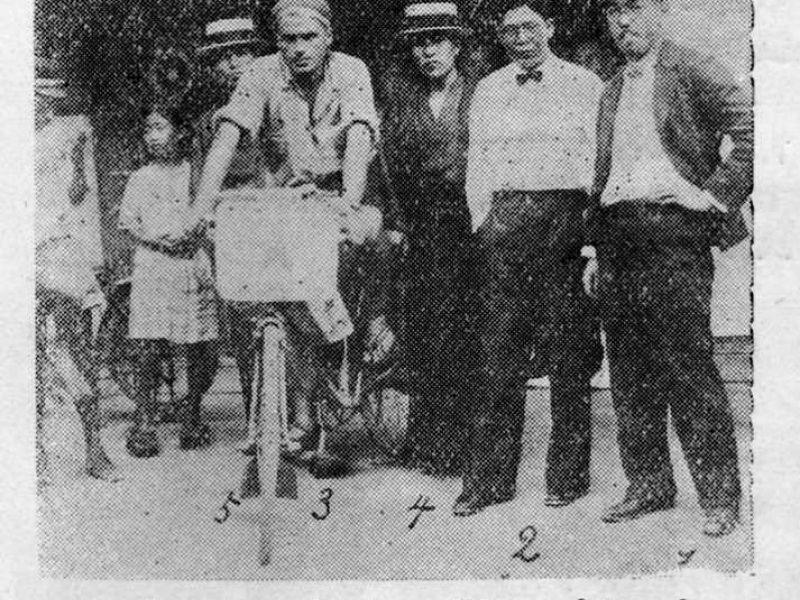
Less well-known than many of his contemporaries, Lucien Péraire is nonetheless one of the most fascinating figures in the history of cycling travel. Born on 26 April 1906 in Lavardac, France, Péraire was a devoted Esperantist — a believer in the international language movement — and a humanist adventurer who saw travel as a way to connect with people across cultural and linguistic divides.
From 1928 to 1932, Péraire undertook a remarkable journey of over 30,000 kilometres through France, Germany, Czechoslovakia, Austria, Hungary, Poland, and deep into the Soviet Union.
His most remarkable innovation was the vélo-rail: a method of riding his bicycle directly on railway tracks, which he invented to cross vast stretches of territory where roads were impassable or non-existent, including large sections of the Trans-Siberian Railway route.
He recorded his experiences in the book Tra la mondo per biciklo kaj Esperanto (“Through the World by Bicycle and Esperanto”), published in 1990 by the Agen Esperanto club. Long forgotten in the memory of his native village, Péraire has been rediscovered in recent years as a pioneering figure in cycling travel, humanist diplomacy, and cultural exchange — a globe-trotter who sought not records but understanding.
Walter Stolle — 159 Countries in 18 Years (1959–1976)
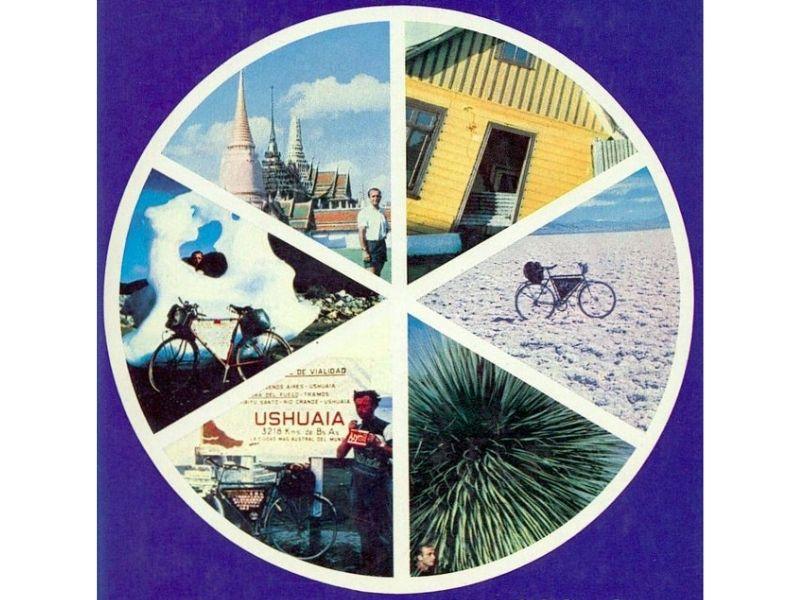
Walter Stolle’s story begins not in triumph but in loss. A German from the Sudetenland, he was displaced from his homeland after World War II and eventually settled in Britain. On 25 January 1959, he set off from Essex on a journey that would last 18 years and take him through 159 countries.
To fund his travels, Stolle delivered over 2,500 illustrated slide shows in seven languages, charging approximately $100 per appearance — a remarkable feat of self-financing that required nearly as much ingenuity off the bike as on it.
The journey was not without hardship: he was robbed 231 times, wore out six bicycles, and had five more stolen. Yet he continued, riding through West African countries in 1974 and navigating political upheaval and physical danger across multiple continents.
Stolle represents a particular kind of cycling traveller hero: not the fastest, not the most famous, but utterly relentless — someone for whom the road was not a challenge to be conquered but simply a way of life.
Heinz Stücke — Half a Century, 600,000 Kilometres (1962–present)
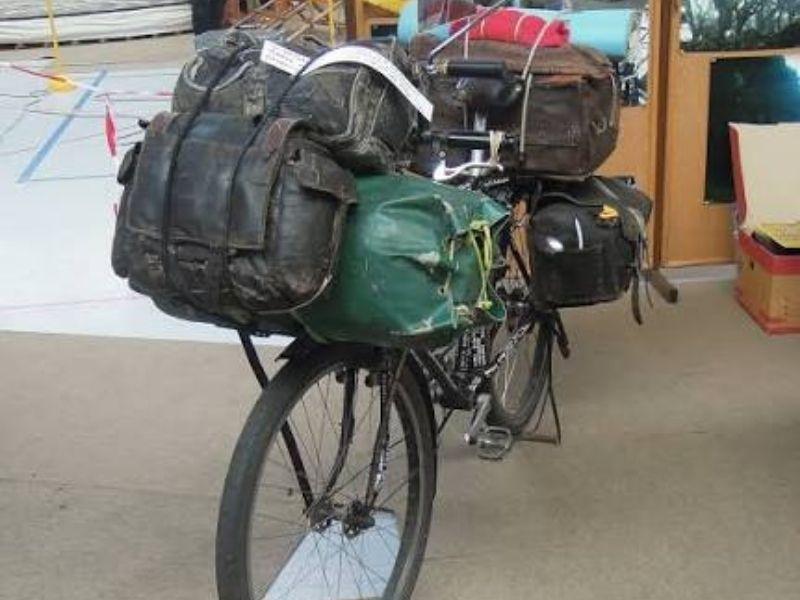
No list of cycling traveller heroes would be complete without Heinz Stücke. The German cyclist set off in 1962 and has spent more than five decades living on the road, accumulating over 600,000 kilometres across nearly every country on earth — one of the longest continuous bicycle journeys in recorded history.
Stücke financed his travels by selling postcards of his adventures and writing about his experiences — a pre-Internet form of content creation that sustained him for decades.
He witnessed world history from the saddle: the fall of the Berlin Wall, the end of apartheid in South Africa, political revolutions, and border changes across six continents. Through it all, he maintained a quiet philosophy: that for every dangerous or difficult encounter, there were a hundred acts of human generosity waiting just around the next bend.
His story is a testament to what happens when adventure becomes identity — when the bicycle is not just a mode of transport but the entire framework of a life. There is a documentary about his story called The Man Who Wanted to See It All.
Lorenzo Barone — The New Generation (1997–present)
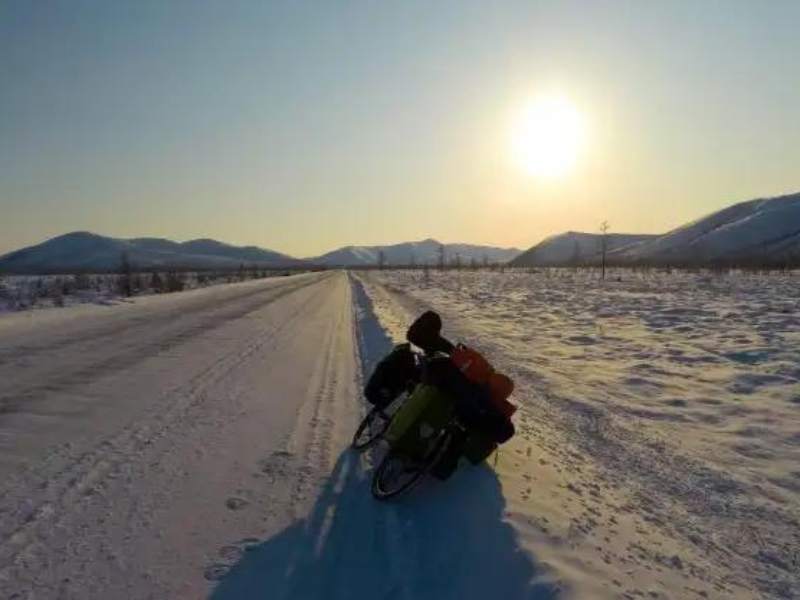
Born in 1997 in San Gemini, Umbria, Italy, Lorenzo Barone represents the next chapter in the long tradition of cycling travel heroism — and he is writing it at a remarkable pace.
Barone set off on his first long-distance adventure at age 18 and has not really stopped since. To date, he has ridden over 100,000 kilometres through 64 countries, but the raw numbers barely scratch the surface of what makes his story compelling.
In 2020, he cycled solo across the African continent from Cape Agulhas — the southernmost tip of Africa — to Port Said in Egypt: over 12,000 kilometres through 10 countries in 106 days. That same year, he crossed Siberia by bicycle in the depths of winter, sleeping in a tent at temperatures reaching -55°C.
In February 2022, he set off from Cape Agulhas again on what he called the world’s longest road: a 29,000-kilometre route from the southernmost point of Africa to Cape Dezhnev, the easternmost point of Asia, crossing three continents and twelve countries. Along the way, he rode through the Altai Mountains, crossed the Kazakh steppe, and met Aygul — a Kazakh woman who would become his wife — and rode the final stretch of the journey with her by his side.
Barone is not just a cyclist but a storyteller, educator, and speaker, with a substantial following on YouTube and social media. He rides not for records or sponsorships but out of a deep, restless curiosity about the world — a direct heir to the spirit of Thomas Stevens and Heinz Stücke, updated for the 21st century.
The Thread That Connects Them
What unites these cycling traveller heroes across more than a century of adventure? Not speed, not equipment, not nationality. What connects Stevens on his penny-farthing with Barone on his modern touring bike is the same quality: a refusal to accept that the world is too large, too dangerous, or too unknown to be crossed on two wheels.
Each of them, in their own time, expanded the definition of what a bicycle journey could be. Each of them inspired others. And each of them understood something that the rest of us forget in our daily lives: that the road, however difficult, is always going somewhere — and that the only question is whether you dare to follow it.