
Last Updated on 31 January 2026 by Cycloscope
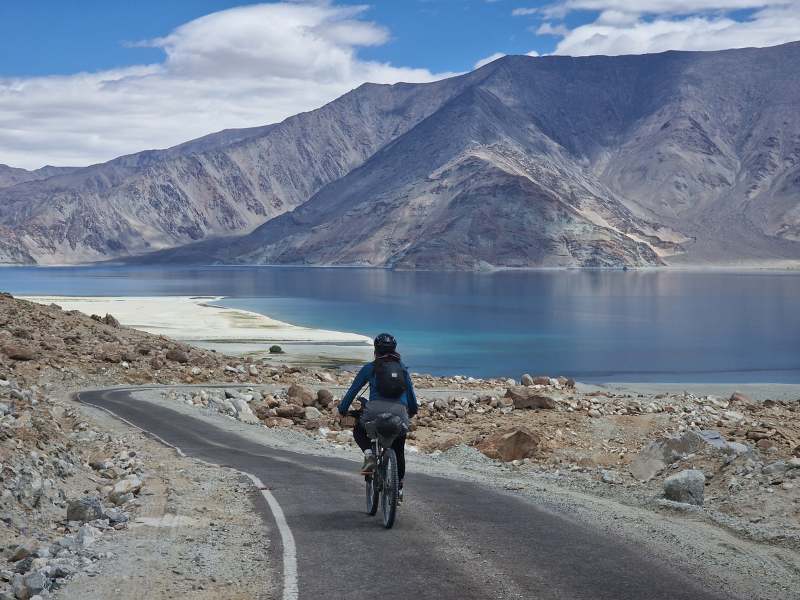
We cycled Ladakh’s stunning lakes, and in this comprehensive guide, we’ll share essential information, including routes, road conditions, safety tips, permits required, and must-see attractions, for an unforgettable cycling adventure in this Himalayan paradise
After cycling the Spiti Valley and the Manali-Leh route, we decided to explore the crystal-clear lakes of Ladakh. The most famous is Pangong Lake (Pangong Tso), but we also visited the less touristy Tso Kar and Tso Moriri.
Disclosure: Some of our articles contain affiliate links. This comes at no additional cost for you and helps us keep this website up and running. (as Amazon Associates we earn commission from qualifying purchases)

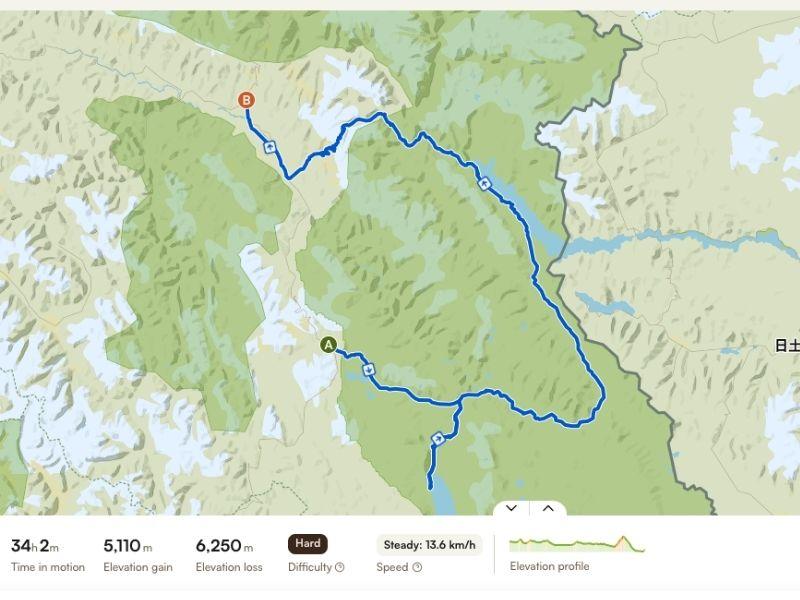
The permit to visit the Pangong Lake area can only be obtained in Leh, and since we had already cycled the Taglang La, we decided to take a lift back to Debring from where we started our journey towards the lakes.
Our route runs from South to North and returns to Leh via Changla La Pass. Of course, you can also get the permit in Leh and start cycling again along the road from Debring to Leh.
Or you can decide to visit only Pangong Lake if you don’t have much time. Let’s say that after all the passes we had already pedaled, we didn’t have too much desire to pedal 5000+ m (16400 ft) twice.
At the end of this article, you’ll find our GPX Map of the Tso Moriri and Pangong Lake route.
Pangong Lake Permit
To visit the lake region in Ladakh (Pangong Lake, Tso Moriri, and Tso Kar), you will need to obtain a permit in Leh. Many travel agencies in the city offer this service; we obtained the permit the same day with the help of Mystic Mountains Ladakh.
It may take a few days, depending on the period and requests; try not to do everything at the last moment. The permit, in addition to the lakes, also covers other areas that require a permit to access, such as the Aryan and Nubra Valleys.
Here’s how you can obtain the necessary permits:
- For Indian Citizens: Indian citizens can obtain the Inner Line Permit (ILP) online or offline. These permits are issued by the Ladakh Autonomous Hill Development Council (LAHDC) or through authorized travel agents.
- Online: You can apply for the Inner Line Permit online through the official website of the Ladakh administration or designated travel portals.
- Offline: If you’re already in Leh, you can visit the Deputy Commissioner’s office or the Tourist Information Center to obtain the permit. You will need to fill out an application form, provide identification documents (such as a passport, voter ID, or Aadhar card), and pay the required fee.
- For Foreign Nationals: Foreign nationals must obtain a Protected Area Permit (PAP) or an Inner Line Permit (ILP) to visit Pangong Lake. These permits are typically obtained through registered travel agencies in Leh. You will need to submit your passport and visa details along with the permit application.
- PAP: Foreign nationals can obtain the Protected Area Permit (PAP) from the Foreigners Registration Office (FRO) in Leh or through registered travel agencies.
- ILP: Alternatively, some foreign nationals may be eligible for an Inner Line Permit (ILP) instead of a PAP. This permit can also be obtained from the Deputy Commissioner’s office or through registered travel agencies.
Tso Kar, the “White Lake”
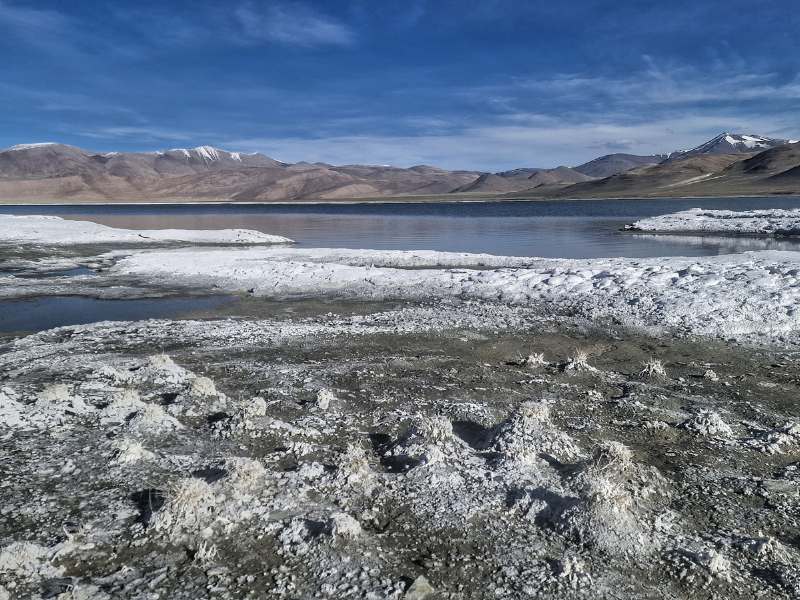
In the heart of the enchanting Himalayan region, specifically in the Rupshu Valley, at 4600 meters, lies a hidden gem known as Tso Kar – the “White Lake” in the mystical land of Ladakh.
The name refers to the salt deposits that shimmer along its shores, giving it a unique and otherworldly appearance.
This serene and shimmering waterbody, home to the rare demoiselle crane, is surrounded by breathtaking beauty and a way of life that seems to have stood the test of time.
The lake is part of the Ramsar Convention’s Wetland site and is renowned for its rich biodiversity, especially birdlife.
It serves as a crucial breeding ground and habitat for various bird species, including migratory species such as the black-necked crane, bar-headed goose, and Brahminy duck.
Apart from birds, the surrounding region also supports wildlife such as the Tibetan wild ass (kiang), the Tibetan gazelle, and the snow leopard.
Here, semi-nomadic communities find solace and sustenance in their harmonious coexistence with nature. The Changpa, as they are known, have embraced a lifestyle that is as timeless as the tranquil lake that mirrors the sky.
Here is the village of Thukje, which might claim the title of the highest hamlet in the world, but does not care. A cluster of stone houses stands strong against the elements.
These simple yet sturdy abodes are a testament to the Changpa’s resourcefulness, built to withstand the harsh winters that enfold this remote region.
As the sun ascends, the people venture out to tend to their livestock, which graze freely on the vast pastures surrounding the lake. Some seek natural medicine, whether herbs or minerals. A funny trio is stuck in the middle of a track with no more fuel.
A matriarchal society, the Changpa take pride in their unique traditions and customs, among which polyandry is one of the most notable.
All this and more we learn from Mr. Karma, who accompanies us on a long sunset tour around the lake, a tour that none of us will ever forget.
Like Pangong Lake, Tso Kar freezes over during winter, and the surrounding area experiences harsh weather.
During the summer, the lake is accessible by road, and travelers can reach it from Leh via the Manali-Leh Highway. The road that takes you to the lake is brand new.
From Debring on the Manali-Leh Highway, a recently asphalted road will take you to Tso Kar. In the village, there are dhabas and guesthouses for eating and sleeping.
Tso Moriri & Kyagar Tso
The road after Tso Kar becomes dirt, but it is not terrible. You will find some basic homestays after Puga Hot Springs in the village of Sumdo, which also hosts the bordering school for nomadic children in the area.
From here, you take the turn towards Kyagar Tso and Tso Moriri. The road gets noticeably worse, rocky at times, but also with asphalt or decent dirt roads.
We advise you to take a lift if you don’t want to travel the road twice. Once in Tso Moriri, you can’t help but go back, crossing the Namshang La or Kyagar La again at 4,960 meters or 16,273 feet.
Tso Moriri, a marvel nestled in the rugged landscapes of Ladakh, is a breathtaking high-altitude lake that seems to mirror the heavens themselves.
Of course, by “mirror,” I mean that its surface occasionally ripples with gusts of wind, showing us that even heavenly reflections can be a bit temperamental.
The village surrounding Tso Moriri is a testament to the delicate balance between humans and the environment. Amidst the barren beauty, the villagers have crafted homes that stand strong against the elements, though they might not always ward off the chilly winds as effectively as one might hope.
Their sun-kissed skin is a testament to their dedication to outdoor life, and their warm smiles are a testament to their mastery of smiling through chapped lips.
With each sunrise, the villagers rise to tend to their livestock, embracing the yaks’ penchant for leisurely strolls and impromptu symphonies of bell ringing.
Their dances, performed with reverence for the mountains and waters, sometimes result in unintended comedic interludes, as altitude-induced light-headedness adds an element of unpredictability to their steps.
Tso Moriri’s allure extends beyond its stunning façade. It’s a mirror that reflects the resilience of a community that thrives in a challenging environment.
Their lives are a delicate waltz with the seasons, occasionally marked by abrupt and unscheduled snow dances.
As you stand by the cerulean expanse of Tso Moriri, taking in the majesty and perhaps shivering a little, remember that even the most stunning destinations come with their own quirks, adding an extra layer of adventure to the experience.
Tso Moriri, also known as Lake Moriri or Mountain Lake, is a breathtakingly beautiful high-altitude lake situated on the Changthang plateau in Ladakh, India.
It lies at an altitude of approximately 4,595 meters (15,075 feet) above sea level, making it one of the highest lakes in the region.
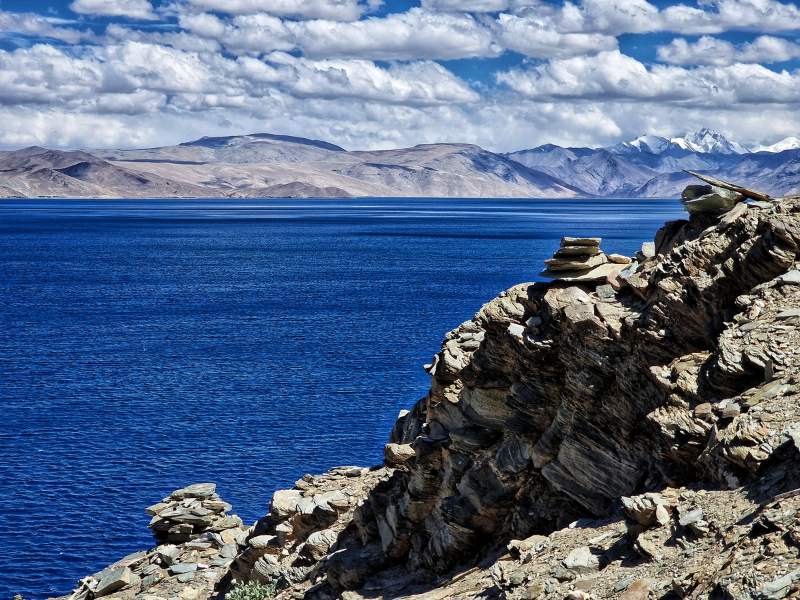
Tso Moriri is renowned for its pristine turquoise-blue waters, set against snow-capped peaks and barren mountains, creating a picturesque, serene landscape.
The lake spans about 120 square kilometers (46 square miles) and is bordered by the majestic peaks of the Himalayas and the Trans-Himalayas.
Similar to Tso Kar, Tso Moriri is also designated as a Ramsar Wetland site due to its ecological significance.
The lake and its surrounding marshlands support a diverse range of flora and fauna, including migratory birds such as bar-headed geese, Brahminy ducks, and black-necked cranes.
The region is also home to other wildlife species, including the Tibetan wild ass (kiang), the Tibetan gazelle, the snow leopard, and various bird and plant species adapted to the harsh, high-altitude environment.
Tso Moriri is a popular destination for travelers seeking off-the-beaten-path experiences in Ladakh. Due to its remote location, the area around the lake offers a tranquil, pristine environment ideal for nature lovers, photographers, and adventure enthusiasts.
Visitors can explore the surrounding landscapes, go birdwatching, trekking, or simply soak in the breathtaking views of the lake and its surroundings.
Access to Tso Moriri is primarily by road, with the nearest major town being Leh, from where travelers can embark on a scenic journey to reach the lake.
Pangong lake
Once you return to the main road, a nice, freshly baked asphalt awaits you, as well as a pleasant descent to the Mahe Bridge.
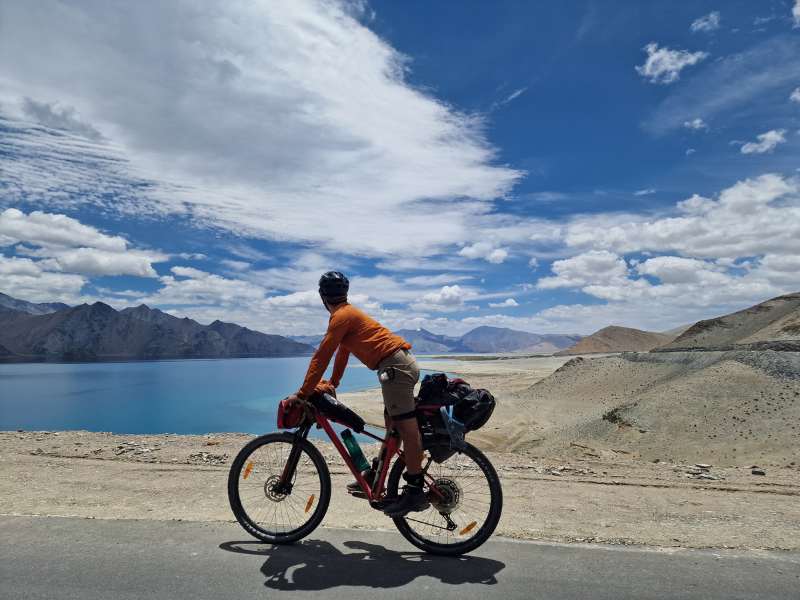
From here to Pangong Lake, there is no asphalt, but the road is decent; it only gets worse towards the village of Chushul. From here, the asphalt starts again and will not leave you until the end of Pangong Lake.
From the village of Tangste, after a nice shower and a sleep at the Chang La Queen Cafe & Hotel, we took the road to the Chang La Pass at 5360 m or 17,688 ft
Pangong Lake, also known as Pangong Tso, is a stunning high-altitude lake in the Himalayas, at an elevation of about 4,350 meters (14,270 feet) above sea level.
It straddles the border between India and China, with about two-thirds of its length extending into Tibet, China, and the remaining one-third in the Ladakh region of India. The lake is roughly 134 km (83 miles) long and up to 5 km (3.1 miles) wide.
Pangong Lake is renowned for its mesmerizing blue waters, which change shades with the light and weather, ranging from azure to deep blue.
The lake’s beauty is further accentuated by the rugged mountains surrounding it, creating a breathtaking landscape that attracts tourists, photographers, and nature lovers from around the world.
The lake gained significant attention due to its inclusion in several Bollywood and international films, notably the climax scene of the popular Indian movie 3 Idiots.”
Pangong Lake freezes over in winter, and it’s accessible by road in summer, with the most common route from Leh, the capital of Ladakh.
Travelers require permits to visit certain areas around the lake due to its proximity to the Line of Actual Control (LAC), the de facto border between India and China.
The road from the north of the lake to Tangste (Pangong Lake Road) was terrible; the asphalt had been completely removed to rebuild it. An expanse of rocks and dust full of traffic.
Along this road, dust permitting, you will see lots of marmots. Anyway, they are paving the road again to widen it and bring mass tourism to Pangong Lake, so maybe it will be in better condition this year.
Our GPS Map of the Tso Moriri + Pangon Lake