

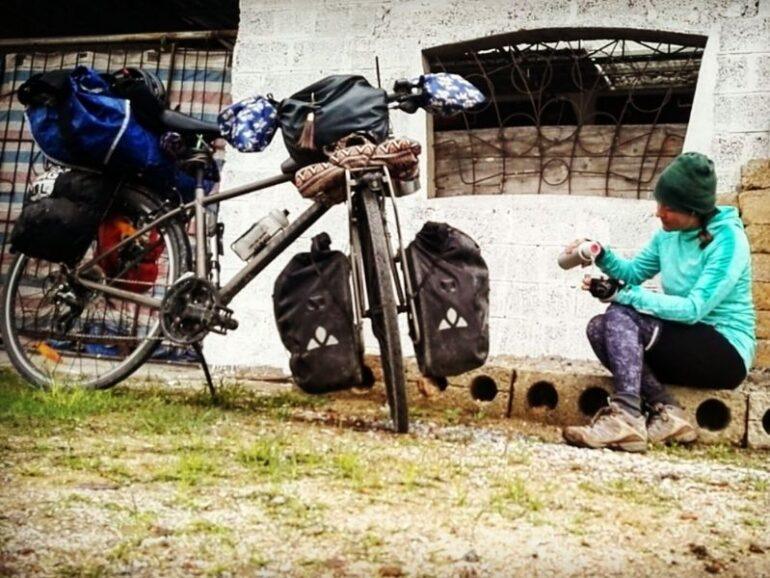
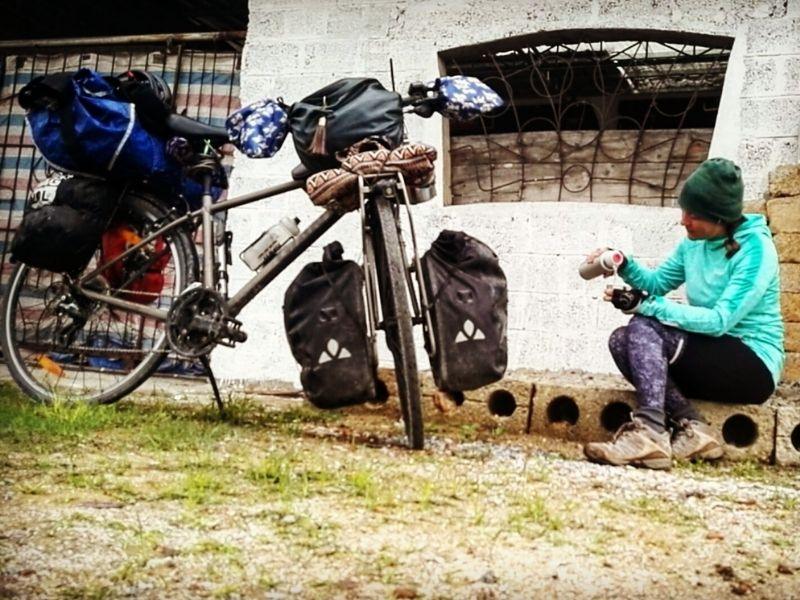
“You Travel Alone? By Bicycle?! Aren’t You Afraid?” Is solo bike travel safe for women? Valentina Brunet shares practical advice, personal stories, and confidence-building tips for cycling alone.
Statistically, the place where most accidents happen is the home. And you, aren’t you afraid of staying at home? According to the statistics, it’s the most dangerous place in the world, yet it is perceived as the safest.
I wasn’t born fearless. On the contrary, I think I came into this world equipped with all sorts of fears and managed to cultivate many more along the way. As a child, for example, I was terrified of needles. Every blood test, every injection was a nightmare that would, with very high probability, end with me fainting and waking up to a concerned nurse slapping my cheeks.
Disclosure: Some of our articles contain affiliate links. This comes at no additional cost for you and helps us keep this website up and running. (as Amazon Associates we earn commission from qualifying purchases)
I wasn’t happy about finding myself in such embarrassing situations.
At the age of twelve, I wasn’t yet aware that fears needed to be confronted, but I did it anyway. I took a safety pin, some ice, a mirror, and an earring, then began drilling through my own ear. About forty-five minutes later, the needle emerged on the other side. I hadn’t fainted: success! I put in the earring and spent a few days with a swollen, painful ear.
That earring is still there, reminding me that fears must be faced—something I fully understood much later.
The moral of the story? I do not recommend piercing your ears at home with a safety pin, but I do recommend facing your fears.
I didn’t force things. I moved forward in small steps, not even knowing exactly where I was headed. But the further I went, the more fascinated I became. I had very little camping experience before embarking on this journey.
The years I spent in New Zealand and Australia gently introduced me to this lifestyle. It remained difficult to grasp for someone like me who, not long before, wouldn’t even take out the trash without spending at least half an hour putting on makeup.
Perhaps it’s a stretch to call it camping when you’re traveling in a comfortable van that only requires parking before climbing into a real bed with a proper mattress. Still, it was excellent training for overcoming the fear of sleeping alone in remote places—places that by day looked like scenes from a fairy tale and by night transformed in my imagination into settings from the most terrifying horror movies.
I still remember those moments when my heart would race wildly over what was probably nothing more than a branch snapping in the wind.
Today I camp alone in a tent without much concern. I always hope not to receive visitors, but unfortunately, every now and then, it happens…
What Should You Do If You Receive Unwanted Visitors?
One night, I was camping at a free campsite with facilities and even a caretaker. I was trying to fall asleep when, around 11 p.m., someone shone a flashlight directly into my face through the tent’s mosquito net.
“Can I sleep with you?”
I rolled my eyes, annoyed and a little frightened (without letting it show), and replied that I would call the police if he didn’t leave immediately.
He left without insisting too much.
Similar episodes have happened several times despite the experience I’ve gained in choosing good camping spots.
Threatening to call the police has almost always worked as an effective deterrent.
It’s important not to lose confidence in your ability to peacefully get rid of the intruder.
If you have phone reception, starting a live Instagram broadcast can also scare off a harasser. Take a photo of them, and photograph or write down their vehicle’s license plate number.
How Can You Prevent Unpleasant Situations?
Dress respectfully and appropriately for the country you are visiting. Avoid revealing too much with tight-fitting clothes or outfits that leave little to the imagination. Adopt a conservative attitude.
For me, this meant stopping myself from smiling at men.
Unfortunately, it can be difficult to distinguish between harmless friendliness and unwanted attention. Intuition is not always right.
In some countries, it is culturally uncommon for men and women to engage in casual conversation, and even a simple smile or willingness to chat can be misunderstood.
There’s no point pretending otherwise: sometimes it is necessary to behave in ways that are not natural to us, even at the risk of appearing unfriendly, to avoid receiving inappropriate proposals.
Sometimes those proposals arrived before any attempt at conversation.
Ignore the local rooster showing off and continue on your way.
Another tactic I’ve used to prevent harassment is wearing a ring on my left ring finger, resembling a wedding band, and inventing a husband—and perhaps even children.
To support the story, it helps to have a few photos of yourself with your “husband,” a nephew, a friend’s children, and perhaps a grandmother.
Unfortunately, in some countries, a single woman is not viewed favorably, while a woman with a husband and children—even imaginary ones—may be treated with more respect.
Recently, while chatting with my dear friend Darinka Montico, we came up with another idea: sending our GPS location whenever we have to spend the night somewhere that raises our suspicions.
Whether we’re staying with a somewhat unusual host, camping in an isolated area that doesn’t exactly resemble the idyllic image of perfect camping, or simply feeling less than safe.
If the friend, partner, or whoever receives the message doesn’t hear from us, at least they will know the last place where we were connected.
It’s probably better to notify a trusted friend—especially a fellow traveler—than your mother or a close relative, who might alert mountain rescue, highway patrol, firefighters, and divers within hours while you’re peacefully sleeping.
There are certainly more advanced solutions, such as GPS tracking devices, but this approach is accessible to almost anyone, provided there is phone reception.
With a little creativity and diplomacy, most situations can be managed.
You can claim to be followed by a television crew, as Darinka suggests. Or, if a suspicious person rides alongside you while you’re cycling, you can simply say: “GPS police.”
That phrase is surprisingly universal. Most people won’t want to risk being tracked down.
The growing number of surveillance cameras and speed-monitoring devices along roads are technologies that, in many ways, work in our favor.
Ready to Leave?
Arm yourself with pepper spray (be careful—it’s illegal in some countries!), anti-spiking drink covers, or even a bow and arrows if they make you feel safer.
Research the places you plan to visit, and then go.
The anxiety before departure will melt away after the first few hours on the road, making room for the constant discovery of new roads, new places, and perhaps entirely new cultures.
Go—but do it gradually.
I would never encourage someone to get up from their office chair and attempt to climb the Himalayas without first having walked up the small hill behind their house for a picnic.
The best training for adventure is adventure itself.
“The only limits are in our minds.”
— Valentina Brunet
If anyone still has doubts or needs suggestions or clarification, I hope they won’t hesitate to contact me through:
Instagram: @valentinaonwheels
Facebook: Valentina Brunet
In this article, I am not claiming that the whole world is perfectly safe and that nothing bad can happen if you hop on a bicycle and start pedaling.
The dangers exist, and they are real.
Unfortunately, as some personal experiences have taught me, our efforts are not always enough, and sometimes we find ourselves facing situations over which we have no control.
In those cases, dwelling on it doesn’t help—talking about it can.
For me, the best therapy has been to keep cycling.
I simply wanted to share a few suggestions that might help prevent problems.
After all, any kind of accident could potentially happen at any moment in our lives.
Should we therefore live in constant fear?
I believe that a positive attitude helps us make the most of life.
We don’t have unlimited time, so we might as well enjoy it fully, doing what we truly love.
Who Am I?
My name is Valentina. I’m 33 years old and come from the lush Primiero Valley in the Dolomites.
I’ve been traveling since 2013, mostly solo. I’ve lived and worked in New Zealand and Australia, doing all sorts of jobs—from mango picker to disability support worker, from cleaner to tour guide leading swimming excursions with whale sharks.
For nearly two years, I have chosen the bicycle as my primary means of transportation, and it has been a wonderful evolution, bringing a new challenge, a new adventure, and immense satisfaction every day.
I set off from Vietnam and cycled through China, Hong Kong, Mongolia, Russia, Kazakhstan, Kyrgyzstan, Tajikistan, Uzbekistan, Turkmenistan, Iran, the United Arab Emirates, Oman, Armenia, Georgia, Bulgaria, Romania, Serbia, Croatia, Slovenia, before concluding with a long journey through our beautiful Italian peninsula.